Tissue and stem cell 1
Human Anatomy Overview
Cell Count and Types:
Approximately 30 trillion cells.
Around 250 differentiated cell types identified through histology.
Basic Tissue Types:
Four main types: Connective tissue, Epithelial tissue, Muscle tissue, Nervous tissue.
Definition of tissues = a group of cells that work together to carry out a specific function, typically organized from a specific stem cell type.
Many tissues types working together to carry out specific functions = organ. There are around 80 organs in 9 organ systems, each with specialized functions.
Diversity of Cell Types
Example Cell Types Identified:
Goblet cells, fibroblasts, enterocytes, pancreatic cells (exocrine & ductal), ß-cells, keratinocytes, neurons, and muscle cells (both cardiac and skeletal).
Advanced techniques like Single-Cell RNA-Seq are ongoing to identify additional cell types based on molecular signatures.
Major Tissue types
Types of Connective Tissue
Loose Connective Tissue: Fibroblasts in loose fibers (collagen, elastin, reticulin). It connects organs and tissues and supports epithelia.
Dense Connective Tissue: Rope-like structures like tendons and ligaments formed by fibroblast embedded in dense collagen fibers.
Cartilage: Composed of chondrocytes embedded in matrix (collagen, elastin, proteoglycans); provides structural support and friction protection.
Bone: Bone cells in dense, mineralized matrix (collagen). Initially formed as cartilage and replaced by bone via ossification.
Adipose Tissue: Contains adipocytes specialized for fat storage.
Blood: Considered a separate tissue; it includes various cell types (RBCs, granulocytes, monocytes, platelets and lymphocytes) suspended in plasma.
Epithelial Tissue
Characteristics
Sheets of cells covering surfaces or lining tubes with clear polarity (apical vs. basal surfaces).
Contain tight junctions for selective permeability, adherens junctions (composed of cadherins and linked to actin filament via catenins) for support, desmosomes (strong cell-cell adhesion junctions linked to intermediate filaments) and hemidesmosomes (which anchor the epithelial cells to the basement membrane).
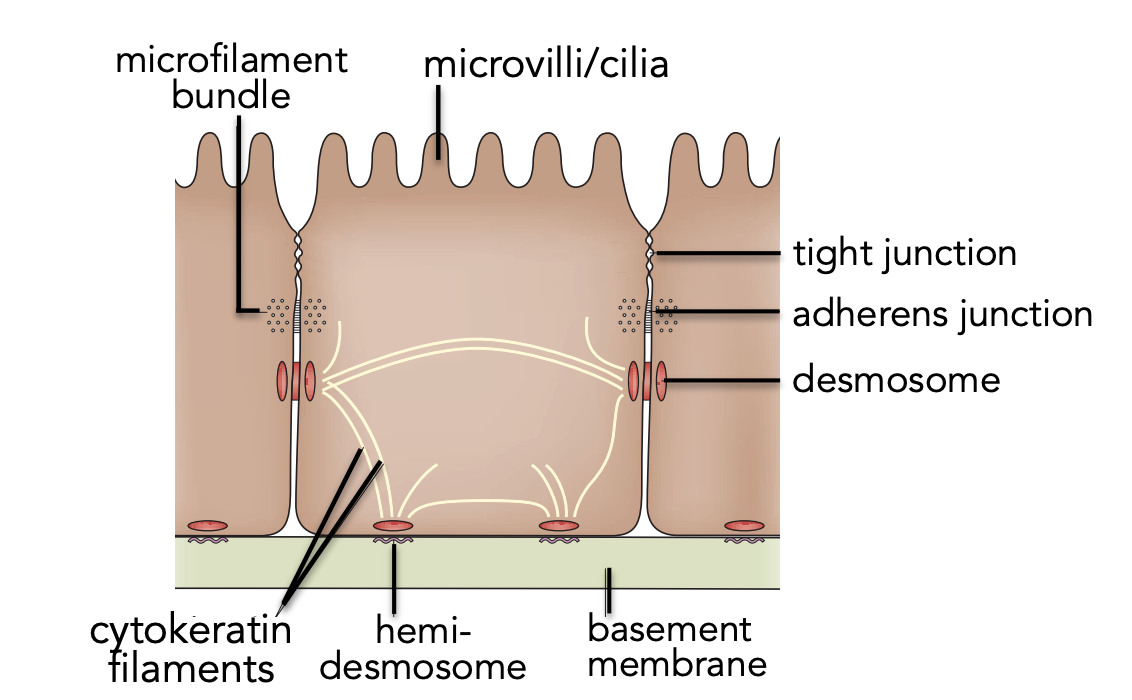
Functions: Protection, absorption (e.g., in the gut and often apical surface have specialized structure).
Types of epithelial cells classified based on shape (simple = single layer of cells):
Simple Squamous: Thin and flat cells.
Simple Cuboidal: Cube-shaped cells.
Simple Columnar: Tall, column-like cells.
Stratified: Multiple layers of cells (squamous, cuboidal, columnar).
Pseudostratified: Appears layered but is a single layer with cells of varying heights.
Types of Muscle Tissues
Skeletal Muscle: Multinucleate myofibres, appear striated because sarcromere pattern; responsible for voluntary movement.
Cardiac Muscle: Striated like skeletal; involuntary; mono or binucleate; individual cells joined with intercalated disc; contraction of the heart through gap junctions created by intercalated discs which allows fast electrical signal transmission.
Smooth Muscle: Non-striated; composed of spindle-shaped cells; mononuclear; found in hollow organs.
Neural Tissues
Composed of neurons and glia (supporting cells).
Neurons: Consist of cell body, axons, and dendrites.
Nerve = bundles of axons
Glia: Various types, in CNS has 4 types: astrocytes (support and nutrients), oligodendrocytes (myelination), and microglia (immune responses) and ependymal cells (maintain homeostasis). In PNS, there are 2 types: Schwann cells and satellite cells.
Neuronal aggregations form nerves, and neuronal cell bodies aggregate in ganglia.
Cell Turnover and Lifespan
Intestinal cells have a rapid turnover cycle: They die and replace every 6-7 days from the proliferating stem cell population in intestinal crypts.
Stem Cells
Are undifferentiated cells that retain the capacity for continuous division and plasticity.
The function of stem cells is tissue maintenance through proliferation.
Stem cell characteristics:
Undifferentiated
Unlimited proliferation
Self-renewal mechanism to produce more stem cells
Differentiation to transit amplifying cells (progenitor cells)
Self-Renewal Mechanisms:
Asymmetric Division: Produces one stem cell and one transit amplifying cell.
Symmetric Division: May produce two identical daughter cells.
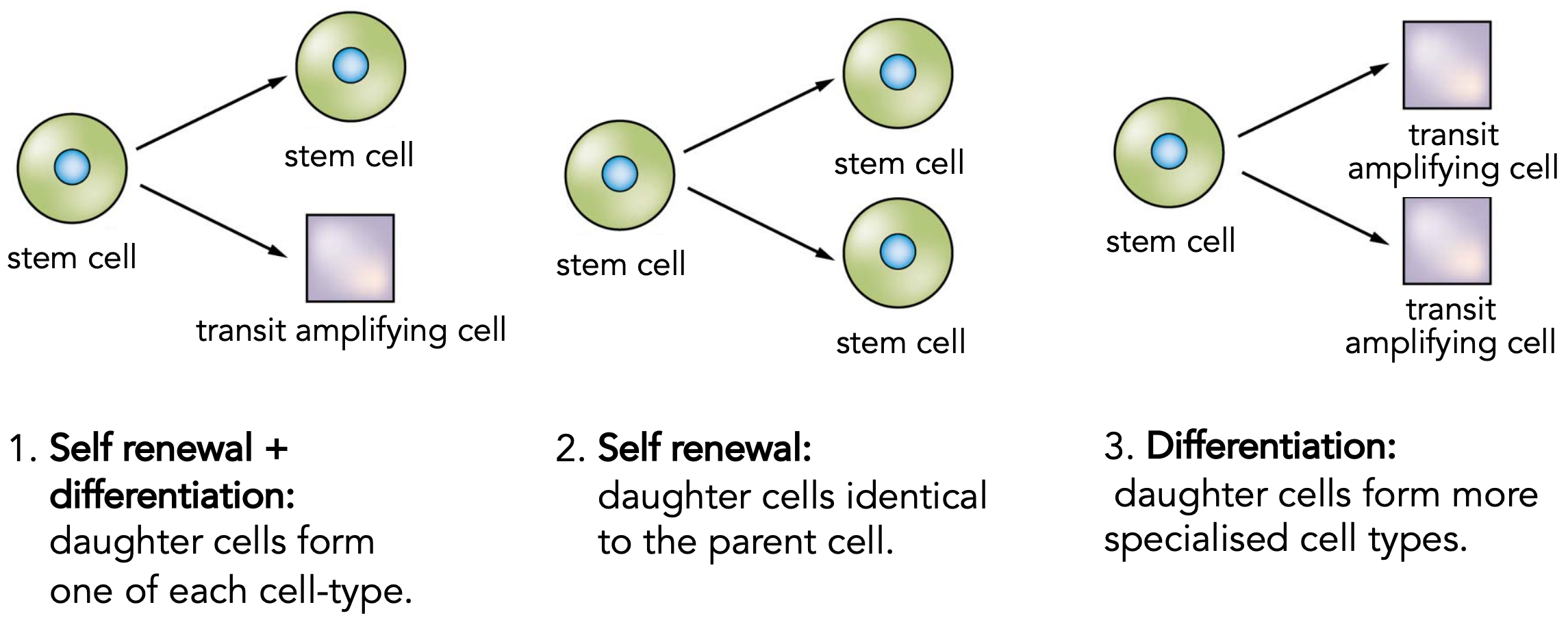
Niche Dependency: Stem cells typically reside in specific niches that maintain their stem cell behavior through signaling from surrounding cells.
For example, in Drosophila ovary, stem cells are exposed to Dpp, a BMP-like protein that keeps cells in mitosis. As Dpp is secreted by somatic cap cells, stem cells need to be surrounded by these cells, otherwise they begin differentiating.