Biopsychology
the divisions of the nervous system
The nervous system is divided into 2 systems:
-The Central Nervous System CNS- consists of the brain and spinal chord. It is also the origin of all complex commands and decisions
the spinal chord carries out the transferral of messages to and from the brain to the PNS. it is also involves reflex actions.
-The Peripheral Nervous system (PNS)- sends information from receptor cells in the sense organs to the CNS. It also receives information from the CNS.
the peripheral nervous system is split into 2 divisions:
-somatic nervous system (SNS)- transmits information to and from senses. it also directs muscles to react and move
-autonomic nervous system- transmits information to and from internal organs. Is further divided into 2 systems:
Sympathetic- enables fight or flight
-dilates pupils
-inhibits salivation
-relaxes airways
-increases heartbeat
-inhibits digestion
-stimulates release of glucose
-relaxes bladder
Parasympathetic- resting state
-contracts pupils
-stimulates saliva
-constricts airways
-slow heartbeat
-stimulates digestion
-inhibits release of glucose
-contracts bladder
the structure and function of sensory, relay and motor neurons.
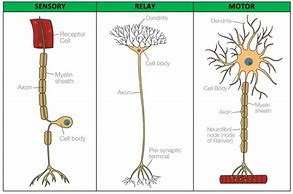
-Sensory neurons: sensory receptors for vision, taste and touch transmit nerve impulses to the spinal cord and brain. They are located in the eyes, ears, tongue and skin. convert information into neural impulses which are translated to sensations once they reach the brain; this allows reflex actions to occur quickly.
-relay neurons: located within the brain and spinal cord and allows motor neurons and sensory neurons to communicate bridging sensory input and motor output.
-motor neurons: located in the CNS and project their axons by forming synapses with muscles to control muscle contractions. they release neurotransmitters when stimulated which bind to muscle receptors and triggers movements.
what different structures are responsible for:
Cell body: includes a nucleus with genetic material of the cell
Dendrites: carry nerve impulses from neighbouring neurones to the cell body
Axon: carry impulses away from the cell body
Myelin sheath: protects the axon
nodes of Ranvier: gaps in the myelin sheath to speed up the transmission of impulses
terminal buttons: communicates with the next neurone across the synapse
Synaptic transmission- The process by which neighbouring neurons communicate with each other by sending chemical messages across the synaptic cleft (gap) that separates them.
Neurotransmitters- are brain chemicals released from synaptic vesicles that relay signals across the synapse from one neuron to another.
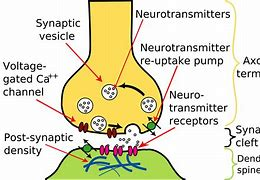
How synaptic transmission works:
The electrical nerve impulse travels down the neuron and prompts release of the neurotransmitters at the pre-synaptic terminal
These chemicals are then released into the synaptic fluid in the synapse
The adjacent neuron then takes up the neurotransmitters from the fluid and converts them into an electrical impulse to travel down the neuron to the next pre-synaptic terminal
Therefore the impulse continues to be transmitted. This is at high speeds ; for example, processing visual information it is encoded the first 50-100 miliseconds of activity.
Excitation- increases positive charge and the likelihood that the neuron will fire (e.g. adrenaline)
Inhibition- increases negative charge and decreases the likelihood that the neuron will fire (e.g. serotonin)
Depression | Anxiety | Schizophrenia | |
Cause | Low levels of serotonin being received by the post synaptic transmission. | High levels of serotonin being received by the post synaptic neuron | High levels of dopamine being received by the post synaptic neuron |
Treatment | Antidepressants block reuptake of serotonin to the pre-synaptic neuron therefore allowing it more chance to bind to the post synaptic receptors | Anti-anxiety drugs, help decrease levels of seratonin | Anti-psychotics help decrease dopamine levels being received. |
Agonist- increase the production/ stimulate the action of neurotransmitters (Anti-depressants)
Antagonist- decrease the production/ blocks the action of neurotransmitters (Anti-psychotics, Anti-Anxiety)
the influence of neurochemistry on behaviour: The function of the endocrine system
The function of the endocrine system focuses on glands and the hormones they secrete.
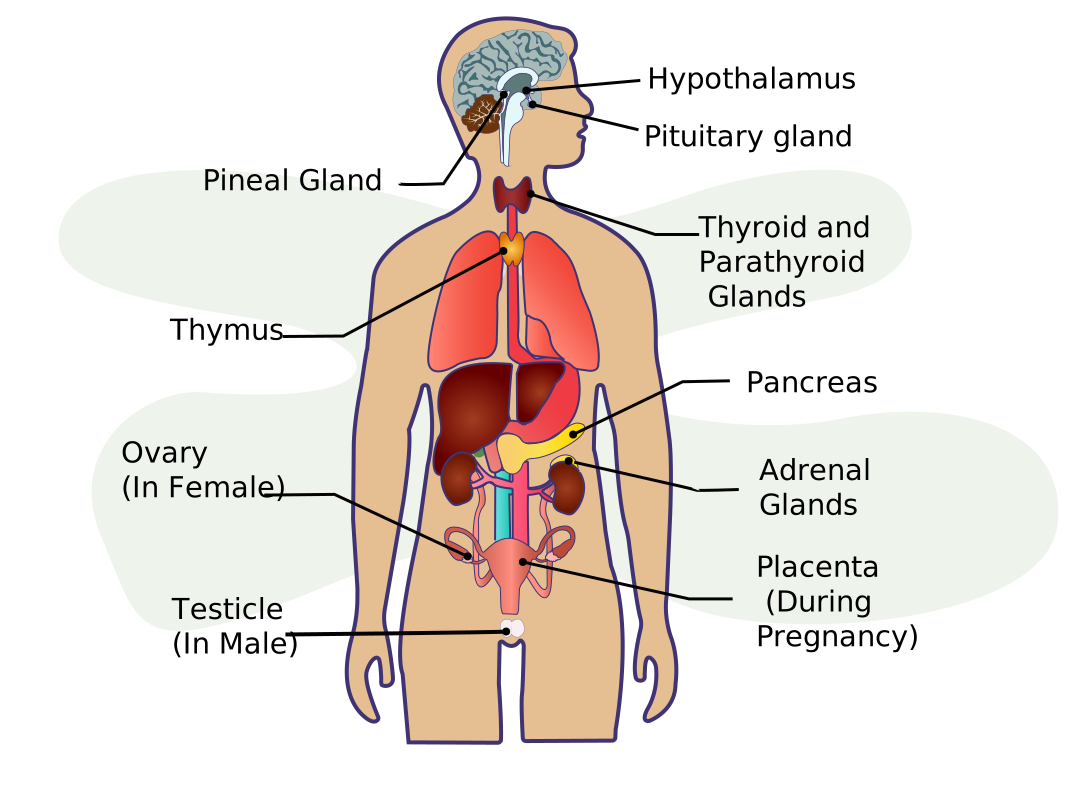
Glands and their functions:
-Pituitary gland (master gland): regulates the endocrine system by communicating with the glands of the body to release hormones.
-adrenal gland: an important part of the ‘fight or flight’ response as it facilitates the release of adrenaline.
-Testes: they facilitate the release of testosterone to aid reproduction in males
-Ovaries: they facilitate the release of oestrogen and progesterone to regulate the menstrual cycle and aid reproduction in females.
The fight-or-Flight response: The role of adrenaline
Stress: a physiological and psychological response to threatening environmental stimuli. There can be 2 types of stress:
Acute stress- caused by short term immediate stressors; these present themselves all at once in the face of perceived threats to wellbeing.
Chronic stress- caused by long-term, on-going, persistent stressors where individuals perceive them as being out of control. They could eventually weaken your immune system.
The hypothalamus is a brain structure that controls your body’s balance and stability.
The bodies response to acute stress. (sympathoadrenal medullary pathway, SAM)
situation is perceived as stressful
Hypothalamus is alerted. This recognises the stress as acute
The SAM pathway is activated
this stimulates the adrenal medulla
the adrenal medulla secretes adrenaline and noradrenaline
this prepares the body for fight or flight.
Localisation of brain function
Contralateral= one side of the brain controls the other side of your body.
Hemispheric lateralisation= When a function is dealt with by one hemisphere alone.
The human brain has two hemispheres which are bridged by the corpus callosum. The bridge (which is a bundle of fibers) acts as a communication pathway so the hemispheres can exchange information.
Galls theory: The early 19th century witnessed a growth of interest in the localisation of functions in the brain (mapping the brain) Galls theory of phrenology was undoubtedly influential but was quickly discredited.
Flourens work using animals: using animals (mid 19th century) Flourens was able to demonstrate that the main divisions of the brain were responsible for different functions more scientifically than Gall, but he wasn’t able to test humans and therefore his work was limited.
Phrenology- the study of the structure of the skull to determine a persons character and capacity.
case study: Phineas Gage:
Gage suffered from frontal lobe brain damage and became: highly agitated, more aggressive, and impatient.
it is common for people with frontal lobe brain damage to be inhibited
what happened?
an iron rod went through his brain and left damage to the left frontal lobe
he lost 4% of his grey matter and 11% of his white matter.
his injury caused his personality to change
he could still speak and was conscious, he did however loose sight in his left eye
this case study supports localisation and holism.
white matter- made up of a large network of nerve fibers (axons) in your brain that allows the exchange of information and communication between different areas of your brain.
grey matter- essential tissue in your brain and spinal cord that allows you to interact with the world around you
Left Hemisphere:
language- for most people language processing is done in the left hemisphere. If you have a stroke on the left side of the brain, language is affected. This area is associated with the Brocas area (speech production) and Wernicke's area (language comprehension)
Right hemisphere:
recognising- (Narumoto et al 2001)- research has found that if you show someone a face where the left side is smiling and the right side is neutral people will see the face expression dominant on the left. The right hemisphere is responsible for your left visual field
spatial relationships- (clarke et all 1993)- women with right hemisphere damage, who get lost frequently highlighted its function with spatial relations. The right hemisphere deals with spacial information.
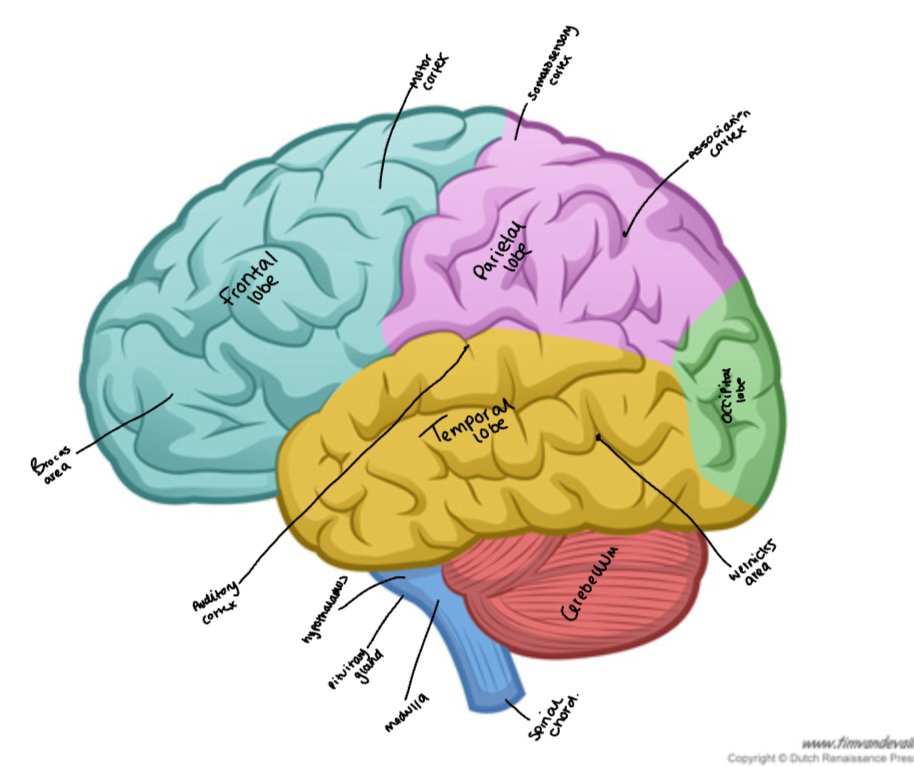
holistic theory- all parts of the brain involved in the processing of thought and action
localisation theory- different parts of the brain preform different tasks and are invlolved with different parts of the body.
Motor centres
responsible for the generation of complex voluntary motor movements (rather than basic actions such as coughing and crying)
located in the frontal lobe
sends messages to muscles via the brain stem and spinal chord.
contralateral
some other areas associated with movement are:
spinal chord and brain: coordinates movement
premotor cortex: plans a movement prior to executing it
prefrontal cortex: stores sensory information prior to movement