CHAPTER 1: SOME BASIC CONCEPTS OF CHEMISTRY
NATURE OF MATTER:-
Matter is defined as anything which occupies space and has mass.
Matter can be classified into:-
Physical - In physical classification matter is classified as solid, liquid & gas. They can be interconverted by temp or pressure.
Chemical - In chemical classification matter is classified as substances and mixtures. A sample containing one substance is called pure substance and samples containing more than one substance is known as mixtures.
MATTER
MIXTURES PURE SUBSTANCES
- HOMOGENEOUS MIXTURES - ELEMENTS
- HETROGENEOUS MIXTURES - COMPOUNDS
PROPERTIES OF MATTER:-
Physical properties can be measured or observed without changing the identity or the composition of the substances.
For Ex: density, volume, melting point & boiling point.
The measurement or observation of chemical properties requires a chemical change to occur.
For Ex: flammability & etc.
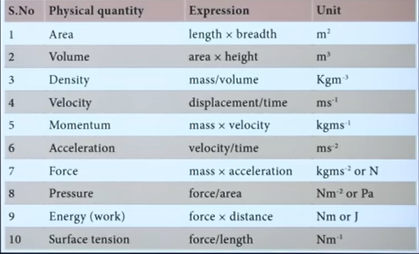
FUNDEMENTAL & DERIVED UNITS:-
UNCERTAINITY IN MEASUREMENT:-
Accuracy: Accuracy describes the closeness of a single measurement to its true value.
Precision: Precision describes how closely the different measurement of a given quantity agree with one another.
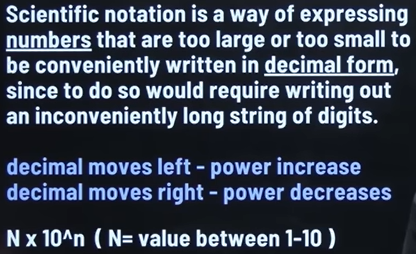
SCIENTIFIC NOTATIONS:-
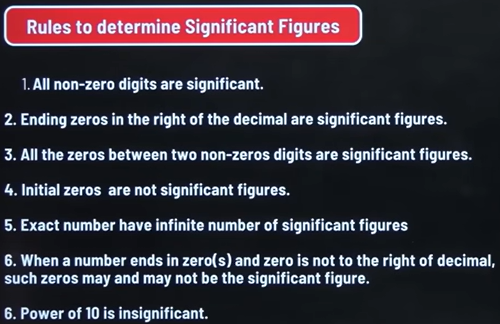
SIGNIFICANT FIGURES:-
Definition: The significant figure in a numbers is the sum of certain digits and one uncertain (doubtful) digit.
ROUNDING OFF THE UNCERTAIN DIGITS:-
If the most right is > 5 , the preceding number is increased by one.
If the most right digit is < 5, the preceding number is retained.
If the most right digit is 5, then the preceding number is not changed it is an even number but it is increased by one of it is an odd number.
LIMITATIONS OF DALTON’S ATOMIC THEORY:-
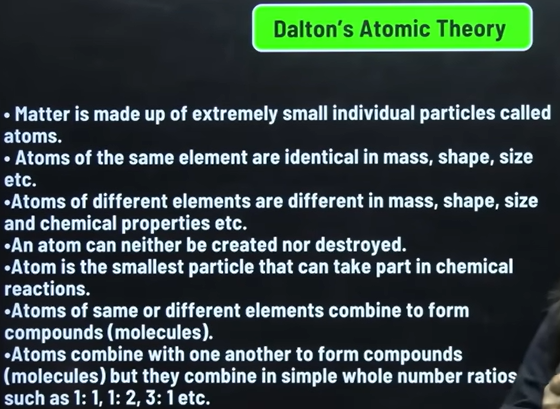
It could not explain why do atoms of different elements differ in their mass size and valence.
Discovery of isotopes.
Discovery of nuclear reaction that show that mass can be converted into energy and vise versa.
An atom is divisible.
It could not explain why atoms combine to form compounds.
By nuclear reaction, atoms of one element can be converted in to atoms of other element. It is called transmutation.
Atoms of different element may have same mass such elements are called isobar.
ATOMIC AND MOLECULAR MASS:-
Atomic Mass: It is the total mass of an atom, which is the sum of the masses of its proton & neutrons.
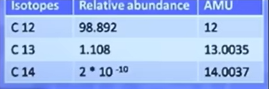
Avg Atomic Mass: The average atomic mass of an element is the sum of the masses of its isotopes, each multiplied by its natural abundance.
Molecular Mass: The sum of the atomic masses of all the atoms in a molecule of a substance is the molecular mass.
Formula Mass: The formula mass of a substance is defined as the sum of the atomic masses of constituent atoms in an ionic compound. This is generally used for ionic compounds which do not contain discrete molecules, but ions as the constituent units.
MOLE CONCEPT:-
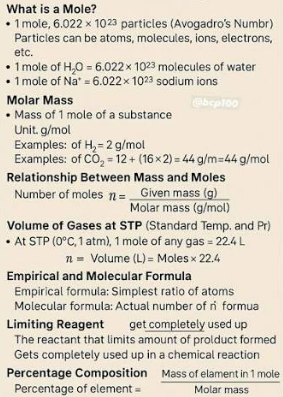
IMPORTANCE OF AVOGADRO’S NUMBER AND MOLE CONCEPT:-
Mass of single atom or molecule can be calculated.
Volume of single atom or molecule can be calculated.
Number of total atoms present in a given mass of the element can be calculated.
Numbers of total molecules present in a given mass of a compound can be calculated.
Number of total molecules present in a given volume of a gas under given condition can be calculated.
Sometimes it is easy to represent the data in terms of moles.
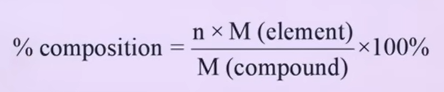
PERCENTAGE COMPOSITION:-
Percentage composition is the percentage of each element in a compound by mass.
EMPERICAL FORMULA:-
Emperical formula: Is the formula of a compound which shows the - simplest whole number ratio between the atoms of the elements in the compound.
MOLECULAR FORMULA:-
Is the chemical formula which represents - the actual number of atoms of each element present in a molecule of the compound.
STOICHIOMETRY:-
Stoichiometry deals with the calculation of masses and sometimes also the volumes of the reactants and the products involved in a chemical reaction.
We can also say that it is nothing but basically the relationship between amounts of reactants and the products in a chemical reaction.
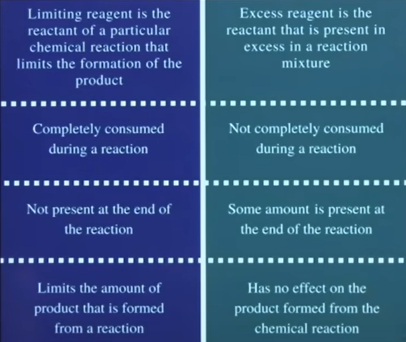
LIMITING REAGENT:-
Limiting reagent is the substance that is totally consumed when the chemical reaction is complete.
The amount of product formed is limited by the limiting reagent, so the reaction cannot continue without it.
DIFFERENCE BETWEEN EXCESS REAGENT & LIMITING REAGENT:-