Social Studies stuff
1. The Louisiana Territory
The nation's first opportunity for expansion during the early 1800s involved the vast territory to the west of the Mississippi River, then known as Louisiana. The United States wanted possession of the port city of New Orleans, near the mouth of the Mississippi River. By 1800, thousands of farmers were settling land to the west of the Appalachian Mountains. To get their crops to market, they floated them down the Mississippi to New Orleans, and from there, the crops were shipped to Europe or to cities on the East Coast.
The farmers depended on being able to move their crops freely along the Mississippi. “The Mississippi,” wrote James Madison, “is to them everything. It is the Hudson, the Delaware, the Potomac, and all the navigable rivers of the Atlantic States formed into one stream.”
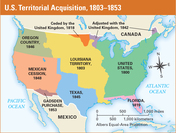
Louisiana Across the Mississippi River lay the unexplored territory of Louisiana. This immense region stretched from Canada in the north to Texas in the south, and from the Mississippi, it reached west all the way to the Rocky Mountains. First claimed by France, it was given to Spain after the French and Indian War, but in 1800, the French ruler Napoleon Bonaparte convinced Spain to return Louisiana to France.
Napoleon had plans for Louisiana and hoped to settle the territory with thousands of French farmers, who would then raise food for the enslaved people who worked on France's sugar plantations in the Caribbean. However, Napoleon's plans alarmed frontier farmers. New Orleans was part of Louisiana, and if Napoleon closed the port to American goods, farmers would have no way to get their crops to market.
“A Noble Bargain” President Thomas Jefferson understood the concerns of American farmers. In 1803, he sent James Monroe to France with an offer to buy New Orleans for $7.5 million, but by the time Monroe reached France, Napoleon had changed his plans.
A few years earlier, an enslaved person named Toussaint L'Ouverture (too-SAN loo-ver-TEER) had led a revolt of other enslaved people in the French Caribbean colony known today as Haiti. The formerly enslaved people defeated the French troops who tried to take back the colony, and as a result, Napoleon no longer needed Louisiana.
In addition, France and the United Kingdom were on the brink of war. Napoleon knew that he might lose Louisiana to the United Kingdom, so rather than lose Louisiana, it made sense to sell it to the United States.
Napoleon's offer to sell all of Louisiana stunned James Monroe. Instead of a city, suddenly the United States had the opportunity to buy an area as big as itself.
It did not take long for Monroe to agree, and on April 30, 1803, he signed a treaty giving Louisiana to the United States in exchange for $15 million. Said the French foreign minister, “You have made a noble bargain for yourselves, and I suppose you will make the most of it.”
The Purchase Debate To most Americans, the Louisiana Purchase looked like the greatest land deal in history. The new territory would double the country's size at a bargain price of just 2 to 3 cents an acre.
Still, not everyone approved. Some people worried that such a large country would be impossible to govern. Politicians in the East fretted that they would lose power and warned that, sooner or later, Louisiana would be carved into enough new states to outvote the eastern states in Congress. Others objected to the $15 million price tag, with one Boston critic writing, “We are to give money of which we have too little for land of which we already have too much.”
Opponents also accused Jefferson of “tearing the Constitution to tatters.” They said that the Constitution made no provision for purchasing foreign territory. Jefferson was troubled by the argument that the Louisiana Purchase was unconstitutional, but he still believed it was better to stretch the limits of the Constitution than to lose a historic opportunity.
Late in 1803, the Senate voted to ratify the Louisiana Purchase treaty. Frontier farmers welcomed the news. “You have secured to us the free navigation of the Mississippi,” a grateful westerner wrote Jefferson. “You have procured an immense and fertile country: and all these great blessings are obtained with-out war and bloodshed.” In 1804, Meriwether Lewis and William Clark led an expedition to explore the newly acquired territory.
2. Florida
Having acquired Louisiana through diplomacy, President Jefferson turned next to Florida. Spain had colonized Florida in the late 1500s. By the 1800s, Florida had a diverse population of Seminole Indians, Spanish colonists, English traders, and fugitives from slavery. In 1804, Jefferson sent two diplomats to Spain to buy Florida, but Spain's answer was “no deal.”
Many white Americans in the Southeast wanted the United States to take over Florida. Enslavers in Georgia were angry because enslaved people sometimes ran away to Florida, where some of them were welcomed by Seminole Indians. In addition, white landowners in Georgia were upset by Seminole raids on their lands. As Spain's control of Florida weakened over the next few years, its government could do nothing to stop the raids on farms in Georgia by Seminoles and formerly enslaved people.
Andrew Jackson Invades Florida In 1818, President James Monroe sent Andrew Jackson—the hero of the Battle of New Orleans—to Georgia with orders to end the raids. Jackson was told that he could chase raiding Seminoles into Florida, but he did not have the authority to invade the Spanish colony.
Despite his orders, Jackson marched into Florida with a force of 1,700 troops. Over the next few weeks, he captured Spanish military posts and arrested, tried, and executed two British subjects for stirring up Indian attacks. He also replaced the Spanish governor with an American. Spain demanded that Jackson be called back to Washington and punished for his illegal invasion.
“Govern or Get Out” Fearing war, President Monroe asked his cabinet for advice. All but one of his cabinet members advised him to remove Jackson and apologize to Spain. The exception was Secretary of State John Quincy Adams, who convinced Monroe to send a blunt message to Spain: govern Florida properly or get out.
Equally fearful of war, Spain decided to get out. In 1819, the Spanish government agreed to yield Florida to the United States. In exchange, the United States agreed to pay off $5 million in settlers' claims against Spain and to honor Spain's longtime claim to Texas.
Not all Americans were happy about leaving Spain in charge of Texas, with one newspaper declaring Texas was “worth ten Floridas.” Even so, the Senate ratified the Florida treaty two days after it was signed.
3. Texas
There was a reason many Americans felt that Texas was so valuable. Much of this region was well suited for growing cotton, the South's most valuable cash crop. Additionally, many southerners hoped that one day Texas would become part of the United States.
Americans Come to Texas The story of Texas begins with Moses Austin, a banker and business owner who dreamed of starting a U.S. colony in Spanish Texas. In 1821, Spanish officials granted Austin a huge piece of land. After Moses Austin died that same year, his son Stephen took over his father's dream.
Stephen F. Austin arrived in Texas just as Mexico declared its independence from Spain and took control of Texas. Mexican officials agreed to let Austin start his colony under certain conditions, including that he select only moral and hardworking settlers. The settlers had to promise to become Mexican citizens and to join the Catholic Church.
Austin agreed to Mexico's terms. By 1827, he had attracted 297 families—soon known as the “Old Three Hundred”—to Texas.
Rising Tensions The success of Austin's colony started a rush of settlers to Texas. By 1830, there were about 25,000 Americans in Texas, compared to 4,000 Tejanos (tay-HA-nos), or Texans of Mexican descent, but tensions between the two groups soon arose.
The Americans had several complaints. They were used to governing themselves, and they resented taking orders from Mexican officials. They were unhappy that all official documents had to be in Spanish, a language most of them were unwilling to learn. In addition, many were enslavers who were upset when Mexico outlawed slavery in 1829.
The Tejanos had their own complaints. They were unhappy that many American settlers had come to Texas without Mexico's permission. Worse, most of these new immigrants showed little respect for Mexican culture and had no intention of becoming citizens. The Mexican government responded by closing Texas to further U.S. immigration and by sending troops to Texas to enforce the immigration laws.
The Texans Rebel Americans in Texas resented these actions. A group led by a lawyer named William Travis began calling for revolution. Another group led by Stephen F. Austin asked the Mexican government to reopen Texas to immigration and to make it a separate Mexican state so that Texans could run their own affairs.
In 1833, Austin traveled to Mexico and presented the Texans' demands to the new head of the Mexican government, General Antonio López de Santa Anna. The general was a power-hungry dictator who once boasted, “If I were God, I would wish to be more.” Rather than bargain with Austin, Santa Anna had him arrested and jailed for promoting rebellion.
Soon after Austin was released in 1835, Texans rose up in revolt. Determined to crush the rebels, Santa Anna marched north with some 6,000 troops.
The Alamo In late February 1836, a large part of Santa Anna's army reached San Antonio, Texas. About 180 Texan volunteers, including eight Tejanos, defended the town. The Texans had taken over an old mission known as the Alamo. Among them was Davy Crockett, the famous frontiersman and former congressman from Tennessee. Sharing command with William Travis was James Bowie, a well-known Texas “freedom fighter.”
The Alamo's defenders watched as General Santa Anna raised a black flag that meant “expect no mercy.” When the general demanded that the Texans surrender, Travis answered with a cannon shot.
Slowly, Santa Anna's troops began to surround the Alamo. The Texans were vastly outnumbered, but only one man fled.
Meanwhile, Travis sent messengers to other towns in Texas to plead for reinforcements, and he vowed not to abandon the Alamo, proclaiming, “Victory or death!” However, reinforcements never came.
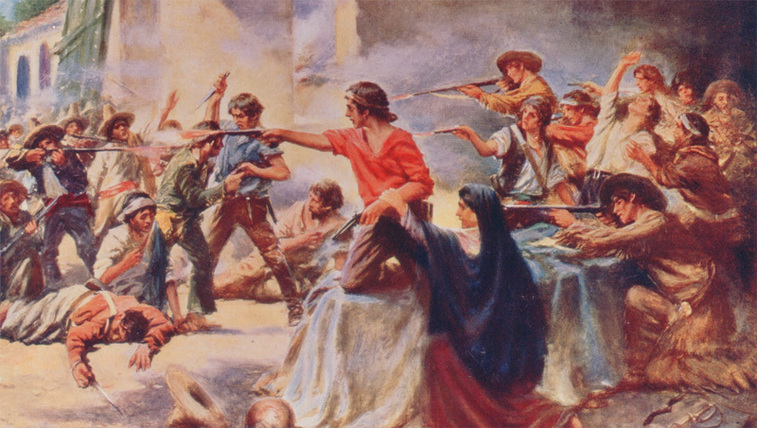
For 12 days, the Mexicans pounded the Alamo with cannonballs, until the first light of dawn on March 6, when Santa Anna ordered his troops to storm the fort. Desperately, the Texans tried to fight off the attackers with rifle fire.
For 90 minutes, the battle raged, and then it was all over. By day's end, every one of the Alamo's defenders was dead, and those who had survived the battle were executed on the spot by Santa Anna's order.
Santa Anna described the fight for the Alamo as “but a small affair.” However, his decision to kill every man at the Alamo filled Texans with rage.
Texas Wins Its Independence Sam Houston, the commander of the Texas revolutionary army, understood Texans' rage. However, as Santa Anna pushed on, Houston's only hope was to retreat eastward. By luring Santa Anna deeper into Texas, he hoped to make it more difficult for the general to supply his army and maintain its battle-readiness.
Although Houston's strategy was unpopular, it worked brilliantly. In April, Santa Anna caught up with Houston near the San Jacinto (san ha-SIN-to) River. Expecting the Texans to attack at dawn, the general kept his troops awake all night. When no attack came, the weary Mexicans relaxed, and Santa Anna went to his tent to take a nap.
Late that afternoon, Houston's troops staged a surprise attack. Yelling, “Remember the Alamo!” the Texans overran the Mexican camp, prompting Santa Anna to flee. However, he was captured the next day, and in exchange for his freedom, he ordered all his remaining troops out of Texas. The Texas War for Independence had been won, but Mexico did not fully accept the loss of its territory.
To Annex Texas or Not? Now independent, the Republic of Texas earned the nickname the Lone Star Republic because of the single star on its flag. But most Texans were Americans who wanted Texas to become part of the United States.
Despite their wishes, Texas remained independent for ten years, during which time people in the United States were divided over whether to annex Texas. Southerners were eager to add another state with slavery, whereas Northerners who opposed slavery wanted to keep Texas out. In addition, others feared that annexation would lead to war with Mexico.
The 1844 presidential campaign was influenced by the question of whether to expand U.S. territory. One candidate, Henry Clay, warned, “Annexation and war with Mexico are identical.” His opponent, James K. Polk, however, was a strong believer in manifest destiny and was eager to acquire Texas. After Polk was elected, Congress voted to annex Texas. In 1845, Texas was admitted as the 28th state.
4. Oregon Country
Far to the northwest of Texas lay Oregon Country, an enormous, tree-covered wilderness that stretched from the Rocky Mountains to the Pacific Ocean. To the north, Oregon was bounded by Alaska, which belonged to Russia, and to the south, it was bordered by Spanish California and New Mexico.
In 1819, Oregon was claimed by four nations: Russia, Spain, the United Kingdom, and the United States. Spain was the first to drop out of the scramble when it gave up its claim to Oregon as part of the treaty to purchase Florida. Several years later, Russia also dropped out. By 1825, Russia agreed to limit its claim to the territory that lay north of the 54°40´ parallel of latitude, the line that today marks the southern border of Alaska.
That left the United Kingdom and the United States. For the time being, the two nations agreed to a peaceful "joint occupation" of Oregon.
Discovering Oregon The United States' claim to Oregon was based on the Lewis and Clark expedition. Between 1804 and 1806, Meriwether Lewis and William Clark had led a small band of explorers to the Oregon coast.
Lewis thought that many more Americans would follow the path established by the expedition. "In the course of 10 or 12 Years," he predicted in 1806, "a tour across the Continent by this rout [route] will be undertaken with as little concern as a voyage across the Atlantic."
That was wishful thinking, as the route that Lewis and Clark had followed was far too rugged for ordinary travelers. There had to be a better way to cross the continent. In 1824, a young fur trapper named Jedediah Smith found that better way when he discovered a passage through the Rocky Mountains called South Pass.
Unlike the high, steep passes used by Lewis and Clark, South Pass was low and flat enough for wagons to use in crossing the Rockies. Now the way was open for settlers to seek their fortunes in Oregon.
Oregon Fever The first American settlers to travel through South Pass to Oregon were missionaries. These missionaries made few converts among Oregon's Indians, but their glowing reports of Oregon's fertile soil and towering forests soon attracted more settlers.
These early settlers wrote letters home describing Oregon as a "pioneer's paradise" and claiming that the weather was always sunny. Their letters also stated that disease was unknown, trees grew as thick as hairs on a dog's back, and farms were free for the taking. One man even joked that "pigs are running about under the great acorn trees, round and fat, and already cooked, with knives and forks sticking in them so you can cut off a slice whenever you are hungry."
Reports like these inspired other settlers who were looking for a new beginning. In 1843, about 1,000 pioneers headed for Oregon in covered wagons. The following year, nearly twice as many people made the long journey across the plains and mountains. "The Oregon Fever has broke out," reported one observer, "and is now raging."
All of Oregon or Half? Along with Texas, "Oregon fever" played a role in the 1844 presidential campaign. Polk won the election with such stirring slogans as "All of Oregon or none!" and "Fifty-four forty or fight!" Polk promised he would not rest until the United States had annexed all of Oregon Country.
However, Polk did not want Oregon enough to risk starting a war with the United Kingdom. Instead, he agreed to a compromise treaty that divided Oregon roughly in half at the 49th parallel, which now marks the western border between the United States and Canada.
The Senate debate over the Oregon treaty was fierce. Southern and eastern senators favored the treaty and saw no reason to go to war over "worse than useless territory on the coast of the Pacific." Western senators opposed the treaty and demanded all of Oregon. On June 18, 1846, the Senate ratified the compromise treaty.
Polk got neither "fifty-four forty" nor a fight. What he got was a diplomatic settlement that both the United States and the United Kingdom could accept without spilling a drop of blood.
5. The Mexican-American War
You might think that Texas and Oregon were sufficient new territory for any president, but not for Polk. This humorless, hardworking president had one great goal of expanding the United States as far as possible.
Polk's gaze fell next on the huge areas known as California and New Mexico. He was determined to have them both—by purchase if possible, by force if necessary.
These areas were first colonized by Spain but became Mexican territories when Mexico won its independence in 1821. Because both were thinly settled and long neglected by the Mexican government, Polk hoped that they might be for sale. He sent a representative to Mexico to try to buy the territories, but Mexican officials refused even to see Polk's representative.
War Breaks Out in Texas When Congress voted to annex Texas, relations between the United States and Mexico turned sour. Mexico considered the annexation of Texas an act of war, and to make matters worse, Texas and Mexico could not agree on a border. Texas claimed the Rio Grande as its border on the south and the west, whereas Mexico wanted the border to be the Nueces (new-AY-sis) River, about 150 miles northeast of the Rio Grande.
On April 25, 1846, Mexican soldiers fired on U.S. troops who were patrolling along the Rio Grande. Sixteen Americans were killed or wounded. This was just the excuse for war that Polk had been waiting for. Mexico, he charged, "has invaded our territory and shed American blood upon American soil." Two days after Polk's speech, Congress declared war on Mexico, starting the Mexican-American War.
The Fall of New Mexico and California A few months later, General Stephen Kearny led the Army of the West out of Kansas with orders to occupy New Mexico and then continue west to California. Mexican opposition melted away in front of Kearny's army, and the Americans took control of New Mexico without firing a shot. "Gen'l Kearny," a pleased Polk wrote in his diary, "has thus far performed his duty well."
Meanwhile, a group of Americans launched a rebellion against Mexican rule in California. The explorer John C. Frémont heard about the uprising and gave his support to the Americans. The Americans arrested and jailed General Mariano Guadalupe Vallejo (vuh-YAY-oh), the Mexican commander of northern California. Then they raised a crude flag showing a grizzly bear sketched in blackberry juice and declared California the Bear Flag Republic.
When Kearny reached California, he joined forces with the rebels. Within weeks, all of California was under U.S. control.
The United States Invades Mexico The conquest of Mexico itself was far more difficult. U.S. troops under General Zachary Taylor battled their way south from Texas. Taylor was a no-nonsense general who was known fondly as "Old Rough and Ready" because of his backwoods clothes. After 6,000 U.S. troops took the Mexican city of Monterrey, their old enemy General Santa Anna stopped them by marching north to meet Taylor with an army of 20,000 Mexican troops.
In February 1847, the two forces met near a ranch called Buena Vista (BWEY-nuh VIS-tuh). After two days of hard fighting, Santa Anna reported that "both armies have been cut to pieces." Rather than lose his remaining forces, Santa Anna retreated south, ending the war in northern Mexico.
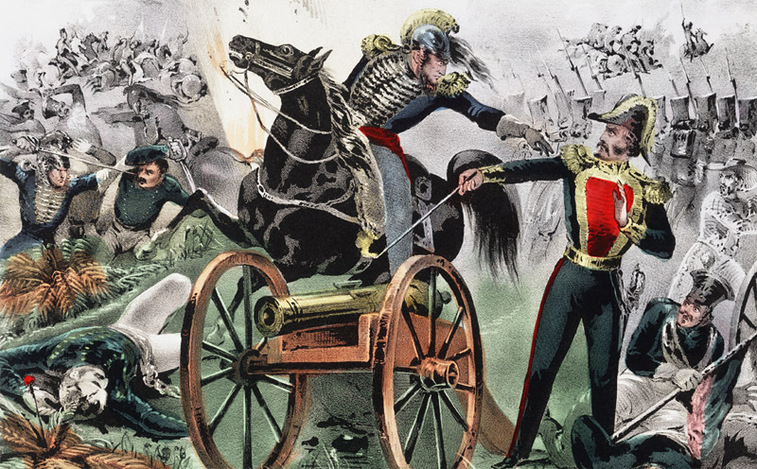
A month later, U.S. forces led by General Winfield Scott landed at Veracruz (ver-uh-CROOZ) in southern Mexico. Because Scott was a stickler for discipline and loved fancy uniforms, he was given the nickname "Old Fuss and Feathers." For the next six months, his troops fought their way to Mexico City, Mexico's capital.
Outside the capital, the Americans met fierce resistance at the castle of Chapultepec (chuh-PUHL-tuh-PEK). About 1,000 Mexican soldiers and 100 young military cadets fought bravely to defend the fortress. Six of the cadets chose to die fighting rather than surrender, and to this day, the boys who died that day are honored in Mexico as the Niños Héroes (NEEN-yos EHR-oh-ace), the boy heroes.
Despite such determined resistance, Scott's army captured Mexico City in September 1847. Watching from a distance, a Mexican officer muttered darkly, "God is a Yankee."
The Treaty of Guadalupe Hidalgo In early 1848, Mexico and the United States signed the Treaty of Guadalupe Hidalgo (gwa-duh-LOO-pay hih-DAHL-go). Mexico agreed to give up Texas and a vast region known as the Mexican Cession. (A cession is something that is given up.) This area included the present-day states of California, Nevada, Utah, Arizona, and New Mexico, as well as parts of Colorado and Wyoming.
Under this agreement, Mexico gave up half of all its territory, and in return, the United States agreed to pay Mexico $15 million. It also promised to protect the 80,000 to 100,000 Mexicans living in Texas and the Mexican Cession. Most of these promises, however, were not kept.
In Washington, a few senators spoke up to oppose the treaty. Some argued that the United States had no right to any Mexican territory other than Texas because the Mexican-American War had been unjust and the treaty was even more so. They said New Mexico and California together were "not worth a dollar" and should be returned to Mexico.
Other senators opposed the treaty because they wanted even more land and believed the Mexican Cession should include a large part of northern Mexico as well. To most senators, however, the Mexican Cession was a manifest destiny dream come true. The Senate ratified the treaty by a vote of 38 to 14.
The Gadsden Purchase A few years later, the United States acquired still more land from Mexico. In 1853, James Gadsden arranged the purchase of a strip of land just south of the Mexican Cession for $10 million. Railroad builders wanted this land because it was relatively flat and could serve as a good railroad route. The acquisition of this land, known as the Gadsden Purchase, created the present-day border of the southwestern United States with Mexico.
Most Americans were pleased with the new outlines of their country, but not everyone rejoiced in this expansion. Until the Mexican-American War, many people had believed that the United States was too good a nation to bully or invade its weaker neighbors. Now they knew that such behavior was the dark side of manifest destiny.
Lesson Summary
In this lesson, you read about how Americans extended their nation's boundaries to the west and the south. The idea of manifest destiny fueled many of the events that led to expansion.
The Louisiana Purchase In 1803, the United States added the vast territory known as Louisiana, which doubled the nation's land area. This territory also gave the United States control of the Mississippi River and the port of New Orleans, ensuring farmers west of the Appalachians could get their crops to market.
Florida After Andrew Jackson marched into Florida and removed the Spanish governor, President Monroe gave Spain the option to govern the territory properly or get out. In 1819, to avoid going to war, Spain signed a treaty that gave Florida to the United States.
Texas In 1836, Americans in Texas rebelled against the Mexican government. After the Texans' devastation at the Alamo, the Texas revolutionary army defeated the Mexican army, leading to the creation of the Lone Star Republic. In 1845, Congress admitted Texas into the union, and in 1846, the Lone Star Republic was formally dissolved.
Oregon Country As routes westward were established, thousands of Americans settled in Oregon Country, and soon there was a drive to annex all of Oregon. In 1846, to avoid going to war, the United States signed a treaty with the United Kingdom and added half of Oregon Country.
War with Mexico In 1846, the United States went to war with Mexico in the Mexican- American War. In an 1848 treaty with Mexico, the United States acquired the present-day states of California, Nevada, Utah, Arizona, and New Mexico, as well as parts of Colorado and Wyoming. In 1853, the Gadsden Purchase added land that completed the outline of the continental United States.