Mastering Differentiation: Composite and Implicit Functions
The Chain Rule
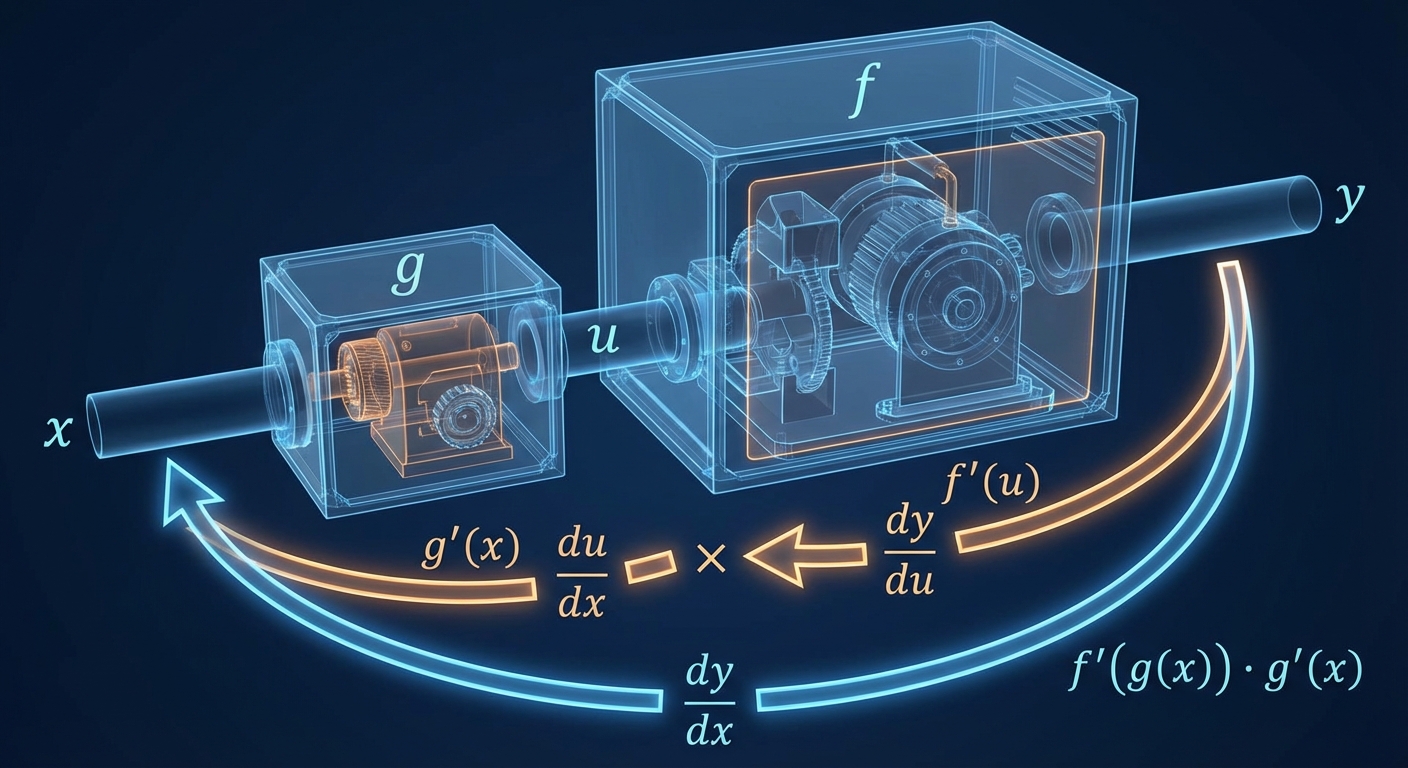
The Chain Rule is the fundamental tool for differentiating composite functions—functions inside of other functions. If you view a function like an onion, the Chain Rule is the mathematical equivalent of peeling it layer by layer, starting from the outside and working your way in.
Concept & Definition
Formally, if is differentiable at and is differentiable at , then the composite function defined by is differentiable at .
The rule states that the derivative of a composite function is the derivative of the outer function evaluated at the inner function, multiplied by the derivative of the inner function.
Formulas & Notation
There are two primary ways to express the Chain Rule. You should be comfortable with both, as AP questions may switch between them.
1. Newton's Notation (Function Notation):
2. Leibniz Notation:
If and , then:
This format is particularly useful for visualizing the "cancellation" of differentials, though mathematically they are rates of change.
Step-by-Step Procedure
- Identify the layers: Determine which function is the "outer" () and which is the "inner" ().
- Differentiate the outer: Find , keeping the inner function exactly as it is.
- Differentiate the inner: Find .
- Multiply: Multiply the result of step 2 by the result of step 3.
Worked Example
Problem: Find if .
Solution:
- Outer function: Derivative is
- Inner function: Derivative is
- Apply Formula:
Answer:
Implicit Differentiation
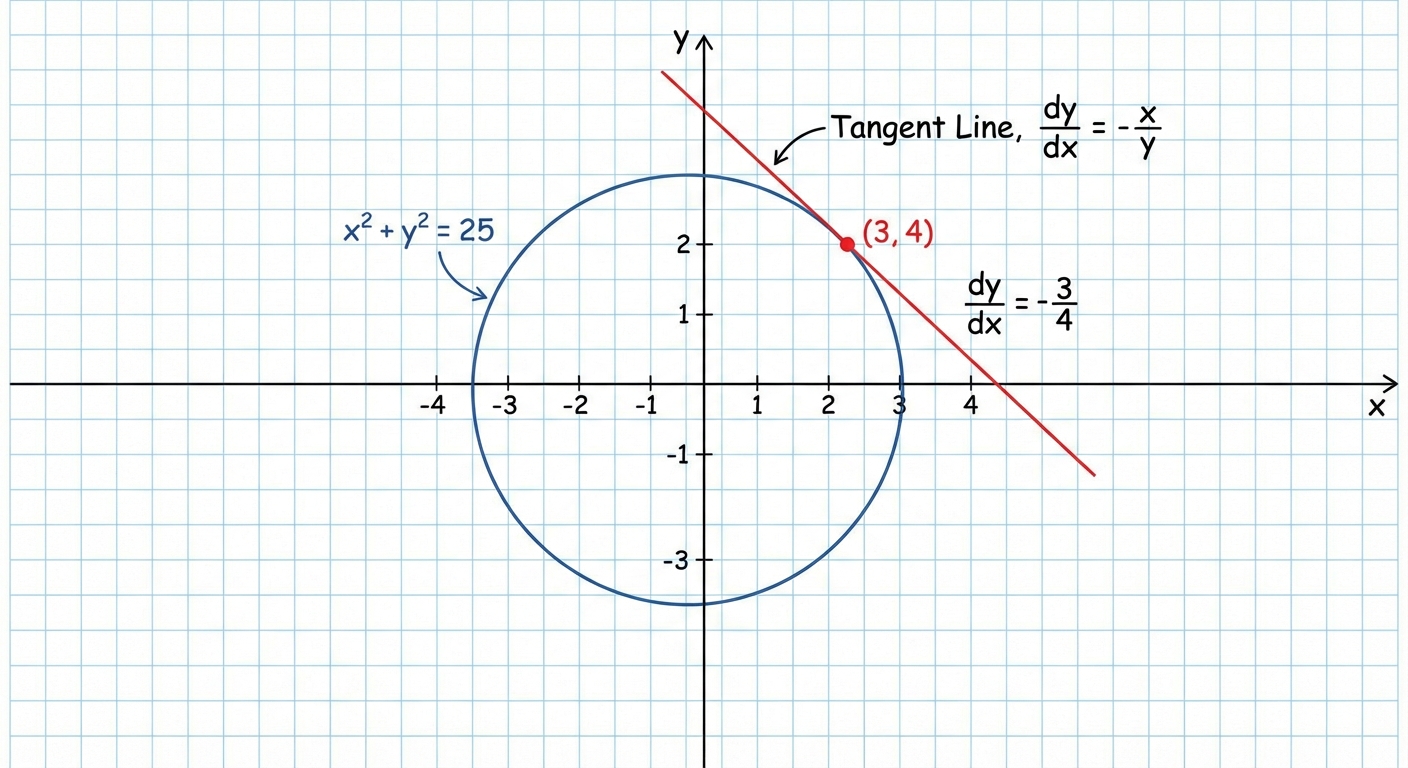
Sometimes functions are not written in the explicit form (e.g., ). Instead, and are mixed together in an equation, such as . This is an implicit relation. Implicit differentiation allows us to find the slope of the tangent line () without solving for first.
The Core Concept
When differentiating implicit equations with respect to :
- Terms with only represent standard differentiation.
- Terms with must currently be treated as composite functions . By the Chain Rule, differentiating a function of produces a term.
Key Rule:
Procedure for Implicit Differentiation
- Differentiate both sides of the equation with respect to .
- Apply the Chain Rule whenever you differentiate a term containing (multiply by ).
- Apply Product or Quotient rules if and are multiplied or divided (e.g., ).
- Gather all terms containing on one side of the equation.
- Factor out and divide to isolate it.
Worked Example
Problem: Find for the circle .
Solution:
- Differentiate both sides:
- Apply Chain Rule to y:
- Isolate terms with :
- Solve:
Higher-Order Derivatives
Higher-order derivatives represent the rate of change of the rate of change. In physics, if is position, is velocity, and is acceleration.
Notation Breakdown
| Order | Prime Notation | Leibniz Notation | Description |
|---|---|---|---|
| First | or | Slope/Velocity | |
| Second | or | Concavity/Acceleration | |
| Third | or | Jerk |
Higher-Order Implicit Differentiation
A common AP Calculus BC exam question involves finding the second derivative () of an implicit relation.
The Critical Substitution Step:
When finding implicitly:
- Find the first derivative in terms of and .
- Differentiate that expression again (often using the Quotient Rule).
- Substitution: The result will likely contain a term. You MUST substitute your answer from Step 1 into this new equation to express the final answer solely in terms of and .
Worked Example (Second Derivative)
Problem: Find if .
Solution:
Find First Derivative:
Find Second Derivative (Differentiate ):
Substitute :
Substitute into the equation above:
Common Mistakes & Pitfalls
1. The "Missing Link" in Chain Rule
Students frequently differentiate the outer function but forget to multiply by the derivative of the inner function.
- Wrong:
- Correct:
2. Implicit Neglect
When differentiating implicitly, students often treat as a constant or just like , forgetting the chain rule attachment (\').
- Wrong:
- Correct: or
3. The Product Rule in Implicit Differentiation
In terms like , students often forget this is a product of two functions.
- Wrong:
- Wrong:
- Correct: (Left d-Right + Right d-Left)
4. Forgetting to Substitute in Higher-Order Derivatives
On Free Response Questions (FRQs), if asked for in terms of and , leaving a in the final answer will result in lost points. You must substitute the expression for the first derivative back in.