Artic Final Exam: Ch 7-11
Big names in articulation and phonology:
Van Riper (1939): creator of the traditional motor approach of speech correction (treat each sound individually, one after the other)
Fey (1992): theorized most phonological approaches have 3 basic principles (groups of similar errors targeted, phonemic contrasts established, natural communicative contexts)
Hodson and Paden (1983, 1991): creators of the cycles phonological remediation approach (approach for severe unintelligibility that “cycles” through groups of target sounds to encourage generalization through gradual phonological acquisition)
Phonological processes: natural sound-simplification patterns used by young children to make speech easier
Fronting: phonological process in which client replaces back sounds with front sounds
Stopping: phonological process in which client replaces fricatives or affricates with stop consonants
Gliding: phonological process in which client substitutes a liquid sound with a glide
Backing: phonological process in which client replaces a front sound with a back sound
Deaffrication: phonological process in which client replaces an affriacte with a fricative
Final consonant deletion: phonological process in which client drops the last consonant in a word
Cluster reduction: phonological process in which client reduces consonant clusters to a single consonant
Weak syllable deletion: phonological process in which client omits the unstressed syllable
Assimilation: phonological process in which client changes a sound to resemble a nearby sound
Contact assimilation: sound changes to resemble directly adjacent sounds
Remote assimilation: sound changes to resemble sound separated by another segment
Progressive assimilation: segment changes sound that follows it
Regressive assimilation: segment changes sound that is before it
Total assimilation: when the changed sound and the influencing segment become identical
Partial assimilation: when the changed sound is close to, but not identical to, the influencing segment
Transcription
Citation form: transcription of words in isolation, unconnected
Uses slashes / \
Connected form: transcription of the way words are produced in the normal, continuous stream of speech
Uses brackets [ ]
Ch 7-8
Five kinds of speech sound disorders: articulation disorder, phonological delay, consistent phonological disorder, inconsistent phonological disorder, childhood apraxia of speech
1) Articulation disorder
Def: Inability to pronounce certain phones, using consistent substitution or distortion for target sound in spontaneous and imitated productions
Severity: Mild - moderate
Age typically referred: school age
2) Phonological delay
Def: phonological patterns that one would use to describe a normally developing child at a younger age
Severity: severe
Age typically referred: prior to school entry
Language problems (vocab and phonological awareness)
3) Consistent phonological disorder
Def: consistent use of some non-developmental error patterns
Severity: severe
Expressive language
Vocabulary
Phonological awareness
Low intelligibility
System-wide focus
4) Inconsistent phonological disorder
Def: inconsistent non-developmental error patterns (40% variability, no clear pattern)
Severity: severe, low intelligibility
5) Childhood apraxia of speech (in ch 11)
Cultural diversity
Dialect: a variation of speech or language based on geographic area, native language background, and social or ethnic group membership
Varied syntax-grammar rules, vocabulary, and phonology
COMMUNICATION DIFFERENCE NOT DISORDER
Standard American English (SAE): form of English relatively devoid of regional and social characteristics
Vernacular dialect: dialect considered to be a nonstandard form of English
African American English (AAE): form of English typically associated with African Americans
Most noted dialect of English spoken in US
Common differences
Deletion of stops (particularly alveolar stops) & nasals
Elision of the weak syllable
Ending consonant clusters reduced
Stopping, fronting, devoicing, metathesis
English as a Second Language (ESL): form of English spoken by someone with a different native language; typically phonology of native language influences the production of English
Language transfer: when the phonology of a person’s native language affects their production of a new language
English language learner: an individual who is attempting to master English as a second language
Silent period: period of time when a child learning a new language becomes very quiet, speaking very little as they focus on understanding the new language
The younger they are, the longer the silent period may last
Code switching: speaker alternating between native language and secondary language (Ex: “It’s already full, mira.”
Language loss: as a person becomes more proficient in their second language, they lose skills and fluency in their native language
Ch 9
Articulation therapy guidelines prioritization (where you should start)
Sounds affecting intelligibility (highest priority)
Developmentally earlier sounds
Stimulable sounds (may be easier for a client to get)
Correct production of the sound in specific contexts (jumping off place for therapy)
Articulation therapy hierarchy (pinwheel diagram)
Isolation → syllables → words → sentences → stories → conversation → generalization

Traditional motor approach: approach where clinician treats each error sound individually, one after the other
Aka phonetic approach
Best for articulation based errors
Van Riper’s (1939)
Multiple-sound approach: approach where clinician attempts to influence several error sounds simultaneously
Van Riper’s (1939)
Sensory perception training: training in which clinician attempts to help the client develop the ability to discriminate between the target sound and other sounds
Focus is on judging target sounds distinctness from other sounds instead of trying to produce it
Sequence
1) Identification: recognition and discrimination of sound in isolation when compared to other sounds (similar and dissimilar)
Sight, sound, feel of target sound
2) Isolation: clinician says words with sound in initial, medial, and final positions, client asked to identify the sound and pick which position the sound was in
3) Stimulation: client given many variations (louder, softer, longer, shorter, different speakers) of the target sound and must identify the sound
Goal: continued i.d. in different contexts and sources
4) Discrimination: clinician gives error production of the target sound similar to how the client does it, client must detect error and explain why it’s wrong
Knowledge of correct and incorrect production
Emphasize self-monitoring skills
Phonetic approach (isolation, contexts, nonsense syllables, spontaneous speech)
Def: therapy approach done after sensory-perceptual training that works from the awareness built in that training to actual productions using isolation, contexts, nonsense syllables, spontaneous speech
Production of the sound in isolation
Goal: elicit normal production of the target sound alone, not in combination with other sounds and stabilize it (make it consistent, usually through repetition)
Easier with fricatives and approximants
Potential activities:
Auditory stimulation: client asked to imitate clinician’s production of the target sound
Phonetic placement: clinician shows client how to position their articulators for the target sounds
Sound modification: clinicians starts with a phonetically similar sound the client can accurately produce and then corrects from there to reach the target sound
Facilitating contexts: certain contexts or key words in which the client can produce the target sound accurately (usually because of the coarticulatory conditions); used to build on target sounds and transition it to other words
Production of the sound in nonsense syllables
Goal: maintain accuracy of the production of the target sound when embedded in various contexts, typically consonants surrounded by various vowels
Helps stop the old articulation pattern the client is used to
Can be boring for clients, since it typically involves drill work
Production of the sound in words
Goal: maintain production accuracy of target sound within words
Work through a list of words with increasing articulatory complexity
Length of word: fewer syllables = easier
Position of target sound in word: initial = easier, final & medial = more difficult
Syllable structure: open syllables > closed syllables (easier), reduplicated syllables = easy
Syllable stress
Coarticulation factors: sounds that surround the target, number of times target occurs in word, consonant cluster
Familiarity of word (familiar to the client or high-frequency words): familiar = easier
Avoiding blends
Production of the sound in structured contexts
Goal: maintain accuracy of production of the target sound as words are placed in short phrases and sentences
Carrier phrases: phrases that have the target sound/word at the end or within the phrase to prompt the client (“I see a ______.”)
Production of the sound in spontaneous speech
Goal: maintain accuracy of production when target sound appears in conversation spontaneously
Carryover, generalization into real world
Ch 10
Fey (3 principles)
1) Target groups of sounds with similar error patterns
2) Establish phonemic contrasts with minimal
pairs
3) Natural communicative context (sounds within real
words instead of individual sounds)
Minimal pair approach: phonological approaches that utilize minimal pairs to contrast phonemes
Minimal pairs: words that differ by only one phoneme
Used to contrast phonemic positions in children with moderate to severe phonological disorders and poor intelligibility
Highlight that different sounds produce different meaning
Minimal pair contrast therapy: therapeutic use of minimal pairs to establish contrasts not present in the child’s phonological system
For moderate to severe phonological disorders & poor intelligibility
Minimal opposition contrast therapy: therapy where minimal pair words that have articulatory similarities (place, manner, voicing) are used at the start of therapy
Mild to moderate disorders
Young children
Stimulable for the target sound
Multiple oppositions approach: approach that directly addresses the collapse of multiple phonemes; confronts the child with several sounds at the same time within one phoneme collapse
2-4 target sounds to be used in minimal word pairs, sets of sounds that are maximally distant from the error and from each other
SEVERELY unintelligible kids who use phonemic collapse
Phonemic collapse: when a client substitutes a single phoneme for multiple (sometime 10+) phonemes, such as substituting /h/ for many other phonemes
Cycles Phonological Remediation Approach
Def: periods of intervention for one set of multiple phonological targets, followed by a period of intervention for another set of targets (cycles, does 2-3 before going back to 1st one)
Assume phonological acquisition is gradual & generalization will occur
Used for children with severely impaired intelligibility
Three key elements:
1) Auditory bombardment at beginning and end of each session
Playing while wearing an auditory trainer and listening
2) Minimal pairs to train production
3) Cycling of phonological targets
First cycle focuses on patterns or processes that are typically early developing
Liquids hard, so kept through every cycle if not present
Diagram example
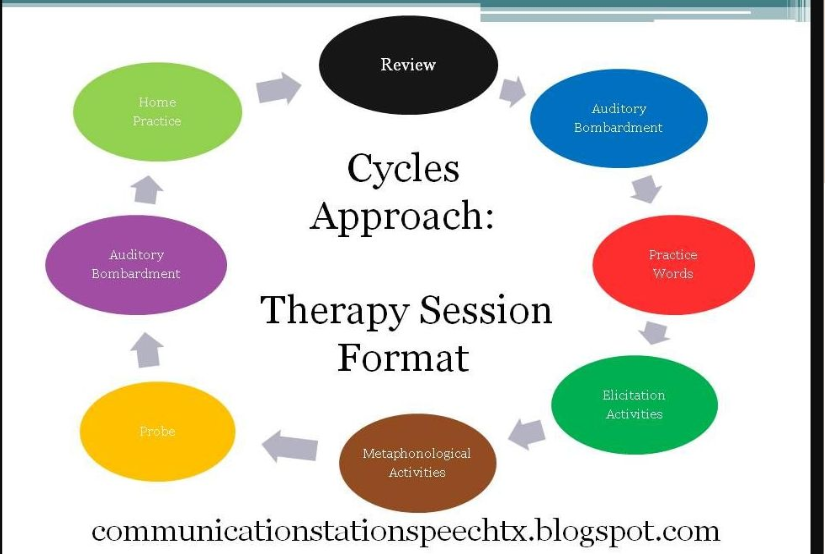
The metaphon approach: approach that emphasizes child’s metaphonological knowledge by developing phonological awareness at different levels (concept, sound, phoneme, & word) and then using that knowledge to recognize and repair their own errors
Metaphonology: the ability to pay attention to and reflect on the phonological structure of language
Based on metalinguistic awareness: ability to think about and reflect on the nature of language and the way it functions
Works well with preschool children
Ch 11.1-11.2
Disorders
Childhood apraxia of speech
Def: neurological childhood speech sound disorder in which the precision and consistency of movements underlying speech are impaired in the absence of neuromuscular deficits (abnormal reflexes & muscle tone)
Difficulty in planning and programming movement, resulting in errors in speech sound and prosody
Early onset & lifetime disorder
Highly unintelligible
Types: developmental apraxia, congential articulatory apraxia, developmental verbal apraxia
Three causes:
1) Known neurological etiologies (stroke, infection, trauma)
2) As a result of complex neurobehavioral disorder (genetic, metabolic)
3) Unknown cause
Three main characteristics
1) Inconsistent errors on consonants and vowels when asked to repeat the syllable or word
2) Lengthened and disrupted transitions between differing articulated sounds and syllables
Cerebral palsy
Def: nonprogressive disorder of motor control caused by damage to the developing brain during the prenatal, perinatal, or early postnatal period
The most common developmental motor impairment
Lack of voluntary speech-motor control, respiration & disordered prososdy
Spastic conditions of muscles and increased tendon reflexes → decreased cognition, perception, sensation, language, hearing, emotional behavior, feeding, and seizure control
Cleft palate
Def: an opening or split in the roof of the mouth that occurs when the tissue doesn’t close fully during development which affects feeding and speech; usually fixed via surgery soon after birth
More frequent speech-language delays and many compensatory strategies present
Compensatory errors: specific errors in the placement of the articulators that typically involves backing phonemes; occurs in patients who have VPI, cleft, or fistula in the hard palate
Typical error patterns:
1) Nasaly consonant distortions
2) Hypernasal vowel distortions
3) Compensatory articulations (substitution or coarticulation)
4) Atypical backing
Submucous cleft: type where there is an intact mucous membrane covering the cleft so the cleft is less noticeable; doesn’t cause as many feeding or speech problems
VPI (velopharyngeal insufficiency)
Def: when the seal between your oral and nasal cavity doesn’t close completely, impairing the intraoral pressure build up necessary for the production of many speech sounds
Consonant distortions associated with nasal emissions
Symptom of cleft palate
Intellectual disability
Def: mental disorder where there is significant limitations both in intellectual functioning and in adaptive behavior seen through conceptual, social, and practical adaptive skills
Three criteria
1) limitations in adaptive skills (relative to cultural group)
2) sub-average intellectual functioning (< 70 IQ)
3) manifestation of a cognitive impairment
before 18 years of age
Adaptive skills: conceptual, social, practical
1) Conceptual: skills in language, reading, writing, math, reasoning, knowledge, and memory
2) Social: skills in empathy, social judgement, interpersonal communication skills, ability to make and retain friendships
3) Practical: skills in self-management, recreation, and organizing school and work tasks
Same phonological processes as normally developing kids but with more frequency
Down syndrome
Def: condition in which a person is born with an extra copy of chromosome 21, resulting in a variety of symptoms including distinct facial abnormalities, cognitive impairments, decreased muscle tone, hearing loss, and many other symptoms
Consonant articulation errors
Cognitive impairments not significant, just slower than children without disabilities
Hearing impairment
Def: generic term for any diminished ability in normal sound perception
Conductive hearing loss: hearing loss caused by issues in the outer or middle ear
Sensorineural hearing loss: hearing loss caused by issues in the inner ear or auditory nerve
Mixed hearing loss: hearing loss caused by issues in both the outer half and inner half of the ear track
The greater the hearing loss, the more errors, typically in stress, pitch, and voicing areas, and typically the more unintelligible
Common errors: deletions, distortions, mispronunciation of specific consonants (affricates, fricative, and consonant blends)
Resemble younger speech
Common phonological processes: final consonant deletion, cluster reduction, devoicing of stops, stopping, fronting, liquid simplification, gliding