Surface Area and Volume
Shapes, Vertices, Edges, and Faces
Platonic Solid: a 3D shape formed by the same regular polygons
Ex. tetrahedron, cube, octahedron, dodecahedron, icosahedron —> These are the only platonic shapes
(They are named platonic solids because these were discovered by Pluto!)
Polyhedron: any 3D shape created by polygons as faces
Ex. prism, pyramid
Ex of non-polyhedra. cylinder, cone, sphere
Prism: A shape that has two bases which are the same polygon
Solid | Vertices, V | Edges, E | Faces, F |
|---|---|---|---|
Tetrahedron | 4 | 6 | 4 |
Cube | 8 | 12 | 6 |
Octahedron | 6 | 12 | 8 |
Dodecahedron | 20 | 30 | 12 |
Icosahedron | 12 | 30 | 20 |
The relationship between the numbers of vertices, edges, and faces of a polyhedron is as follows: (discovered by Euler)
F+V-2=E
Cross Sections
Cross Section: the shape formed when a non-empty three dimensional space is intersected with a plane
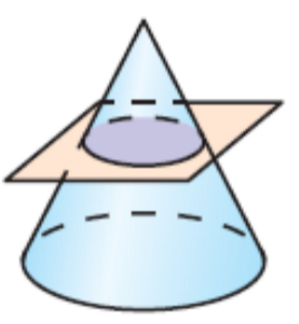
Circle
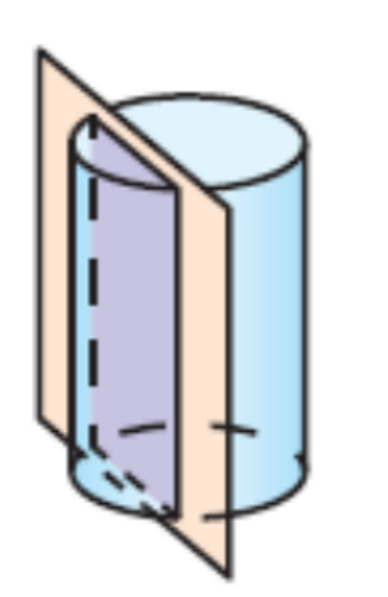
Rectangle
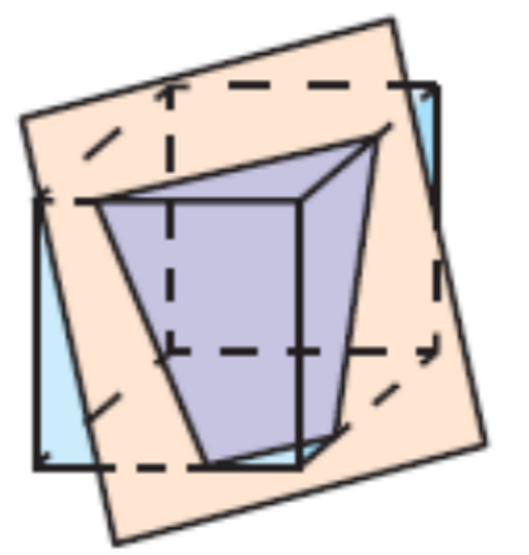
Trapezoid
Surface Area
Surface Area: the area of the net of a 3D shape
The general formula for a prism is: SA=Ph+2B, where
SA is the surface area
P is the perimeter of the base
h is the height of the prism
B is the area of the base
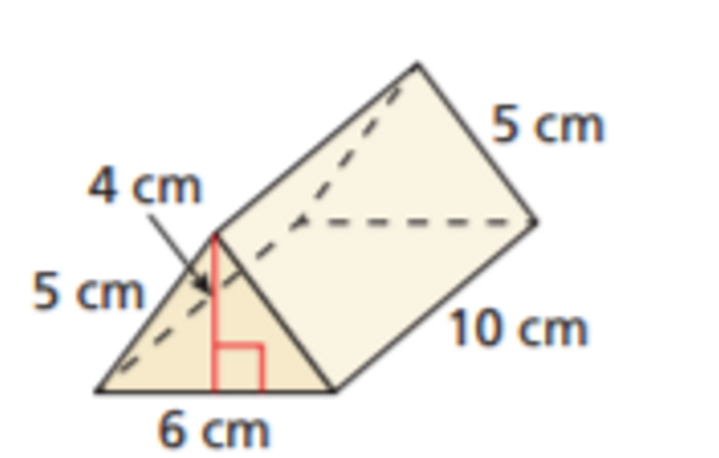
SA = Ph+2B
SA = (16)(10)+2[(1/2)(6)(4)]
SA = 160 +24
SA = 184 ft²
**Don’t forget that surface area is a type of area, so the unit will be squared!
The formula for an oblique prism is: SA=2B+2AParallelogram+2ARectangle, where
SA is surface area
B is the area of the base
AParallelogram is the area of the parallelogram side
ARectangle is the area of the rectangle side
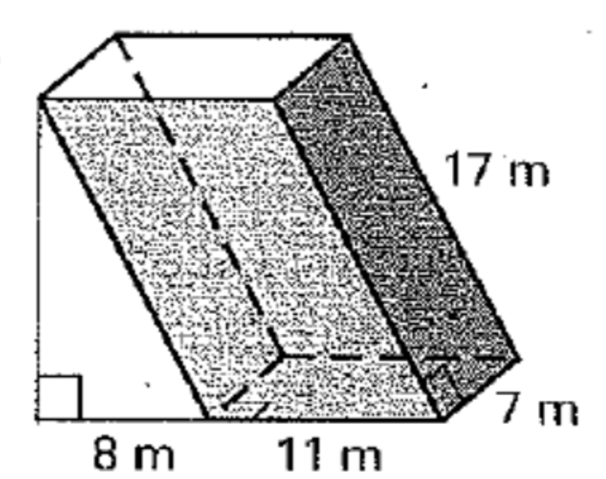
SA = 2B + 2AParallelogram + 2ARectangle
SA = 2(11)(7) + 2(11)(15) + 2(17)(7)
SA = 722 m²
Regular Pyramid: a pyramid with a regular base and congruent isosceles lateral faces
The formula for a regular pyramid is: SA=½Pl + B, where
SA is the surface area
P is the perimeter of the base
l is the slant height
B is the area of the base
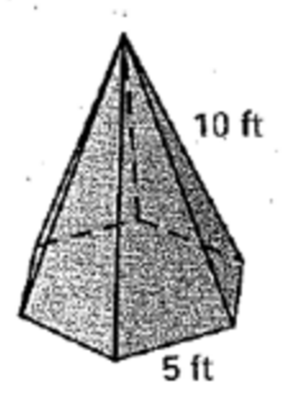
SA = ½Pl + B
SA = ½(30)(√93.75) + [½(2.5√3)(30)]
SA = 210.2 ft²
The formula for a cone is: SA=πrl+πr², where
SA is the surface area
r is the radius
l is the slant height
**Write the answer in terms of π
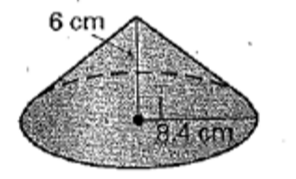
SA = πrl + πr²
SA = π(8.4)(√106.56) + π(8.4)²
SA = [8.4√(106.56)π+106.56π] cm²
The formula for a cylinder is: SA=2πrh+2πr², where
SA is the surface area
r is the radius
h is the height
The formula for a sphere is: SA=4πr³, where
SA is the surface area
r is the radius
**Write the answer in terms of π
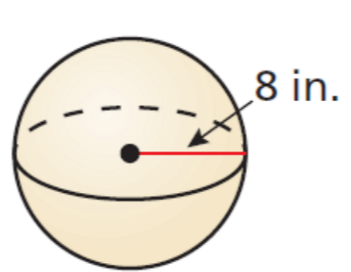
SA = 4πr³
SA = 4π(8)³
SA = 256π in²
Volume
The formula of a prism is: V=Bh, where
B is the area of the base
h is the height of the prism
The formula of a pyramid is: V=⅓Bh, where
B is the area of the base
h is the height of the pyramid
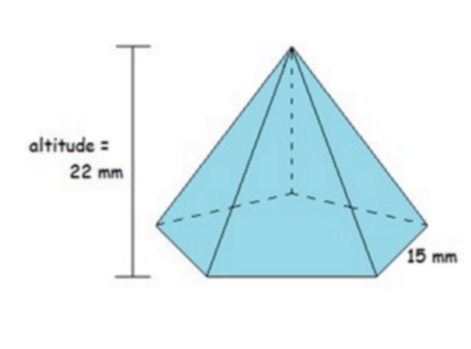
V = ⅓Bh
V = ⅓(½aP)h
V = ⅙(7.5/tan36°)(75)(22)
V = 2838.8 mm³
**Don’t forget the units for volume are cubed!
The formula for a sphere is: V=⁴⁄₃πr³, where
r is the radius
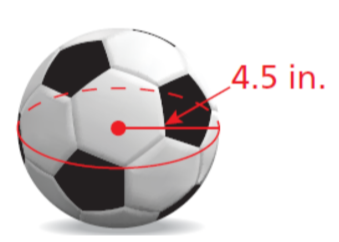
V = ⁴⁄₃πr³
V = ⁴⁄₃π(4.5)r³
V = 121.5π in³