Week 4 tutorial problems
If children obtain half their genes from one parent and half from the other parent, why
aren’t siblings identical?
Due to recombination and crossing over. INDEPENDENT ASSORTMENT IS THE ANSWER THEY’RE LOOKING FOR.
You have a pond with salamanders in the backyard and you find a few variants. One variant has yellowish skin rather than brown skin like the rest of the salamanders. The yellow salamander is crossed to a wild-type brown salamander and in the next generation all the salamanders are brown. The F1 salamanders are crossed to each other and in the F2 ¾ are brown and ¼ are yellow.
a. Did we need to look at the F2 generation to conclude that the yellow salamander is a recessive mutant? Explain.
No not really. Cuz if it were dominant then the F1 generation would be all yellow.
b. You also find a salamander in your pond that is missing its tail. You cross this tail-less
salamander to a wild-type salamander and in the F1 all salamanders have tails. In the F2 you
see 18 wild type and 2 salamanders with missing tails. How can these results be explained
and how can you refine your experiments?
Does not follow mendelian genetics completely. Possibly environmental factor. Have a controlled environment where tails cannot fall off.
A male Drosophila melanogaster has the genotype A/a; B/b; C/c; XD/Y. The A, B, and C locus
are on different autosomes.
a. Draw a pre-gametic cell (a meiocyte) in metaphase of meiosis I, label the chromosomes with
alleles. *There is no crossing over in Drosophila males
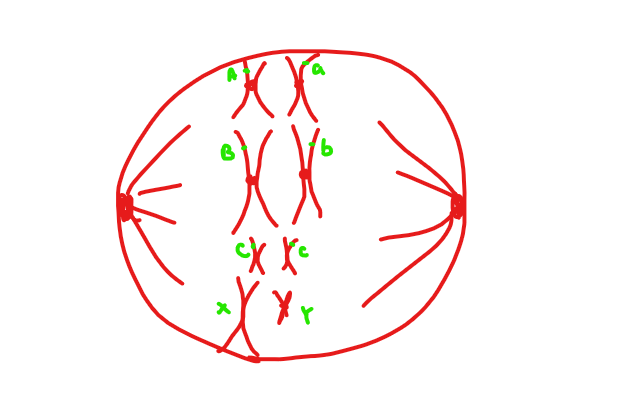
b. How many different sperm genotypes can be produced from this one meiocyte (2n) you drew above?
2
c. How many possible sperm genotypes will be produced by a population of meiocytes
undergoing meiosis in the male above?
16
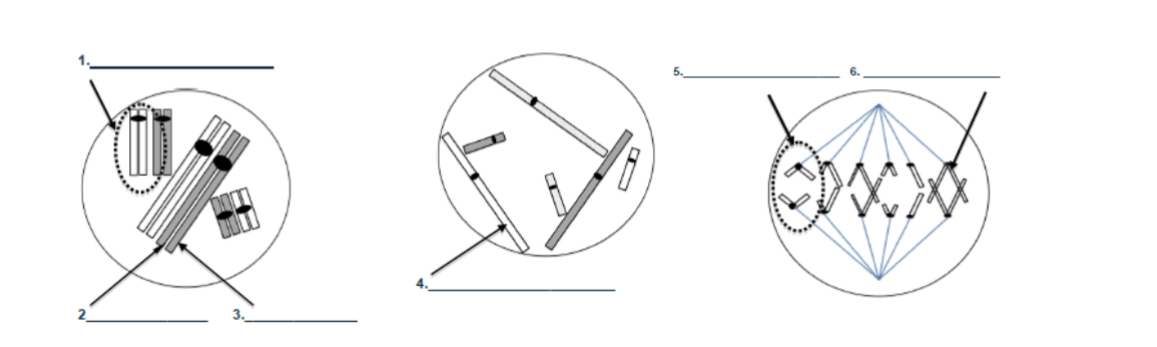
homologous chromosome
telomere?
sister chromatid?
chromosome?
sister chromatids (one chromosome total)
centromere
cell 1 is 2n = 6
cell 2 is 3n = 6
cell 3 is