Thermochemistry
conversion factors: 1 Cal/kcal = 1000 cal = 4.184 KJ = 4184 joules
Part 1 Thermochem
Two Trends in Nature:
Order → Disorder (Second law of thermodynamics)
High energy → low energy (meaning heat will transfer to cold)
Energy = capacity to do work or supply heat
Chemical Potential Energy - energy stored in chemicals
determined by the kinds of atoms and arrangement
Heat (Q/q) - energy that flows from a warmer to cooler
Temperature - average KE of particles, effect after heat added.
Law of Conservation of Energy (second law of thermodynamics): Energy cannot be created or destroye, only transferred and can change forms
Forms of Energy: work atoms moving or breaking/ forming bonds, stored energy within bonds, heat
Units
Calorie (cal) - unit of heat which brings the temperature of the water on a gram of water, 1 degree up
Dietery (Cal) - = 1kcal = 1000cal
Joule (J) = quantity of heat that raises 1 gram of water 0.239 degrees Celsius
1Cal = 1kcal = 1000 cal = 4184 j = 4.184 kJ
Heat Movement
Endothermic -
heat goes into the system, making the surroundings cooler
(sign for heat is positive), heat on the reactant side,
Exothermic -
heat goes into surroundings, exiting the system
(sign for heat is negative), heat on product side.
Specific Heat - is the specific amount of heat required for a substance to be raised one degree celcius for one gram
Usually given in a table. If asked to calculate it. C= q/m∆t
Units = J/g °C or cal/g °C
Water has a high specific heat, meaning it can absorb a lot of heat before it changes temp, but metals have a low specific heat it can absorb fast and give fast
A metal spoon is better in a soup because it can conduct heat faster
everything has the same temperature but gives off different amount of heat at a time due to specific heat
lower specific heat - metals - transfer heat faster - less heat is needed to raise the temperature
Calorimetry
Measurement of heat changes in reaction (in an insulated container)
Enthalpy (H): amount of heat a substance has at a given temperature and pressure
q=H because we are not changing the conditions in the room
Q= mC∆t - Use when mass is given, specific heat, temperature change, or heat transfer is given. Use sig figs
use when there is a temperature change
mC∆t= mC∆t - use in specific situations
Thermochemical Equations
if heat per reaction is given, and mass is given or mole and temperature stays the same
ex: CH4 (g) + 2O2 (g) CO2 (g) + 2H2O (l) ΔH = -890.4 kJ
doing the reverse changes the sign - can be used in hess law later
negative sign means that heat is released (exothermic), the converse is true
multiply the heat if there are more moles
physical states must be stated
Calorimetry
Calorimeter - an instrument that measures the gain or loss of heat
can be used to find the specific heat of a substance
can also be used to determine the heat given off or absorbed by a chemical reaction
It can measure heat because of change of water.
According to the law of conservation of energy: the heat lost by the process is gained by the water or the water loses heat and it is absorbed by the process
q process = -q water (4.184 J/g°C)
In these equations, the final temp is the same for both water and the object
mCAT (object) = -mCAT (water)
the negative sign means the substance is losing heat
Phase Changes
The boiling point is the temperature at which the (equilibrium) vapor pressure of a liquid is equal to the external pressure.
Normal is at 1 atm
this value is given in a table
Melting point = freezing point - same temp can have both solid and liquid
same temp, but in order to change phases, it needs to break IMF
Molar heat of fusion (∆Hfus = -∆Hsolidify) is the energy required to melt 1 mole of a solid substance.
This value is given.
positive is heat added in (melt), negative is heat taken away (solidify)
Molar Heat of Vaporization - needed heat to change the phase (positive value). The negative value would be molar heat of condensation.
Molar Heat of sublimation is the energy needed to sublime 1 mole (fus plus vap)
Heating Curve - shows when to use different equations like heat of fusion or mcat.
When using the phase change equation, use stoichiometry because its per mole
Stanard Enthalpy
enthalpy is essentially heat but is affected by pressure
Standard Enthaltpy of Formation- heat change when one mole of a compound is formed form its elements at 1atm
(stable compounds are 0, ex: o2 in period table)
given by table
Standard Enthalpy of Reaction (ΔH0 ) is the enthalpy of a reaction carried out at 1 atm.
Sum of Product standard Enthalpy (make sure to include moles) - the reactant sums
 if the question then asks per mole, then you divide by the amount of mole in that reaction. (released no sign, change yes sign)
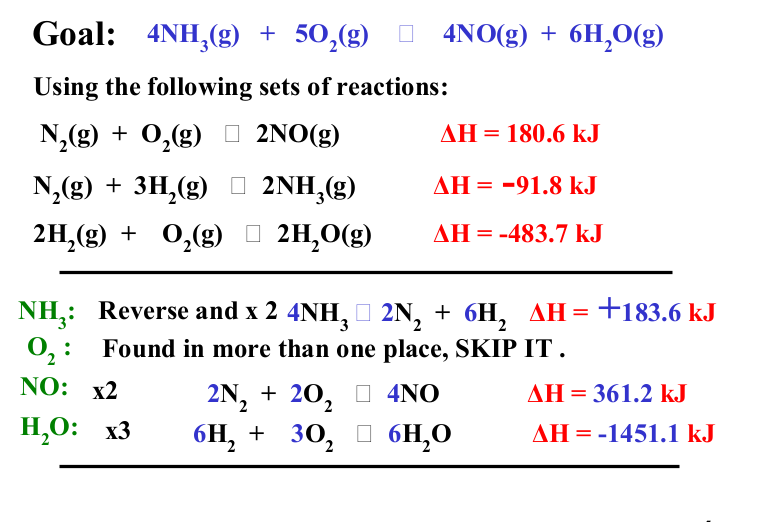
Hess Law
A State Function: Path independent.
Both lines accomplished the same result, they went from start to finish.
Net result = same.
When reactants are converted to products, the change in enthalpy is the same whether the reaction takes place in one step or in a series of steps.
Important Lab Info
Specific Heat
Heat of Fusion of Ice
Q/m
Heat up water, melt the ice till it goes to its melting/ freezing point. Then calculate energy
Caloriometru