21st Literature ASIA
21st Literature
YSA
Representative Texts and Authors from ASIA
Asia, the largest continent in the world, has a vast literary tradition in terms of scope and length of existence.
Literature in the Eastern hemisphere prospered and mirrored the developments in religion, war, and politics. It is wise to study the Asia literature by geographical region.
Representative Texts and Authors from CHINA
China, one of the world’s cradles of civilization has started its unbroken literary tradition in the 14th century BCE. The preservation of the Chinese language (both spoken and written), has made the immeasurable prolonged existence of their literary traditions possible. It has retained its reputation by keeping the fundamentals of its identity intact.
Poets like Du Fu, Li Po, and Wang Wei of the Tang Dynasty (618 – 907), the finest era of Chinese literature, has produced world-renowned literary works. Chinese writers in modern times are still creative and productive and have kept the Chinese literary tradition prosperous.
Du Fu
He is also known as Tu fu. According to many literary critics, he was the greatest Chinese poet of all time. He wrote the poem “The Ballad of the Army Cats” which is about conscription- and with hidden satire that speaks of the noticeable luxury of the court.
Li Po
He is also known as Li Bai, a Chinese poet who is a competitor of Du Fu as China’s greatest poet. He was romantic in his personal life and his poetry. His works are known for its conversational tone and vivid imagery. He wrote the poem “Alone and Drinking under the Moon” that deals with ancient social custom of drinking.
Wang Wei
He was a poet, painter, musician, and statesman during the Tang dynasty (the golden ages of the Chinese cultural history). He was the established founder of the respected Southern school of painter-poets. Many of his best poems were inspired by the local landscape.
Mo Yan
He was a fictionist who won the 2012 Nobel Prize for Literature. His first novel was “Red Sorghum”, and still his best-known work. It tells the story of the Chinese battling Japanese intruders as well as each other during the 1930s. it relates the story of a family in a rural area in Shandong Province during this turbulent time.
Yu Hua
He was a world-acclaimed short story writer and considered as a champion for Chinese meta-fictional or postmodernist writing. His widely acclaimed novel “To Live” describes the struggles endured by the son of a wealthy land-owner while historical events caused and extended by the Chinese Revolution are fundamentally altering the nature of Chinese society.
Representative Texts and Authors from KOREA
Korea’s literary tradition is greatly influenced by China’s cultural dominance. As early as the 4th century CE, Korean poets wrote literary pieces in Classical Chinese poetry then transformations happened at the 7th century.
Hangul, Korean’s distinct writing system and national alphabet, is developed in the 15th century that gave new beginnings of Korean literature. In contemporary times, the Korean War has made a significant mark on Korean literature. In 1950, the themes present in the literary works are about alienation, conscience, disintegration, and self-identity.
Ch’oe Nam-Seon
He was considered a prominent historian. Pioneering poet, and publisher in the Korean literature. He was also a leading member of the modern literary movement and became notable in pioneering modern Korean poetry.
One of his works, the poem “The Ocean to the Youth” made him a widely acclaimed poet. The poem aimed to produce cultural reform. He sought to bring modern knowledge about the world to the youth of Korea.
Yi Kwang-su
He was also the one who launched the modern literary movement together with Ch’oe Nam-Seon. He was a novelist and wrote the first Korean novel “The Heartless” and became well-known because of it. It was a description of the crossroads at which Korea found itself, stranded between tradition and modernity, and undergoing conflict between social realities and traditional ideals.
Kim Ok
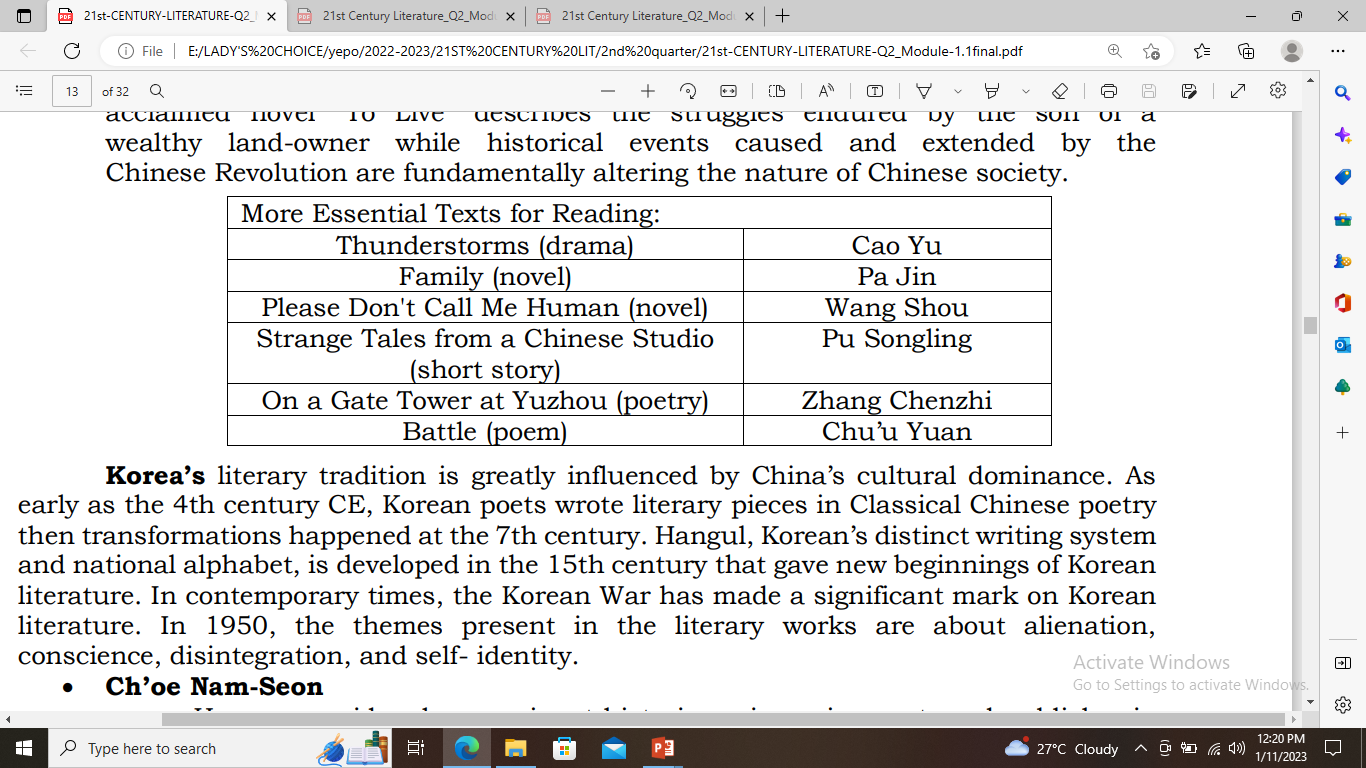
He was a Korean poet and included in the early modernism movement of Korean poetry. He wrote the first Korean collection of translation from Western poetry “The Dance of Agony”. More Essential Texts for Reading:
Thunderstorms (drama) Cao Yu Family (novel) Pa Jin Please Don’t Call Me Human (novel) Wang Shou Strange Tales from a Chinese Studio (short stpry) Pu Songling On a Gate Tower at Yuzhou (poetry) Zhang Chenzhi Battle (poem) Chu’u Yuan.
Yun Hunggil
He was a South Korean novelist who won the 1977 Korean Literature Writers Award. He wrote the classic novel “Changma” (The Rainy Spell) that on a post-war family with two grandmothers and their shared grandson.
Pak Kyongni
She was a South Korean poet and novelist. She wrote the Korean’s masterpiece and internationally acclaimed 21-volume epic novel T’oki (‘The Land”), wherein she chronicled the violent Korean history from 1897 to 1945.
Representative Texts and Authors from JAPAN
Japan has a rich and unique literary history even though it has been influenced by the Chinese language and Chinese literature. It has a world-renowned poetic genre called haiku (a short descriptive poem with 17 syllables) and the diverse forms of theatre Noh (traditional Japanese theatrical form and one of the oldest extant theatrical forms in the world) and Kabuki (traditional Japanese popular drama with singing and dancing performed in a highly stylized manner).
Japanese literature reflects simple yet complex, imperfect yet abounding with beauty – the traditional Japanese cultural identity. In contemporary times, Western influences take part in the Japanese literature, specifically in the pioneering of modern Japanese novels, translations of the poetry, and reinventions of traditional Japanese poetic forms like haiku and tanka. Playwroghts like Abe Kobo and Mishima Yukio are Japan’s notable literalists.
Abe Kobo
He was a Japanese novelist and playwright and also known by the pseudonym of Abe Kimifusa. He wrote the best-known play “Tomodachi” (Friends) which is a story, with dark humor, reveals the relationship with the other, and exposes the peculiarity of human relations in the present age.” He also won the 1967 Akutagawa Award. He also won the 1951 Akutagawa Award for his short novel Kabe (“The Wall”).
Kimitake Hiraoka
He is also known by the pen name Mishima Yukio, the most important Japanese novelist of the 20th century. He was one of the finalists of the 1963 Nobel Prize for Literature and won numerous awards for his works. He wrote the novel “The Temple of the Golden Pavilion” and won Yomiuri Prize from Yomiuri Newspaper Corporation for the best novel. “The Temple of the Golden Pavilion”, translated into the English language by Ivan Morris, based on the burning of the Reliquary (or Golden Pavilion) of Kinkaku-Ji in Kyoto by a young Buddhist acolyte in 1950.
Ryūnosuke Akutagawa
He was a Japanese writer and regarded as the Father of the Japanese short story. He wrote the short story “Rashomon” that recounts the encounter between a servant and an old woman in the dilapidated Rashōmon, the southern gate of the then-ruined city of Kyoto, where unclaimed corpses were sometimes dumped. The Akutagawa Prize, Japan’s premier literary award was named after him to honor his memory after he died by committing suicide.
Haruki Murakami
He was a Japanese novelist who won the international award Jerusalem Prize. He also won the Gunsou Literature Prize for his first novel “Hear the Wind Sing”. It featured episodes in the life of an unnamed protagonist and his friend, the Rat, who hang out at a bar. The unnamed protagonist reminisces and muses about life and intimacy. Murakami’s work has been translated into more than fifty languages.