Unit 2: Networks of Exchange 1200-1450
Contextualization:
- during the Classical period, trade routes grew
- Silk Road and Indian Ocean routes allowed for the transfer of goods ideas, technology, people between empires
Historical Development:
Economic impacts
- the expansion of trade changed the global economy →empires relied on trade to grow and consolidate power and spread influence
- new financial tools like paper money as medium of exchange of goods
- New technologies such as Islamic dhows and Chinese junks sped up rate of trade
- Groups of traders →caravans increased volume of trade
Cultural impacts
- spread of religions →trade was the primary way religions such as Islam, Hinduism, and Buddhism spread and also proselytization (attempts at active conversion)
- Abbasid Caliphate and Song China’s science and mathematics →Europe!
- astrolabe → navigation, compass, gunpowder
- Ibn Battuta and Marco Polo
Environmental Impacts
- Food →essential, so primary trade good during this time
- Champa rice →agriculture and population growth in China
- Diseases (bubonic plague)
- killed third population of Europe
Evidence
The Silk Road
Define: Land trade route linking China and the West
- under Mongol control→trade flourished because merchants felt safe
- transported luxury items
- standardization of weights and measures
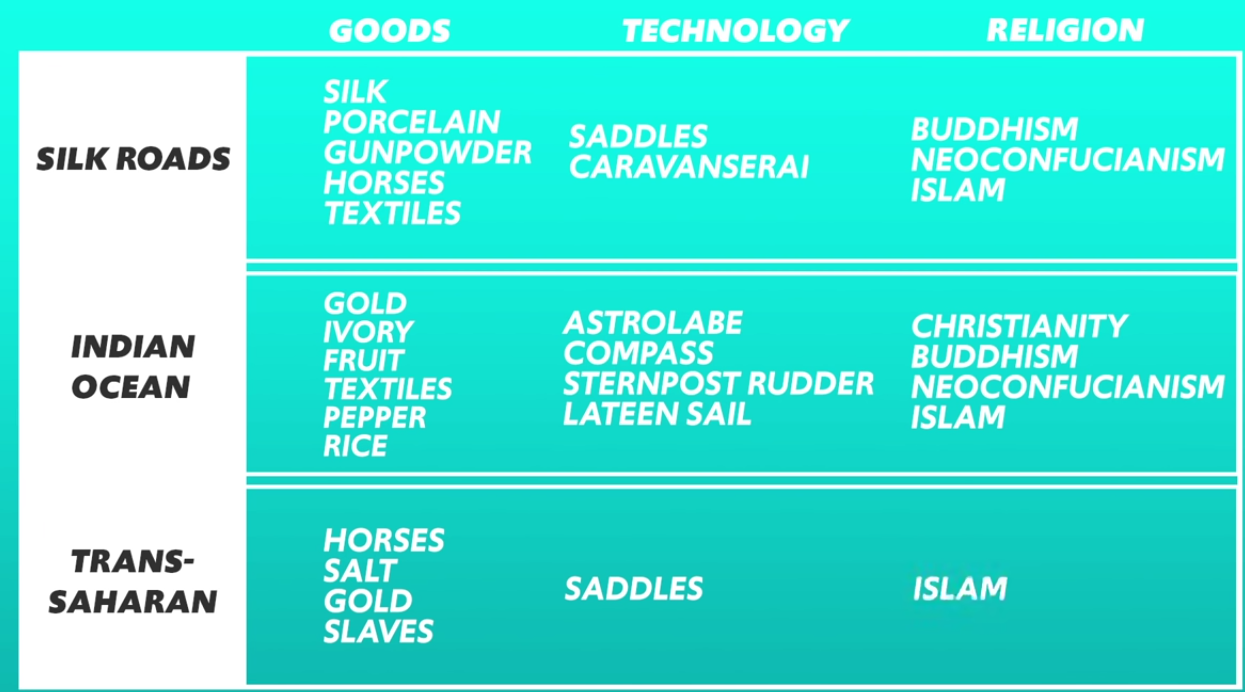
- canvaserais →inns along the Silk Road that made travel safer →protection from bandits and weather (hub for cultural exchange/interaction)
- carried religions like Buddhism, Islam, Christianity
- development of money economies
The Mongol Empire
Define: Largest contiguous land empire
- Genghis Khan consolidate Mongols into fearsome fighting force to form empire (nomadic)
- Pax Mongolia →peaceful, prosperous trade
- Mongols religiously tolerant, women treated better
The Indian Ocean trade
Define: The Indian Ocean trade routes were a network of sea routes that connected the East and West and facilitated trade and cultural exchange between the ancient civilizations of Africa, the Middle East, India, Southeast Asia, and East Asia.
- knowledge of monsoon winds overcome weather patterns, minimize danger of shipwrecks →increase volume of trade
- Development of sailing technologies (LATEEN SAIL, ASTROLABE, DHOW SHIPS) →expand scale of trade, navigate safely
- relatively easy to navigate, no obstacles
- included much more people than Silk Road trade
The Tran-Saharan Trade
Define: The Trans-Saharan trade routes were a network of land-based trade routes that connected ==West Africa== with the ==Mediterranean== and the ==Middle East.==
- Diasporic communities formed
- traders settled new areas, established communities
- African slaves brought to Middle East and Americas
- Camel →domesticated in the Middle East
- brought to Africa by Arab traders
- revolutionized trade and transportation →long distance, minimal water, heavy loads
- Spread of Islam
- appealed to rulers who adopted it in order to legitimize their rule
- appeal: social justice, personal responsibility, equality
Cultural Effects
- Neo-confucianism (China)
- Buddhism+Confucianism →important state philosophy (Tang Dynasty)
- HINDUISM →SOUTHEAST ASIA
- Ex. Angkor Wat (Khmer empire) →religious monument
- Hindu and Buddhist temple in SOUTHEAST ASIA
- indian ocean trade
https://quizlet.com/446176656/ap-world-history-unit-2-test-flash-cards/
https://quizlet.com/436316285/ap-world-modern-unit-2-flash-cards/
depend on large states in corporations,which gave birth to new tech
saddles, compass, lateen sail
culture → missionaries
Champa rice →china from vietnam
growth of trading cities →convergence
Silk road →saddles and caravanserai
saddles →trans-saharan route
 Ibn Batutta (explore dar-al islam) and Marco Polo (went to china)
BLACK DEATH →disease spread through trade routes
Pax mongolia →made spread of disease quicker AND higher volumes of trade →model for centralized rule