Evidence of Evolution
- Fossils
- Evidence of an organism that lived long ago
- The deeper down in the ground a fossil is found, the older it is
- Fossils can be dated using carbon dating
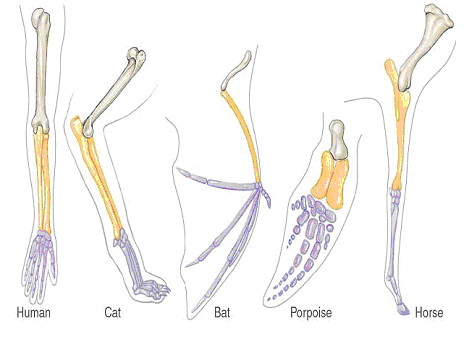
- Homologous Structures
- Similar structures found in different species, but with different purposes
- Ex: Bones in the flippers of a whale, arms of humans, and wings of a bat
- Vestigial Structures
- Structures that organisms have, but do not serve a purpose
- Ex: Appendix, tailbone
- Presumed to have been useful in ancestral species
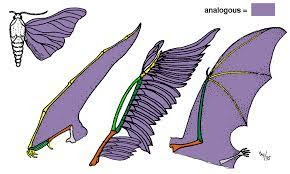
- Analogous Structures
- Structures used for similar purposes, but they are very different in structure
- Molecular Biology
- Closely related organisms have very similar DNA and amino acid sequences
- Many similarities in DNA are seen between closely related species
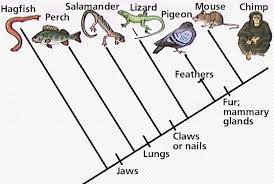
- Cladograms
- Chart used to show the evolutionary relationships among organisms
- Evolution
- Gradual change in a species over many generations
- Divergent evolution
- @@Two closely related species develop different traits to survive in different@@ @@environments@@
- Convergent evolution
- ^^Two unrelated species develop similar traits to survive in similar environments^^
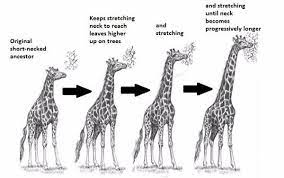
- Jean-Baptiste Lamarck
- Hypothesized that acquired traits could be passed on to offspring through use and disuse
- Traits are inheritable
- Different from Darwin, Lamarck said if a giraffe stretches its neck for leaves, then its neck would become longer and its offspring would inherit the longer neck
- This is wrong because acquired traits do not change the DNA and cannot be passed down to offspring
- Charles Darwin
- Went on a five-year voyage to map the coast of South America to investigate organisms and fossils
- From his observations he developed a theory about evolution called @@natural selection@@
- Natural Selection
- 4 principles
- In a population, more individuals are produced than the environment can support
- They compete for food and shelter
- Overpopulation - struggle for survival
- Members of a population have inheritable variations
- Variations arise from random, inheritable mutations
- Some individuals have characteristics that enable them to survive and reproduce better than other individuals
- Survival of the fittest
- The ability to survive and reproduce better leads to gradual change in a population over time