Electrons HC
Atomic Orbitals: Areas where electrons most likely to be found
Described with:
Energy Levels: Different orbitals are in different energy levels, from 1-7, where 1 is lowest energy, closest to nucleus.
Orbital Shapes: orbitals have different shapes, s, p, d, and f
Orbital orientations: different orbitals have different orientations, the x, y, and z axis.
Electrons in orbitals: each orbital can hold 2 electrons, one spins up, one spins down
Orbitals exist together
Electron Configuration: Energy Level → Orbital shape → Orientation → Spin up or spin down. Ex: 2px +1/2
Aufbau Principle: Electrons occupy lowest energy orbitals it can
Pauli Exclusion Principle: No two electrons in the same atom can have the same set of 4 quantum numbers, or if there are two electrons in an orbital, one spins up, one down.
Hund's Rule: Orbitals of equal energy are each occupied by one electron before any orbital is occupied by a second electron.
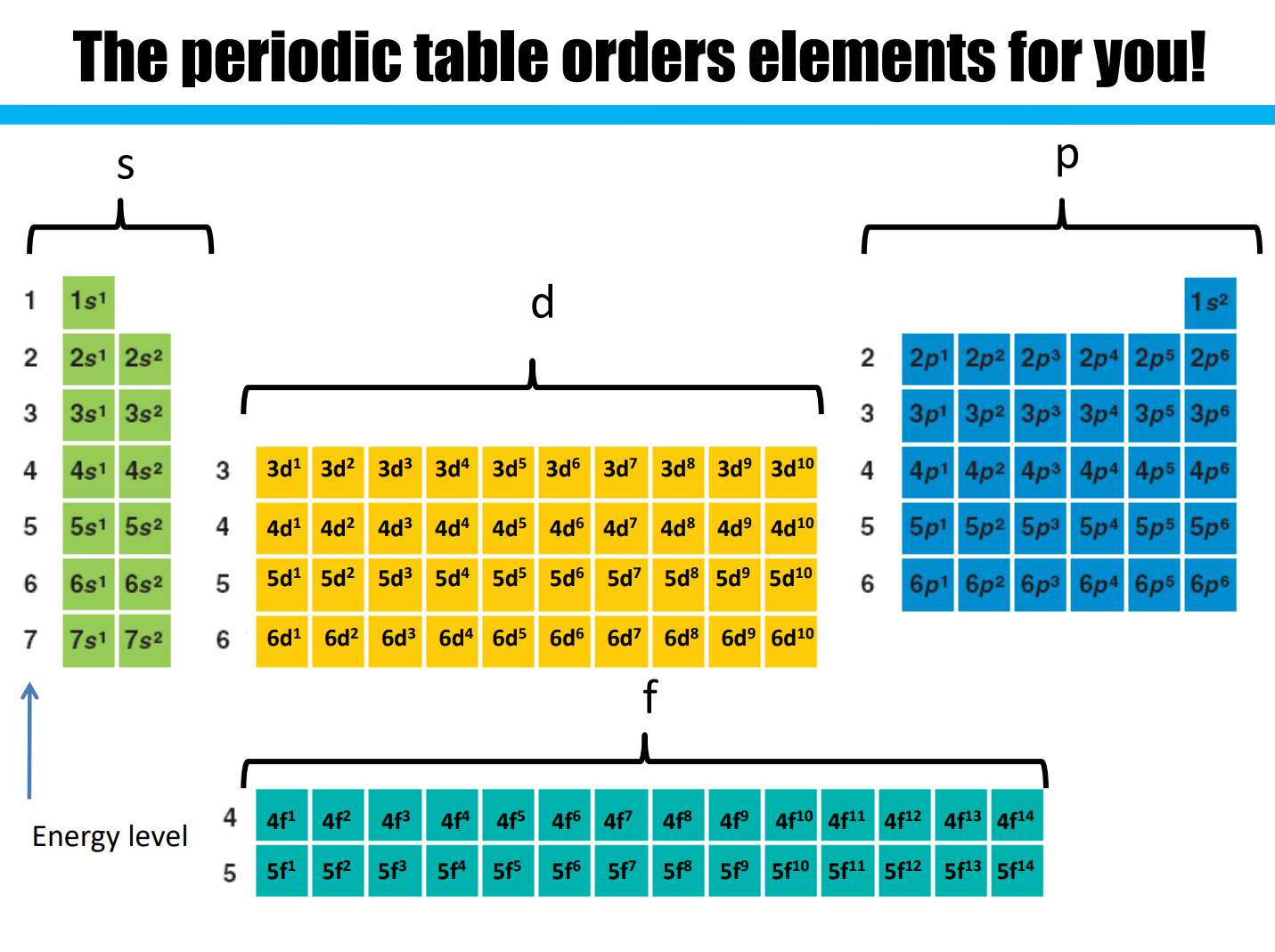
Noble Gas Config:
Previous noble gas in [ ], like [Xe]
List the rest of electron configuration
Ions are atoms with a charge and are created when its normal number of electrons is changed.
Atoms try to emulate noble gases to gain stability and will lose and gain electrons to become more similar to noble gases. They usually become similar to the nearest noble gas.
When making cations, remove electrons from the highest energy level orbital. This means transition metals (d-block elements) wouldn’t lose from the d orbital first, and would probably lose from the s
Absorption: If atoms are given energy, electrons can excite and be pushed up to higher energy levels. Usually absorbs heat.
If not given enough energy, it will not do anything.
Emission: Electrons do not want to stay at higher levels (Aufbau Principle) and will fall down, Sometimes releases energy in forms like light. The amount of energy released depends on what energy level the electron is falling from
Energy Spectrum: Wavelengths of energy can be measured and can describe the energy gap where electrons fell from.
Visible Spectrum: Low → High Energy = ROYGBIV
Energy levels are spaced differently.
Atoms have unique wavelengths of energy they can release or absorb.
Line Emission Spectrum: Wavelengths of energy released as electrons fall.
Line Absorption Spectrum: Missing bands of energy being absorbed by cold gases.

