Week 3 - Sweden and Prostitution
Background:The Law that Prohibits the Purchase of Sexual Services, enacted on January 1, 1999, emerged as a powerful legislative response to the mounting social and political awareness regarding the multifaceted exploitation associated with prostitution and the rampant trafficking of women and girls. Spearheaded by the Swedish women’s movement, this legislation signifies a profound shift in the approach to sexual exploitation within legal frameworks, uniquely aiming to criminalize the demands of those purchasing sexual services rather than penalizing the individuals selling them. This revolutionary perspective reflects a broader societal acknowledgment of the inherent harms linked to the sex trade, framing it as a critical matter of public health, human rights, and gender equality.
The Law's Objectives and Principles:
Root Cause Addressing:The fundamental objective of the Law is to decrease both prostitution and trafficking by disrupting the demand from men seeking to purchase sexual services. This approach adopts a critical lens that recognizes prostitution as a manifestation of male violence against women. The law positions victims not as offenders, but as individuals deserving of protection, intervention, and rehabilitation. Emphasis is placed on empowering victims and systematically addressing the socio-economic conditions, including poverty, ignorance, and entrenched gender inequality, that often lead women into the sex trade.
Zero Tolerance Approach:Enshrining a zero-tolerance policy against all forms of prostitution and trafficking, the law is supported by extensive public education campaigns and dedicated victim support initiatives. These efforts aim to foster a comprehensive societal consensus against male violence, thereby promoting healthier, more equitable gender relationships and challenging the normalization of exploitation within society.
Social Context and Global Implications:
Increasing Trafficking Trends:In a global context, both prostitution and human trafficking have surged, significantly driven by a neoliberal free market ideology that commodifies women and girls. This societal environment fosters conditions where the vulnerabilities of marginalized populations are exploited, resulting in intensified trafficking networks and fundamental violations of human rights.
Critique of Current Ideologies:A growing number of countries are beginning to normalize sex work, framing it as a legitimate career option. This emerging perspective poses a direct conflict with comprehensive understandings of women's rights and full gender equality. Critics assert that such normalization undermines crucial protective efforts aimed at vulnerable populations, challenging the foundational principles of the feminist movement that advocates for the dignity and rights of women.
Principles Behind Swedish Policies:
Political Priority:For decades, Swedish policies have held a strong commitment to combatting prostitution and trafficking, inherently linking gender equality to the government's actions and societal responses concerning sexual exploitation. This foundational connection reinforces the understanding that addressing these issues transcends legal concerns, constituting an integral aspect of achieving true equality and justice in society.
Protection over Punishment:In Sweden, there exists a prevalent belief that penalizing the victims—primarily women involved in prostitution—constitutes a grave injustice. Instead, the law emphasizes addressing systemic challenges that render individuals susceptible to entering prostitution, focusing on tackling socio-economic inequalities and structural gender disparities. This protective strategy aligns with broader social welfare objectives, incorporating essential support services that address the needs of affected populations.
Enforcement and Effects of the Law:
Implementation:Following the law's enactment, law enforcement was empowered to take decisive measures against purchasers of sexual services. Substantial resources were allocated to bolster police efforts, particularly in geographic areas known for street prostitution, complemented by the establishment of training programs designed to sensitize officers to the complexities surrounding sexual exploitation and trafficking issues.
Statistical Impact:Initial estimates suggested that around 125,000 men were engaged in purchasing the services of approximately 2,500 women annually. Notably, by 2002, evaluations indicated a remarkable decline in street prostitution, estimated at up to 50%. This significant reduction serves as a critical indicator of the law’s effectiveness in reshaping consumer behavior and diminishing visible prostitution.
Buyer Demographics:Research conducted in Stockholm sheds light on the demographics of buyers, noting that the majority were not typically economically disadvantaged. Instead, they encompassed diverse age groups and socioeconomic classes, with many being married men with families. This insight complicates common stereotypes regarding prostitution and underscores the intricate motivations that drive individuals to purchase sex services.
Challenges and Criticisms:
Enforcement Issues:Despite the law’s noble intentions, various challenges have arisen concerning its enforcement. Police practices have faced significant hurdles, including initial skepticism and resistance from certain officers regarding the implementation of the legislation. Such challenges raise concerns about the consistency and efficacy of law enforcement efforts throughout different regions and communities.
Cultural Norms:Cultural attitudes and traditional notions of masculinity continue to exert tension within law enforcement regarding their responses to sex buyers. These cultural norms complicate the efforts to enforce the law effectively, revealing a pressing need for ongoing training and cultural competence development among law enforcement officials.
Comparative International Perspective:
Trafficking Statistics:A comparative analysis reveals that countries such as Denmark are experiencing rising incidences of street prostitution and trafficking, primarily due to the absence of similar legal frameworks aimed at reducing demand. Sweden's proactive preventive measures have yielded substantially lower trafficking activity rates, highlighting the effectiveness of a law that targets the buyers rather than the sellers.
Projected Future Amendments and Support:
Legislation Evaluation:Ongoing discourse surrounding potential amendments to the law underscores a commitment to enhancing and broadening the approach taken to eradicate vulnerabilities leading individuals into trafficking. Advocates emphasize the necessity of reinforcing the preventive framework and establishing comprehensive safety nets for populations at risk of exploitation.
Public Support:Continuing public endorsement for the Law is overwhelmingly positive, with recent polling indicating that approximately 80% of the Swedish population supports its underlying principles and enforcement mechanisms. This strong public backing reflects a societal dedication to combating sexual exploitation and human trafficking.
Conclusion:Ultimately, the Law serves not only as a punitive measure afflicting those who engage in the purchasing of sex but also seeks to establish critical societal norms asserting that women and children are not commodities for sale. It represents a foundational step in the ongoing battle against systemic issues associated with sexual exploitation and trafficking, fostering an environment that is fundamentally hostile to the normalization and commodification of female bodies within Sweden. Moreover, this pioneering approach has ramifications that extend into international dialogues surrounding prostitution and trafficking, potentially influencing similar legislative efforts globally.
Principles Behind Swedish Policies and Legislation Against Prostitution and Human Trafficking
Core Principles:
Combating prostitution and human trafficking is the key political goal at national and international level
women and children, especially marginalized groups, are protected under international human rights principles
Treating women and girls as commodities is incompatible with equality
Swedish Approach
Prostitution is officially viewed as a form of male sexual violence against women and children
Victims are not penalized, but rather supported to escape exploitation
Swedish policies against prostitution focus on the root cause → Men’s demand for and use of women and girls for sexual exploitation → without demand there is no market for prostitution
Prostitution is a serious and harmful issue → women and children are viewed as victims of male violence and are offered assistance
In Sweden, all forms of legal or policy measures that legalize different types of prostitution activities (brothels) or that decreminalize the perpetrators of prostitution industry (pimps, traffickers, brothel owners)→ most serious threat to gender equality and the rights of women and girls
legalization of prostitution would normalize extreme form od sexual descrimination and violence, strenghten male domination over female human beings
legalization of prostitution means that the state imposes regulations with which they can control on class of women as prostituted
The work against prostitution and human trafficking is done by:
the swedish government and public authorities
women’s movement
shelter movement
non-governmental organizations (NGOs) that provide support services and advocacy for victims
The law that prohibits the purchase of sexual services
On January 1, 1999, the Swedish Law that Prohibits the Purchase of Sexual Services (the Law) entered into force.
This Law recognizes that it is the man who buys women (or men) for sexual purposes who should be criminalized, and not the woman.
The Law is gender neutral and is, as mentioned previously, a fundamental part of the comprehensive Swedish strategy to combat prostitution and trafficking in human beings.
Swedish women’s movement → initiated the criminalization of the prostitution buyers
concluded that prostitution is patriarchal tool of oppression that has deleterious effects on the women and girls who are induced and kept in prostitution, as well as an extreme form of male violence used to control female human beings as a class
It is important to note that this legislation only targets buyers of persons in prostitution.
The persons who are in prostitution, the victims of male violence, are not subject to any kind of criminal or other legal repercussions
The government pledged money and assistance to women who are victims of male violence, including prostituted women
the state, to a certain extent, is responsible for assisting women to leave violent situations, including prostitution, and for providing women with access to shelters, counseling, education, and job training.
The Law is currently worded as follows:
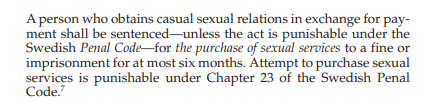
→ The offense comprises all forms of sexual services, whether they are purchased on the street, in brothels, in so-called massage parlors, from escort services, or in other similar circumstances
Number of women in prostitution in Sweden
In 1999, it was estimated that 125,000 Swedish men bought about 2,500 prostituted women one or more times per year → the number of women in street prostitution in Sweden today is no more than 500
There is no evidence that the sale of women has moved from the streets to the Internet
The global prostitution and pornography industry has always been quick to take advantage of every new technological advance that can benefit their activities and promote the sale of their products
The Net Sex Project concludes in its report that the number of Swedish women who are prostituted via the Internet remains stable at around 80 to 100 women, with the same women advertised on many different Web sites.
Who are the Swedish men who buy prostitutes
Every eighth man older than 18 years in Sweden, or approximately 13% of men ages 18 years and older, have, at least once, bought a person for prostitution purposes within Sweden or in other countries
all ages and all income classes
majority are, or have been, married or cohabiting, and they often have children
men who have or have had many sexual partners are the most common buyers of prostituted persons → dispelling the myth that the buyer is a lonely, sexually unattractive man with no other option for his sexual outlet than to buy prostituted women
Enforcement of the law
The primary purpose of the Law is to prevent the purchase of sexual services
→ the Swedish police are to intervene before a crime is committed
Most police reports give evidence of attempts by men to buy sexual services.
→ It is considered an attempt when a buyer offers something, such as money, drugs, or a place to stay to a prostituted person as payment for a sexual service
→ Most men arrested under the Law pled guilty to avoid not only a court trial but also the possibility that their partners or wives will find out about their having bought and used prostituted women.
The effective enforcement of the Law is ultimately determined by the attitude of the leadership within the local police forces, as well as that of the individual police officer
In Sweden as in other countries, the police force is a male, homosocial, and conservative working environment—a police force that is being asked to enforce a law that seriously threatens traditional male values
Police officers were very skeptical of the Law at start→ claiming it too difficult to enforce
Extraterritorial jurisdiction
All Swedish laws are extraterritorial → Swedish citizens can be charged, prosecuted, and convicted under Swedish laws when having committed a crime in another country, if that country has legislation similar to Swedish legislation
In countries where prostitution is legalized or tolerated, the idea that women are objects for male sexual pleasure and, therefore, can be sold and bought, is normalized
It is then perfectly acceptable that men go to brothels to buy and sexually exploit women.
this has an effect on how all women and girls are regarded by men in these countries
The highest numbers of sex tourists (per capita), consequently, come from Australia and the Netherlands.
Effects of the law on trafficking in women
the Law has had direct and positive effects in limiting the trafficking in women for prostitution to Sweden (NCID → National Criminal Investigation Department)
The NCID estimates that between 400 and 600 women are trafficked into Sweden every year, mainly from the Eastern European countries such as Estonia and Lithuania, as well as from Russia
There is also no conclusive evidence that the number of women trafficked to Sweden has decreased
when a new law against trafficking went into effect, cases of trafficking in human beings for sexual purposes in Sweden were prosecuted under the procuring provisions or, depending on the individual case, under the provisions on kidnapping, unlawful deprivation of liberty, placing a person in a distressful situation, coercion, or sexual exploitation.
The NCID has received signals from Europol and national police forces in other European countries that Sweden no longer is an attractive market for traffickers.
Traffickers and pimps are businessmen who calculate profits, marketing factors, and risks of getting caught when they decide in which countries they will sell women into prostitution.
According to victim testimonies, pimps and traffickers prefer to market their women in countries such as Denmark, Germany, the Netherlands, and Spain, where the operating conditions are more attractive, where the buyers are not criminalized and where certain prostitution activities are either tolerated or legalized
future amendments to the law
In 2001, the Parliamentary Sexual Crimes Committee released its extensive report on amendments to the sexual crimes legislation in chapter 6 of the Swedish Penal Code
the law prohibiting the purchase of sexual services be amended and strengthened
Currently, the Law excludes from criminal liability those men who regularly purchase the same prostituted woman.
the Law does not cover situations in which a person or a group of persons purchase a sexual service for someone else.
This situation often occurs when a group of men come together for a stag party to celebrate the marriage of one of them, and friends buy a woman for the bridegroom as a sending-off gift
By criminalizing these group situations, the Law would also apply to corporations who provide escort services for male customers and business associates