39 - Plant Responses to Internal and External Factors
39.1 - Signal transduction pathways link signal reception to response
plants have some of the largest genomes on record
plants respond to external stimula by altering development
etiolation - physical adaption for growing in the dark
High shoot growth
no leaves
short root
de-etiolation - when a plant reverses etiolation
Reception
signals detected by proteins that change shape in response to a stimulus
in deetiolation, the protein is called a pyhtochrome
this is uniquelly locating in cytoplasm, not the membrane
Transduction
transduction of weak stimuli require second messengers
second messengers - molecules and ions that amplify a response and transfer it
In de-etiolation, both calcium ions and cyclic GMP are used
phytochrome activiation leads to a 100 fold increase in calcium ions in the cell
the shape change also means that guanalyl cyclase is activated, creating GMP
both must be activated to work
Response
the activities involved with second receptors lead to a response
transcriptional response alters mRNA encoding of an enzyme
post-translational response - activates preexisting enzymes
39.2 - Plants use chemicals to communicate
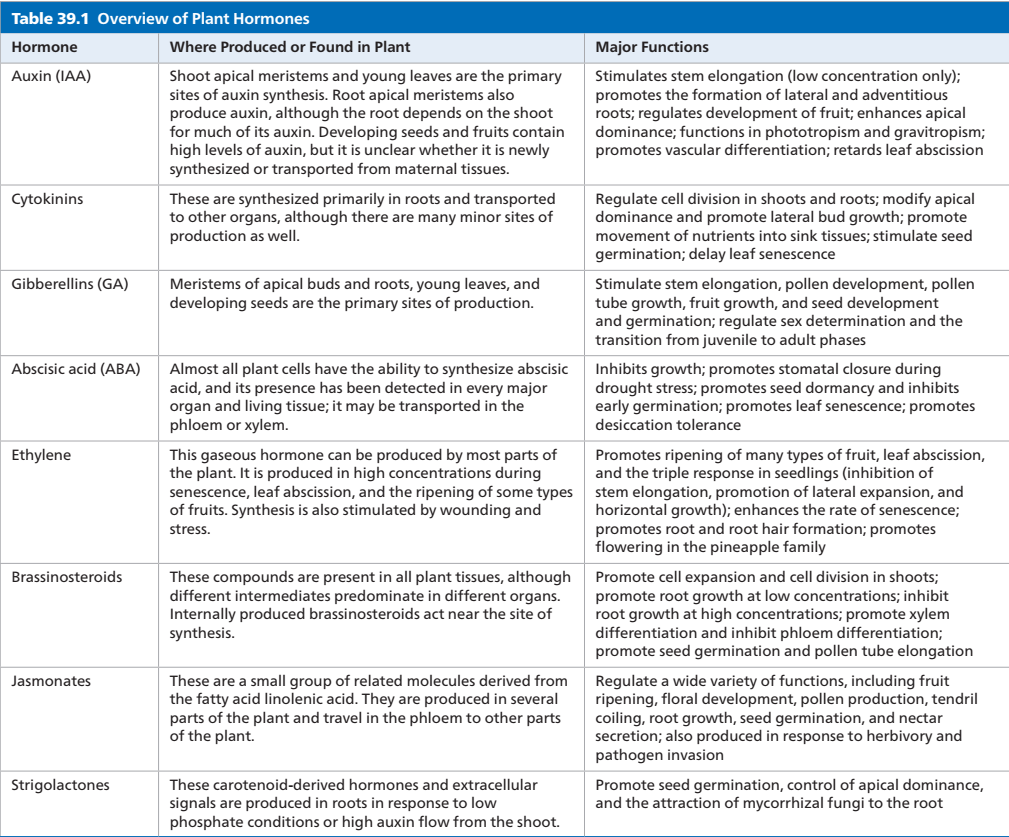
plant growth regulator - hormones tha tcontrol 1 or more physiological aspects of a plant
Survey of Plant Hormones
Auxin
tropism - turn
phototropism - plant turn to light
auxin - any gormone that causes coleptile curvature
moves only tip to base
polarly distributed
also elongates cells in shoots
onlt in 10^-8 to 10^-4 M
auxin stimulates proton pumps
reduces ph
actives expansins that loosen wall fabric