Gymnosperms: Conifers I & II
Conifers I: Gymnosperms
Vascular plants—plants with xylem and phloem and vascular bundles
ferns
gymnosperms—1000 species
angiosperms—233,000 species
Gymnosperms: seed plants bearing “naked seeds,” which are ovules exposed at pollination
Gymnosperms originated about 250 MYA as the first seed plants, and reached their peak of diversity during the Mesozoic Era, 250-100 MYA
Gymnosperms—12 plant families, 88 genera, 1000+ species
Conifers (‘cone-bearing’)—600+ spp.
Pinus—about 100 spp., n. hemisphere
Ginkgo—1 species
Cycads (palms)—(tropical)—300+ spp.
Zamia
Gnetum (genus) (also tropical) (100 spp.)
Literary quote of the week, from The Overstory, by Richard Powers (have you read it? Put it on your Winter Break reading list!):
"It's the long species of the only genus in the sole family in the single order of the solitary class remaining in a now-abandoned division that once covered the earth--a living fossil three hundred million years old that disappeared from the continent back in the Neogene and has returned to scratch out a living in the shadow, salt, and fumes of Lower Manhattan. A tree older than conifers, with swimming sperm and cones that can put out a trillion and more grains of pollen a year. In ancient island temples on the other side of Earth, thousand-year-olds, molten and blasted, close to enlightenment, swell to incredible girth, their elbows growing back down from giant branches to re-root into new trunks of their own. A tree like this grew on the street just outside the house of the man who ordered the bombing of Hiroshima, and a small few of them survived that blast. The fruit flesh has a smell that curdles thought; the pulp kills even drug-resistant bacteria. The fan-shaped leaves with their radiating veins are said to cure the sickness of forgetting...He remembers. He remembers. Ginkgo. The maidenhair tree....
There, as he watches, the whole tree bares. It falls from one moment to the next, the most synchronized drop of leaves that nature ever engineered. A gust of air, some last fluttered objection, and all the veined fans let go at once, releasing a flock of golden telegrams down West Fourth Street."
Conifers (and ginkgo) in FOR 401
Pinaceae
Cupressaceae
Ginkgo (not technically a conifer)
Conifer foliage
Pinus (pine)
Leaves (needles are acicular, or needlelike
Needles are borne in bundles called fascicles
The buds are inside the fascicle and usually aborted
The number of needles per fascicle is diagnostic
Pinus taeda, Pinus echinata, Pinus strobus?
Tsuga (hemlock)
Short, single, flat needles
Needles attached to branches with a short peg, or petiole
Rows of white stomata on the undersides of the leaves
Picea (spruce)
Needles are borne singly on small bumps, called sterigmata (plural singular is a sterigma)
Spruce is sharp
In NC we have red spruce, Picea rubens. We also learn Norway spruce.
Abies (fir)
Blunt-tipped, flat needles
‘Fir is flat’ or ‘fir is friendly’
Also has rows of white stomata on undersides of needles
Larix (larch)
Deciduous
Needles borne in clusters on short spur shoots
Cupressaceae
Bark on mature trees in fibrous and shreddy
Many species have flat and scale-like leaves. Others have small branchlets and needles
Cones have branchlets and needles
Cones have peltate scales (more later)
Metasequoia and Taxodium are deciduous
Conifers II
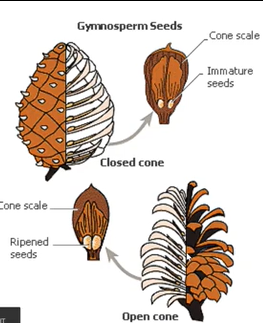
Two types of cones
Species in Pinaceae have flat-scaled cones
Species in Cupressaceae have peltate-scaled cones
Conifer reproduction
Considers don’t flower!
Male and female cones are separate structures
Microsporangiate strobilus—male cone
=micro/small + spot/spore + angiate/vessel, strobilus/cone
Megasporangiate (or macrosporangiate) strobilus—female cone
mega/large + spor/spore + angiate/vessel, strobilus/cone
Strobilus=cone
Plural of strobilus=strobili
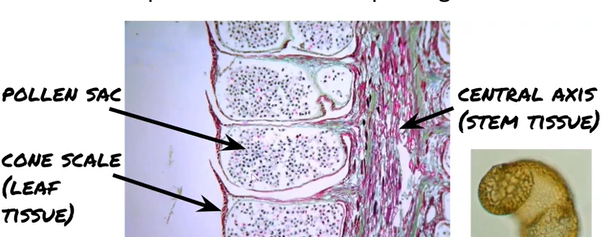
Male cones
Central axis of strobilus in stem tissue
Scales are leaf tissue
Female cones: all stems tissue; the female cones are short shoots
Microsporgania
Male cone is much smaller than female cone
Microsporangia are borne in pairs at the base of papery scales
Contain many diploid microsporocytes (=microspore mother cells) that form the pollen
Pollen from pines are too big to be allergens
Pollination and fertilization
Pollination in conifers takes place with wind, in the spring
Once pollen reaches female cones:
Pollen can slide down bract
Pollination droplet in ovule may pull or float pollen in
Pollen may germinate and grow to ovule
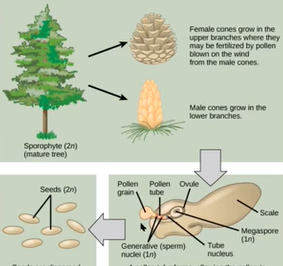
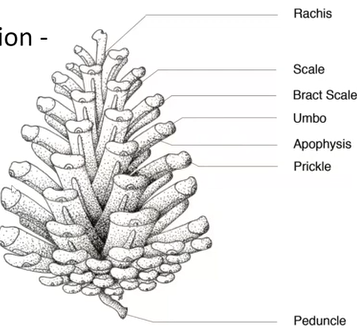
Bracts help transfer pollen to the scales
Megasporangia
apophysis: end of cone scales; lighter in color and exposed when cone is closed
umbo: a protuberance at the center of the apophysis
prickle: an umbo shaped like a point
cones that have prickles are said to be “armed”
the winged seeds sit on top of the scale
Peltate scales have 2-9 seeds per scale
Bract is fused to the cone scale
Scales are fused to a central point or axis
Conifer reproduction cont.
“Fleshy” cones
Juniperus: dioecious
Abies (firs), Taxodium (cypress), and Cedrus (cedar) have deciduous cones
Other species have intact cones that open on the tree or drop to the ground
Seed dispersal
Cones open and close in response to relative humidity
Most scales are two layers, top and bottom
The top layer shrinks only 1% in lower humidity
The bottom layer shrinks 20%, pulling the cone scale down and open
Most conifers are wind-dispersed, cones open in dry weather and seeds are released
Taxodium seeds float on water
Juniperus seeds are animal dispersed
Pinus edulis, which grows throughout much of the West, has extremely nutritious and tasty pine seeds, which have been harvested by many Indigenous tribes (through modern times) as an important food source. They are called pignolia nuts in Italy and are an important ingredient in pesto.
Serotinous cones
Serotinous cones open late
Usually found in species that regenerate after a catastrophic fire
Cones are sealed shut with resin that requires fire to melt