INCLUSION AND IDENTITY
THE NEED TO BELONG
Social psychologists Roy Baumeister and Mark Leary argued that humans have a need to belong: “a pervasive drive to form and maintain at least a minimum quantity of lasting, positive, and impactful interpersonal relationships.”
The generalized desire to seek out and join with other people, which, when unsatisfied, causes a state of tension and want.
SOLITUDE AND SOCIAL ISOLATION
Aristotle famously suggested that “Man is by nature a social animal; and an unsocial person who is unsocial naturally and not accidentally is either unsatisfactory or superhuman.”
Henry David Thoreau, "Society is commonly too cheap. Certainly, less frequency would suffice for all important and hearty communication"
physical isolation from others brings self-discovery, contemplation, and increased spirituality.
protracted social periods isolation of are disturbing and may cause psychological impacts
SOCIAL AND EMOTIONAL LONELINESS
Loneliness
Cognitive and affective malaise, which can include sadness, dejection, self-deprecation, and boredom, experienced when one’s personal relationships are perceived to be too few or too unsatisfying.
not the same as being alone, instead is an aversive psychological reaction to a perceived lack of personal or social relations.
Emotional Loneliness
occurs when the problem is a lack of a long-term, meaningful, intimate relationship with another person
Social Loneliness
occurs when people feel cut off from their network of friends, acquaintances, and group members
Degrees of separation
In social network analysis, the number of steps or relationships needed to link one person in the network to another specific person in the network.
INCLUSION AND EXCLUSION
Ostracism
The word ostracism dates to the Greeks, who voted to punish members of the community with banishment by inscribing their names on potshards called ostraca.
Excluding one or more individuals from a group by reducing or eliminating contact with the person, usually by ignoring, shunning, or explicitly banishing them.
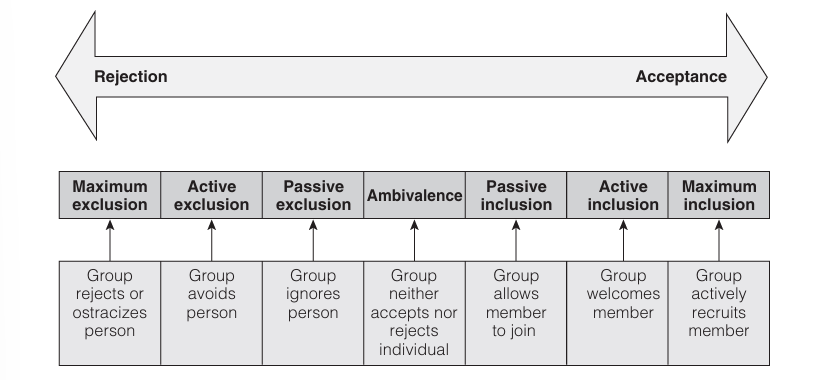
REACTIONS TO EXCLUSION
Most people respond very negatively to ostracism and exclusion.
Reflexive stage
characterized by a flood of negative feelings—pain, disappointment, and distress—- that all serve to signal that something is wrong.
Resignation stage
alienation, helplessness, loss of self-worth, and depression.
FIGHT OR FLIGHT RESPONSE
A common reaction of people when they face stressful, threatening circumstances, and William suggested that it is motivated by a desire to gain a sense of control in a deleterious situation.
A physiological and psychological response to stressful events characterized by the activation of the sympathetic nervous system (increased heart rate, pupil dilation) that readies the individual to counter the threat (fight) or to escape the threat (flight)
fight response
may confront group members directly, attempt to force their way into the group, insist that the group exclude someone else, or derogate those who have excluded them.
flight response
attempt to withdraw physically psychologically rather or than tolerating the inattention, they withdraw, keep to themselves, or seek acceptance by some other groups.
tend-and-befriend response
A physiological, psychological, and interpersonal response to stressful events characterized by increased nurturing, protective and supportive behaviours (tending), and initiating and strengthening relationships with other people (befriending).
cybeostracism
Excluding one or more individuals from a technologically mediated group interaction, such as a computer-based discussion group, by reducing or eliminating communication with the person.
EXCLUSION AND AGGRESSION
the need to belong is a powerful force in human behaviour, so much so that individuals can respond violently when the need is thwarted.
terrible acts and violence caused by exclusion are tied together by a common thread; REJECTION
INCLUSION IN HUMAN NATURE
The Herd Instinct
the idea that humans are instinctively drawn to gather with other humans is not a new one
psychologist William McDougall (1908) argued that humans are inexorably drawn to “the vast human herd,” which “exerts a baneful attraction on those outside it”
Evolutionary psychology uses Charles Darwin’s theory of natural selection to explain why contemporary humans act, feel, and think the way they do
Sociometer Theory
feelings of self worth function not as an index of one's sense of personal value but instead an indicator of acceptance into groups.
A conceptual analysis of self-evaluation processes that theorizes self-esteem functions to psychologically monitor of one’s degree of inclusion and exclusion in social groups (proposed by Mark Leary).
The Biology of Ostracism and Inclusion
Naomi Eisenberger: “Because of the importance of social connection for human survival, the social attachment system—which ensures social connection—may have piggybacked directly onto the physical pain system, borrowing the pain signal itself to indicate when social relationships are threatened.”
The pain of exclusion is neurologically similar to pain caused by physical injury
Inclusion triggers a different set of physiological events: Lowered heart rate and blood pressure and an increase in neuropeptide levels and hormone oxytocin.
Individuals who are sensitive to pain are also more likely to respond more negatively to social rejection.
When left out of a group activity, two specific areas of the brain—the dorsal anterior cingulate cortex (dACC) and the anterior insula—were particularly active.
Painkillers that relieve physical pain can also relieve the pain from social exclusion.
FROM INDIVIDUALISM TO COLLECTIVISM
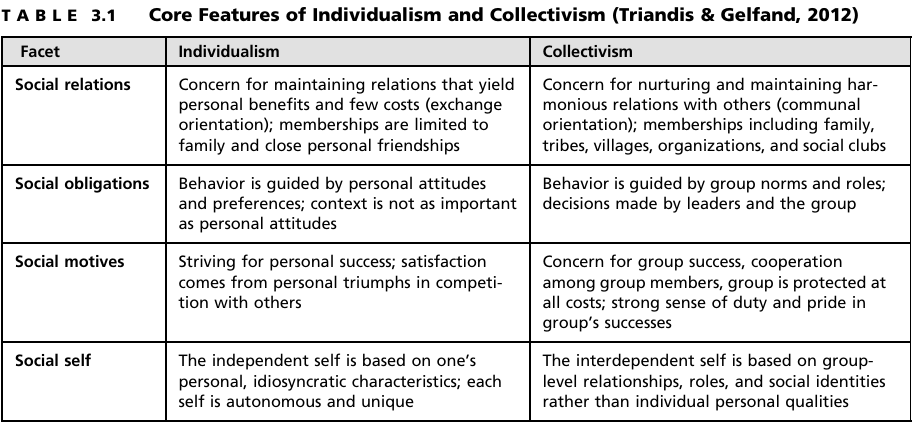
Individualism
is based on the independence and uniqueness of each individual.
A tradition, ideology, or personal outlook that emphasizes the primacy of the individual and his or her rights, independence, and relationships with other individuals
Collectivism
recognizes that human groups are not mere aggregations of independent individuals, but complex sets of interdependent members who must constantly adjust to the actions and reactions of others around them
A tradition, ideology, or personal orientation that emphasizes the primacy of the group or community rather than each individual person.
As cross-cultural psychologist Harry C. Triandis explains, “The essence of collectivism is concern for the effect of one’s actions on other people”
Triandis (2009) emphasizes four core elements in his theory of individualism-collectivism: the significance of social relations, acceptance of social obligations, shared goals, and changes in group members’ self-conceptions
Social relation
Exchange relationship
A reciprocal interdependency that emphasizes the trading of gratifying experiences and rewards among members.
Communal relationship
A reciprocal interdependency that emphasizes meeting the needs and interests of others rather than maximizing one’s own personal outcomes.
Norm of reciprocity
A social standard that enjoins individuals to pay back in kind what they receive from others.
that requires members to pay back in kind what others give to them. The members cooperate with others, but they do so to pay back past favours and to create obligations for future favors.
Social Obligation
Group culture
psychologist Edgar Schein explains, “Any definable group with a shared history can have a culture” and “once a group has learned to hold common assumptions, the resulting automatic patterns of perceiving, thinking, feeling, and behaving provide meaning, stability, and comfort”
The distinct ways that members of a group represent their experiences, including consensually accepted knowledge, beliefs, rituals, customs, rules, language, norms, and practices.
In collectivistic groups, members have mutual obligations and have no right for disagreement or disrupting group activities.
In individualistic groups, members are expected to act on the basis of their attitudes, beliefs, and preferences.
Ultimatum game
An experimental bargaining situation in which one individual, the allocator, must propose a division of a shared resource to other members; if they reject the allocator’s proposal, no one receives any of the resources.
Social Goals
equity norm
A social standard that encourages distributing rewards and resources to members in proportion to their inputs.
means people should get rewards equal to what they put in. The more you contribute, the more you should receive.
equality norm
A social standard that encourages distributing rewards and resources equally among all members.
says everyone gets the same reward, regardless of their contribution. In groups that value togetherness (collectivistic), means everyone shares equally, even if only one person is responsible for the success
Social Self
personal identity
An individual’s perception of those aspects of his or her self-concept that derive from individualistic, personal qualities such as traits, beliefs, and skills.
is what makes you unique, like your personality and skills
social identity ( or collective self)
An individual’s perception of those aspects of his or her self-concept that derive from his or her relationship with other people, groups, and society
is how you're similar to others, like your connections to groups
individualist
prioritize independence and uniqueness
Individualspredisposedtoput their own personal interests and motivations above the group’s interests and goals
collectivists
emphasize interdependence and social connections
Individuals predisposed to put the group’s interests and goals above their personal interests and motivations.
CULTURAL DIFFERENCES
Western cultures, like the US and some European l, tend to be more individualistic. Many Asian, African, Eastern European, and Middle Eastern countries are generally more collectivistic. Latin and South America show more variation
Maintaining Optimal Distinctiveness
Optimal Distinctiveness Theory
proposed by social psychologist Marilynn Brewer (2012), argues that most people have at least three fundamental needs:
the need to be assimilated by the group,
the need to be connected to friends and loved ones,
and the need for autonomy and differentiation.
A conceptual analysis that assumes individuals strive to maintain a balance between three basic needs: the need to be assimilated by the group, the need to be connected to friends and loved ones, and the need for autonomy and differentiation (proposed by Marilyn Brewer).
FROM PERSONAL IDENTITY TO SOCIAL IDENTITY
identity
is shaped by both personal characteristics and group affiliations
Social Identity Theory
A theoretical analysis of group processes and intergroup relations that assumes groups influence their members’ self-concepts and self-esteem, particularly when individuals categorize themselves as group members and identify with the group.
minimal intergroup situation
A research procedure used in studies of intergroup conflict that involves creating temporary groups of anonymous, unrelated people (developed by Henri Tajfel and John Turner).
two key cognitive processes
Social Categorization
The perceptual classification of people, including the self, into categories.
stereotypes ( or prototypes)
A socially shared set of cognitive generalizations (e.g., beliefs and expectations) about the qualities and characteristics of the typical member of a particular group or social category.
self-stereotyping ( or auto-stereotyping)
Accepting socially shared generalizations about the prototypical characteristics attributed to members of one’s group as accurate descriptions of oneself.