Insects and People: Internal Anatomy of Insects
Respiration - Tracheal System
Tracheal System: a complex network of silvery air tubes that lead from the spiracles on the body surface to practically all cells of the body. This is how ==oxygen gets to the tissues== (NOT BY THE HEMOLYMPH) of the circulatory system.
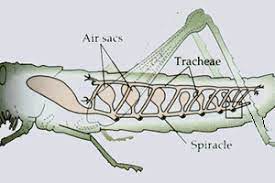
A sort of breathing is possible by expanding and compressing the body while alternately ==opening and closing different spiracles==. Still, oxygen must diffuse through the smaller tracheae to reach the cells.
VOCAB:
- Spiracles: an external respiratory opening, each of a number of pores on the body of an insect
- Hemolymph: an insect’s blood
- Circulatory system: the system that circulates blood through the body
Aquatic Adaptations
Aquatic insects obtain oxygen in three major ways:
- Air tubes: these extend spiracles to water surface, like a snorkel
- Bubbles: these are taken from the water’s surface, carried over surface of body where spiracles are located
- Gills: these are structures which obtain dissolved oxygen from the water itself and supply it to the tracheal system
Digestion - Three Guts
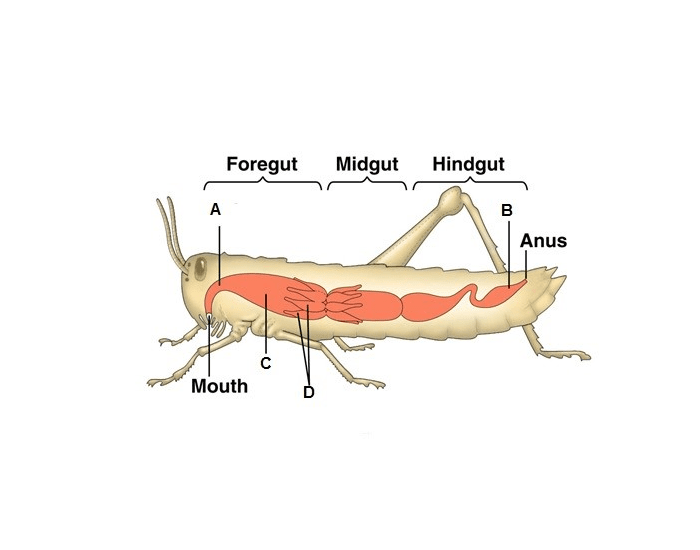
This generalized gut contains most of the digestive structures found in most insects. Insects with various foods have widely differing digestive systems.
The insect gut is made of three guts:
- Foregut: where food is temporarily stored and grinded down before digestion
- Midgut: where most of digestion and absorption takes place to absorb nutrients from the food
- Hindgut: where waste is prepared for excretion and water is preserved
The Malpighian tubes are located between the midgut and the hindgut, and they pick up nitrogenous waste from the insect’s blood. Meanwhile, mammals produce nitrogenous waste as urine. Since ==insects want to conserve water,== they excrete uric acid.
Excretion - Spaghetti
Malpighian Tubules: blind tubes that open into the junction of midgut and hindgut. They sway around in the hemolymph. ==Nitrogenous waste== (from protein metabolism) is removed from the hemolymph and passed out with feces.
==Most common wastes:==
- uric acid: in terrestrial insects and birds (requires little water)
- Ammonia: in aquatic insects (toxic, so requires more water to flush out)
Circulation - Slosh System
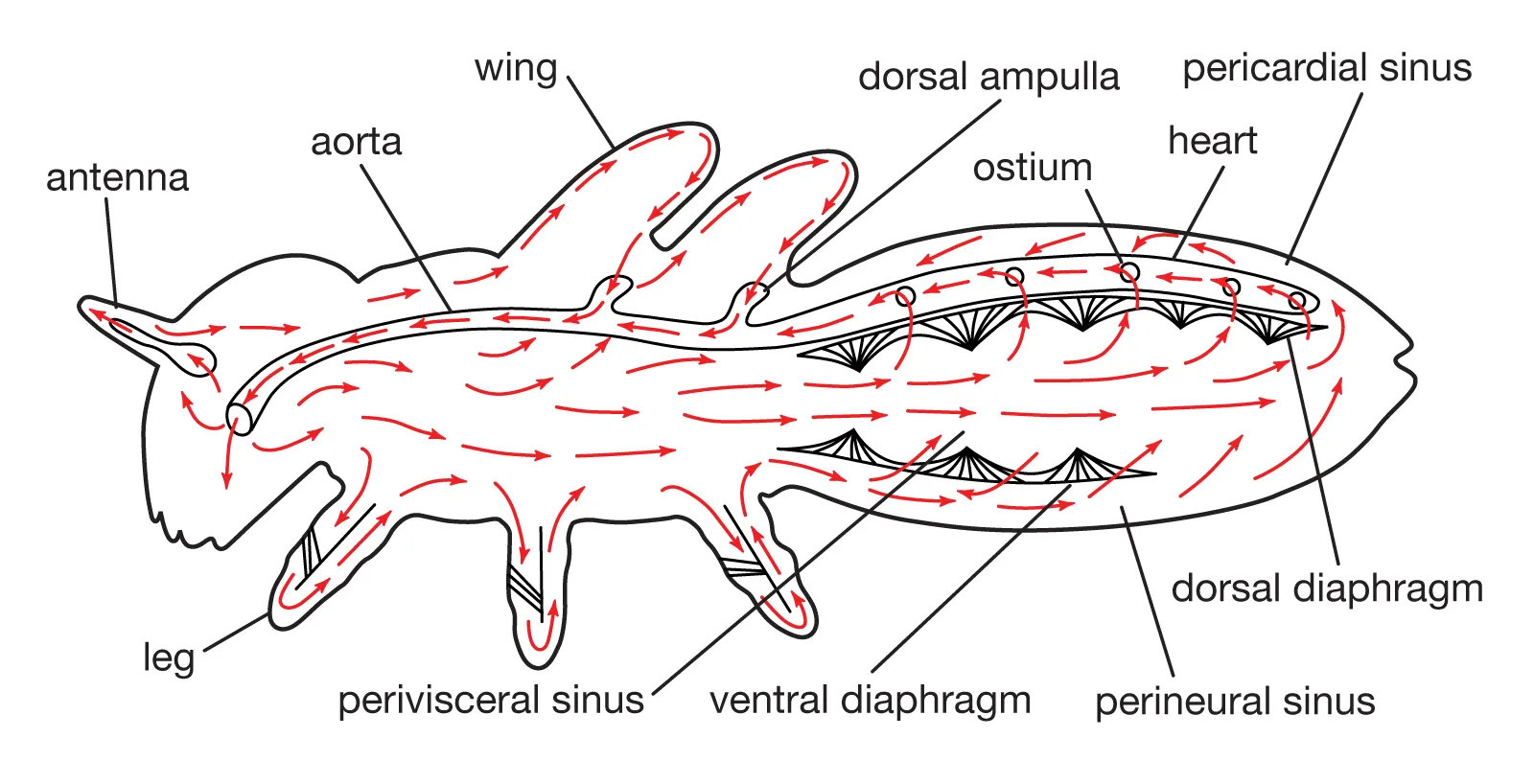
Hemolymph: insect blood; it contains plasma and blood cells (==hemocytes==)
- Primary functions:
- Acts as a lubricant and hydraulic
- ==Transport== - chemical food, waste, hormones
- ==Internal defense== - against pathogens
Hemocoel: the blood cavity that surrounds all organs and bathes them in hemolymph.
- Thus insects, have an ==“open” circulatory system.==
Dorsal Vessel: consists of two parts:
- heart: takes in hemolymph in the abdomen, pumps it forward (anteriorly)
- aorta: conducts hemolymph through the thorax to head
Diaphragms: channel the flow of hemolymph so that it is distributed throughout the body
Accessory Hearts: ==pump hemolymph into wings==, legs, and other remote structures
Storage - Fat Body
Fat Body: stores most chemical food, like fats, carbohydrates, and proteins.
- It also serves to transform these chemicals into various products needed by the body (i.e. intermediary metabolism)
It is an irregularly shaped tissue found throughout the body, particularly in the abdomen.
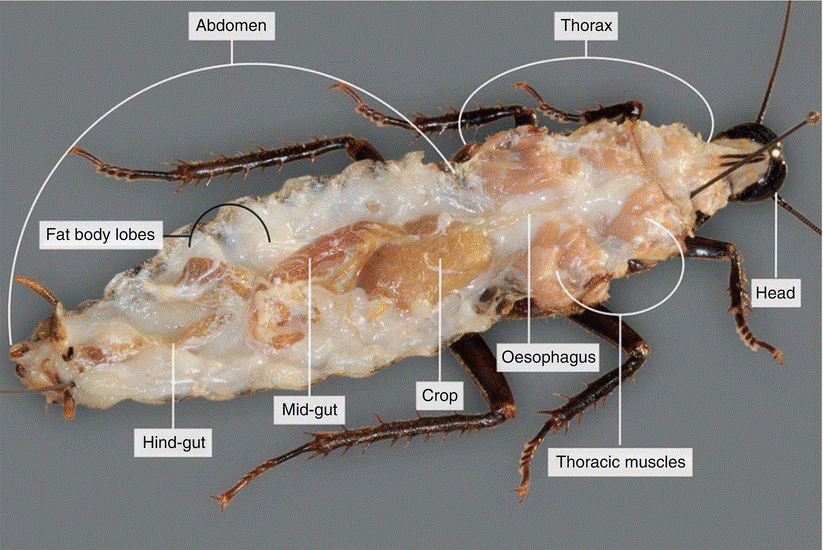
A well-nourished insect often has so much fat body that other organs of the abdomen are obscured.