MABKOM LONG EXAM 1.2
Stuff we dont need to study:
Dont study the Theories of Wika (Mga stupid terms)
Don’t memorize the speaking of Dell Hymes but maybe his models so read it sometimes
Speech Act Theory*
TIPS:
NOT ALL TUNOGS ARE TINUTURING WIKA
WIKA IS ARBITRARY, U CANT REALLY EXPLAIN IT
communication came from the latin word “communis” which means “common” “shared” “public”
Katuturan ng Komunikasyon
Ang komunikasyon bilang proseso
Ito ay tuloy-tuloy na proseso. Nagaganap sa pakikipagtalastasan at maaaring maiimpluwensiya sa ating pagiisip
Ang komunikasyon as “systemic”
Magkakaugnay sa isa’t isa ang bawat elemento ng proseso ng komunikasyon
Ang mga simbolo ay sinasabing abstrakto, malabo, ang kahulugan, at arbitraryo
Dahil ito ay hindi kongkreto o hindi nahahawakan (intangible)
Arbitraryo rin ang simbolo dahil walang natural o katutubong relasyon ang mga simbolo sa mga bagay na kanilang nirerepresenta, ang mga pagpapakahulugan sa mga ito ay napagkasundang lamang.
Malabo o di tiyak ang kahulugan ng mga simbolo.
Ito rin ay kahulugan. Ito ay itinuturing na buod o ubod o kaluluwa ng komunikasyon. Hindi likas ang kahulugan sa karanasan. Ang tao ng lumulikha nito sa pamamagitan ng pakikipagtalastasan.
ANTAS O LAWAK NG KOMUNIKASYON
1.) KOMUNIKASYON INTRAPERSONAL
Pakikipagusap sa sarili bagama’t maaaring sabihing ibang katawagan
Halimbawa: Talking to urself
2.) KOMUNIKASYON INTERPERSONAL
Ito ay komunikasyon sa pagitan ng mga tao
Halimbawa: Debate, pakikipagusap,
3.) PANGKATANG KOMUNIKASYON
4.) PAMPUBLIKONG KOMUNIKASYON
5.) KOMUNIKASYON MASS MEDIA
6.) KOMUNIKASYONG INTERKULTURAL
LAYUNIN NG KOMUNIKASYON
Pagtugklas o pagkilala sa sarili (Self)
Pagtulong sa kapwa (Others)
KOMUNIKASYONG BERBAL
pasulat o pasalita
Ayon kay De Vito (2003)
MGA KATANGIAN NG WIKA BILANG SISTEMA NG KOMUNIKASYON
1.) Ang kahulugan ng wika ay NAGMUMULA SA TAO
2.) Ang kahulugan ng wika ay NAKABATAY SA KONTEKSTO
3.) Ang kahulugan ng wika ay KAPUWA DENOTATIBO AT KONOTATIBO
Denotatibo - meanings u can get sa dictionary, literal meaning
Konotatibo - metaphor, feelings, ibang kahulugan
4.) Ang kahulugan ng wika ay MAAARING TAHAS O MALIGOY
Tahasang pananalita - ito’y pagpapahayag ng walang kinikilingan, pag-iisip, damdamin na nais iparating (STRAIGHT TO THE POINT)
Di-Tuwirang Pananalita - maligoy o paulit-ulit na lamang na paraan
Pahiwatig - Ito ay isang katutubong pamamaraan ng pagpapahayag na di-tuwirang ipinaaabot ngunit nababatid at nahihiwatigan ng matalas na pakiramdam at matunog na pagbabasa ng mga berbal at di berbal na palatandaang kaakibat nito
5.) Ang kahulugan ng wika ay INSTITUSYONG PANGKULTURAL
EPEKTIBONG GAMIT NG BERBAL NA MENSAHE
“Conceptual Distortion”
Tulad ng mga maling pag-aakala, lihis na paniniwala, mga maling pangangatwiran, maling pagpapakahulugan sa tuwing nakikipagtalastasan
MGA ANYO NG CONCEPTUAL DISTORTION:
1.) Ang wika ay SUMASAGISAG LAMANG SA REALIDAD, HINDI ITO ANG REALIDAD
meaning not everything u read is real
Ang oryentasyong intensyonal ay isang tendensiya na tingnan ang mga tao, bagay o pangyayari batay sa kung ano ang sinabi ng ibang tao o kung anong leybel ang ikinapit sa kanila. (Intentional Orientation)
2.) Ang wika ay NAGPAPAHAYAG NG KAPUWA KATOTOHANAN AT HINUHA
3.) Ang wika ay HALOS ISTATIK
Ang ebalwasyong istatik ay isang “conceptual distortion” na tumutukoy sa tendesiyang panatilihin ang mga ebalwasyong ibinigay natin sa mga tao o bagay
Basically the tendency to see people or things based on how they were before and when in reality they changed
4.) Ang wika ay NAKAPAGKUKUBLI NG MGA PAGKAKAIBA SA PAGITAN NG MGA TAO O PANGYAYARI
Indiskriminasyon
Failure to see or differentiate between people ore events because they fall into a general category
10 DALUYAN O TSANEL NG KOMUNIKASYON
1.) Ang Katawan (KINESICS)
SAGISAG (EMBLEM)
TAGAPAGLARAWAN (ILLUSTRATORS)
PAGKONTROL NG BERBAL NA INTERAKSIYON (REGULATORS)
PANDAMDAM (AFFECTS DISPLAY)
KASANGKAPAN SA PAGSASAGAWA NG BAGAY (ADAPTORS)
2.) Ang Mukha
3.) Ang Mata (Oculesics)
Eye contact
4.) Espasyo o Distansya (Proxemics)
Espasyong Intimate (Close Distance)
Espasytong Personal (Comfort Zone)
Espasyong Sosyal (Halubilo sa other people)
Pampubliko (Audience)
5.) ARTIFACT
6.) PAGHIPO (HAPTICS/TOUCH)
Pinakaprimitibong anyo ng komunikasyon
Naghahatid ng ibang
7.) PARALANGUAGE
8.) PANANAHIMIK
9.) ORAS AT PANAHON (CHRONEMICS)
10.) PANG-AMOY (OLFACTORY)
ELEMENTO O SANGKAP NG KOMUNIKASYON
1.) Tagahatid - PINAGMULAN NG MENSAHE
2.) Mensahe - SALITA
3.) Tsanel - DALUYANG GAMIT
4.) Tagatanggap
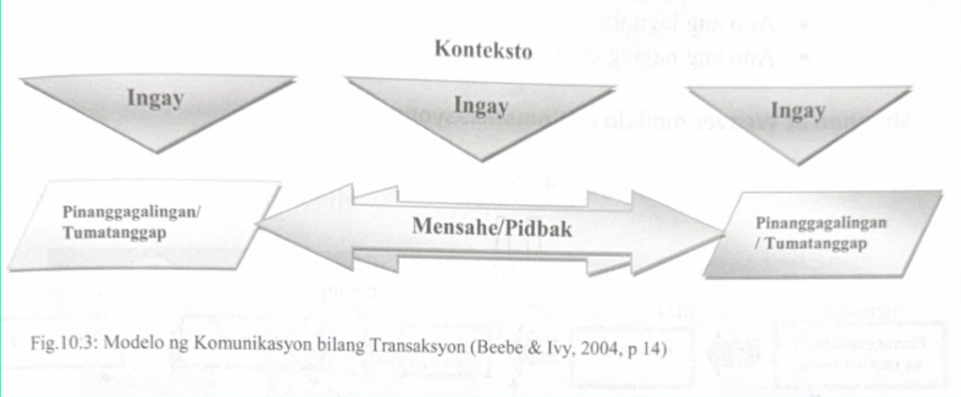
5.) Ganting Mensahe (FEEDBACK)
6.) Hadlang (OBSTACLE)
7.) Konteksto (CONTEXT)
8.) SISTEMA (SYSTEM)
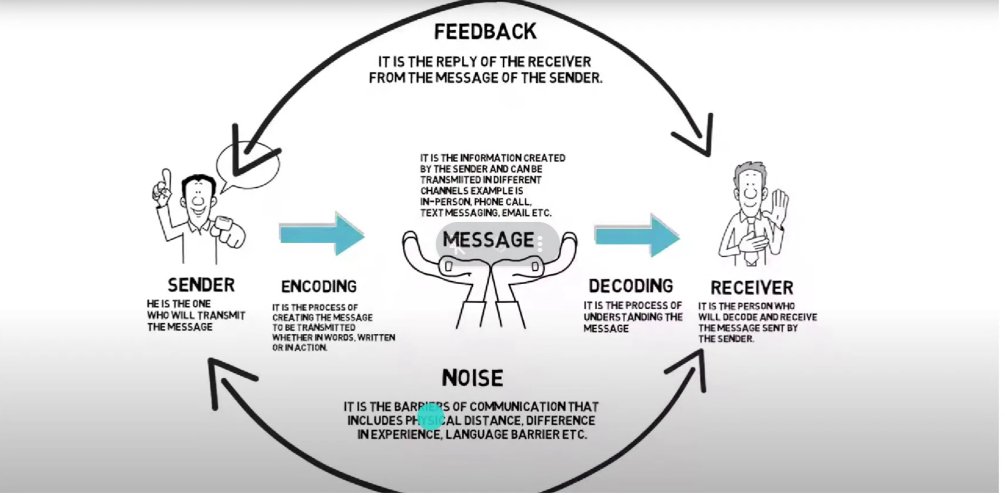
Modelo ng Komunikasyon
BEEBE AND IVY:
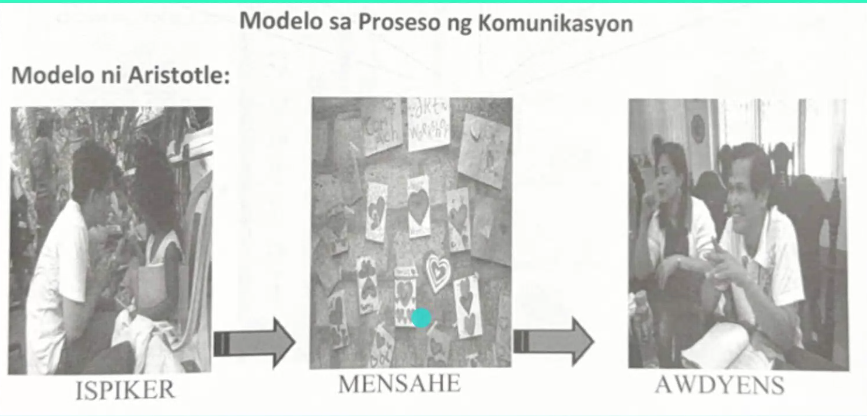
ARISTOTLE:
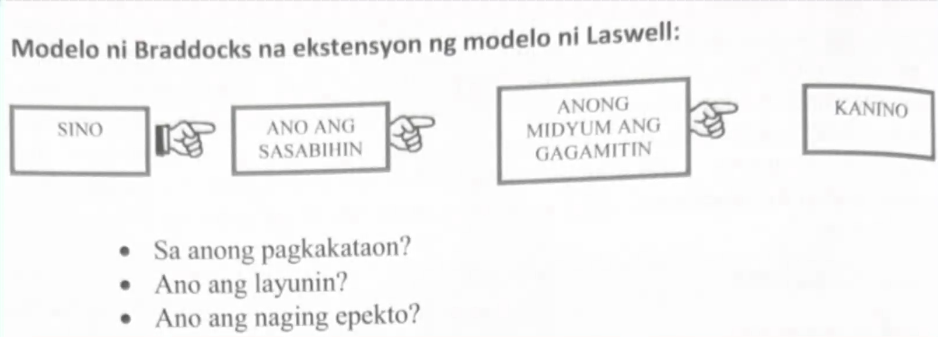
BRADDOCKS NA EXTENSYON NG MODELO NI LASWELL:
SHANNON AT WEAVER:
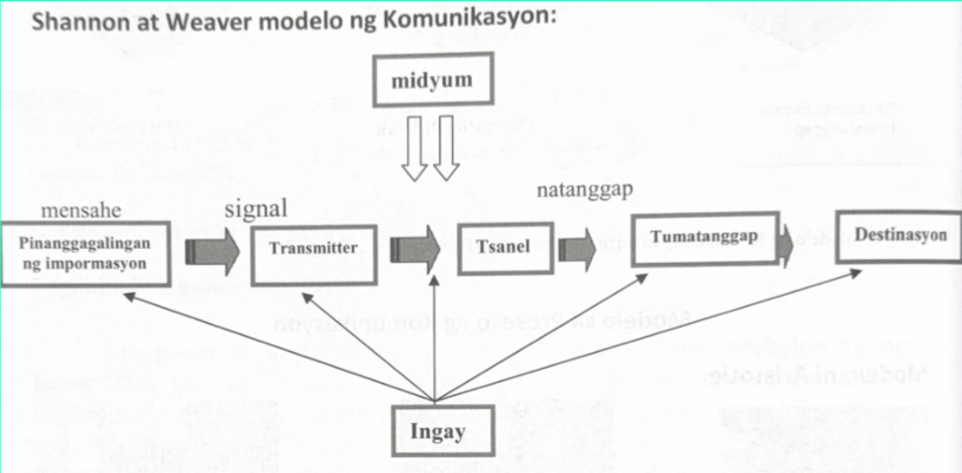
READ PAGE 10 OF MGA BATANG TEORYA SA VARAYTI AT VARYASYON NG WIKA
The Communication Accommodation Theory by Howard Giles explains why people adjust their speech depending on their listener and the social situation. Speakers may converge (imitate or match the language, accent, dialect, or paralanguage of others) to reduce social distance, or diverge (emphasize their own speech style) to highlight social differences and identity.
Giles encouraged applying this theory across various social and cultural contexts, and studies have shown its relevance in mass media, families, students, the elderly, and more.
The theory highlights that language is dynamic—it shifts based on society, education, economic status, and context. Even small changes in speech can signal one’s social standing, personality, or intelligence. Thus, CAT is important in understanding the role of language in human interaction.
TWO TYPES:
Convergence – This occurs when a speaker tries to adapt or align with the speech of their listener to reduce social distance. Examples include baby talk when speaking to a child, speaking slowly and clearly to foreigners, or imitating the tone/intonation of another dialect like Ilonggo or Maranao adapting their accent.
Divergence – This happens when a speaker seeks to emphasize their differences and maintain their social or cultural identity. They use words, accents, or expressions that highlight their background or status. Examples include Annabelle Rama using “Day/Dayna” (a Visayan marker), or a wealthy person choosing the term “muchacha” instead of “kasambahay” to stress social class.
TEORYANG INTERLANGUAGE
The Interlanguage Theory describes the temporary linguistic system created by learners of a second language (L2) that is distinct from both their first language (L1) and the target language. It is also called an approximative system or transitional competence.
Learners construct their own grammatical rules as they progress, and their “errors” are seen not as failures but as signs of language development. However, when certain errors become permanent and resistant to correction, this phenomenon is known as fossilization.
Examples include different varieties of English (Filipino English, Japanese English, Singaporean English, etc.), which approximate standard English (American or British). Interlanguage exists on a continuum—some learners may nearly reach native-like proficiency, while others remain with fossilized features, such as consistent mispronunciations (“picksure” for “picture”).