Geography Ecosystems Knowledge organiser
Key Climate Location and Climate:
Tropical Rainforest-
Along equator Asia, Africa / South America 6% of earth’s surface, largest in South America and Brazil
25°C – 30°C and over 250mm rain per month.
Tropical Grasslands (Savanna)-
Between equator and tropics. 20 – 30°C and between
500 - 1500mm of rain per year. Wet and dry seasons.
Deserts -
Over 30°C and less than 250 mm per year rain.
Hot deserts are distributed between 20-30o North and south of the Equator. The largest example is the Sahara Desert in North Africa. There are no hot deserts found in Europe.
Deciduous forests Higher latitudes (W Europe, N America, New Zealand-
20°C and between 500 – 1500 mm rain per year. 4 distinct seasons. Lose leaves in the winter to cope with the cold.
Found in the Northern Hemisphere with the largest In Europe
Tundra- Above 60°N (Arctic Circle)-
Less than 10°C and less than 500mm per year rain. Cold, icy and dry means 2 month growing season.
The Thar Desert
North West India
Mostly in the Indian state of Rajasthan
Border of India and Pakistan
Thar desert is one of the major hot deserts of the world Most densely populated desert in the world Covers 200,000km2
The Thar Desert can exceed 50ºC in the summer.
Challenges in the Thar desert :
The Thar Desert can exceed 50ºC in the summer.
Water supply is an issue due to population growth and farming development. There are very few rivers, such as the river Luni, and these are intermittent.
There is a very limited road network across the desert. High temperatures can melt the tarmac and strong winds often blow sand over the roads.
Opportunities in the Thar desert:
India’s largest wind farm, the Jaisalmer wind Park, was constructed in 2001.
Rajasthan canal, built in 1958, is 650km long and has made irrigation possible allowing the growing of wheat and cotton.
Bhaleria solar power plant uses the ideal sunny, cloudless skies, for solar power generation.
At Jaisalmer the Sanu limestone is the main source of limestone for India’s steel industry.
The best opportunities in a case study environment will always be Renewable energy as it is sustainable so will be better for future economic developments, better for the future of the environment, and provide long term jobs for people.
Hot deserts
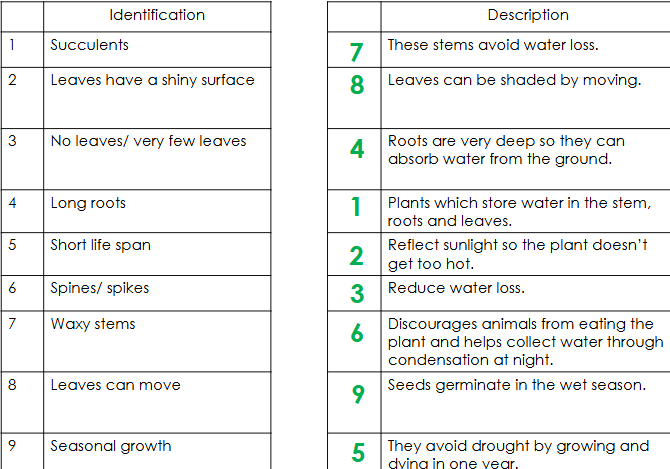
Xerophytic- Plants with desert appropriate adaptations
Cactus adaptations:
Roots close to the surface
Pleated skin to absorb water
Needles to prevent being eaten
Stores water and nutrients in a cavity inside
Thick skin to reduce/ stop water loss through transpiration
Camel adaptations:
Hump that stores fat
Thick hairs in their ears to keep sand out
Thick eyelashes
Closable nostrils
Problematic topics:
TWD
Causes of deforestation
Protecting rainforests
Desertification
Small scale ecosystems