Chapter 13
Coming Apart: Separation and Divorce
Goals:
Differentiate b/n the types of divorce, including legal definitions, stations of divorce, and gray divorce.
Compare and contrast ways in which we measure divorce rates in the US
Summarize the existing trends, patterns, factors, and processes that relate to divorce within American families today.
Describe the recent substantial decline in divorce, especially among millennials.
Identify the various processes associated with separation, divorce, and establishing new relationships and identities as a separate individual.
Describe how the process and outcomes of divorce vary by couple.
Describe divorce among same-sex couples.
Explain how divorce impacts children, including child rearing, custody, residential stability, socialization, and development throughout the life course.
Examine the impacts of divorce on economic stability, standards of living, employment, health coverage, and mental health.
identify the social and legal responses to divorce and child custody that currently affect families of divorce in the US today.
Intro
are we being too soft on marriage and that’s the reason people divorce?
This chapter goes over the many aspects of divorce
relative risk factors involved
the process of separating
the experiences and outcomes of divorce for men, women, and children
policy matters of
joint custody, no-fault divorce, mediation, and covenant marriage
The meaning of Divorce
some suggest divorce reflects an idealization of marriage
not a devaluation or rejections
Initially such a notion might raise an eyebrow
many reason whose who DO divorce WOULDNT divorce if they did not have such high expectations of marriage
so much hope of fulfillment of various needs in their spouses
Smith (2010) suggests divorce papers to be a significant part of the contemporary marriage system
representing driving force of American culture
Americans simultaneously highly value both marriage and individual fulfillment
Failing to find the individual fulfillment they desire, expect and SEEK in marriage they tend to divorce and keep looking.
High divorce rate could also indicate less people believing in the permanence of marriage
in this regard, the never-married adults of today believe that they would still like to get married in the future, but have no REAL explanation as to why they currently aren’t
3 in 10 people say they have not found that special someone with the qualities they are looking for.
27% say they aren’t financially stable enough to be involved in a marriage
22% argue that they’re ready to settle down or are just too young for that significant level of commitment
Other reasons
still being currently involved in school (3%)
have some other reason that doesn’t fit the categories (14%)
Legal Meaning of Divorce
Divorce is a terminating of one’s marriage
Once upon a time it meant the actions of one of the spouses had permanently damaged the marriage to such a degree that the marriage suffers form something that cannot be fixed
Fault-based divorce - Adversarial process of divorce in which one spouse alleges that the other has committed an act that has caused the marriage to break down or had failed to act in ways that would preserve the marriage.
examples
adultery
cruel and inhumane treatment
mental cruelty
habitual drunkenness
disertion
No-fault divorce - The dissolution of marriage because of irreconcilable differences for which neither party is held responsible.
can claim irreconcilable differences make it impossible for them to continue as marries
Divorce is not the only way a marriage can be ended.
Annulment and desertion are two other means of ending or exiting an existing marriage.
The differences?
Divorce- spouses agree that the relationship has failed or one spouse proves that the other committed an act that caused the marriage to fail
Annulment - granted when it is determined the marriage has never met the legal requirements of marriage
Desertion - when one spouse simply leaves, leaving the other spouse in legal limbo because he or she technically remains married to the absent spouse.
The Multiple Realities of Divorce
Stations of divorce - The multiple experiences people have as their marriages end
Paul Bohannen wanted to recognize the complex and multidimensional nature of the divorce experience in the lives of those who divorce. Developing adescriptive model of the divorce process that focused on the multiple experiences of people have had when their marriages ended
emphasizing these components of divorce
emotional
legal
economic
co-parental
community
psychic stations
These “stations” neither have a particular order nor begin and end simultaneously.
The stations
Emotional divorce - when one spouse (or both) begins to disengage form the marriage and starts to feel that “something isn’t quite right,” begins well before the legal divorce. But even as divorce papers are filed, one or both of the partners may find themselves feeling ambivalent. Because emotional divorce is not complete, they may try to reconcile.
Legal divorce - court-ordered termination of a marriage. By the time a couple is legally divorces, much has happened. The legal the time a couple is legally divorced, much has happened. The legal decree permits divorced spouses to remarry and conduct themselves in a way that is legally independent of each other. Of course, legal “independence” may be an overstatement, as a divorce decree sets the terms for the division of property and child custody, issues that may lead to bitterly contested and/or recurring divorce battles. Many other unresolved issues surrounding a divorce, such as feelings of hurt and betrayal, may be acted out during the legal divorce. No-fault divorce was, in part, intended to minimize these issues.
Economic divorce - makes the economic aspect of marriage painfully apparent. Property acquired during a marriage is considered join martial property and must somehow be divided between the divorcing spouses. The settlement is based on the assumption that each spouse contributes to the estate. this contribution may be non-monetary, as in the case of traditional homemakers whose support and practical assistance enables their husbands to work outside the home. As part of the economic divorce, child support and, less often, alimony may be ordered by the court. As the partners go their own ways, husbands and wives often experience different consequences in their standards of living as they set up separate households and no longer pool their resources. Women usually experience a decline in their standard of living, whereas men sometimes see theirs increase.
Co-parental divorce - is experienced when a couple has children. Parenthood and parental responsibility persist even after marriages end. Even those parents who never see their children remain fathers and mothers. The co-parental divorce is among the most complicated aspect of divorce because it also gives rise to single-parent families and, in most cases, stepfamilies. As parents of divorce, issues of child custody, visitation, and support must be addressed. With divorce, new ways of relating to the children and former spouses must be developed, ideally keeping the children’s best interest foremost in mind.
Community divorce - when people divorce, their social world changes. In-laws become ex-laws; often they lose (or stop) contact. (This is particularly troublesome when in-laws are also grandparents.) Friends may choose sides or, not wanting to be caught in the middle, drop out; they may not be as supportive as desires. New friends may replace old ones as divorced men and women begin dating again. They may enter the singles subculture, where activities center on dating. Single parents may feel isolated form such activities because child rearing often leaves them little or no time or leisure and diminished income leaves them little or no money.
Psychic divorce - accomplished when one once again feels like a separate individual and no longer feels like part of a couple. A former spouse becomes irrelevant to one’s sense of self and emotional well-being. As part of the psychic divorce, former spouses develop a sense of independence, completeness and stability, and reconstruct their identities. Navigating through the psychic station may be more difficult and take a good deal longer than it does to experience most of the other stations of divorce.
Divorce in the United States
till death do us part - before 1974
surge in divorce rates - mid 1960s and in 1974
divorce rates peaked - 1981
divorce rates level off - late 1980s
39% of all new marriages are likely to end in divorce - according to a study in 2018
Measuring Divorce: How Do We Know How Much Divorce There Is?
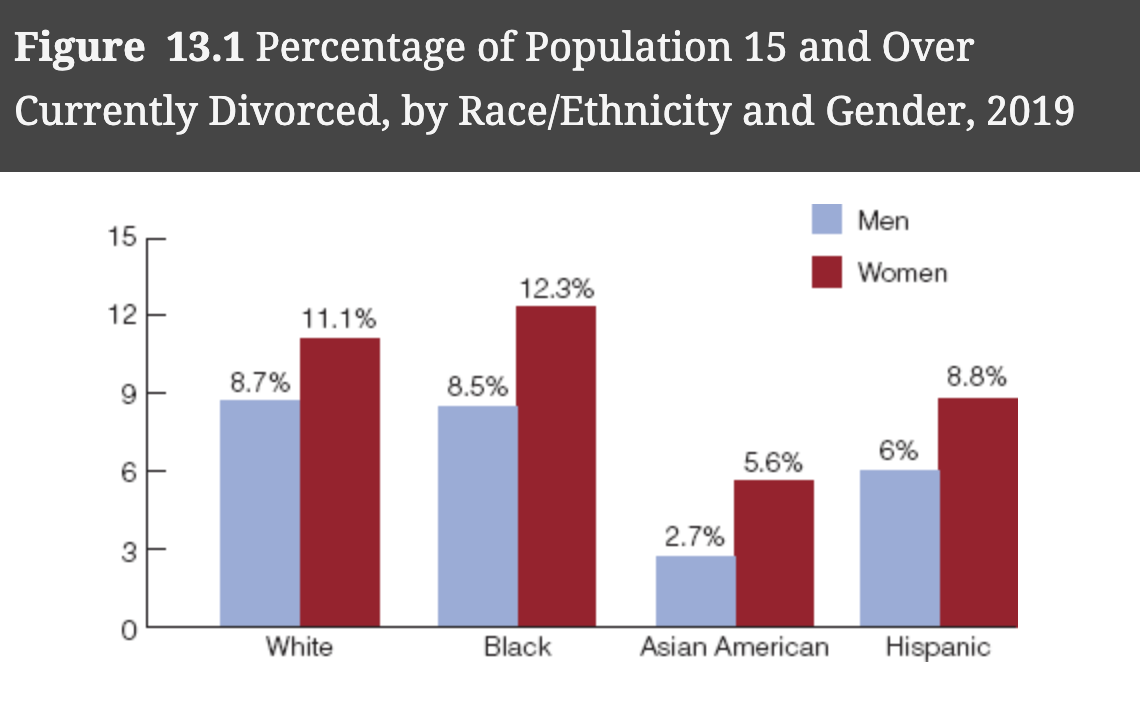
Ratio Measure of Divorces to Marriages
Ratio measure of divorce - A statistical calculation reflecting the ration of the number of divorces in a given year to the number of marriages in that same year.
calculated by taking the number of divorces and the number of marriages in a given year and producing a ratio to represent how often divorce occurs relative to marriage.
Crude Divorce Rate
Crude divorce rate - A statistical measure of divorce calculated on the basis of the number of divorces per 1,000 people in the population.
Crude divorce or marriage rates have certain problems
when calculating, counting every 1,000 people in the population means including unmarried people, children, the elderly, and the already divorced, etc.
Unmarried people cannot become divorced. Unless you want to argue philosophically on the subject matter, but no one is going that far rn.
THEREFORE, a statistic that is highly susceptible to the age distribution, proportions of married and single people in the population, and changes in such population characteristics.
Refined Divorce Rate
Refined divorce rate - A statistic reflecting the number of divorces in a given year for every thousand married couples
so this one is more accurate
measured by married women age 15 and older
YUCK married at 15!?!??! their brain isn’t developed yetttt
leading to the conclusion one out of two marriages in en divorce
Predicting Divorce
Predictive divorce rate - A statistical calculation of the expected divorce rate of people who enter marriage in a given year.
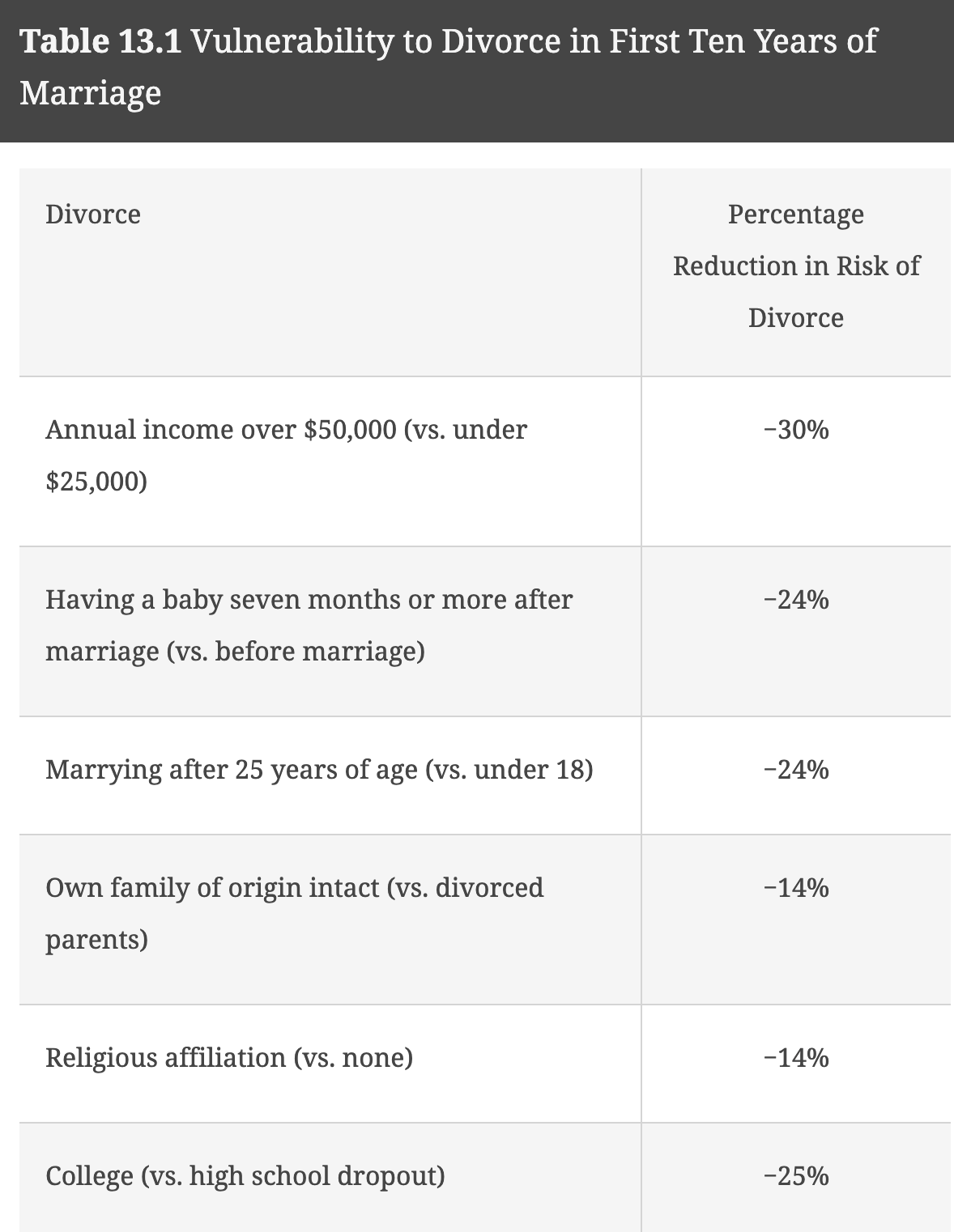
so essentially if you’re a reasonably well-educated person with a decent income, come from an intact family, and are religious, and marry after age 25 without having a baby first, you have a low chance of divorce.
Factors Affecting Divorce
Sometimes it’s easy to point to the cause of a particular divorce, other times it isn’t
example
easy - infidelity or abuse
hard - unique combo
Some analyses address the complex sets of changes that make divorce rates hard to predict.
Example
Heaton (2002) notes that there have been increases in the prevalence of premarital sex, premarital births, cohabitation, and both racial and religious intermarriage.
all these tend to be associated with higher likelihood of marital instability, especially divorce.
YET, there also have been increases in age at marriage and in educational attainment that tend to be associated with higher rates of stable marriage.
Societal factors
even the reduced divorce rates in and since the 1990’s were considerably higher than the rates early in the 20th century.
International Variation in Crude Divorce rates, 2017
Country - Divorces per 1,000
Ireland (2015) - 0.7
Italy - 1.5
Croatia, Greece - 1.5 to 1.8
Bulgaria, Iceland (2011), Romania, Turkey - 1.5 to 1.6
Poland - 1.7
China - 3.2
Japan - 1.7
Austria, France (2016), Luxembourg, Norway, United Kingdom (2016) - 1.8 to 2.0
Netherlands - 1.9
Germany, Hungary, Spain - 1.9 to 2.1
Korea - 2.1
Cyprus, Estonia, Finland, Portugal - 2.2. to 2.5
Sweden - 2.4
Denmark - 2.6
Switzerland - 1.9
Czech Republic - 2.4
Belgium - 2.0
Lithuania - 3.0
Latvia - 3.1
Other countries
Malta - 0.7
Slovenia - 1.2
Italy - 1.5
Bulgaria - 1.5
Japan - 1.7
Only 2 countries have rates that exceeded the US rate
Lithuania - 3.0
Latvia - 3.1
Changed Nature of the Family
In the Us
Agriculture → Industrial
This undermined many familial traditional functions
Important sources of child socialization and child care
schools
media
peers
Hospitals and nursing homes to manage birth and care for the sick and aged
because the family pays for goods and services rather than producing or providing them itself, its members are no longer interdependent.