16.1 Plant hormones and growth in plants
Plants show directional growth in response to environmental cues such as light and gravity - these are known as tropisms.
Chemical coordination
Key limitations of plants - they are not mobile, do not have a rapidly responding nervous system.
But they are coordinated organisms that show clear responses to their environment, communication between cells + sometimes other plants.
They have evolved hormones - these are chemicals that are produced in one region of the plant and transported both through the transport tissue and from cell to cell and have an effect on another part of the plant. (important hormones include auxins, gibberellins, abscisic acids ABA, and ethene.)
May produce chemicals which signal to other species, chemical defences against herbivores.
Plant hormones work at very low concentrations, so isolating them and measuring changes in concentrations is not easy. Multiple interactions between the different chemical control systems also make it difficult for researchers to isolate the role of a single chemical in a specific response.
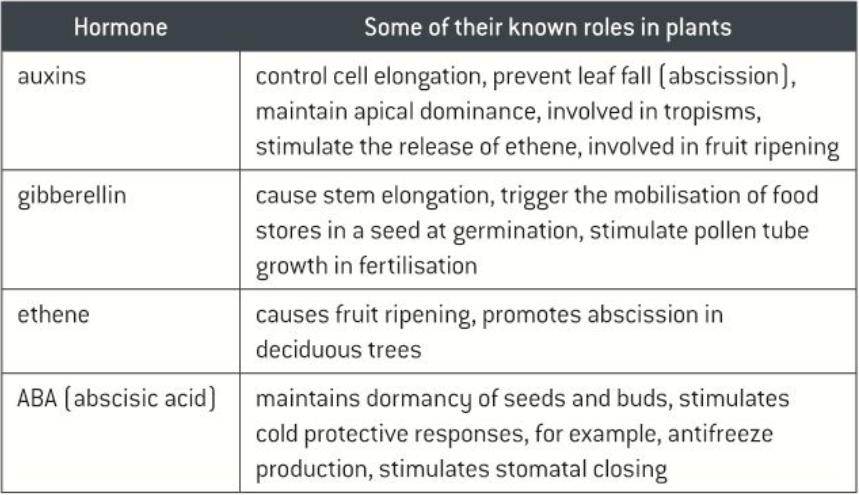
Plant hormones and seed germination
For a plant to start growing, the seed must germinate.
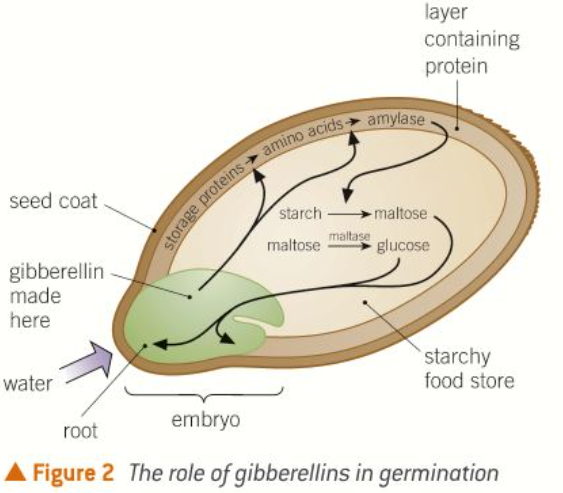
When the seed absorbs water, the embryo is activated and begins to produce gibberellins. They in turn stimulate the production of enzymes that break down food stores found in the seed.
The food store is in the cotyledons in dicot seeds and the endosperm in monocot seeds. The embryo plant uses these food stores to produce ATP for building materials so it can grow and break out through the seed coat.
Evidence suggests - gibberellins switch on genes which code for amylases and proteases - the digestive enzymes required for germination.
Also that ABA acts as an antagonist to gibberellins (interferes with the action of gibberellin) and that it is the relative levels of both hormones which determine when a seed will germinate.
Experimental evidence - supporting the role of gibberellins in germination of seeds
Mutant varieties of seeds have been bred which lack the gene that enables them to make gibberellins, these seeds do not germinate. If gibberellins are applied to the seeds externally, they then germinate normally.
If gibberellin biosynthesis inhibitors are applied to seeds, they do not germinate as they cannot make the gibberellins needed for them to break dormancy. If the inhibitor is removed, or gibberellins applied the seeds germinate.
 Plant hormones, growth and apical dominance - the growth of a plant shoot after a seed has germinated is controlled by a number of plant hormones.
Auxins
Like indoleacetic acid (IAA) are growth stimulants produced in plants, small qualities can have powerful effects. They are made in cells at the tip of the roots and shoots and in the meristems.
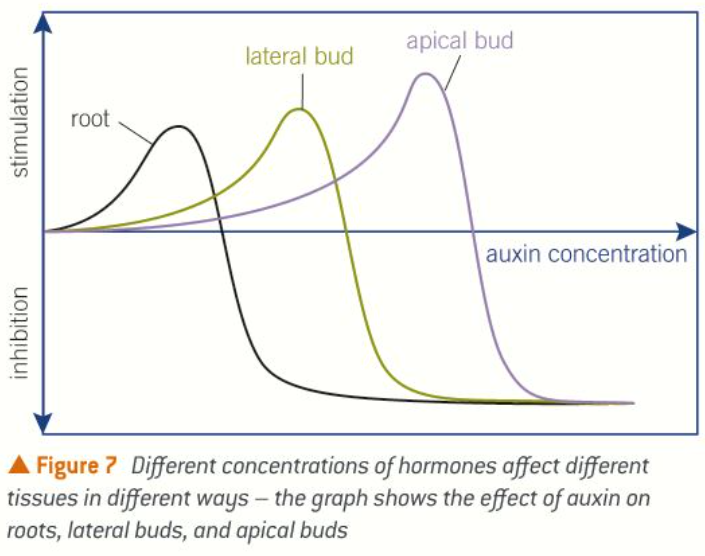
Auxins can move down the stem and up the root both in the transport tissue and from cell to cell, the effect of auxin depends on its concentration and any interactions it has with other hormones.
They stimulate the growth of the main apical shoot.
Evidence suggests that auxins affect the plasticity of the cell wall - the presence of auxins means the cell wall stretches more easily.
Auxin molecules bind to specific receptors sites in the plant cell membrane, causing a fall in the pH to about 5. This is the optimum pH for enzymes needs to keep the walls very flexible and plastic.
As the cells mature, auxin is destroyed. As the hormone levels fall, the pH rises so the enzymes maintaining plasticity become inactive. As a result, the wall becomes rigid and more fixed in shape and size and the cells can no longer expand and grow.
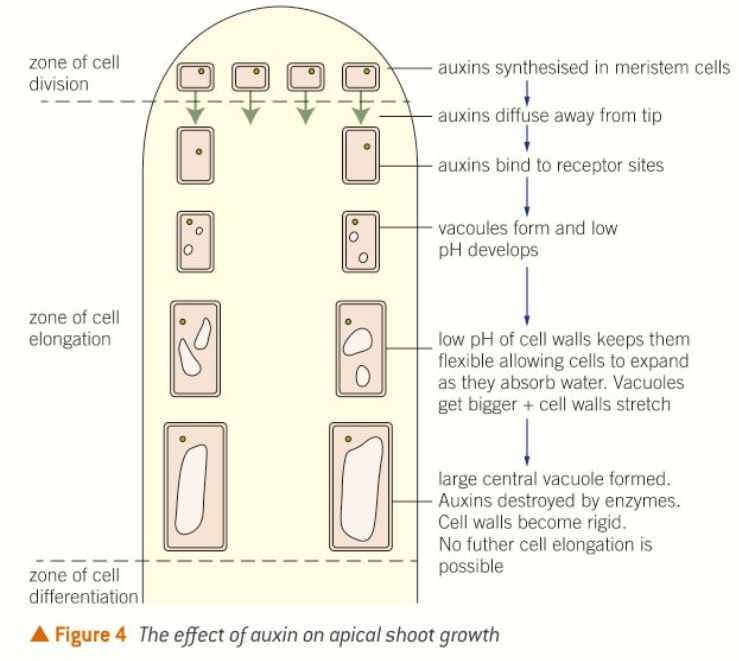
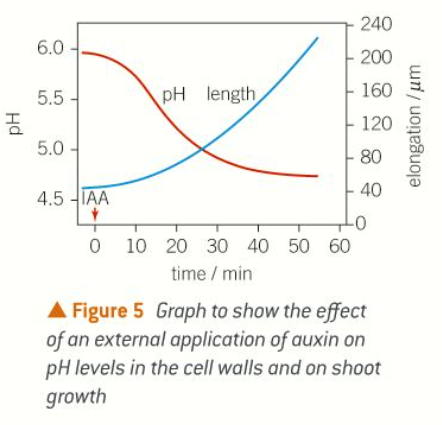
Current model: Auxin molecules bind to specific receptor sites in the plant cell membrane, activating process which pumps hydrogen ions into cell wall spaces, lowering pH to about 5, the optimum pH for the enzymes that break down bonds between cellulose microfibrils, so they slide past each other easily and the walls remains very flexible and plastic allowing cells to stretch and grow (2); graph shows decrease in pH of cell wall from almost 6 to below 5 after the application of auxin (1); this is followed by increased rate of shoot elongation from 1–2 microns per minute (1); to approximately 6 microns per minute (1); appears to confirm both change in pH and resulting increase in stretching of cell wall and growth (1). - good mark scheme answer
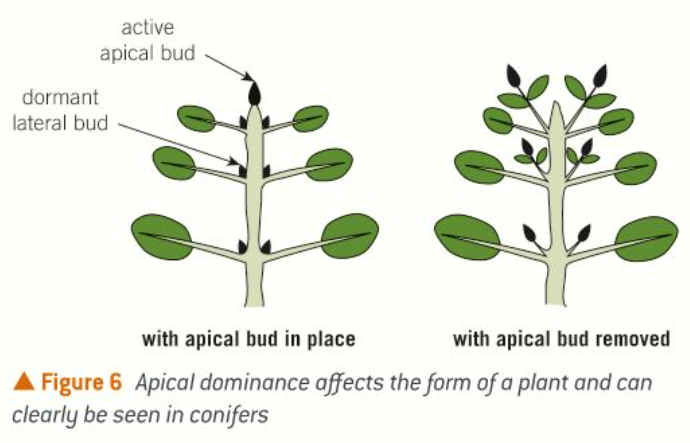
High concentrations of auxins suppress the growth of lateral shoots. → this results in apical dominance.
Growth in the main shoot is stimulated by the auxin produced at the tip so it grows quickly. The lateral shoots are inhibited by the hormones that moves back down the stem, so they do not grow very well.
Further down the stem, the auxin concentration is lower and so the lateral shoots grow more strongly.
There is a lot of experimental evidence for the role of auxins in apical dominance. For example, if the apical shoot is removed, the auxin-producing cells are removed and so there is no auxin, as a result, the lateral shoots, freed from the dominance of the apical shoot, apical dominance is reasserted and lateral shoot growth is suppressed.
Low concentrations of auxins promote root growth. Up to a given concentration, the more auxin that reaches the roots, the more they grow. Auxin is produced by the root tips and auxin also reaches the roots in low concentrations from the growing shoots.
If the apical shoot is removed, then the amount of auxin reaching the roots is greatly reduced and root growth slows and stops. Replacing the auxin artificially at the cut apical shoot restores the growth of the roots. High auxin concentration inhibit root growth.
Gibberellins
Involved in germination of seeds and important in elongation of plant stems during growth.
They affect the length of internodes - the regions between the leaves on a stem.
They were discovered because they are produced by a fungus from the genus Gibberella that affects rice, infected seedlings grew extremely tall and thin.
Scientists investigated the rice and isolated chemicals - gibberellins - which produce the same spindly growth in the plants. It was then discovered that plants themselves produce the same compounds.
Plants that have short stems produce few or no gibberellins (there are over 100 naturally produced gibberellins)
Scientists have bred many dwarf varieties of plants where the gibberellin synthesis pathway is interrupted. Without gibberellins the plants stems are much shorter, the reduces waste but also makes the plant less vulnerable to damage by weather and harvesting.
Investigating the effect of hormones on plant growth
These include growing seedlings hydroponically (in nutrient solution rather than soil) in serial dilutions of different hormones or applying different concentrations of hormones to the cut ends of stems or roots and observing effects.
In most experiments, it is important to make serial dilutions to observe the effects of different concentrations of the hormones as they can have different effects on the growth at different concentrations.
Experiments investigating the effect of hormones on plant growth usually involve large number of plants. When you have completed the measurements, the spread of data from each experimental group should be measured using standard deviation.
Synergism and antagonism
Most plant hormones do not work on their own but by interacting with other substances. In doing so,, very fine control over the responses of the plant can be achieved. If different hormones work together, complementing each other and giving a greater response than they would each on their → SYNERGISM
If the substances have opposite effects → ANTAGONISM