Acetone Breath in an Unconscious Patient
Molecular Explanation of the 3 Main Causes
Detection of acetone in the breath suggests:
increased ketone body production
usually due to severe carbohydrate deficiency or inability to use glucose.
The three classic causes are:
Long-term starvation
Diabetes mellitus
Alcoholism
What are ketone bodies?
Ketone bodies are produced in the liver from excess acetyl-CoA.
Main ketone bodies:
acetoacetate
β-hydroxybutyrate
acetone
Acetone is volatile and is exhaled in breath.

1. Long-Term Starvation
During starvation:
blood glucose falls
insulin decreases
glucagon increases
This shifts metabolism into a catabolic state.
Early starvation (first 10–18 h)
Main energy source:
glycogenolysis

Liver glycogen becomes depleted after about:
10–18 hours.
After glycogen depletion
The liver increases:
gluconeogenesis
using:
amino acids
lactate
glycerol
At the same time:
adipose tissue increases lipolysis
fatty acid oxidation rises.
Why ketone bodies increase
Fatty acid oxidation generates large amounts of:
acetyl-CoA
When acetyl-CoA exceeds TCA cycle capacity:
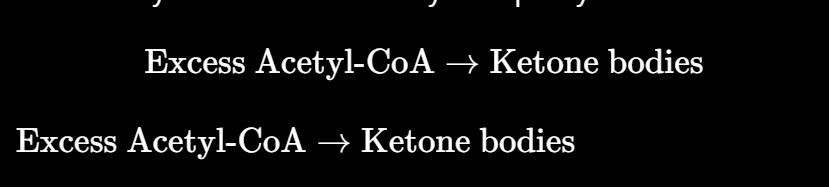
Ketone bodies become major fuels for:
brain
muscle
after prolonged fasting.
Acetone breath
At high ketone levels:
acetoacetate spontaneously forms acetone
Acetone is exhaled:
producing fruity/acetone breath.
2. Diabetes Mellitus
In:
Type 1 Diabetes
there is:
absolute insulin deficiency
In severe uncontrolled diabetes:
cells cannot effectively utilize glucose
body behaves as if it is starving.
So metabolism resembles starvation despite high blood glucose.
Metabolic consequences
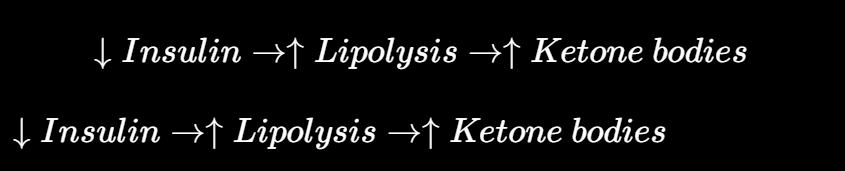
↓ Insulin + ↑ Glucagon
causes:
lipolysis
fatty acid oxidation
ketogenesis
Diabetic ketoacidosis (DKA)
Large ketone production causes:
metabolic acidosis
dehydration
acetone breath
unconsciousness in severe cases.
3. Alcoholism
Ethanol metabolism occurs mainly in the liver.
Two oxidation reactions produce large amounts of:
NADH
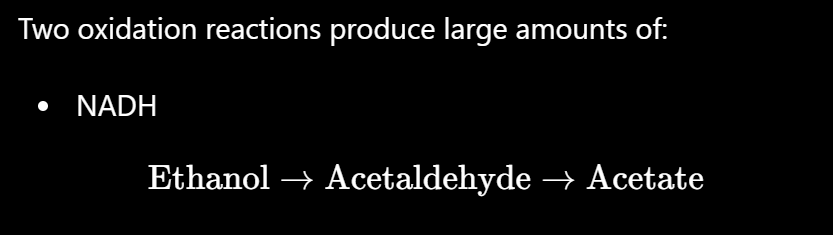
Both reactions generate:
NADH
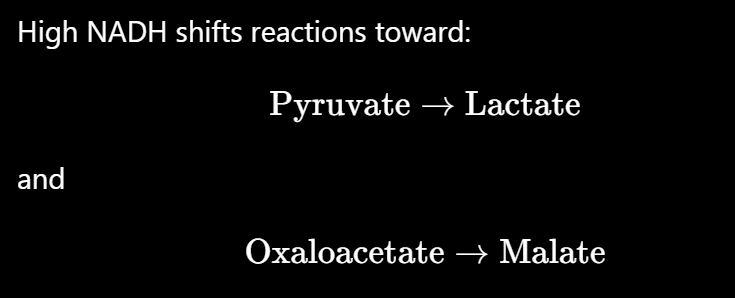
Effect of excess NADH
High NADH shifts reactions toward:
Why this causes ketoacidosis
Oxaloacetate is needed for:
gluconeogenesis
TCA cycle function.
When oxaloacetate becomes depleted:
gluconeogenesis decreases
acetyl-CoA cannot efficiently enter TCA cycle
So acetyl-CoA is diverted into:
ketone body synthesis.
Result:
alcoholic ketoacidosis
acetone breath
hypoglycemia.
High-Yield Comparison Table
Condition | Main Trigger | Major Hormonal/Metabolic Change | Cause of Ketosis |
|---|---|---|---|
Starvation | Lack of food | ↓ insulin, ↑ glucagon | Fatty acid oxidation |
Diabetes mellitus | Lack of insulin | Inability to use glucose | Massive lipolysis |
Alcoholism | Excess NADH | Inhibited gluconeogenesis | Acetyl-CoA diverted to ketones |