Cancer
What is Cancer?
A diverse collection of diseases characterized by uncontrolled division of abnormal cells that can invade nearby tissues and spread through the blood and lymph systems to distance sites
Common properties:
Divide uncontrollably
Invade and colonize locations normally reserved for other cells → metastasize
Most forms of cancer involve multiple genetic changes
Types of Cancer - usually named for organs or tissues where the cancer forms
Carcinoma: Most common, begins in the skin cells or in tissues that line or cover internal organs, e.g. Adenocarcinoma forms in epithelial cells that produce fluid or mucus (breast, colon, prostate)
Sarcoma: Begins in bone, cartilage, and soft tissues, including muscle, fat, blood vessels, tendons, ligaments
Leukemia: Begins in blood forming tissue of the bone marrow. Do not form solid tumors. Large numbers of abnormal white blood cells build up blood and bone marrow, crowding out normal blood cells
Lymphoma: Begins in lymphocytes (T cells or B cells), the disease-fighting white blood cells of the immune system
Cancer is genetic on a cellular level
Most cancers originate in a single cell via mutation
A cancer cell divides to generate two cancer cells
Cancer originating in somatic cells is NOT inherited
But, a genetic predisposition for cancer can be inherited — inherited mutations make it more likely that cancer will develop
Cancer is deregulation of cell division — lack of cell cycle control → over-proliferation
Mitotic Cell Cycle
Protein Regulators
Positive regulators: Increases cell division
Too much → too much cell proliferation → cancer
Negative regulators: Decreases cell division
Too little → too little control on cell division → cancer
* Often multiple genetic changes required for cancer to result
Proto-oncogenes (normal): the (+) regulators or accelerators
Oncogenes (gain-of-function): Mutated gene whose mis-expression can lead to rampant cell division and contribute to cancer → too much activity, cell division is unregulated
Too many copies of the normal proto-oncogene can also lead to uncontrolled cell division
Treatment for some HER2+ cancers: HERCEPTIN
An antibody that selectively binds to the extracellular domain of the human epidermal growth factor receptor 2 protein, HER2, prevents EGF (Human Epidermal Growth Factor) to bind
*To treat the cancer, the specific mutation must be known
Tumor Suppressor Genes: the (-) regulators or brakes
Genes whose normal function is to prevent uncontrolled cell proliferation, so reduced function can lead to cell overgrowth
Retinoblastoma: tumor in the retina
Inheritance is Autosomal Dominant, but some individuals with the dominant gene do not develop a tumor — incomplete penetrance
Inheritance of a mutant allele INCREASES risk of developing a tumor
Some Tumor Suppressor genes can be involved in familial AND sporadic cancer of a particular organ/tissue such as breast, colon or retina
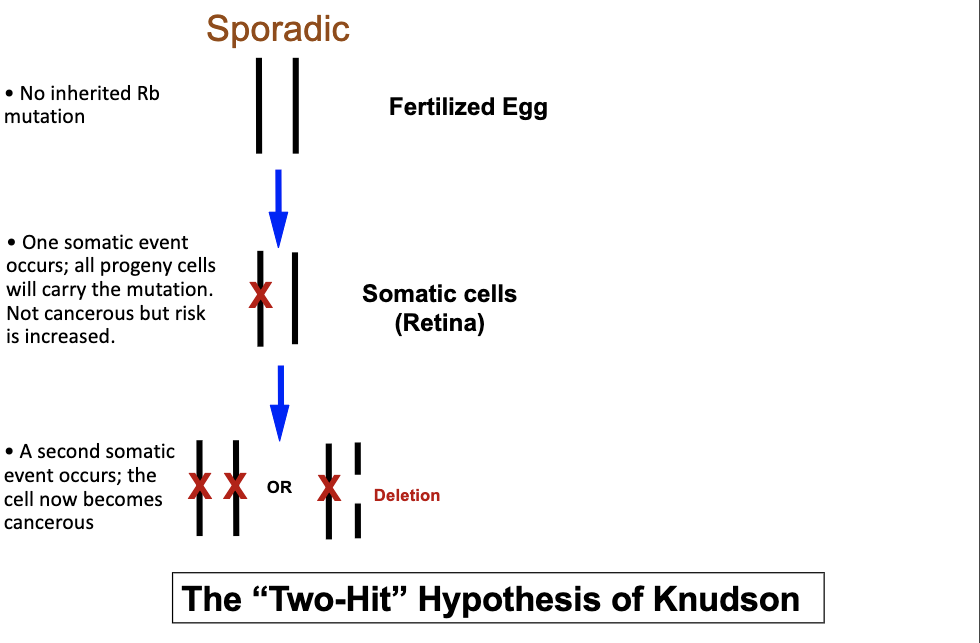
TSG mutations can be inherited in a dominant fashion, but they are recessive at the level of the cell — tumor formation requires TWO mutant alleles
Familial: Inherit one mutant allele from a parent (1 genetic) second mutant allele develops in somatic tissue (1somatic)
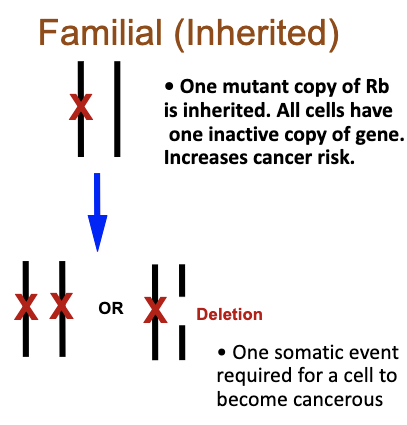
Sporadic: BOTH mutant alleles develop in somatic tissue, not transmitted to offspring (both copies somatic)
Most forms of cancer involve multiple genetic changes, leading to malignancy — cancer development is a multistep process !!
Growth begins as a small benign growth (polyp), too much or too little regulators would affect the growth