Western Classical Civilizations
Textbook Chapters
Chapter 3, Lesson 3: Assyria and PersiaChapter 4, Lesson 1: Poets and Heroes
Chapter 4, Lesson 2: The Greek City-States
Chapter 4, Lesson 3: Classical GreeceChapter 4, Lesson 4: Classical Greek CultureChapter 4, Lesson 5: Alexander and the Hellenistic EraChapter 7, Lesson 1: The Rise of RomeChapter 7, Lesson 2: From Republic to Empire
Chapter 7, Lesson 3: The Early Roman Empire
Chapter 8, Lesson 1: The First Christians
Chapter 8, Lesson 2: Decline and Fall of Rome
World Religions Handbook: Christianity
Assyria and Persia
The Assyrian Empire
→ first of new empires, formed on the upper Tigris River
→ Semitic-speaking people that used iron weapons to established an empire by 700 B.C., including Mesopotamia, parts of Iran, sections of Asia minor, Syria, Israel, and Egypt down to Thebes
Key Characteristics
ruled by kings whose power was seen was absolute, allowing the empire to become well organized
developed an efficient system of communication to administer more effectively → a network of stages posts that used relays of horses to carry messages → receive messages within a week!
effective military leaders and fighters, well organized and disciplined army
infantrymen (ground combat) were the core + cavalrymen and horse-drawn war chariots for shooting arrows
first large armies equipped with iron weapons
different military tactics, known for their siege warfare + terror as an instrument of warfare
laid waste to lands in which they were fighting on, smashed dams, looted towns, ste crops on fire
known for committing atrocities on their captives
took over much of Mesopotamian civilization, perceiving themselves as guardians of Sumerian and Babylonian culture
End of Assyrian Empire: fell due to internal strife and resentment of Assyrian rule, eventually falling to a coalition of Chaldeans and Medes
The Persian Empire
→ following the collapse of the Assyrian Empire, the Chaldean king Nebuchadnezzar II made Babylonia the leading state in western Asia
→ rebuilt Babylon as the center of his empire + gave it a reputation as one of the great cities of the world
→ eventually fell to the Persians
The Rise of the Persian Empire
Persians = Indo-Europeans who lived in southwestern Iran
primarily nomadic
eventually unified by the Achaemenids, who led to the development of the classical civilization of Persia
Cyrus, family member of the Achaemenids, founded a powerful Persian state that stretched from Asia Minor to India, “The Great”
highly organized empire with Persian and local rulers
captured Babylon + had lenient treatment towards it
allowed the Jews held captive by Babylon return to Israel
demonstrated wisdom and compassion in conquest and organization
had a reputation for mercy + genuine respect for other civilizations
conquered areas but allowed them to keep their kings as long as they pledged allegiance to Persia
Darius, successor of Cyrus, extended the Persian province to the Indus River and Egypt
conquered Thrace in Europe, creating the world’s largest empire at the time
invaded the Greek mainland
strengthened the Persian gov. by dividing the empire into 20 provinces
Governor = satrap, each satrap collected taxes, provided justice, and recruited soldiers
Key Characteristics
notable for efficient transportation and communication system that sustained the empire (under Darius)
well-maintained roads, such as the Royal Road
set up stations for communication like the Assyrians
monarchy was the center of the gov. administration system, called the “Great King” (under Cyrus)
had tremendous authority, held the power of life or death
supported by a large army and bureaucratic administration of civil service officers
influenced empires created by the Greek and Romans
virtually no slavery because Zoroastrianism condemned it
The Fall of the Persian Empire
Following Darius’ rule, Persian kings became isolated at their courts, surrounded by luxuries
Kings increased taxes, and loyalty to the empire declined
Struggles for the throne increased as polygamous kings increased
led to the conquest by the Greek ruler Alexander the Great, who ended up conquering the Persian Empire
Persian Culture
→ 10,000 Immortals: Persia’s most feared soldiers
→ Coins: used metal coins with standardized values to help promote trade
Persian Religion
Zoroastrianism = Persia’s major cultural, philosophical and religious influences
Zoroaster, prophet of “true religion”, has his teachings recorded in the Zend Avesta, the sacred book of Zoroastrianism
provide an early example of development of monotheism, like judaism
→ originally, Persians were polytheistic, but Zoroaster reduced it to monotheism: Ahura Mazda the supreme god who created all things
→ Zoroastrianism was influential in the development of concepts of free will and final judgment of humanity
taught that Ahura Mazda gave all humans the freedom to choose between right and wrong
taught that Ahura Mazda would triumph in the struggle between good and evil
those who had performed good deeds would achieve paradise, while those who performed evil deed would be thrown into an abyss to experience torment and misery.
similar to the concept of karma
Ancient Greece
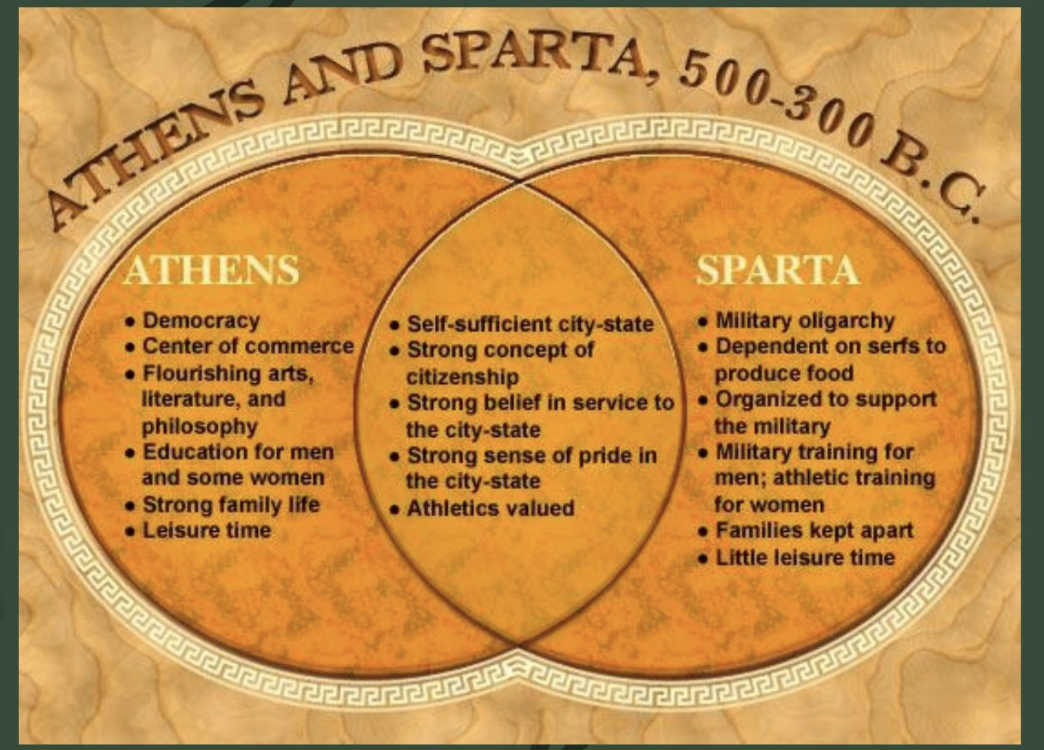
Classical Greece
→ villages expand into independent city-states: geographically isolated from other city-states due to mountainous terrain
Polis: center of Greek life, a town or village center where people met for political, social, or religious activities
Acropolis: a fortified area (temple) at the top of the polis, served as a fortress and religious center
Agora: open area below the acropolis, served as a market and gathering place
City-state: people of the polis who shared an identity/common goals, loyalty to the city-state, distrust of other city-states
The Challenge of Persia
→ the Greeks continued to spread throughout the Mediterranean, eventually coming into conflict with the Persian Empire
→ the Persian Empire controlled the ionian Greek cities in Asia Minor, who attempted revolt, but were unsuccessful and prompted Darius to seek revenge
→ an outnumbered Athenian army attacked and defeated the Persians, who returned to Asia after their defeat
→ Xerxes became the new Persian monarch, vowing to avenge Persia and invade Greece
→ despite Xerxes’ efforts, the Athenians, Spartans, and other Greeks were united by a common goal of defeating the Persian invaders, to which they ended up succeeding.
The Athenian Empire
→ took over leadership following the defeat of the Persians, forming a defensive alliance against the Persians known as the Delian League
→ pursued the attack against the Persian Empire, liberating all Greek states from Persian control
→ Athens was able to create an empire due to the Delian League
Pericles, a dominant figure in Athenian politics, allowed the empire to expand while under democracy
Age of Pericles saw the height of Athenian power and brilliance
The Age of Pericles
→ height of Athenian power
→ Pericles created a direct democracy, expanding the responsibilities and involvement of Athenian citizens in their government
→ every male citizen participated directly in the government decision making by attending the assembly, voting on all major issues
The Assembly consisted of ~43,000 male citizens older than 18 years old
passed all laws, elected public officials, made decisions concerning war and foreign policy
anyone was allowed to speak, but usually only respected leaders did so
believed all Athenian citizens were equal under the law (except for women)
By making lower-class citizens eligible for public office, Pericles made it possible for poor citizens to participate in civic affairs
believed that all Athenian citizens were an equal before the law and that they should be proud of their democracy
assembly became a central institution and fundamental idea of Western civilization, introduced the development of democratic-republican government
promoted arts, architecture, and philosophy
Achievements:
The practice of ostracism: a harmful person named by at least 6000 members was banned from Athens for 10 years
system of justice (dikastai), similar to the trial by jury of peers
Athens became the center of Greek under Pericles
Pericles began a great rebuilding program; building temples and statues
Art, architecture, and philosophy flourished, becoming the “school of Greece”
Daily Life in Classical Athens
→ had the largest population of Greek city-states
→ most residents of Athens were not citizens, and were subject to some of the responsibilities of citizens
→ slavery was very common, numbering ~100,000 in Athens, working in fields or in home
Economy and Society
largely based on farming and trade
grew grains, vegetables, and fruit for local use; grapes and olive trees for wine and olive oil, raised sheep and goats for wool and dairy products
lack of fertile land + large population = import 50-80% of grain
trade became highly important to Athenian economy
family was an important institution in ancient Athens; composed of husband, wife, children, and sometimes dependent relatives and even slaves
primary role: to produce new citizens by having children
women could take part in most religious festivals, but were otherwise excluded from public life; expected to remain at home
women were expected to bear children, especially male children, take care of her family and her house
women were strictly controlled: could not own property beyond personal items, always had to have a male guardian, not allowed any formal education
The Great Peloponnesian War
Greek world divided into 2:
1) Athenian Empire (Athens and the Delian League)
2) Sparta and its supporters (Peloponnesian League)
→ Athens and Sparta had vastly different societies, neither being able to tolerate each other
→ Sparta feared the growing Athenian Empire and a series of disputes finally led to the outbreak of the Great Peloponnesian War
Both sides had winning strategies:
1) Athenians: planned to remain behind the city’s protective walls and receive supplies from their colonies and navy
2) Spartans: surrounded Athens, hoping that the Athenians would send out their army to fight beyond the walls.
→ Athenians had a better navy, but the Spartans had a stronger army, able to win over the Athenians in open battle
Plague eventually broke out in the overcrowded city of Athens, killing more than 1/3 of the population
the Athenian Empire eventually surrendered after fighting for 25 years after Pericles’ death
classical Greek culture and government ended as well as the war and the Athenian Empire
weakened the major Greek states and any chance of cooperation among them
Sparta
→ Conquered others to grow the size of their city-state
Helots: people captured by Sparta
society revolved around military and self-discipline
women had greater freedom and power than in other city-states
ruled by an oligarchy with two kings
shunned the outside world and did not like visitors
focused on military strength and discouraged citizens from studying art/literature/philosophy
restricted from recording history
obedient to Sparta before obedience to family
Classical Greek Culture
Greek Religion
→ Greeks considered religion necessary to the well-being of the state
→ constructed temples dedicated to gods and goddesses, which became major buildings in Greek cities
Twelve chief gods and goddesses were thought to live on Olympus, including Zeus, Athena, Apollo, Artemis, Ares, Aphrodite, and Poseidon
festivals were developed as a way to honor the gods and goddesses, with certain ones being held at special locations
numerous events, including athletic games, took place in honor of the gods at the Greek festivals, including the Olympics
Oracle: a sacred shrine where a god or goddess was said to reveal the future through a priest or priestess, the most famous one being Delphi, the oracle of Apollo
Classical Greek Arts and Literature
→ massively influenced the arts of the Western world
→ concerned with expressing eternal ideals; the human being was presented as an object of great beauty
Architecture and Sculpture
the most important form of architecture was the temple
famous building: the Parthenon, dedicated to Athena as an expression of the Athenians’ pride in their city-state
exemplifies the principle of classical architecture: the search for calmness, clarity, and freedom from unnecessary detail
lifelike statues of the male nude, showed relaxed attitudes, became a favorite subject of Greek sculptors and became a classical Greek style
did not seek to achieve realism, but a standard of ideal beauty
Drama
presented in outdoor theaters as part of religious festivals
the first Greek dramas were tragedies: a trilogy of plays exploring universal themes
dealt with universal themes such as the nature of good and evil, the rights of the individual, the nature of divine forces, and the nature of human beings
striving to do the best thing may not always lead to success, but the attempt is a worthy endeavor
ex. Sophocles’ Oedipus Rex and Antigone, Euripides’ Medea
Greeks took pride in their accomplishments and independence
later, comedy was developed to criticize politicians and intellectuals to entertain and provoke a reaction
Homer’s Epic Poems
The Iliad: based on stories of the Trojan War, focused on the hero Achilles whose anger led to disaster
The Odyssey: Based on the period right after the fall of Troy, focused on the hero Odysseus’ journey trying to get home to his wife
The Writing of History
Herodotus wrote History of Persian Wars, often seen as the first real history in Western civilization
Thucydides is considered the greatest historian in the ancient world
wrote history about the Great Peloponnesian War
saw war and politics as caused by activities of human beings, rather than gods
provided remarkable insight into the human condition; believing that studying history is important to understand the present
Greek Expansion
Trade Development: Greek colonies in prime port locations, exchange of goods
New Social Groups: men made wealthy by trade wanted political power
Tyrants: rulers who seized power from aristocrats
Religion: Polytheistic, believed gods were immortal but had human qualities, basis of Greek mythology
Oligarchy: rule by a few, some city-states chose this form of gov.
Democracy: started in Athens, gov. by the people or rule of the many, a lasting influence on Western civilization.
Greek Philosophy
philosophy = organized system of thought
→ early Greek philosophers focused on the development of critical or rational thought about the nature of the universe
→ influenced ancient scholars and continues to do so today
Sophists
group of traveling teachers in Greece who rejected speculation
argued that it was simply beyond the reach of the human mind to understand the universe, and that it was more important for individuals to improve themselves
stressed the important of rhetoric
Socrates
taught many pupils, believing that the goal of education was only to improve the individual
used the Socratic method, using a question-and-answer format to lead pupils to see things for themselves by using their own reasoning skills
believed that all real knowledge is already present within each person, only testing needed to call it forth
questioned authority, causing him to be accused and convicted of corrupting the youth of Athens by teaching them to question and think for themselves
Plato
one of Socrates’ students
considered by many the greatest philosopher of Western civilization
believed that a higher world of eternal Forms has always existed// Ideal Forms
makes up reality and only a trained mind in philosophy can become aware of or understand these Forms
the objects that we can perceive with our senses are reflections of the ideal Forms; reality is fund in the Form itself
explained his ideas in his work, The Republic
distrusted the workings of democracy
believed that individuals could not achieve a good life unless they lived in a just and rational state
believed that an ideal state were to be divided into three basic groups: philosopher-kings, warriors, and the rest of people, or producers, (not driven by wisdom or courage), and when each of these groups performed their appropriate role, society would function smoothly
believed that men and women should have the same education and equal access to all positions
established a school in the Athens known as “The Academy”, one of the first institutions of learning in Western civilization
Aristotle
pupil of The Academy
did not accept Plato’s theory of ideal forms
thought that examining individual objects did not have forms that existed in a separate, higher world of reality, but thought that forms as a part of things themselves
formed basis for the scientific method used today: characterized by observation, measurement, and experimentation
interests laid in analyzing and classifying things based on observation and investigation
defined entire categories of scientific study, such as logic, biology, and physics
wrote about a range of subjects, including ethics, politics, poetry, and the sciences
discussed three good forms of government: monarchy, aristocracy, and constitutional government
slightly favored constitutional government as the best form for people
did not seek an ideal form like Plato, but instead analyzed already existing forms of government
Alexander the Great and the Hellenistic Era
Macedonians Invade Greece
→ Greece perceived the Macedonians (neighboring Greece to the north) to be barbarians
→ The Macedonians were rural people organized in groups rather than city-states
Philip and Alexander
Philip II
Philip II came to throne, building a powerful army and turning Macedonia into a chief power of the Greek world
a great admirer of Greek culture, wanted to unite all of Greece under Macedonia
Athenians allied with other city-states to fight the Macedonians, but ultimately lost
conquered Greece
insisted that the Greek states form a league and cooperate with him in a war against Persia
assassinated before his invasion of Persia
Alexander the Great
→ 20 years old when he became king, when his father Philip II died
→ tutored by Aristotle
freed Ionian Greek cities of Western Asia Minor from the Persians + defeated large Persian army at Issus + destroyed the Persian empire
captured Syria and Egypt
built Alexandria as the Greek capital of Egypt, becoming the classical center of Greek culture
conquested as far as India
conquered most of the Mediterranean world, including Egypt + Persia, all the way to the Indus River Valley
passed away at 32 due to wound, fever, and alcohol
Legacy
master of strategy and tactics
had the ability to fight in all kinds of terrain and opponents
extended Greek and Macedonian rule over a vast area
creation of monarchies
standardized the Greek language
left cultural legacy on language, architecture, literature, art, and religious diversity throughout Asia and North Africa
Greek culture blended aspects of Eastern culture to become a new Hellenistic culture
The Hellenistic Era
→ “Hellenistic” derives from the Greek roots meaning “to imitate Greeks”
→ empire formed by Greeks and non-Greeks, fusion of Greek culture with the cultures of the Middle East and India
→ an age that saw expansion of the Greek language and ideas to the non-Greek world of Southwest Asia and beyond
Hellenistic Kingdoms
→ Alexander’s empire fell apart soon after his death, and the most important Macedonian generals engage in a struggle for power + any hope of unity was dead
Four Hellenistic kingdoms emerged as successors to Alexander:
1) Macedonia
2) Syria in the east
3) the kingdom of Pergamum in western Asia Minor
4) Egypt
→ all were eventually conquered by the Romans
→ Alexander the Great originally planned to fuse Macedonians, Greeks, and Persians into his new empire by using Persians as officials and encouraging his soldiers to marry native women
Hellenistic monarchs relied on Greeks and Macedonians to form the new ruling class
all business was transacted in Greek
Hellenistic kings create new population centers that varies in size from military settlements of only a few hundred men to cities with thousands of people. as did Alexander the Great
rulers encourage the spread of Greek colonists to Southwest Asia
Greeks + Macedonians provided new recruits for army + civilian administrators + workers
Greek cities of the Hellenistic Era became the chief agents in the spread of Greek culture in Southwest Asia, spreading all the way to modern Afghanistan and India
Hellenistic Arts and Literature
→ period of considerable cultural accomplishment in many areas, especially science and philosophy
Library in Alexandria became the largest in ancient times, with more than 500,000 scrolls
encouraged the study of literature and language
museum that encouraged scholarly research
Hellenistic kings were very willing to spend money to beautify the cities within their states, building baths, theaters, and temples
Patronized sculptors, as thousands of statues were erected in various Hellenistic towns and cities
maintained the technical skill of the classical period, but moved away from idealism of earlier classicism to a more emotional and realistic art
kings invested lots of money to beautify cities with buidlings and statues
Produced a great quantity of literature, as writing was a talent held in high esteem
very little of this literature has survived
Athens remained the center of Greek theatre, new type of comedy developed that sought to only entertain and avoided political commentary
Science, Mathematics, and Technology
→ considerable advances in the science of astronomy and in mathematics
Aristarchus of Samos, developed the theory that the sun is at the center of the universe while the Earth rotates around the sun in circular orbit, yet was not widely accepted
Eratosthenes determined that Earth was round and calculated Earth’s circumference, sieve of Eratosthenes which helped to identify prime numbers
Euclid, a mathematician, wrote a textbook on plane geometry, Elements
!!!!Archimedes, worked on the geometry of spheres and cylinders, established the value of the mathematical constant pi
invented the Archimedes’ screw, a machine used to pump water out of mines and to lift irrigation water
Hellenistic Philosophy
Epicurus, founder of Epicureanism
believed that human beings were free to follow their own self-interest and make happiness their goal
happiness was the pursuit of pleasure, the only true good
pleasure was freedom from emotional turmoil and worry
achieved by freeing themselves from public activity
Stoicism, founded by Zeno
most popular philosophy + later flourished in Roman Empire
wanted to find happiness, but believed that it could only be found by living in harmony with the will of God
then, they could bear whatever life offered
did not want to separate themselves from the world
public service = noble
real Stoic was a good citizen
The Romans
The Rise of Rome
The Land and Peoples of Italy
a lot of fertile land, supporting a large population
geography played a major role in the early development and expansion of Roman civilization
Indo-Europeans moved into Italy who spoke Latin, and Historians knew very little about these peoples
herders and farmers who lived in settlements consisting of huts on the tops of Rome’s seven hills
Greeks came to Italy in large numbers during the age of Greek colonization, colonized South Italy
had much influence on the people of Rome; cultivated lives and grapes, passed on their alphabet, and provided the Romans with artistic and cultural models through their sculpture, architecture, and literature
early development of Rome was influenced most by the Etruscans, located north of Rome in Etruria
found Rome a village and turned it into a prosperous city
Romans borrowed ideas from the Etruscans, such as their clothing and army organization
The Roman Republic
→ early Rome was under the control of seven kings; two of the last three were Etruscan
→ Romans overthrew the last Etruscan king and established a republic with no king, some citizens had the right to vote
War and Conquest
defeated Etruscans, Latin states, and Greeks
Rome was engaged in continuous warfare for 200 years, giving them control over a large portion of the Italian Peninsula
encouraged people to help with Rome’s success
conquered virtually all of Italy
Roman Confederation: Rome allowed some peoples (especially Latins) to have full Roman citizenship, while most of the remaining communities were made allies that mostly remained free but were required to provide Rome with soldiers
→ loyal allies could improve their status and become Roman citizens
Successful Strategies
→ Romans believed they were successful because of their duty, courage, and discipline
how did they succeed?
Romans were good diplomats: clever in extending Roman citizenship and allowing states to run their own internal affairs, yet firm and cruel when necessary
Romans excelled in military matters; had accomplished and persistent soldiers
brilliant strategists, built colonies and connected them so Romans could move troops quickly
Romans were practical in law and politics; did not try to build an ideal gov, but created political institutions in response to problems
Roman Political Structure
→ distrusted kingship after being ruled under the Etruscans
Divided into two groups: patricians and plebeians
1) Patricians: wealthy landowners who became Rome’s ruling class
2) Plebeians: Less wealthy landowners, craftspeople, merchants, and small farmers (larger group)
→ Both groups paid taxes, owed military service, and could vote; but only Patricians could be elected to office
Chief executive officers: consuls and praetors
Two consuls, elected each year, ran the government and led the Roman army into battle
Praetor is in charge of civil law (laws that applied to Roman citizens), served as judges for noncitizens
Roman Senate: a select group of about 300 patricians who served for life
initially just to advise government officials, eventually had the force of law
example of a form of democratic-republican government
→ had several people’s assemblies in addition to the Senate, providing both rich and poor citizens with opportunities to support their gov. through civic participation
Centuriate Assembly: elected chief officials and passed laws (most important assembly)
wealthiest citizens always had a majority, council of the plebs came into being as a result of the struggle between the social orders in Rome
The Struggle of Orders (Patricians v. Plebeians)
→ Conflicts between patricians and plebeians went on for hundreds of years!!
→ children of patricians and plebeians were forbidden to marry each other; plebeians belived they deserved both political and social equality with the patricians
Plebeians were successful in changing their government
The council of the plebs was created
Tribunes of the plebs (new officials) were given the power to protect the plebeians
Plebeians were eventually permitted to marry patricians and become consuls
Council of the plebs eventually received the right to pass laws for all Romans
Eventually, all male Roman citizens were now supposedly equal under the law. However, a few wealthy patrician and plebeian families formed a new senatorial ruling class that dominated the political officers, not creating a democracy
Roman Law
Twelve Tables: Rome’s first code of laws that established a concept of equality before the law for all citizens
applied to only Roman citizens
had a lasting influence on Western civilization
→ Twelve Tables were later expanded to create the Law of Nations: special rules in cases involving noncitizens, based on natural law and reason
standards still applied today like “innocent until proven guilty”
Roman Expansion
Romans v. Carthaginians; Carthage was the largest and richest state in the area, made the Romans fearful
The First Punic War
Romans sent an army to Sicily
Carthaginians thought of Sicily as a part of their empire, and considered this an act of war
Romans were primarily a land power and realized they could not win the war without a navy and built a large fleet
Roman fleets defeated the Carthaginian navy and the war came to an end
→ Carthage gave up all rights to Sicily and paid a fine to the Romans; Sicily became the first province of Rome
The Second Punic War
Hannibal, the greatest of Carthaginian generals, struck back as Romans encouraged one of Carthage’s Spanish allies to revolt
Hannibal entered Spain and crossed the Alps with an army
Romans met Hannibal head-on, and Hannibal’s force devastated a Roman army
some Italian cities rebelled and went over to Hannibal’s side, but Rome gradually recovered
Rome pushed the Carthaginians out of Spain and invaded Carthage
Romans defeated Hannibal’s forces and made Spain a Roman province
→ Rome became a dominant power in the western Mediterranean
More Conquests
Romans fought the Third Punic War and destroyed Carthage
Carthage became a Roman province called Africa
Rome also battled the Hellenistic states
Macedonia became a Roman province, Greece was also placed under the control of the Roman governor of Macedonia
→ Rome became a master of the entire Mediterranean Sea
Transition from Republic to Empire
Decline of the Roman Republic
→ The Senate became the real governing body of the Roman state, with members being mostly drawn from the landed aristocracy
Growing Unrest
Farmers: many farmers of small amounts of land were unable to compete with large wealthy landowners and lost their land, pushed out
Leadership: political offices became increasingly controlled by wealthy and powerful families
Reforms: calls for reform, some wanted to take public land and give to landless Romans, created more unrest and violence
Army:
→ Originally, the Roman army had been comprised of men who were small landowners
However, generals now recruited volunteers from urban and rural poor who did not own any property
forced generals to become involved in politics and get laws passed that would provide land they promised to veterans
created a new system of military recruitment that placed great power in the hands of the individual generals
The End of the Republic
Roman was characterized by two important features: competition for power by a lot of people and civil wars that resulted from their conflicts
Three powerful individuals: Crassus, Pompey, and Julius Caesar came to hold enormous military and political power → formed the First Triumvirate
power became concentrated between these three men, showing great consequences for Rome
Crassus: control over Syria, richest man in Rome, killed in battle
Pompey: control over Spain, returned from a successful command in Spain as a military hero
Caesar: control over Gaul, famous military leader, very loyal army, extremely popular
The First Triumvirate
→ three men had enormous combined wealth and power; allowing them to dominate the political scene; eventually Crassus was killed in battle, and only two men remained
→ Caesar gained fame and military experience and had an army of veterans who were remained loyal
leading senators decided that rule by Pompey would be least harmful to their cause as they feared Caesar’s popularity
commanded that Caesar step down from his command
Caesar chose to keep his army and moved into Italy and started a civil war between his forces and those of Pompey and his allies and marched on Rome → left Caesar in complete control of the Roman government
Caesar officially became a dictator for life
gave land to the poor + increased the member limit of the Senate to 900 (weakened the Senate’s power by filling it with supporters)
granted citizenship to people in provinces who helped him
reformed the calendar introducing the Egyption solar year of 365 years
planned many projects but was unable to execute them
→ group of leading senators assassinated him believing that it would restore the old, balanced system, but instead backfired
The Second Triumvirate
Three more men:
Antony: Control over the East, Caesar’s ally and assistant, allied with himself with Egyption Queen Cleopatra, defeated by Octavian
Octavion: Control over the West, Caesar’s heir and grandnephew, took control of the Roman Empire, highly popular, given the title of Augustus and Imperator, rebuilt public religion
Lepidus: Commander of Caesar’s cavalry, removed by Octavian and Antony
→ Octavian and Antony soon came into conflict, with Antony eventually losing the civil war
→ Octavian stood supreme over the roman world, as the civil wars ended and so had the republic
The Beginning of the Roman Empire
→ Octavian became the first Roman emperor and was awarded the title of Augustus and imperator (commander in chief)
attempted to restore the republic
began a new system for governing provinces; certain provinces were given to the emperor
allowed him to overrule the senatorial governors and establish unity in imperial power
stabilized the frontiers of the Roman Empire; even attempted to conquer Germany
conc
erned about the social health of the Roman state, rebuilt many ruined temples and built new ones to honor the Roman gods
encouraged the development of a new religious cult dedicated to the emperor; Augustus was declared a god by the Senate]
created a new order while maintaining traditional values
The Early Roman Empire
Pax Romana: Roman Peace
→ lasted for 200 years
Emperors worked with senators, emperor’s power increased while senators’ power decreased
ended arbitrary executions
maintained peace in the empire
supported domestic politics
created new social programs like funds for poor children to raise/educate children
public works projects like aqueducts, bridges, roads, and harbors
→ Provincial Cities
Politics: local officials in Roman agents, collected taxes and performed gvoernment duties
Culture: cities resemble each other, spread Roman law and Latin
→ Economy and Society
period of prosperity and peace
high levels of trade
lots of grain imported to feed the population
luxury items imported for the wealthy
large gap between rich and poor, farming still the main job for most people, small farmers often dependent on large landed estates of the wealthy
→ Art, Math, Science, and Literature
Romans excelled in architecture
used a combination of Greek styles with Roman arches/vaults/domes
first to use concrete on a large scale
engineering feats like aqueducts
Sculptures: more realistic than the Greek use of the ideal
Numbers: Roman numerals used letters to represent numbers, still used today
Abacus: counting frame for complex math problems
Poetry: Virgil wrote the Aeneid in Rome’s honor of politics
Medicine: Galen developed the “Four Humors” theory; made many mistakes in physical anatomy
Latin: official language of the Roman Empire
Roman Life
Women: taught to read, more education for wealthier daughters
Men: social structure built around paterfamilies
Men Education: men learned reading, writing, moral principles, family values, law, and physical training, men were expected to be soldiers
Women Upper-class: had considerable freedom and independence, could not own/inherit/sell property, not segregated from males, attend cultural events
Romans believed in having a right relationship with gods, attained through priesty rituals
Held traditional festivals and ceremonies to revive Roman state religion
renamed Greek gods (Zeus = Jupiter, Hera = Juna, Poseidon = Neptune)
Empire’s success equated to favor from the gods
Romans tolerate other religions
The Fall of Rome
The Late Roman Empire
Emperor Reforms:
Diocletian: created a very powerful army, made a rigid economic and social system
Constantine: built Constantinople, the “New Rome”, Christianity was made the new state religion
Byzantine society eventually became larger than Rome itself, but considered themselves to be Romans anyways
Problems and Upheavels:
Invasions: Sassanid Persians and Germanic tribes invaded the frontiers
resulted in internal turmoil that made the empire weak and vulnerable, invaders destroyed crops
Civil Wars: Military men battled with each other to the emperor, strongest army wins
Created chaos and instability throughout the empire
Plague: The Antonine Plague, thought to have been spread by returning soldiers
Created a massive labor shortage, food production declined, army weakened
Collapse of Rome
Constantine united Rome, but it divided again following his death
Administrative structure of the empire collapsed and the Germanic tribes took over
Visigoths invaded and defeated the Roman army
Rome suffered from invasions and poor leaders who abused their power
German military leader deposed the Roman emperor once and for all
Rome breaks down into small kingdoms, signifying the fall of the Roman Empire
Christianity
Jesus: Jewish teacher who traveled and preached in Judea and Galilee, the start of Christianity
Salvation: Jesus’ mission to complete the promise of salvation long promised to Israel from God.
believed in the inner transformation of people
Jesus preached about humility, charity, and love towards others
The Bible
Old Testament: The Hebrew Bible
New Testament: The teachings of Jesus and his apostles, The Old Testament and the New Testament make up the Christian Bible
Christianity Spreads
→ Paul, highly educated Jewish man was also a Roman citizen, converted to Christianity and traveled extensively through the Roman Empire to share his message
preached that Jesus was the Savior
preached that Jesus was the Son of God
preached that acceptance of Jesus as the Christ would save people from sin and reconcile them to God
Roman Persecution
a. Roman Rules: Romans started to see Christianity as a threat to public order due to conflict between Christianity and Jews
b. Roman Religion: Romans began viewing Christianity as a treasonous religion because Christians refused to worship the state gods and emperors
c. Reign of Nero: Open persecution of Christians began under Emperor Nero. Christians were subjected to cruel deaths, such as feeding them to the lions
Christianity in the Roman Empire
Constantine: Emperor converted to Christianity and made it Rome’s official religion
Community: Christianity filled the human need to belong a unifying social element
Church: created a new structure with clergy (church leaders)
Catholicism: first organized Christian denomination
Review
Acropolis
Agora
Aqueduct
Christianity
Direct Democracy
Hellenism
Pax Romana
Peloponnesian Wars
Polis
Polytheistic
Republic
Twelve Tables
Socrates
Alexander the Great
Patrician
Plebeian
Macedonians