L1 - Reservoirs and Fluxes Across Timescales
Introduction to the Carbon Cycle
The carbon cycle is a fundamental component of Earth Science, dealing with how carbon is exchanged between various reservoirs and how human activities have impacted these exchanges. This module is essential for understanding broader concepts concerning Earth's system biochemical cycles.
Importance of Studying the Carbon Cycle
The study of the carbon cycle is critical for several reasons:
Foundation of Climate Science: Carbon dioxide (CO₂) and methane (CH₄) are significant greenhouse gases that influence Earth's energy balance and climate.
Historical Reconstruction: Understanding the historical variations in atmospheric CO₂ concentrations is vital for modeling future climate scenarios.
Biochemistry Importance: Carbon compounds are central to biochemistry, supporting life through structures such as carbohydrates, amino acids, and lipids, and regulating energy storage and distribution.
Overview of Key Carbon Compounds
Some primary carbon compounds include:
Carbohydrates: Energy reserves in plants linked with biochemistry processes.
Amino Acids: Essential for driving biochemical reactions.
Lipids: Serve multiple roles in energy storage and water absorption.
Lignin: Contributes to structural plant integrity, allowing access to sunlight.
Chlorophyll: A crucial compound for photosynthesis, allowing plants to convert sunlight into energy.
Understanding Carbon as a Greenhouse Gas
Greenhouse Effect: CO₂ and CH₄ maintain the energy balance of the atmosphere, affecting Earth’s temperature.
Air Quality Metrics: Understanding atmospheric composition is essential for assessing climatic changes and evaluating the impact of carbon flux.
Historical Data: Recognizing the historical CO₂ concentration levels helps link carbon cycles to climate changes over geological timescales.
Earth's Energy Balance
Incoming Solar Radiation: Measured in watts per square meter, influenced by Earth's curvature and surface reflectivity (albedo).
Energy Loss from the Earth: Function of black body radiation, governed by the Stefan-Boltzmann Law, denoting temperature relations.
Important Formulas
Incoming Energy
Outgoing Energy (Black body Radiation)
Energy Balance Equation:
Estimation of Equilibrium Temperature:
However, the average surface temperature on earth is about 288K or +15oC
The explanation for this is that the outgoing radiation is responsible for some heating.
Looking at the absorption spectra for gases in the atmosphere, we can see that there is a strong peak in absorption in the infrared wavelengths. These wavelengths are also those which the Earth emits.
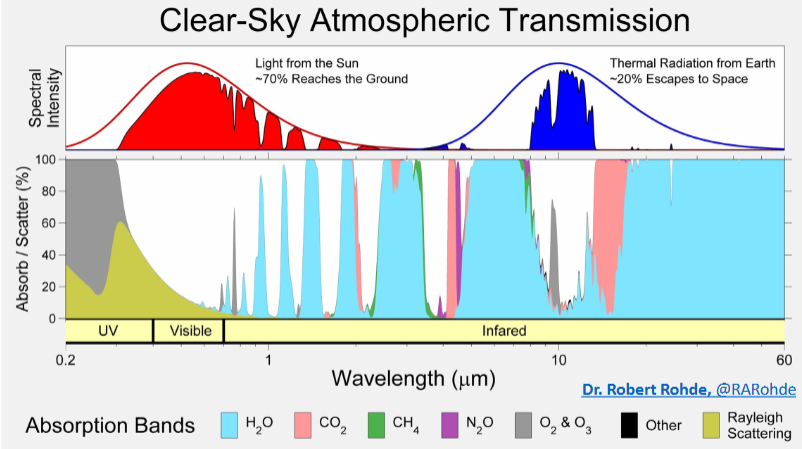
It can also be noted that while 70% of the light from the Sun reaches the ground, only 20% of that escapes to space
Greenhouse gases are potent, as despite methane making up a lot less of the atmosphere (0.00018%) than CO2 (0.0407%), it still has a significant comparable effect as a GHG
Carbon Reservoirs and Fluxes
Understanding these reservoirs requires analyzing their size, function, and interaction:
Atmosphere: CO₂ levels projected from historical data.
Gigatons of Carbon:
Ancient: 420 GT
Pre-industrial (1750): 590 GT
1990s data: 750 GT
Oceans: Split into surface and deep ocean, differentiated by residence times.
Biosphere: Includes terrestrial life in soils and vegetative structures (plants and animals).
Lithosphere: Includes fossil fuels and geological carbon storage (predominantly larger than atmospheric stocks).
Timeframes: The time for reservoirs to affect atmospheric CO₂ varies, with terrestrial biosphere and surface oceans impacting within decades to centuries, while lithosphere has a slower timescale.
Key Carbon Cycle Fluxes
Photosynthesis: Movement of carbon from atmosphere into organic molecules using solar energy by autotrophs.
General equation of photosynthesis:
Respiration: Breakdown of glucose to release energy, contributing to CO₂ in the atmosphere.
Weathering Processes: Dissolve CO₂ into bicarbonate in the atmosphere and oceans, contributing to geological carbon transport.
Fossil Fuel Burning: Rapidly increases atmospheric CO₂.
Anthropogenic Changes in Carbon Cycle
Recent studies highlight the drastic changes induced by human actions:
Current Atmospheric CO₂ Levels: Present values above 420 ppm.
Fossil Fuel Emissions: Approximately 11 GT of carbon per year from various sources (global warming implications).
Carbon Uptake: Terrestrial systems uptake of carbon at a rate of approximately 5.2 GT per year, with oceans contributing 2.8 GT.
Important Observational Data
Historical atmospheric CO₂ records derived from Ice Core analyses and ongoing measurements ( Manalua Observatory).
Significant CO₂ trajectories suggest notable trends affecting climate patterns. Recent data indicate a rapid increase beyond historical fluctuations, necessitating thorough analysis and understanding of the carbon cycle's response to anthropogenic activity.
Conclusion
The carbon cycle serves as a critical system affecting climate and biosphere. Carbon-based compounds form the foundation of biochemical processes. Appreciating the balance and interplay between carbon reservoirs and fluxes will contribute to meaningful climate solutions. The emphasis on continual study and analysis of this cycle is necessary as it underpins many Earth Sciences disciplines. Understanding carbon isotopes, sources, and sinks will provide insights into future climate dynamics. The knowledge of changes in carbon storage and flow reinforces the need for adaptive responses to an evolving climate system.