DNA and Protein Synthesis
Nucleic Acids and Their Structure
Introduction to Nucleic Acids
Nucleic Acids are biological macromolecules essential for all known forms of life. They are composed of monomers called nucleotides.
A Nucleotide consists of:
One phosphate group
One sugar (5-carbon)
One nitrogenous base
Nucleic Acids are polymers made up of multiple nucleotides bonded together through phosphodiester bonds.
Structure of DNA
Backbone of DNA
The Backbone of DNA is formed by the alternating structure of the phosphate and sugar groups of nucleotides. This backbone is crucial for the structural integrity of DNA.
The sequence of phosphate and sugar (5-carbon) remains constant.
They form the sides of the DNA ladder.
Covalent bonds between the phosphate and sugar keep the DNA structure stable.
Double Helix Structure
DNA adopts a specific three-dimensional structure known as the DOUBLE HELIX, characterized by:
Two strands wound around each other.
The strands consist of nucleotides bonded together.
Nitrogenous Bases
The rungs or steps of the DNA ladder are called Nitrogenous Bases.
There are four types of nitrogenous bases:
Adenine (A)
Guanine (G)
Thymine (T)
Cytosine (C)
A mnemonic for identifying pyrimidines from purines:
The letter 'Y' appears in the word pyrimidine, which corresponds to Cytosine and Thymine being pyrimidines.
Bonding Patterns
Specific base-pairing occurs:
Adenine bonds with Thymine (2 hydrogen bonds)
Guanine bonds with Cytosine (3 hydrogen bonds)
Purines (Adenine and Guanine) bond with pyrimidines (Cytosine and Thymine).
The strands of DNA run ANTI-PARALLEL (one runs 5’ to 3’ and the other 3’ to 5’).
DNA Packaging
Organization in Cells
Each human cell possesses around 2 meters (approx 6.5 feet) of DNA, all fitting tightly into the nucleus.
The organization process involves multiple steps:
DNA wraps around proteins called histones to form nucleosomes.
Nucleosomes further coil to form supercoils.
Supercoils organize into chromosomes.
Differences Between DNA and mRNA
Feature | DNA | mRNA |
|---|---|---|
Strand | Double-stranded | Single-stranded |
Sugar | Deoxyribose | Ribose |
Base Replacement | Thymine (T) with Uracil (U) | - |
DNA Replication
Overview of Replication Steps
UNWIND
The double helix unwinds with the help of topoisomerase, relieving tension.
UNZIP
DNA helicase breaks hydrogen bonds between base pairs at the replication fork (Y-shaped structure).
Single-Strand Binding Proteins (SSBPs) prevent strands from re-annealing.
COMPLEMENTATION
The RNA primer prepares the template strand for DNA synthesis by DNA polymerase III, which matches complementary nucleotides.
DNA Pol III grows new strands towards the 5’ end of the template strand. (Bases can only be added to the 3’ end)
BONDING
Covalent bonds form between adjacent nucleotides.
DNA Polymerase I replaces RNA primers with DNA bases and Ligase connects the fragments.
Note: Steps 1 and 2 occur simultaneously.
Leading vs. Lagging Strand
Leading Strand: Synthesized continuously toward the replication fork.
Lagging Strand: Synthesized in fragments (Okazaki fragments) that must be connected afterward.
As primase and polymerase replicate across the fork, the fork opens up a little bit more, thus a “lagging” strand.
Gene Expression and Protein Synthesis
Overview of Steps
Transcription: The process of transcribing DNA into mRNA.
Translation: The process of converting mRNA information into a protein (chain of amino acids).
Transcription Process
Initiation: DNA unwinds at the promoter with transcription factors binding.
Elongation: RNA Polymerase II synthesizes mRNA by pairing bases, going from 5’ to 3’. This process uses a single strand of DNA as a template.
Termination: The elongation continues until a stop signal is reached, and the mRNA strand detaches from DNA.
mRNA Modifications Before Translation
5’ cap added for stability.
Poly-A tail added to the 3’ end.
Introns (non-coding sequences) are removed; exons (coding sequences) remain.
The splicing process is accomplished by spliceosomes which cut out introns and join exons.
Alternative splicing: Different combinations of exons can lead to different proteins being produced.
Differences Between Prokaryotes and Eukaryotes in Transcription
Prokaryotes:
Occurs in cytoplasm.
No mRNA editing is required, thus no introns.
Translation can occur simultaneously with transcription.
Eukaryotes:
Takes place in the nucleus with pre-mRNA being edited.
Translation happens in the cytoplasm after mRNA processing.
Transcription factors are necessary for initiation.
Translation Process
Occurs on ribosomes, converting the nucleotide sequence of mRNA into a sequence of amino acids.
A codon consists of three nucleotide bases representing an amino acid or a signal for start/stop.
There are 20 amino acids and 64 possible codons.
Ribosomes contain three tRNA binding sites: A site (arrival), P site (peptide bond forming), and E site (exit).
Mutations in DNA
Overview of Mutations
Mutations: Changes in the genetic information that can be passed to future generations. They can occur due to various factors including mutagens, like chemicals and environmental factors.
Types of Mutations
Point Mutations (Substitutions)
A single base is replaced with a different base, potentially affecting one amino acid.
Types:
Missense: Changes codon to a different amino acid.
Nonsense: Changes codon to a stop signal.
Silent: Codon changes, but results in the same amino acid.
Frameshift Mutations
Involves insertion or deletion of bases, changing the entire downstream amino acid sequence.
THE CAT ATE THE RAT → TBH EBA TAT ETH ERA
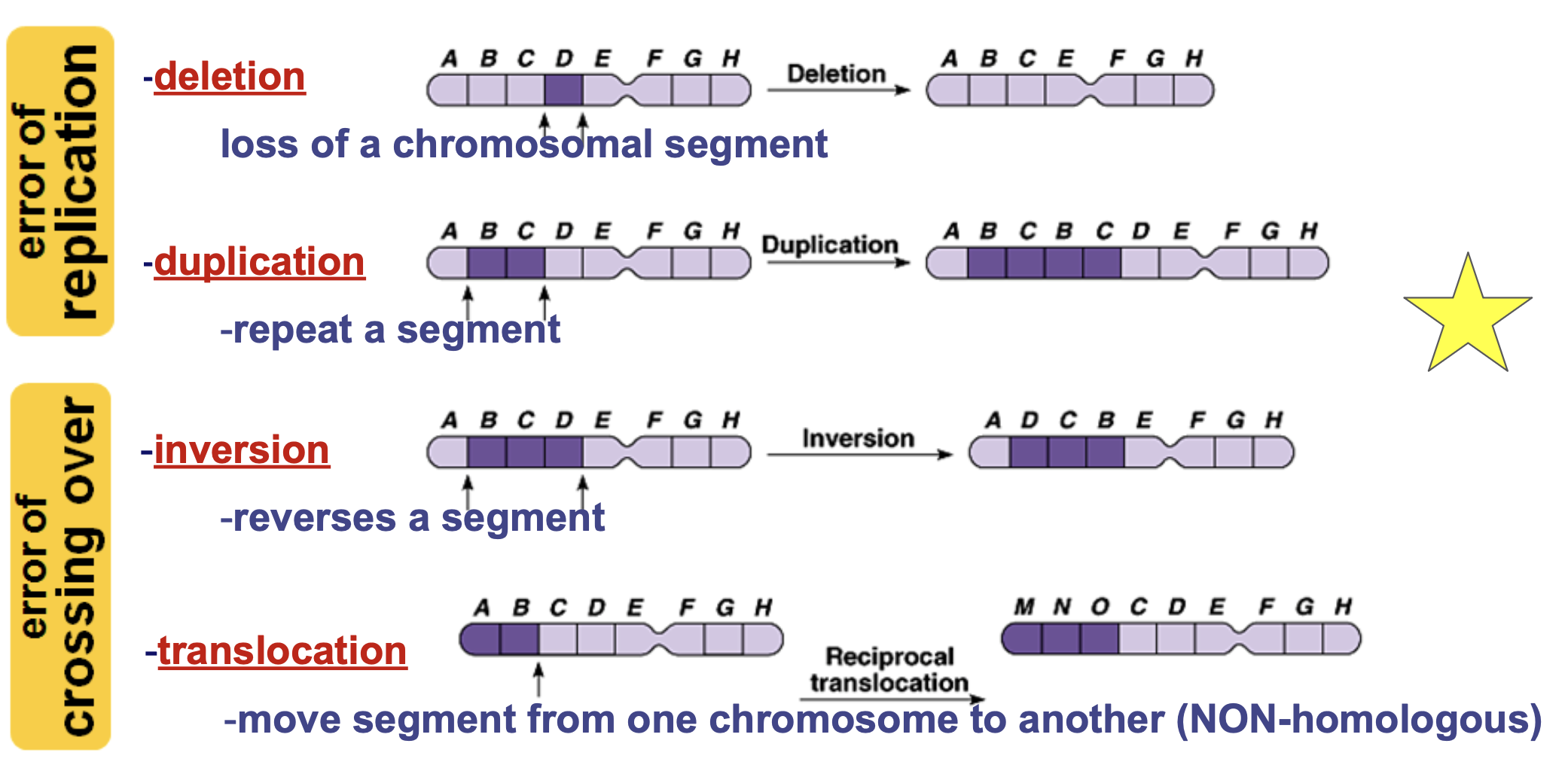
Chromosomal Mutations
Types include:
Deletion: Loss of a chromosomal segment.
Duplication: Repeat of a segment.
Translocation: Movement of a segment from one chromosome to another (non-homologous).
Inversion: Reversal of a segment within a chromosome.