NZQA Biology AS 91603: Biological Clocks
The Cycles of Biological Clocks
There are four cycles to describe the different biological clocks the world and organisms have:
- circa-annual cycle (~365 days)
- this includes reproduction, hibernation, migrations, leaf fall (abscission), and dormancy of seeds
- circadian cycle (~24 hrs)
- this includes wake-and-sleep cycles, body temperature changes, and heart rate
- circalunar cycle (~29 days)
- this affects tidal patterns which then affects marine organisms
- circatidal (12.5 hrs)
- it affects marine organisms such as feeding cycles for shellfish and rock pool animals
It is important for organisms to be synced with the appropriate cycles as important events such as mating, germination, and migration are triggered by different stimuli.
Stimuli can be endogenous or exogenous.
Endogenous: depending on the cycles/internal biological clock
- endogenous rhythms will persist even in the absence of environmental cues
- examples include storing food for the winter, animals coming on heat, solar navigation
Exogenous: depending on the environmental cues
- examples include day length, temperature, height of tides
To remain in sync with the environment, biological clocks need to be reset at regular intervals. This process is called entrainment.
Free running period: the length of one cycle in the absence of environmental time cues
Entrainment is often done by environmental cues as they set the cycle period. It may be;
- photoperiodism: the response of an organism to seasonal changes in day length
- light pulse
- food availability
- temperature compensation
- note: clock cycles do not change with temperature
The environmental cue that resets the biological clock is called the zeitgeber (German: time giver). This process happens in the brain through multiple structures;
- the suprachaismatic nucleus (SCN) is located in the anterior part of the hypothalamus; it uses signals from eyes to establish the circadian rhythm by releasing hormones and neuronal signals to trigger behavioural and physiological events
- for nocturnal animals in the event of night-time, the SCN releases a chemical message to the paraventricular nuclei (PVN), the intermediolateral nucleus of the spinal chord (IML), the superior cervical ganglion (SCG), before reaching the pineal gland
- the pineal gland is responsible for melatonin secretion
- if the SCN is destroyed, it will lead to a complete loss of the circadian rhythm
- rats with damaged SCNs were found to sleep the same total amount but at random times for random lengths of time
The cycle pacemaker occurs in the SCN in vertebrates, but it is distributed in brain cells in some insects.
The per/tim/tau(dbt) genes control the pacemaker. Drosophilia, honey bees, hamsters, and humans share these same genes; it is likely from a common ancestor - a flatworm that lived about 600 MYA.
Actogram: a graphical representation of an organism’s phases of activity and rest over the course of a day
Patterns of Activity within Circadian Cycles
Diurnal: mostly active during the day e.g humans, bees
Nocturnal: active at night e.g owls, kiwi birds
Crepescular: active at dawn and dusk e.g rabbits and mosquitoes
Arrhythmic: no regular pattern
While hibernation is part of circa-annual cycles, these often happen during winter. However, aestivation is known as summer hibernation; animals, such as earthworms, will hibernate by burrowing deep into soil to keep themselves moist and cool during the summer.
Interpreting Cycles using an Actogram
Actogram: a graphical representation of an organism’s phases of activity and rest over the course of a day
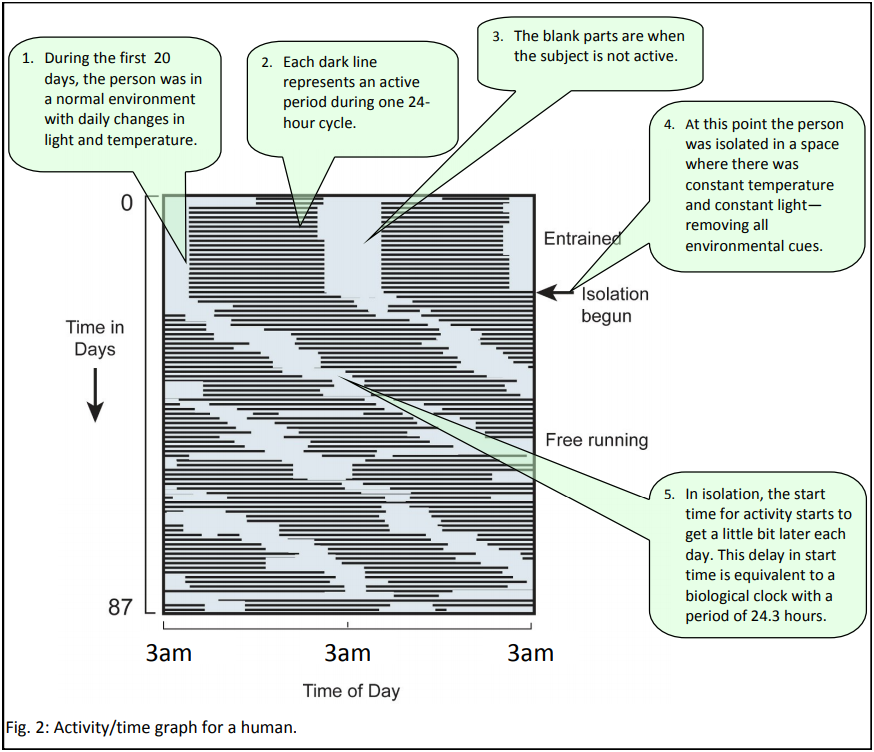
Working out the Free Running Period:
- work out when the first period of activity finishes to the nearest half hr
- count down 10 days
- work out when the 10th period of activity finishes to the nearest half hr
- work out the difference between these two times
- convert into minutes to work out average time gained/lost over 24 hrs
- add or substract from 24 hrs to work out the free running period
Plant Timing Responses
Like animals, plants have both exogenous and endogenous factors that control rhythms
Circadian rhythms shown by plants include:
- opening and closing of stomata
- sleep movements e.g leaves of beans drooping at night
Circaannual rhythms by plants include:
- germination
- flowering
- leaf fall
These rhythms are controlled by day length (photoperiodism) and temperature.
Flowering plants can be broadly grouped into:
- short day plants (SDP) — flowering is initiated when the day length is short, night is long (less than 12 hrs of daylight)
- long day plants (LDP) — flowering is initiated when the day length is long, night is short (more than 12 hrs of daylight)
- day neutral
- dandelions are an example of day neutral plants
Critical daylight/photoperiod: the length of the day or light period in a 24-hr cycle required to induce the flowering of long-day plants or to inhibit flowering of short-day plants
To measure day length, plants will use leaves which hold the phytochrome system.
Phytochrome system: a photosystem containing a sensitive photosynthetic pigment called phytochrome
Phytochrome exists in 2 forms: and .
- Pr is the inactive form of phytochrome — often builds up in SDPs
- Pfr is the active form of phytochrome — often builds up in LDPs
- Pr stands for Phytochrome red
- Pfr stands for Phytochrome far red
- when Pfr accumulates, the plant detects that the day is long and the night is short. LDPs will flower, SDPs will not; Pfr inhibits SDPs, Pr promotes SDPs
- when Pr accumulates, the plant detects that the day is short and the night is long. SDPs will flower, LDPs will not; Pfr promotes LDPs, Pr inhibits LDPs
- day neutral plants are not affected by the build-up of these phytochrome pigments and will tend to flower all the time
- If plants are exposed to far-red light, Pfr is rapidly converted to Pr; hence, red light can promote seed germination and flowering whereas far-red light can inhibit seed germination and flowering
- This is not always the case: in some plants, flowering is inhibited by red light and promoted by far-red light
Flowering is controlled by the phytochrome system. Theoretically, the more daylight a plant absorbs, the more Pfr build-up occurs, which then leads to the production of the hormone florigen.
Florigen: a hypothetical hormone made from a chemical signal when Pfr is produced that is responsible for the flowering of plants in the shoot apical meristems
In controlled environments, it is possible to manipulate the flowering of SDPs and LDPs by flashing light at the appropriate time. Flowering plants can be made to flower out of season. For example. sugar cane flowering is delayed so that more sugar accumulates before harvest.