EXAM 2
Coping Mechanisms:
Play Approaches:
Doll-puppet play
Mutual story telling
Lack of cognitive awareness:
Temper tantrums ; communication
Positive Coping:
Emotional network ; Engage in activities
Ability to work on task
Play materials & toys
Bedtime:
10-13 hrs of sleep including naps
Electronics cause not enough sleep ; difficulties in attention, behavior, and learning
Naps not common in older preschoolers ; quiet time beneficial for parent and child to prep for night time
active play & imagination may lead to nightmares, sleep walking, sleep terrors
Physical growth - dental and physical
Permanent teeth erupt toward the end of preschool period
Weight increases 4 lbs/year ; height increases 2 inches/year
More aware of sexual identity/body
the frequency of dental caries has decreased due to effective preventive measures such as fluoride toothpaste and dental sealants.
significant factor associated with the prevalence of dental caries in children = Low socioeconomic status
Bone growth
ages 1-8 require calcium intake of 700 to 1000 mg
Cognitive pattern-Piaget’s preoperational substage play: AGES 2-4
Children represent world with words, images, drawings
Form concepts and reason: Symbolic function & Intutive thought
May not be able to: Reversibility means a child can mentally “undo” an action, like understanding subtraction as the reverse of addition. (5 +3 = 8 ; but not 8-5 = 3)
Ability to mentally represent an object that’s not present
Hallmark sign = ability to use symbols with language
Egocentrism = preschoolers can’t put themselves in another’s shoes
Animism = belief that inanimate objects have lifelike qualities and are capable of actions
Piaget’s preoperational substage: Intuitive thought substage
primitive reasoning and wants to know all the answers to all sorts of questions.
“Why” stage
Intuitive - unaware of how they know what they know
Centering - attention on one characteristic to the exclusion of all others
Conservation: awareness that altering appearance of an object doesn’t chance its basic properties
Ages 3-6 Milestones / gross & fine motor
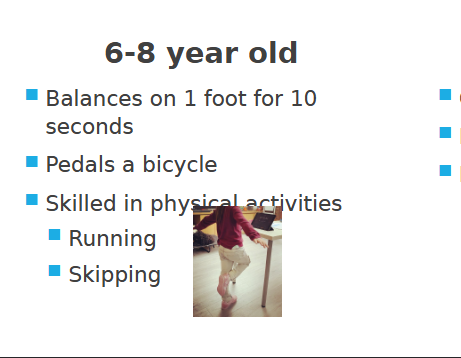
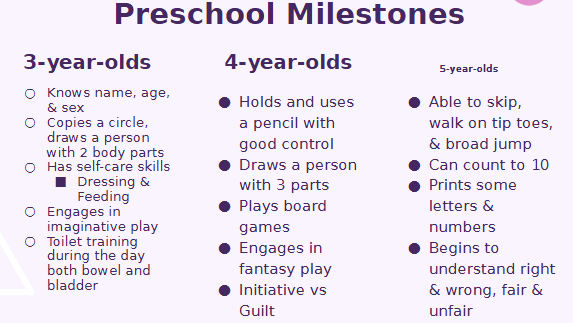
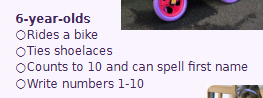
Preschooler Health patterns:
Illness/injury seen as punishment
Anxiety surrounding body ; fear mutilation and death
Preschoolers see health as how their family defines health
Older preschoolers capable and responsible of independent toileting
Band-aid usage in preschoolers:
Protect minor injuries, promote healing, control bleeding
Emotional Comfort, reassusrance, Encourage coping, premotes independence & self-care
Values and Beliefs
Fascinated with new life and death ; ask endless questions
Death seen as departure or type of sleep ; may believe their negative thoughts caused death of a person
control behavior to retain parental love and approval
lack developed consciences
Developmental screening and assessment:
Early identification of developmental or emotional disorders is essential
Early intervention because child’s brain capable of change during preschool period
Need screenings with standardized tests
1 in 6 children ages 3-17 have one or more developmental or behavioral disability
ASD (Autism Spectrum Disorders):
challenges with social interactions, communication, restricted interests, repetitive behaviors
Diagnosis: display all 3 of social affective difference in addition to at least 2 of the 4 symptoms related to restrictive and repetitive behaviors
Reactions of divorce:
What is a likely reason for a preschool-aged child to repeatedly ask, "is daddy coming home for supper tonight?" after their parents divorce
The child is struggling to cope with or comprehend the permanence of the divorce
Memory:
Memory important in language development
Language and literacy development helps with problem solving
Aid memory by labeling/saying pictures, group objects, mimic others
Don’t use mnemonic techniques or rehearsal
Initiative vs Guilt:
Develop initiative through: vigorous motor activity, active imagination
Praising preschoolers, opportunities for experimentation
Nutrition:
Older preschoolers resist trying new foods ; develop strong food preferences ; parents must promote healthy food/snack options
Select finger foods to promote independence
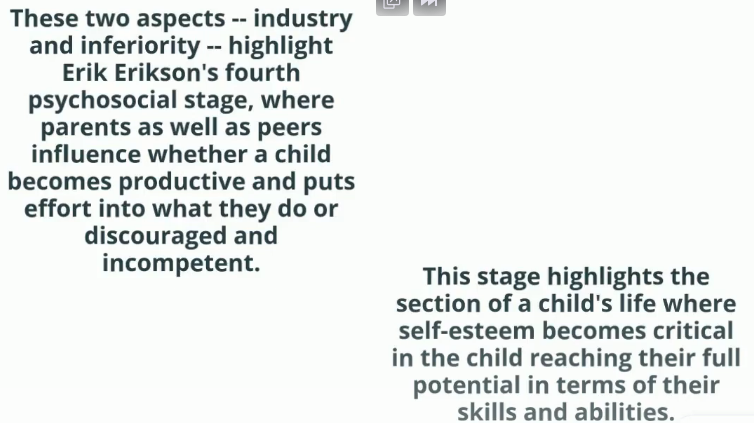
SCHOOL AGE: INDUSTRY V INFERIORITY
Parental influence on developing industry:
Productive = positive encouragement
trying out tasks and gradually succeed builds confidence and learns their skills ; guidedance without overcontrol ; responsible
Influence on inferiority:
When a child feels discouraged, resulting in them feeling inferior or incompetent (like getting bullied or picked on)
Chacrteristics: feeling inadequate, inferior, defeated, isolated, and discouraged.
School Readiness (5 domains):
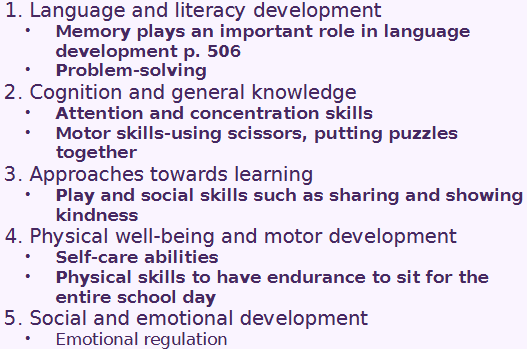
Health issues:
Somatization - transferring feelings into a physical problem
Depression-disturbance of mood, sadness, guilt, worthlessness
Stress symptoms: pounding heart, stomach butterflies, sweaty hands
bullying symptoms: anxiety, helplessness
Coping strategies: Deep breathing, roleplaying, counseling
ADHD - High energy, creativity, & intuitiveness that enables them to be successful in some areas of their life
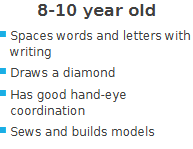
Fine Motor:
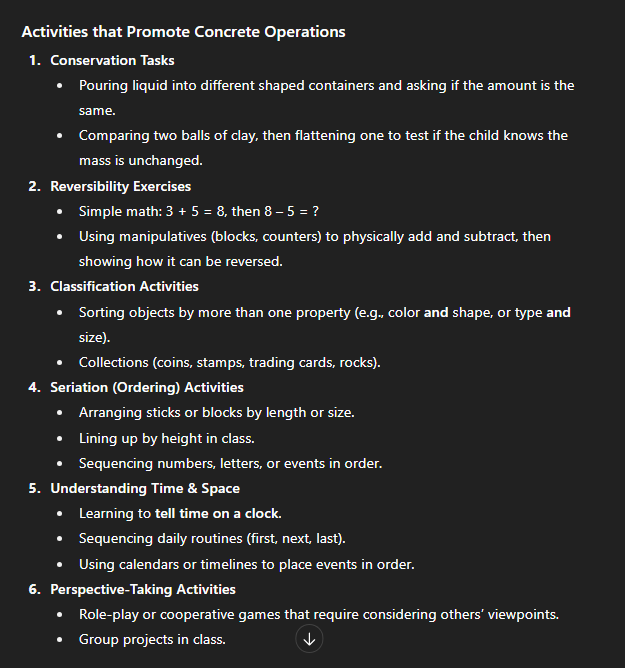
Activities that promote concrete operations
Cognitive perceptual pattern:
Piaget’s Theory - concrete operations
egocentric interactions to cooperative interactions
increased understanding of concepts
reasoning from intuitive to logical or rational operations
considers other POVS
concept of time develops - can tell time
Collecting things (like information)
concrete thinking = less self centered, increased understanding of environment
lack of understanding rules
Mastery of new ideas and concepts
Need intact senses
Memory capabilities: organizing, classifying, and labeling information ; rehearsal - repeating to learn
Cognitive development & skill acquisition needed for future sucess
moral development: cultural, parental, religious values
Physical growth:
Muscle mass increases = muscle strength increases
Height increases 3 inch/year ; weight 2-3 lbs/year
growth slower than infancy & adolescence
Dental:
Checkups for problems, education on brushing and flossing dependent on age, healthy eating habits
common dental problems: Dental caries, malocclusion, periodontal disease.
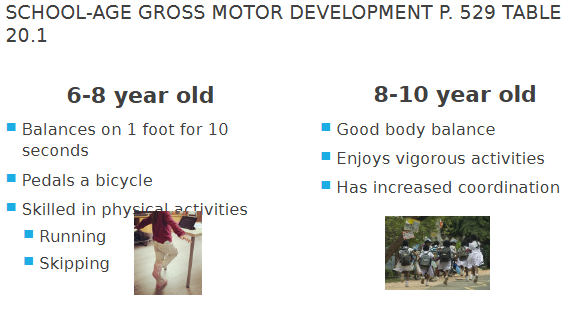
Legs grown longer than other parts of the body allowing greater (motor skills):
Strength, balance, coordination, fluid motion
Running, jumping, climbing, throwing, riding bike
Inclusive Playground - low height for younger, challenging climbing for older, sandbox and swings for group interaction.
Social development:
Relationships with peers developing
peer groups bring acceptance and foster’s feelings of self-worth
Gross Motor 6-10:
Sleep disturbances:
night terrors, sleepwalking, sleeptalking, enuresis (bedwetting), confusional arousals, rhythmic movement disorder
enuresis = involuntary urination at a controllable age
encopresis = persistent voluntary or involuntary passing of stool into the child’s underpants after age 4 years (chronic constipation)
Prevention of sleep disturbances: Implement consistent bedtime routines, create a safe sleeping environment, and educate on the importance of sleep hygiene.
Nutrition:
School age need 1200-1600 calories/day
Deficient in iron, calcium, and vitamin C
Children eat foods that are high in salt, sugar, and calories
33% of children eat food from fast food restaurants ; leads to childhood obesity
Access to food, mass influence, and busy lifestyles contribute to poor food choices = poor nutritional patterns
non-program content time on television devoted to food-related advertisements
Obesity is a common in Black American & Hispanic children.
Increased risk for hypertension, diabetes, sleep apnea, heart disease.
The Milk/Dairy group emphasized as the essential food group for strong bone and teeth development.
provides calcium, phosphorus, and vitamin D, critical for proper mineralization of bones and teeth during the rapid growth of childhood.
Benefits of Play:
No structure to activities
strengthens muscles, promotes balance, expands energy, improves language and cognitive skills
active play during recess associated to self-regulation and academic achievement
Parents should promote physical activity instead of sedentary play (video games/screen time - can promote violence and adult themes)
ADOLESCENCE: psychological, emotional, cognitive, moral transition from childhood → young adult
Charactertistics: impulsive, enthusiastic, independent, rebellous, risk takers, vulnerable
Adolescents think they’re invincible = act without thinking abt concequences ; risk takes
Risk taking behaviors: drugs, alcohol, tobbaco, piercings, tattos, gangs, bullying, high risksexual practices
Erickson: Identity vs. role confusion
Confusion arises when fears of participating in actitivites will proviude them opportunities to excel or win approval of other
industry, autonomy, initiative, trust
1600 to 1800 calories for females
Sexual Characteristics (sex & puberty):
Primary: organs for reproduction, delayed puberty need referral to endocrinologist: male age 14, girls age 13
Secondary: External features not needed for reproduction: breast, pubic/facial hair, male voice changes
Gynecomastia - disappears (temp)
May last long and cause body image problems
Menstruation: 2 years after breast buds
Factors: increased weight, use of products that mimic estrogen production, stress
The first menstrual period is called menarche
Scoliosis: lumbar spine ; common orthopedic issue in adolescence
Eating disorders (both male and female ; more common in females):
Has comorbid psychiatric conditions
Obessive-compulsive disorders: anxiety, depression, suicide thoughts (uncommon)
Anorexia Nervosa - self starvation:
symptoms: lack of menstruation, brittle hair/nails, dry yelloish skin
Perfectionism and high achievement
Binging/purging disorders - eat and cannot stop resulting in vommiting
Bulimia Nervosa - self induced purging
Anorexia/Bulimia nervosa on one end, binge eating disorders on the other
Sleeping:
at least 9 hours of sleep
Disturbances: teens with evening jobs working late, teens with out of town sports games with travel time, teens on phones/video
Acne (common) - increased production of sebum from sebaceous glands. sebaceous follicles clogged with sebu, and debris making black/whiteheads ; don’t squeeze lesions = irriration of gland and tissue injury
Factors: stress & diet
wash face twice/day '; gentle cleanser, retinoid
mild acne: combination of topical agents and antibiotic ; severe acne: hormonal therapy
STIS - Sexually transmitted infections
Emergence of secondary sex characteristics increased adolescent’s awareness of themselves as a sexual human being
Reasons for sexual activity: affection/close, peer pressure, maturity, feels good/right
Sexting - increased global practice in teens
Sexually explicit content through messages
StI prevention essential
Anticipatory guidance: supporting/educating prior to teens decision to become sexually active ; contrapceptives for protection from STI’S
Adolecents need
Positive self image: positive relationships and protection from emotional experiences
Appropriate social support: peer relation ships protection from emotional experiences
Feeling balued and nurtured: having caring adults help emerge from adolescence in healthy way
Piaget’s: formal operations “where am i going”, “who am i”, “how do others see me”
formal = focus on thoughts, onjects, and experiences than exact
groundwork for abstract thinking
introspection and egocentrism
Death: first - overdose (Heroine laced with fentanyl ; prescrition opioids and addiction) ; 2nd: suicide