6.1.1 Aromatic Compounds
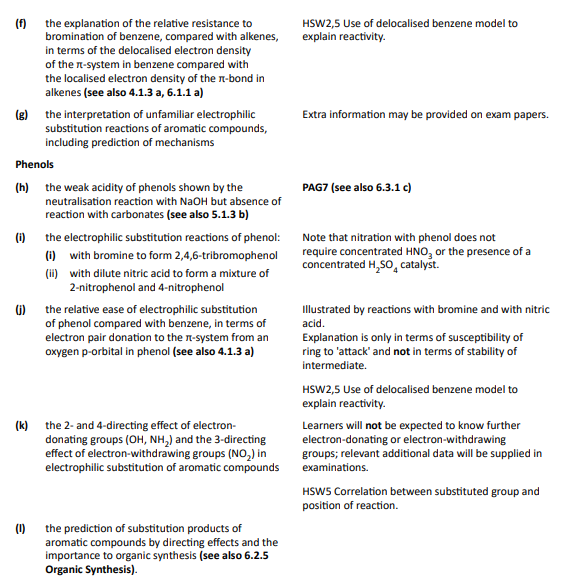
Aromatic Compounds are those that contain a benzene ring.
a.)

Kekule’s Model of Benzene
Properties
Alternating double and single bonds
Cyclic & Planar
Why is this incorrect?
It didn’t readily undergo electrophilic addition, which suggests the lack for presence of a C=C bond.
All 6 bond lengths where similar, whereas C=C bond are usually shorter than C-C.
The ring was more thermodynamically stable than expected.
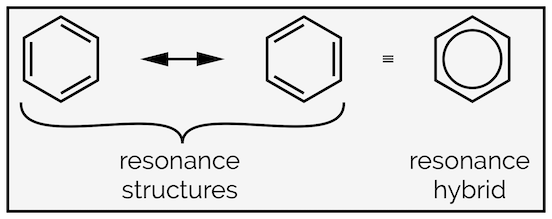
Delocalised Electron Model of Benzene
The structure oscillates between the Kekule forms but is neither of them.
Properties
Planar
No Double Bonds
Quite Stable as no bonds
Thermodynamically Stable
The length of the bonds is between the bond length of C-C and C=C.
The three bonds are not in one position, but delocalised all over the ring.
b.)
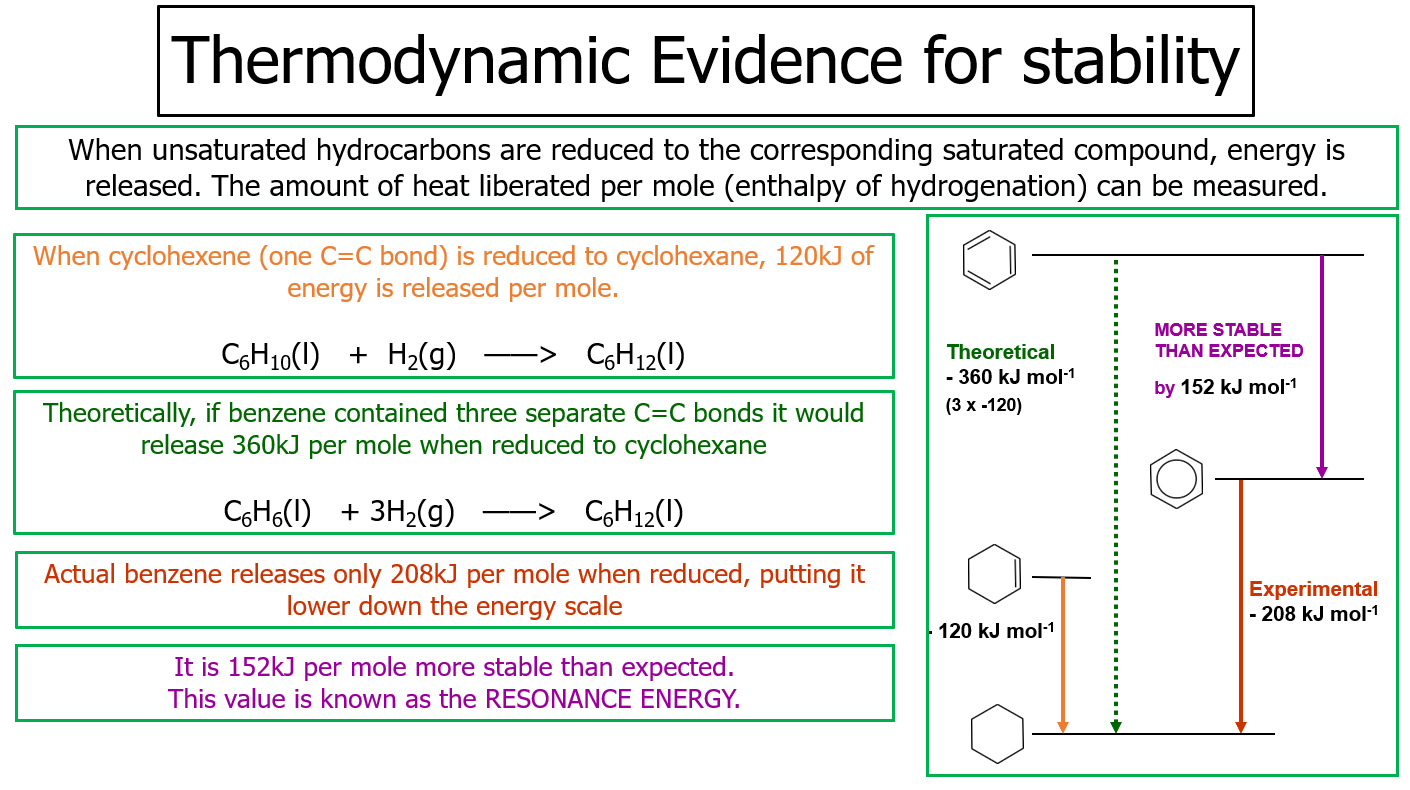
Additionally, benzene doesn’t discolour bromine water (which indicates the lack of alkenes) or undergo addition reactions with HBr or HCl.
Phenyl means something containing a benzene ring phenol










d.)
Why does benzene undergo electrophilic substitution?
It is energetically stable due to the delocalization energy, addition reactions would break that
The electron density is less than that of a C=C bond, so electrophiles are less attracted to it.
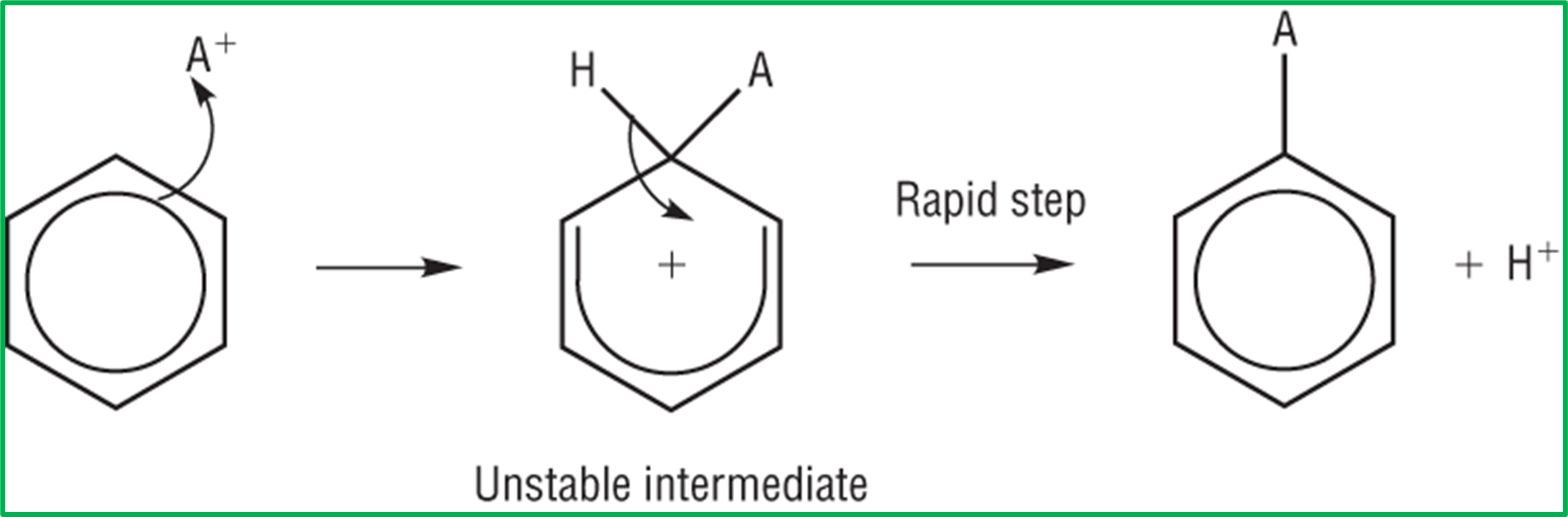
Rules:
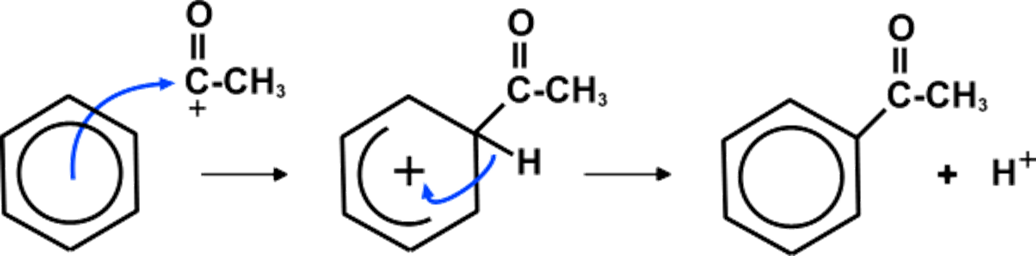
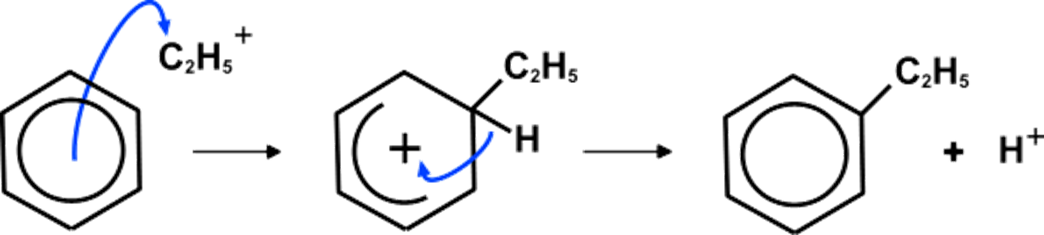
The first curly arrow must start on the ring – but can start anywhere on the ring.
The broken ring must cover 4 of the C-C bonds. (not significantly more or less.
The examiners want to see the + charge on the broken ring away from carbon 1.
The second curly arrow must go back into the broken ring.
Don’t forget that the displaced H atom must have a + charge.
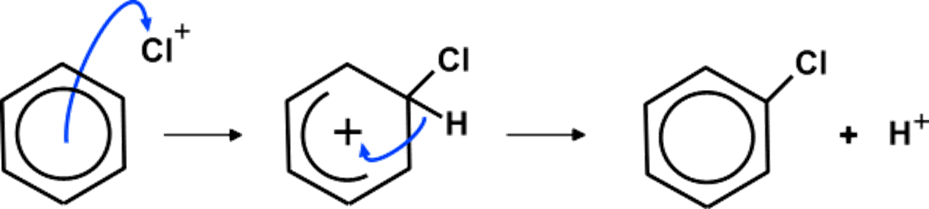
Electrons are attracted to the electrophile. Electrons from the delocalised benzene ring are attracted to the electrophile. A pair of electrons from the delocalised ring move from the ring to form a bond with the electrophile.
The delocalised ring is disrupted temporarily. A “horseshoe” is drawn within the intermediate structure to show this disruption. To restore stability in the delocalised electron ring, the electron pair from the hydrogen bonded to the C atom, are returned to the ring.
The delocalised ring is restored. The hydrogen is lost as a H⁺ ion and the electrophile is substituted in its place. The benzene delocalised electron ring has been restored.
Nitration
Conditions :
Conc. (catalyst)
Conc.
Reflux at 55°C

Generation of Electrophile:
HNO3 + 2H2SO4 à NO2+ + 2HSO4- + H3O+

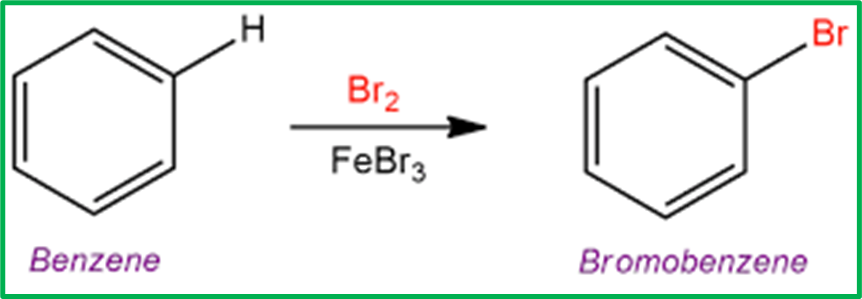
Halogenation
Conditions :
Halogen
Halogen carrier (Catalyst)
[FeCl3, FeBr3, AlCl3 or AlBr3]
Reflux
Generation of Electrophile:
Cl2 + FeCl3 ⇋ FeCl4- + Cl+
Friedel-Crafts Alkylation
Conditions :
Halogenalkane
Anhydrous Aluminium Chloride (AlCl3)
Room Temperature
Dry, Inert Ether solvent.

Generation of Electrophile:
RCl + AlCl3 ⇋ AlCl4- + R+
Friedel-Crafts Acylation
Conditions :
Acyl Chloride (RCOX)
Anhydrous aluminium chloride (AlCl3)
Reflux at 50°C
Dry, Inert Ether Solvent

Generation of Electrophile:
RCOCl + AlCl3 ⇋ AlCl4- + RCO+