Unit 1 – Cellular Biology
1. What does it mean for a cell to differentiate? How are genes involved in this process?
Cell Differentiation - process by which a cell becomes specialized to perform a specific function via activation of some genes by chemical signals and not others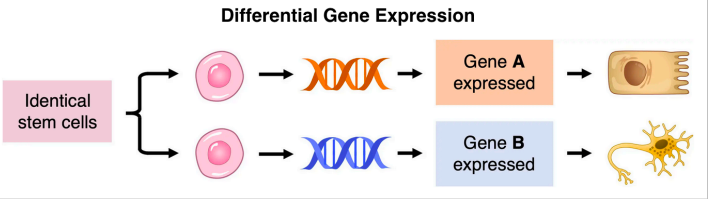
Gene Packing
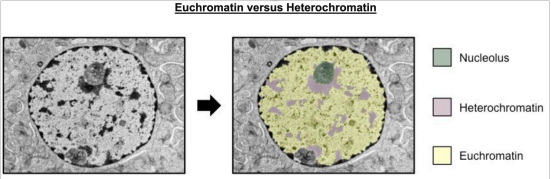
Differentiated cells have different regions of DNA packaged as euchromatin and heterochromatin
Euchromatin - expanded form that is accessible for transcription (active gene)
Heterochromatin - condensed form that is not accessible for transcription (inactive gene)
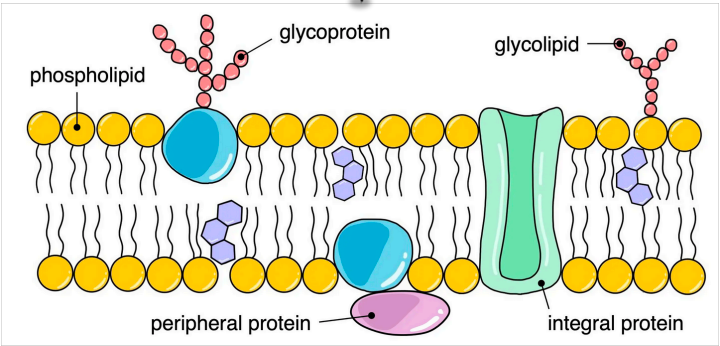
2. Label a diagram to show the structure of membranes.
3. Know the main properties of different forms of transport
Passive Transport
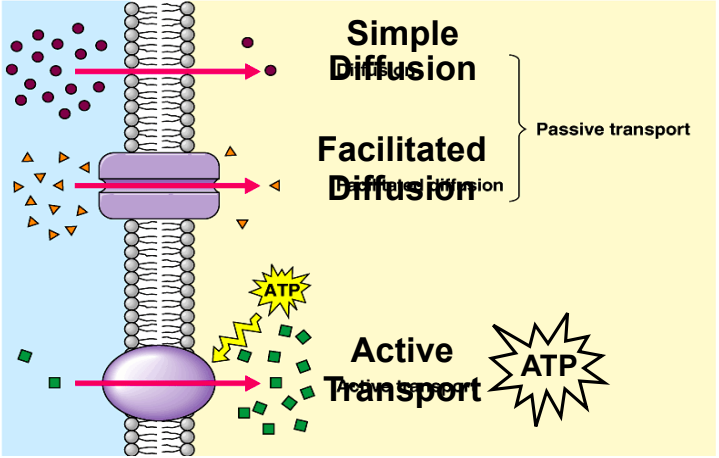
Simple Diffusion
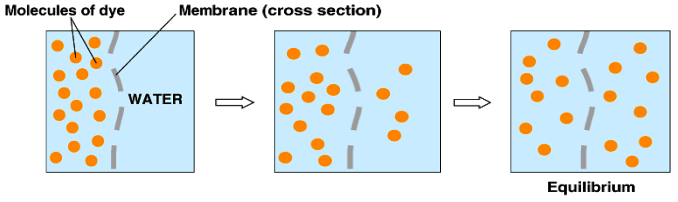
Movement of small substances directly across membrane from HIGH concentration to LOW concentration until equilibrium reached
No energy needed
Small and non-polar molecules (e.g. O2, CO2, glycerol)
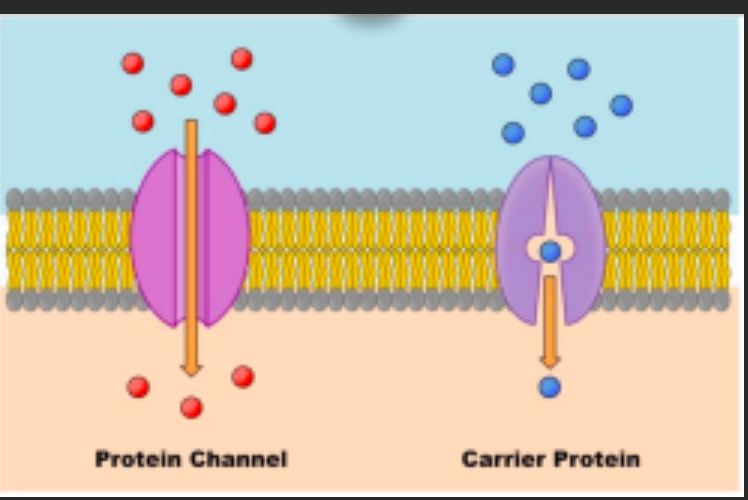
Facilitated Diffusion
Facilitated = with help
Movement of large, charged, or hydrophilic particles through protein channels or by carrier proteins from HIGH to LOW concentration
No energy needed
Osmosis
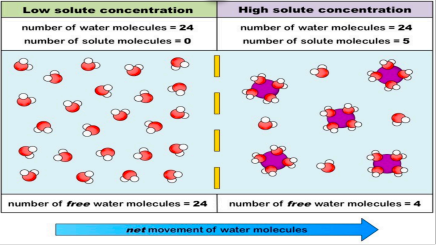
Diffusion of water across a semi-permeable membrane from HIGH concentration to LOW concentration
Equal concentration of water and dissolved substances on both sides of membrane - equilibrium
Osmolarity
measure of solute concentration
Direction of osmosis is determined by comparing total solute concentrations
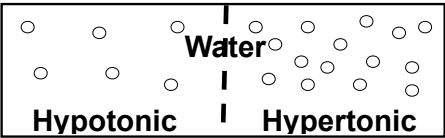
Hypertonic - high solute (high osmolarity)
Hypotonic - low solute (low osmolarity)
Isotonic - equal solute concentration (no net water flow)
Active Transport
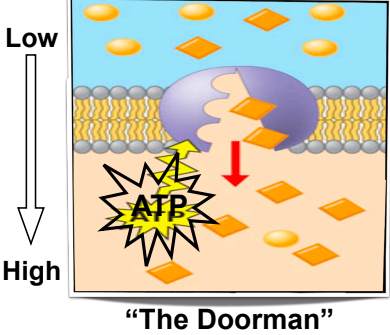
Movement of molecules against concentration gradient
Protein pump transports solutes “uphill”
“Costs” energy = ATP
Vesicular Transport
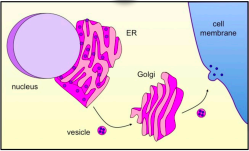
Materials destined for secretion are transported around cell in vesicles
E.R - membrane bulges/buds to create vesicle sent to Golgi
Golgi - vesicles fuse, materials modi ed, then secreted via fusing with plasma membrane, or directly into extracellular fluid, or sent in vesicle to lysosome
Bulk Transport
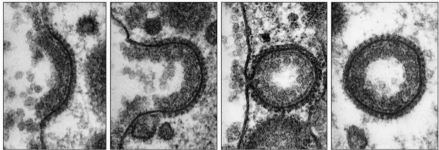
Bulk Transport - movement of very large molecules or large quantities in/out of cell through vesicles and vacuoles
Endocytosis - enter cell without crossing membrane
Phagocytosis = solid substances are ingested
Pinocytosis = liquids/dissolved substances are ingested
Exocytosis - exit cell without crossing membrane
4. What is osmolarity? Relate this to hypertonic, hypotonic, isotonic, as well as solute concentration.
measure of solute concentration
Direction of osmosis is determined by comparing total solute concentrations
Hypertonic - high solute (high osmolarity)
Hypotonic - low solute (low osmolarity)
Isotonic - equal solute concentration (no net water flow)
5. Be able to predict the movement of water for cells placed in different solutions.
6. What is the endosymbiotic theory, and what is evidence for this theory?
7. How does mitosis differ from meiosis? What are their respective roles in multicellular organisms?
8. Describe the development and suppression of cancer.
9. Calculate length and magnification.
Unit 2 - Molecular Biology (Pt. 1)
1. Explain the special properties of water and provide examples of each.
2. Explain the characteristics of a good solvent.
3. Define isomer and describe the relationship between structure and function. Give specific examples.
4. Know the characteristics of carbohydrates. Be able to identify based on a diagram.
5. Know the characteristics of lipids. Be able to identify based on a diagram.
6. Know the characteristics of proteins. Be able to identify based on a diagram.
7. Know the details of enzymes.
8. Draw and fully label a potential energy diagram for an endothermic or exothermic reaction with the use of an enzyme and without.
9. Compare and contrast catabolic and anabolic reactions.
Unit 2 - Molecular Biology (Pt. 2)
1. Explain what happens to the carbons in a glucose molecule during respiration.
2. Describe anaerobic pathway of lactate fermentation and alcohol fermentation.
3. Compare and contrast aerobic respiration and anaerobic respiration in terms of organisms it occurs in, energy yield, organelles involved, when the processes happen, and the conditions required for the process to occur.
4. Know all the products, reactants, stages, organelles of photosynthesis. Including where they enter/exit.
5. Compare and contrast photosynthesis and cellular respiration in terms of organisms they occur in, membrane bound organelles, final electron acceptors, enzymes involved, source of electrons, cause of electromotive force, when and why the process happens, and the conditions required for the process to occur.
Unit 3 - Genetics
1. Explain Chargaff’s rule and be able to determine the amount of each nucleotide in a sample.
2. Be able to sequence the complimentary and template strand of DNA.
3. Describe how DNA replication results in a lagging strand.
4. Describe the results of the Meselson and Stahl experiment.
5. Be able to transcribe and translate DNA into a protein.
6. Be able to sequence and compare the DNA sequence of individuals.
7. Be able to solve problems (monohybrid, sex-linked, incomplete dominance, codominance, and multiple alleles)
8. What are blood types? What determines what blood type you are?
Unit 4 - Evolution
1. Briefly summarize the concept of the “natural world” held by each of the following scientists (or their contribution to the understanding the natural world): Lamarck and Darwin
2. Explain the multiple mechanisms through which evolution occurs.
Unit 5 - Ecology
1. Define the following terms: crude density and ecological density. Be able to calculate each.
2. Be able to solve problems involving the mark-recapture method of estimating population size.
3. Use energy pyramids to show the transfer of food energy from one trophic level to the next. Be able to calculate the amount of energy passed between trophic levels.
4. What is binomial nomenclature?
5. What is the difference between prokaryotes and eukaryotes?
6. What are the 3 domains?
7. Be able to complete a dichotomous key.h