Cells Study Guide
Cell Study Guide
Vocabulary
Cell: the basic unit of structure and function in living things
Organelle: specialized structure that performs important cellular functions
Membrane Bound Organelles: only eukaryotic cells
Cell Wall: a rigid layer of nonliving material that surrounds the cell membrane and provides support to the plant cell or other organisms
Golgi Body ( apparatus): system of membranes that modifies ( production/ processing) , and packages protein for export by cell
Mitochondria: the powerhouse of the cell, organelle that is the site of ATP ( energy) production
Centrioles: cell organelle that aids in cell division in animal cells only
Cell (Plasma) Membrane: thin,flexible barrier around/ at the boundary of a cell; maintains homeostasis by acting as a selective barrier and regulates what enters and leaves the cell ( regulates chemical composition)
Cytoplasm: jellylike fluid inside the cell in which the organelles are suspended/held
Nucleus: control center of the cell, contains DNA and RNA, responsible for growth and reproduction , boss of the cell
Lysosomes: contains enzymes that breaks down materials( food ) and waste ( old organelles), helps to clean the cell
Microtubules: move inside vesicles,granules, and organelles via attachment proteins “conveyor belts”, found in cytoplasm, support and shape cell ( part of cytoskeleton)
Vacuoles: cell organelle (sac) that stores materials such as water, salts proteins, and carbohydrates
Vesicles: small membrane sacs that specialize in moving products into, out of , within a cell
Endoplasmic Reticulum: transports proteins , makes, phospholipids and detoxifies poisons ( known as the cell superhighway)
Rough Endoplasmic Reticulum: studded with millions of membrane - bound ribosomes, is involved with the production ,folding, quality control and transport of some proteins,highway of the cell
Smooth Endoplasmic Reticulum: has no ribosomes and creates lipids or fats, contains enzymes that help carry out functions
Nucleolus: makes ribosomes, found inside the nucleus
Ribosomes: attached to the membrane systems or scattered in the cytoplasm, cite of protein synthesis : makes proteins
Chloroplast: an organelle found in plant and algae cells where photosynthesis occurs, composed of numerous membranes that are used to convert solar energy into chemical energy, contains chlorophyll
Chlorophyll: green pigment in plants that absorbs light energy used to carry out photosynthesis. It is found in plants, algae and some bacteria
Organ system:a group of organs that work together in performing vital body functions
Tissue: a group of similar cells that perform a specific function
Eukaryote: a cell that contains a nucleus and membrane bound organelles
Prokaryote: A unicellular organism that lacks a nucleus and membrane bound organelles, found only in the domains Bacteria and Archaea
Unicellular: made of a single cell
Multicellular: made of more than one cell
Cilia: The hairlike projections/structures on the outside of some cells that move in a wavelike manner,used for movement
Flagella: whiplike tails found in one - celled organisms to aid in movement
Cytoskeleton: network of protein filaments within some cells that helps the cell maintain its shape and is involved in many forms of cell movement
Homeostasis: a tendency to maintain a balanced or constant internal state; the regulation of any aspect of body chemistry , such as blood glucose, around a particular level
Phospholipid : a molecule that is a constituent of the inner bilayer of biological membranes, having a polar, hydrophilic head and nonpolar. Hydrophobic tail
Selective Permeability : a property of a plasma membrane that allows some substances to cross more easily than others
Transport Proteins: membrane proteins that help move substances across a cell membrane
Fungi: a kingdom made of non green, eukaryotic organisms that have no means of movement, reproduce by using spores, and get food by breaking down substances in their surroundings and absorbing the nutrients
Protist: kingdom composed of eukaryotes that are not classified as plants, animals, or fungi, ex (amoeba,euglena, read algae
Chromosomes: linear, chromosomes shaped in a line like the animals and other eukaryotic cells
Plasmid: circular, small circular shaped DNA molecule that is common in bacteria cells
Complexity: how complicated or intricate or detailed something is
Chromatin: substance found in eukaryotic chromosomes that consists of DNA tightly coiled around histones ( contains the cell's genetic material inside the nucleus)
Prokaryote
No nucleus or membrane bound organelles
Includes bacteria: coccus, spirillum, bacillus ( rods ) - and archaea, e. coli,salmonella
Good bacteria can be found in yogurt, bad can be found in strep throat ( streptococcus)
Simple,unorganized, and smaller, small house
DNA is not in a nucleus , free floating
Characterized by their lack of nucleus
unicellular
cell wall has peptidoglycan
small ribosomes
circular DNA floats in cytoplasm
Eukaryote
Cell with a nucleus and membrane bound organelles
Includes plant, human, protist, and fungi cells
More complex , organized and larger,mansion
Mitochondria can be found only here
Genetic material is linear
Unicellular or usually multicellular
cell wall has chitin or cellulose
large ribosomes
linear DNA present in nucleus
Both
Cell Membrane
DNA
Ribosomes
Cytoplasm
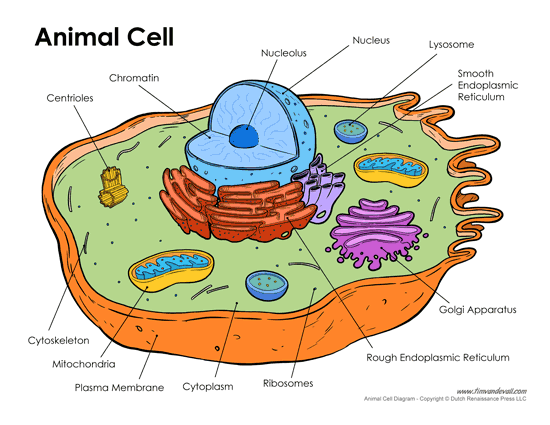
Animal Cells have lysosomes and centrioles , plants do not
Plant Cells have a cellwall, chloroplasts, and chlorophyll
Photosynthesis
occurs only in plants
process happens in chloroplasts, specifically in the thylakiod and stroma
stomata : gaurd cells on the underside of leaves, open and close to let C02 in and 02 out
anabolic process ( converts small molecules to larger ones )
reactants - carbon dioxide, water and sunlight
products - oxygen and glucose
energy is trapped , light is essentail
Equation: 6H2O + 6CO2 + sunlight = 6O2 + C6H12O6
light , carbon dioxide, and temperature all affect the rate of photosynthesis
rate is much higher in summer, winter - no leaves
Cellular Respiration
occurs in all living organisms
breakdown of organic molecules ( glucose) to release energy for use in the cell
process occurs in the mitochondria, specifically in its matrix and inner membrane,
glycolysis, kerbs cycle, and ATP synthase action also happen in the mitochondria
catabolic process ( breakdown of complex - large molecules )
Reactants - oxygen and glucose
Products - water , carbon dioxide, energy - Adenosine Triphosphate
energy is released when the bond is broken betwenn the 2nd and 3rd phosphate , htis new molecule is Adenosine Diphosphate
energy is released, light is not essentail
Equation : 6O2 + C6H1206 = 6H2O + 6CO2 + 36ATP
matter is recycled, complimentary reaction, cycle keeps happening
includes Aerobic and Anerobic Respiration
Both Cycles
ATP is involved and provides energy for cellular functions
Uses ATP synthase and Electron Transport chain
electron carriers
Aerobic Respiration
requires oxygen
occurs in mitochondria
produces 36 - 38 ATP
energy efficeint
occurs only in eukaryotes
breakdown of glucose to get energy
exercise initially supplies the bodies working muscles with oxygen
equation : glucose + oxygen = carbon dioxide and water
Anaerobic
Anaerobic is also called fermentation
Anaerobic includes Lactic acid and alcoholic
Anaerobic does not use oxygen
Anaerobic respiration can only be done in bacteria
yeast uses Anaerobic respiration
Anaerobic respiration occurs in cytoplasm
Anaerobic respirstion occurs after exercising
The Equation for Anaerobic is - Glucose = Lactic Acid
Anaerobic and Aerobic
Anaerobic and Aerobic make ATP
Anaerobic and Aerobic are both used for energy
Anaerobic adn Aerobic both occur in cells
Anaerobic and Aerobic both breakdown glucose
In Anaerobic and Aerobic glucose is a reactant
Simple Diffusion
movement of molecules from an area of high concentration to an area of low concentration
simple diffusion molecules pass directly through the lipid bilayer without the help of channels
no energy is required for simple diffusion
examples of simple diffusion include oxygen and carbon dioxide
Osmosis
osmosis is the diffusion of water through the cell membrane
during osmosis water moves from an area of high concentration to low concentration through channels called aquaporins
no energy is required for osmosis
Active Transport
active transport is the movement of molecules through a cell membrane from an area of low concentration to an area of high concentration
active transport always requires energy ( ATP) and transport proteins
types of active transport include Endocytosis,(phagocytosis and pinocytosis) exocytosis, and protein pumps
active transport uses large and charged molecules such as starches and ions
active transport is like riding a bike uphill
Passive Transport
passive transport does not require energy
examples of passive transport include simple diffusion, osmosis, and facilitated diffusion
passive transport uses oxygen , water, carbon dioxide, and glucose
passive transport is like riding a bike downhill
Cell Membrane
the cell membrane is made of a double layer of Phosphoslipids
a phospholipid is made of two parts : phospate head - hydrophilic
and lipid tails - hydrophobic
phosphate heads face the outside and the lipid tails face each other inside the membrane
cholesterol is a rigid molecule , that provides structure to the membrane, and prevents lipid tails from sticking together or drifting apart
proteins channels help molecules to pass through the membrane without distrupting lipid tails
types of protein channels include transport proteins, receptor proteins, and marker proteins
Fluid component: portion of the cell membrane have the ability to move
Mosaic Portion: lipids and proteins are dipersed through the membrane form patterns