Cells
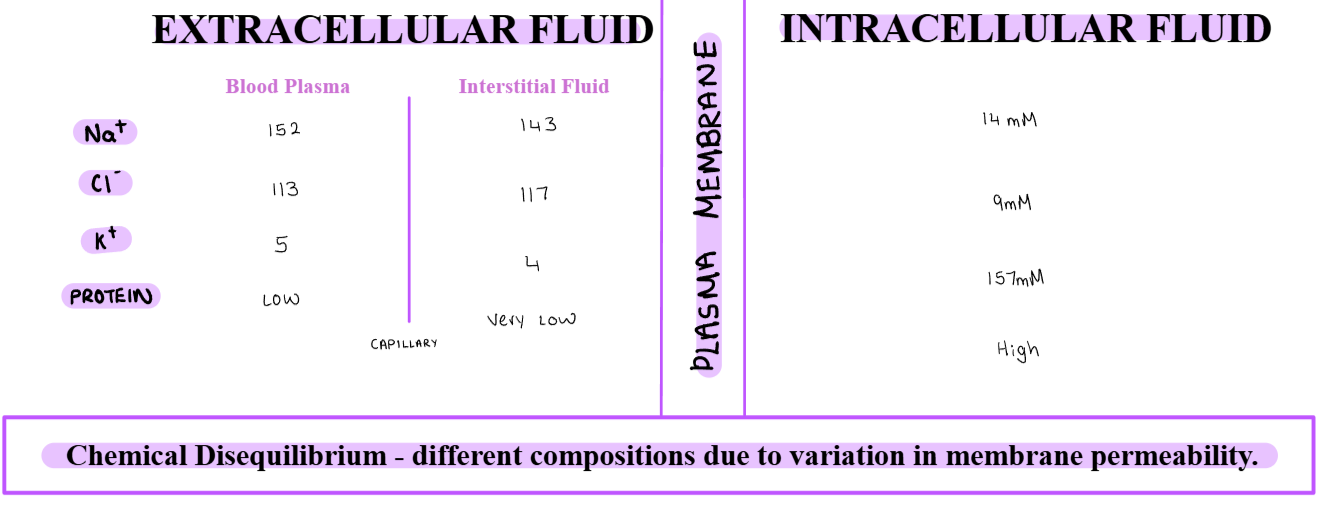
Body Fluid Compartments:
The human body is made up of around 18% protein, 15% fat, 7% minerals and 60% water.
Intracellular fluid makes up around 40% of the total body weight.
Interstitial fluid makes up around 15% of the total body weight.
Blood plasma makes up around 5% of the total body weight.
Intracellular fluid and Interstitial fluid are separated by a cell membrane, whereas interstitial fluid and blood plasma are separated by the capillary endothelium.
Cell Membranes:
The cell membrane is a phospholipid bilayer, which consists of hydrophilic heads and hydrophobic tails.
There are transmembrane proteins, which form pores to allow molecules to move through the membrane. Additionally, there are external receptor molecules on the surface of the cell membrane for functions such as cell recognition.
Transport Processes:
Diffusion - collisions cause the random movement of molecules from a high to low concentration, down the concentration gradient. Diffusion can take place in open systems or across partially permeable membranes.
Osmosis - the movement of water from an area of more negative water potential to less negative water potential across a partially-permeable membrane.
Filtration - occurs in the kidney. Within the capillaries, there is very high pressure which forces substances out through pores in the membrane. Some can pass through, and others cannot due to size.
Endocytosis is the process of moving substances into the cell, which includes pinocytosis (invaginated membranes pinch off pockets, e.g. in fat uptake), and phagocytosis (the cytoplasm encapsulates).
Exocytosis is the process of moving substances out of the cell, which requires energy from ATP.
Proton-Mediated Transport:
Proteins act as carriers and channels to facilitate the flow of substances that cannot permeate the lipid bilayer.
Facilitated diffusion is the passive movement of substances from a high to low concentration, down the concentration gradient.
→ Carrier proteins - molecules combine with the carrier to diffuse across the membrane.
→ Channel proteins - channels such as aquaporins.
Active transport is the active movement of substances from a low to high concentration, against the concentration gradient.
ATPase breaks down ATP into ADP and Pi, releasing energy. For example, the sodium-potassium-ATPase pump moves ions into compartments.