Rocks
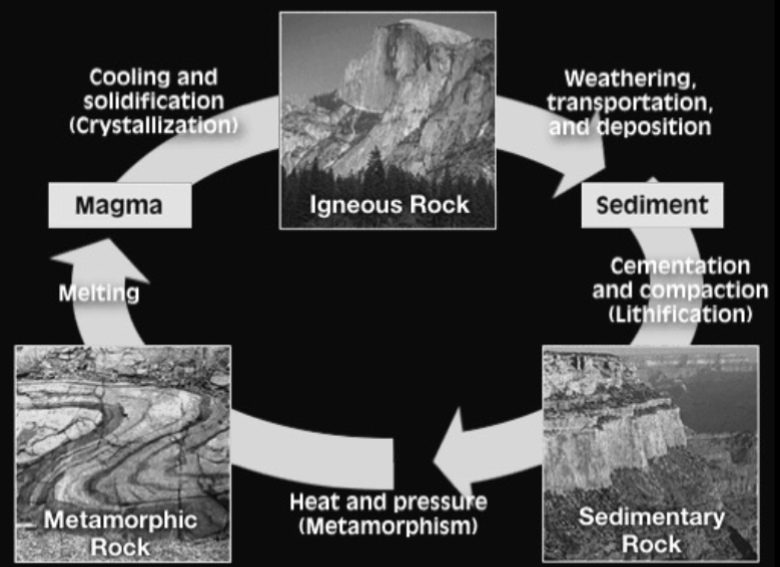
The Rock Cycle
Magma - cooling and solidification (crystallization) = Igneous rock
Weathering, transportation, and deposition = Sediment
Cementation and compaction (lithification) = Sedimentary rock.
Heat and pressure (metamorphism) = Metamorphic rock.
Melting = Magma
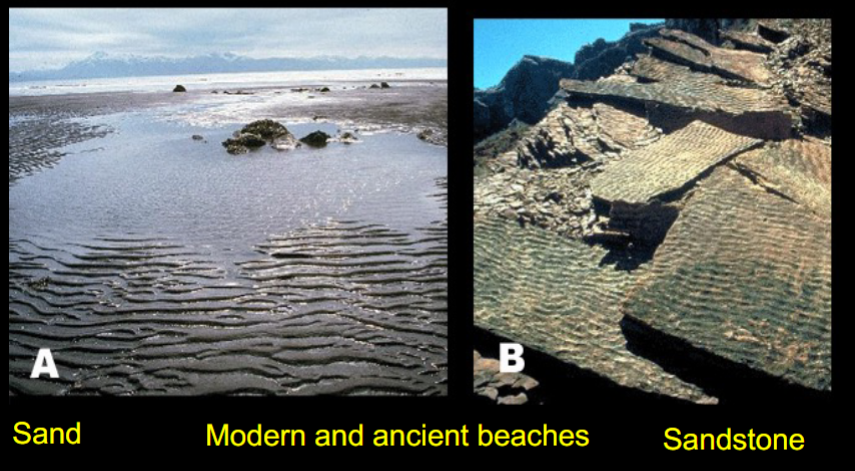
Sedimentary Environments:
Sand (wind)
Sandstone (less wind)
Modern and Ancient beaches
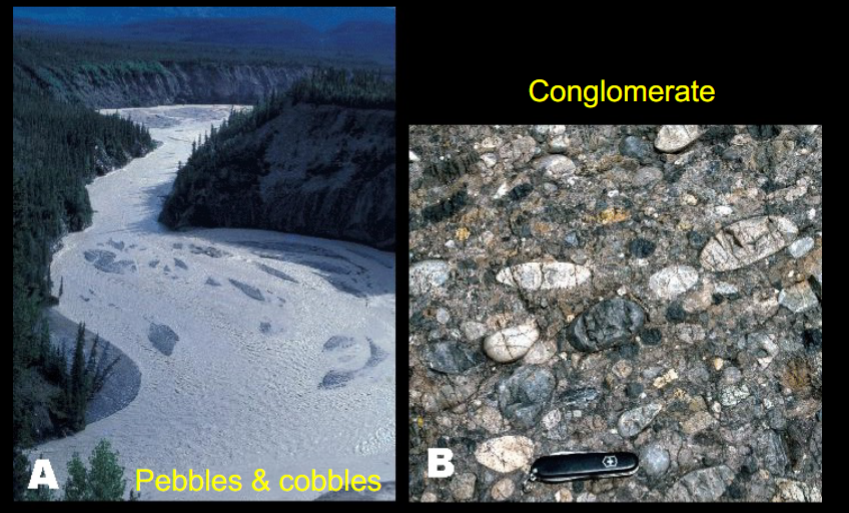
Pebbles and cobbles (suggests water slowed)
Slowly moving water can only transport the finest particles.
Ex: lake
Conglomerate (suggests water moving fast)
Faster water can transport larger grains, leaving behind the largest.
Ex: river
Modern and Ancient rivers laden with sediments (as often found in mountains
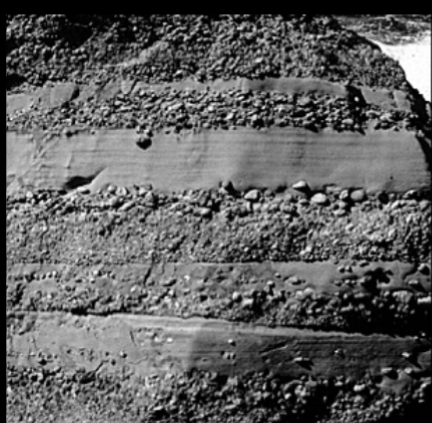
The Principle of Uniformitarianism (relative age)
Unifromitarianism is the concept that geological processes occurring today have been consistent throughout Earth's history, allowing us to interpret the past based on present-day observations.
Recent mudcracks don’t have any sediments between them, but for example, paleozoix mudcracks show distinct layers of sediment accumulation, indicating an ancient environment where similar processes were occurring (245 to 570 million years)
Geological Time
Relative ages - based upon order of formation
Steno (17th century philosopher) put together three basic rules of relative age determination
Original Horizontality
Layers often form laterally extensive horizontal sheets
Erosion can break those flat layers
So we can say that flat-lying rock layers are unlikely to have been disturbed
Superposition
Cross-cutting relationships
Younger features cut across the older ones, showing they came after
Faults, dikes, erosion, and more, must be younger than the material that is faulted, intruded, or eroded You can't break, cut through, or wear down something until it's already there — so the thing doing the breaking or cutting is younger than the thing it affects.
A volcano cannot intrude rocks that aren’t there
Uconformity
That means an unconformity is a missing chunk of time in the layers of rock — like a page torn out of Earth’s history book.
It happens because of:
Nondeposition: No new rock was forming during that time.
Erosion: Older rock was worn away before new layers formed on top
Solution?
Let’s take the Grand Canyon for example, thick layers of strata and numerous gaps
Stratigraphic Correlation: Formations can be traced long distances - Rock formations can stretch across wide areas, and
Even if one place is missing a layer, nearby areas might still have it,
So geologists compare overlapping rock layers from different locations to piece together a full picture — like putting together parts of a puzzle
2. Numerical ages - actual number of years since an event (geochronology)
Based on radioactive decay of atoms in minerals (relative age of geologic events) - act as in internal clocks
Radioactive Decay
Isotopes: Atoms with the same number of protons but different neutrons → similar, slightly different mass numbers.
Stable isotopes don’t change (e.g., ¹²C, ¹³C).
Radioactive isotopes decay over time (e.g., ²³⁸U, ¹⁴C).
Decay follows a chain, producing new unstable elements until reaching a stable endpoint.
Progenitor isotope: the one that decays.
Product isotope: the result of the decay.
Half-life (t½): Time it takes for half of the unstable nuclei to decay.
Each isotope has its own specific t½.
After 1 t½ → ½ of parent remains.
After 3 t½ → ⅛ of parent remains.
As the parent (progenitor) decreases, the daughter (product) increases.
Radioactive decay also creates heat In the crust
accurate methods to determine relative abundance of isotopes have only existed for 60 years
Carbon-14: Carbon-14 is made in the atmosphere and absorbed by living things. When an organism dies, it stops taking in carbon-14, and the amount in its tissues starts to decrease over time (because photosynthesis reduced)
The Phanerozoic eon is more known to scientists, most specifically the Cenozoic era (rise of mammals), and again more specifically the Holocene epoch (human civilization, rise of techniques)
Eons
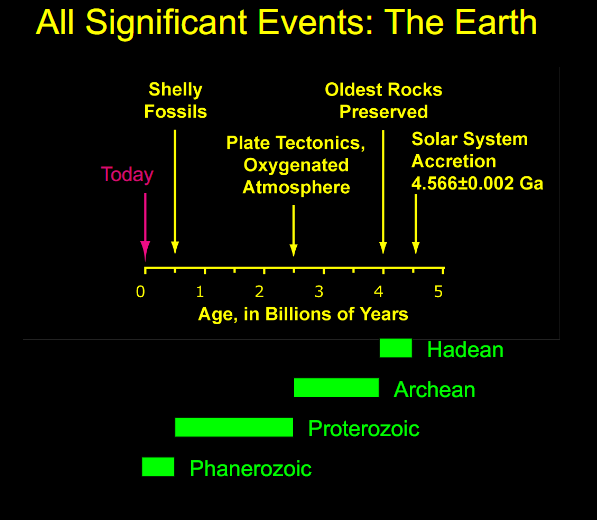
Phanerozoic (“Visible life”) – 542 Ma to present.
Marks first appearance of hard shells, rapid life diversification, and land colonization (~480 Ma).
learned how to mark shells
Proterozoic (“Before visible life”) – 2.5 to 0.542 Ga.
Development of tectonic plates, atmospheric O₂ buildup, and multicellular life.
started to get dry land
Archean (“Ancient”) – 4.0 to 2.5 Ga.
Birth of continents and earliest life forms.
can sample now
Hadean (“Hell”) – 4.6 to 4.0 Ga.
Internal differentiation and formation of oceans/secondary atmosphere.
Iron: Appeared early in Earth's history, as it is a fundamental component of the Earth's core and early crust. Iron-rich rocks date back to the Archean Eon (4.0 to 2.5 billion years ago), with the earliest solidification of Earth's iron-rich core.
Oxygen: Free oxygen in the atmosphere began to appear around 2.4 to 2.3 billion years ago during the Proterozoic Eon (2.5 to 0.542 billion years ago) in an event known as the Great Oxidation Event. Before this, oxygen was largely absent in the atmosphere, and life forms that relied on anaerobic conditions were dominant.
Age of the Earth
The oldest rocks on Earth's surface are about 3.96 billion years old (Ga).
Zircons in ancient sandstones date back to 4.1-4.2 Ga.
Some rocks in northern Quebec may be 4.2 Ga.
The age of Earth is estimated at 4.57 Ga, based on correlations with:Meteorites
Moon rocks.
Black Smokers and Metabolic Energy
Black smokers are underwater hydrothermal vents that release sulfide and iron compounds. These compounds can power metabolism and help synthesize organic molecules, supporting life forms that don't rely on sunlight. The organisms near these vents, known as extremophiles, thrive in extreme conditions, showing that life could have originated in such environments, with metabolism independent of sunlight.
Yes, exactly! The interaction between sulfides (like hydrogen sulfide from the vents) and iron (often present in the vent minerals) creates oxidative reactions that generate energy. This energy can be used by certain microbes to synthesize organic molecules. Here's how the process works in a simplified way:
Earth is about 4.5 billion years old.
Life possibly appeared as early as 4.2 billion years ago, certainly by 3.5 billion years ago.
Early life forms were primitive single-celled organisms (prokaryotes).
Example: Cyanobacteria formed colonies known as stromatolites.
Cyanobacteria:
First to perform photosynthesis.
Produced oxygen as a byproduct.
Played a key role in the Great Oxidation Event.
Helped increase Earth's oxygen levels, enabling complex life.
CO2 + sunlight = organic carbon + free oxygen
The Cambrian Explosion: PHANEROZOIC EON
Paleozoic: The age of fish (first land plants)
Mesozoic: The age of dinosaurs (land and sea creatures)
Cenozoic: The age of mammals.
Holocene
The genus Homo likely dates back 2.5-3.0 million years.
Homo sapiens sapiens is probably no older than 150,000 years.
Humans have been on Earth for less than 0.01% of its total history
45,000 years before we separated ourselves from monkeys
The Cambrian (542 million years ago) marks the appearance of animals with hard shells. Before this, life was primarily soft-bodied.
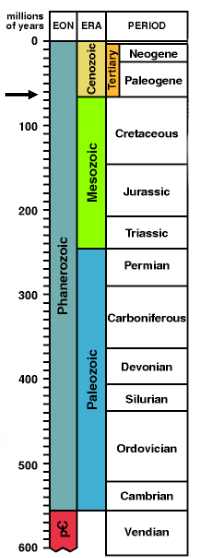
The Cretaceous-Tertiary (K-T) mass extinction, which led to the demise of the dinosaurs, was caused by a giant meteor impact.
🌍 Mini Geological Timeline
🪐 Formation Events
4567 Ma – Solar System forms
4467 Ma – Moon forms
~4400–3960 Ma – Oldest rocks and minerals
3800 Ma – End of major Mare (lunar) impacts
🧫 Early Life & Biological Evolution
3500 Ma – Oldest definitive life (prokaryotes)
2700 Ma – Photosynthesis begins (cyanobacteria)
1500 Ma – First sexual reproduction (eukaryotes)
635 Ma – First animals
542 Ma – First shells (Cambrian explosion)
480 Ma – First land plants
340 Ma – First fully land animals
230 Ma – First dinosaurs
132 Ma – First flowers
2.5 Ma – First humans (genus Homo)
🌍 Earth Systems & Atmosphere
2500 Ma – Plate tectonics begin
~2500–1800 Ma – World’s major iron ore deposits form
~2400–2300 Ma – Atmosphere becomes oxygenated (Great Oxidatidoe on Event)
2400 Ma – Ozone layer forms
40 Ma – Himalayas begin to form
🌡 Major Extinctions & Events
635 Ma – Last global glaciation (Snowball Earth)
251 Ma – Mass extinction – 95% of marine species lost
64 Ma – Dinosaur extinction (Cretaceous–Tertiary boundary)