Digestion 9 Regulation of saliva secretions
This is purely neural
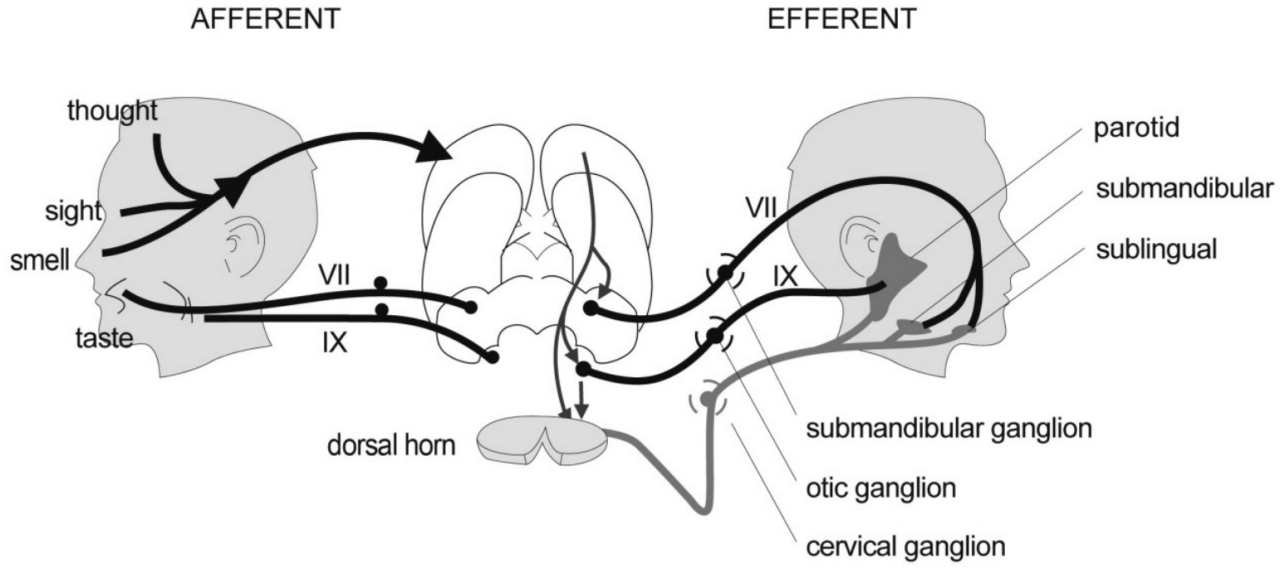
the control of salivary secretion depends on reflex nerve impulses that involve:
afferent limbs
medullar salivatory nuclei
efferent limb consisting of the parasympathetic and sympathetic secretomotor and vascular nerves
both parasympathetic and sympathetic stimulation increases saliva secretion
parasympathetic activity evokes a copious secretion relatively poor in protein and marked vasodilatation in the salivary gland
sympathetic activity evokes sparse but protein-rich saliva
the primary stimulus for salivation is taste
sour taste induces the greatest amount of saliva secretion by the salivary glands
afferent input is carried to the superior and inferior salivatory nuclei in the medulla via the facial (VII) and glossopharyngeal (IX) nerves
input from other senses, such as smell and sight are also integrated in the salivatory nuclei
parasympathetic efferent pathways for the sublingual and submandibular glands are from the facial nerve via the submandibular ganglion and for the parotid gland from the glossopharyngeal nerve via the otic ganglion
these pathways regulate fluid secretion by releasing
acetylcholine (ACh) at the surface of the salivary gland acinar
cells
macromolecule secretion is regulated by norepinephrine release from sympathetic nerves
sympathetic post ganglionic pathways are from the cervical ganglion of the sympathetic chain
higher brain centers control salivation by sending neurons to the salivatory nuclei
parasympathetic nerves of the salivary gland may also release peptides (substance P and Vasoactive Intestinal Polypeptide (VIP), neurokinin A, neuropeptide P) and NO as cotransmitters of acetylcholine
ACh triggers saliva secretion via the IP3 pathway whiles