East Africa: Stone Civilizations and Christian Roots (1100–1980 CE)
Monumental Architecture of the Shona Peoples
Scale, durability, and engineering define the artistic legacy of Southeastern Africa. In AP Art History, the primary focus for this region is the architectural marvel of Great Zimbabwe, which serves as a testament to the complex socio-political organization of pre-colonial Africa.
Great Zimbabwe (c. 1000–1400 CE)
Great Zimbabwe is the largest ancient structure in sub-Saharan Africa. It served as the capital of the Kingdom of Zimbabwe (ancestors of the modern Shona peoples). It functioned as a royal center where kings governed and negotiated trade.
Form and Materials
- Coursed Granite Blocks: The builders used granite, which naturally fractures into even slabs. They utilized dry masonry (or ashlar masonry)—stacking stones without mortar.
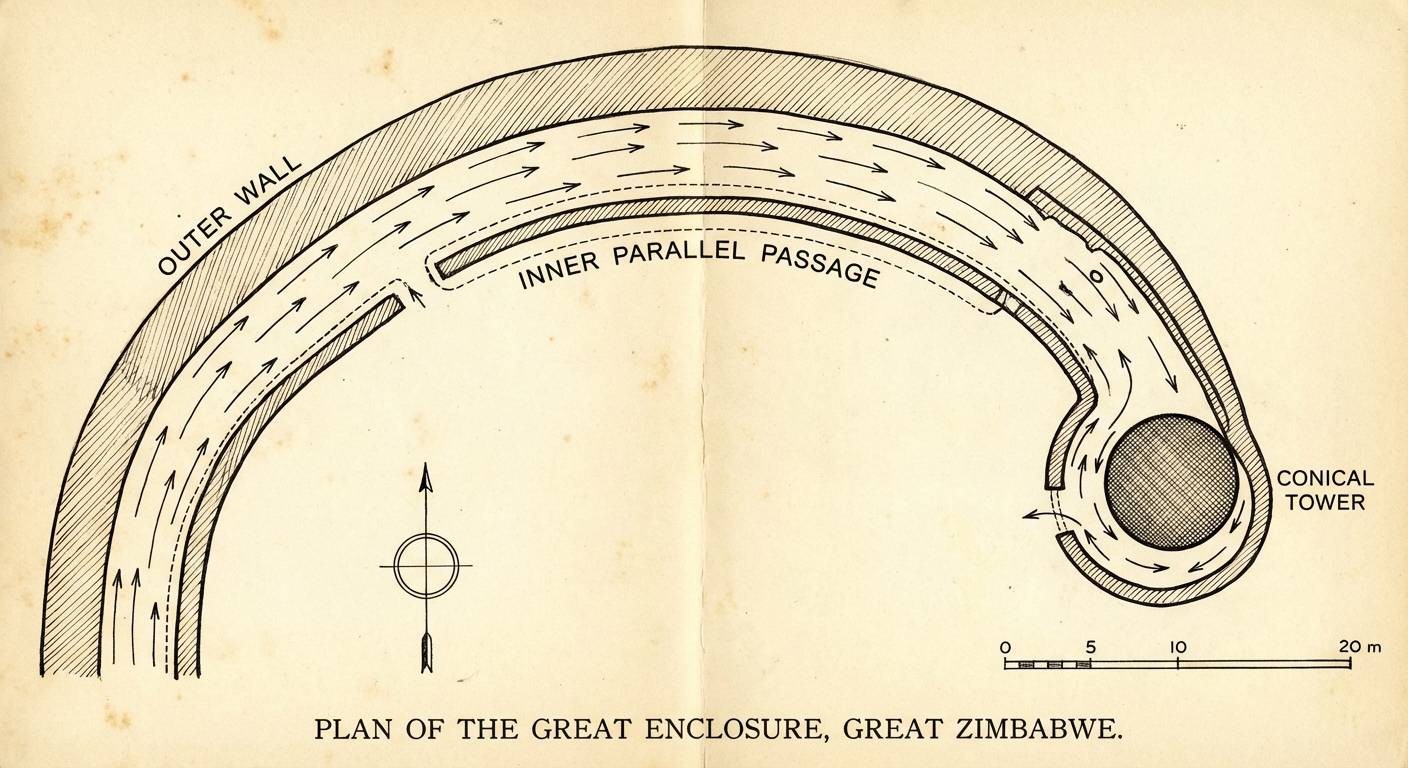
- Curvilinear Walls: Unlike Western architecture, which favors right angles, these walls curve organically, mimicking the forms of the landscape and traditional protective fencing.
- Batter: The walls slope inward toward the top (battered walls), providing structural stability without the use of arches or domes.
Content and Layout
The site is divided into three main areas:
- The Hill Ruin: The oldest section, located on a rocky eminence, generally associated with the king and ancestral worship. It includes eagle-shaped soapstone monoliths (symbols of royal power).
- The Great Enclosure: A massive walled structure located in the valley. It likely served as a royal residence for the queen, a school, or a court.
- The Valley Ruins: Mud-brick housing for the general population (now mostly disintegrated), showing the class distinction between the stone-dwelling elite and the commoners.
The Conical Tower
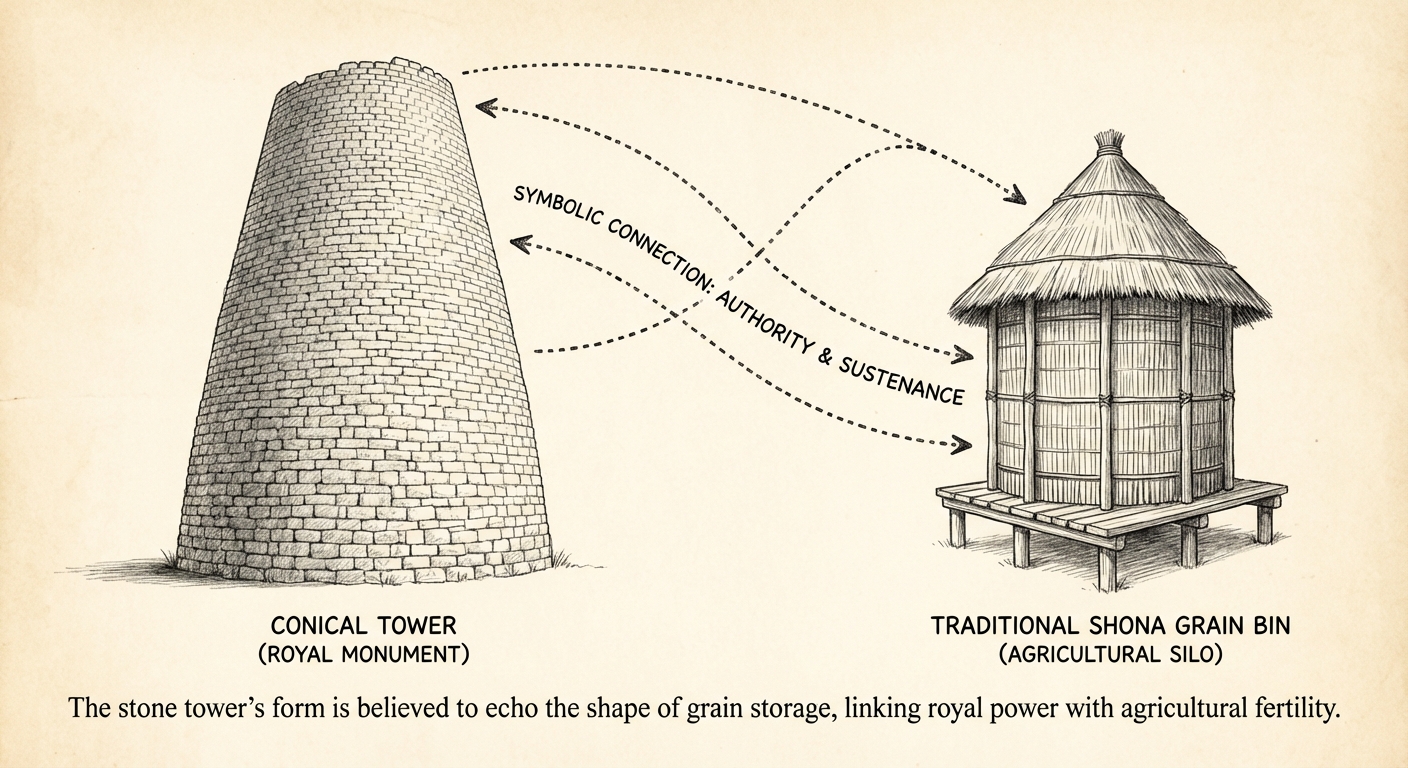
Located inside the Great Enclosure, the Conical Tower is a solid stone structure shaped like a grain bin.
- Symbolism: It represents the power of the king to provide for his people. In Shona culture, the ruler receives tribute in grain and distributes it during famine. The tower is a monumentalized granary, symbolizing agricultural fertility and royal generosity.
- Gender Duality: Some scholars suggest the layout of the complex balances male (Hill Ruin) and female (Valley/Great Enclosure) elements.
Context: Trade and Decline
Great Zimbabwe was part of a vast Indian Ocean trade network. Archaeologists have found Ming dynasty porcelain (China), Persian pottery, and Indian beads at the site. The wealth of the kingdom was built on cattle and gold. It was eventually abandoned around 1450 CE, likely due to environmental exhaustion (deforestation and overgrazing).
Ethiopian Art and Architecture
While West and Central Africa are often associated with animist traditions or ancestral masquerade, Ethiopia in East Africa has one of the oldest Christian traditions in the world (dating back to the 4th century CE).
The Zagwe Dynasty and Lalibela
In the 12th and 13th centuries, King Lalibela of the Zagwe dynasty sought to create a "New Jerusalem" in Ethiopia after Muslim conquests made pilgrimages to the actual Jerusalem difficult.
Rock-Hewn Churches (c. 1200 CE)
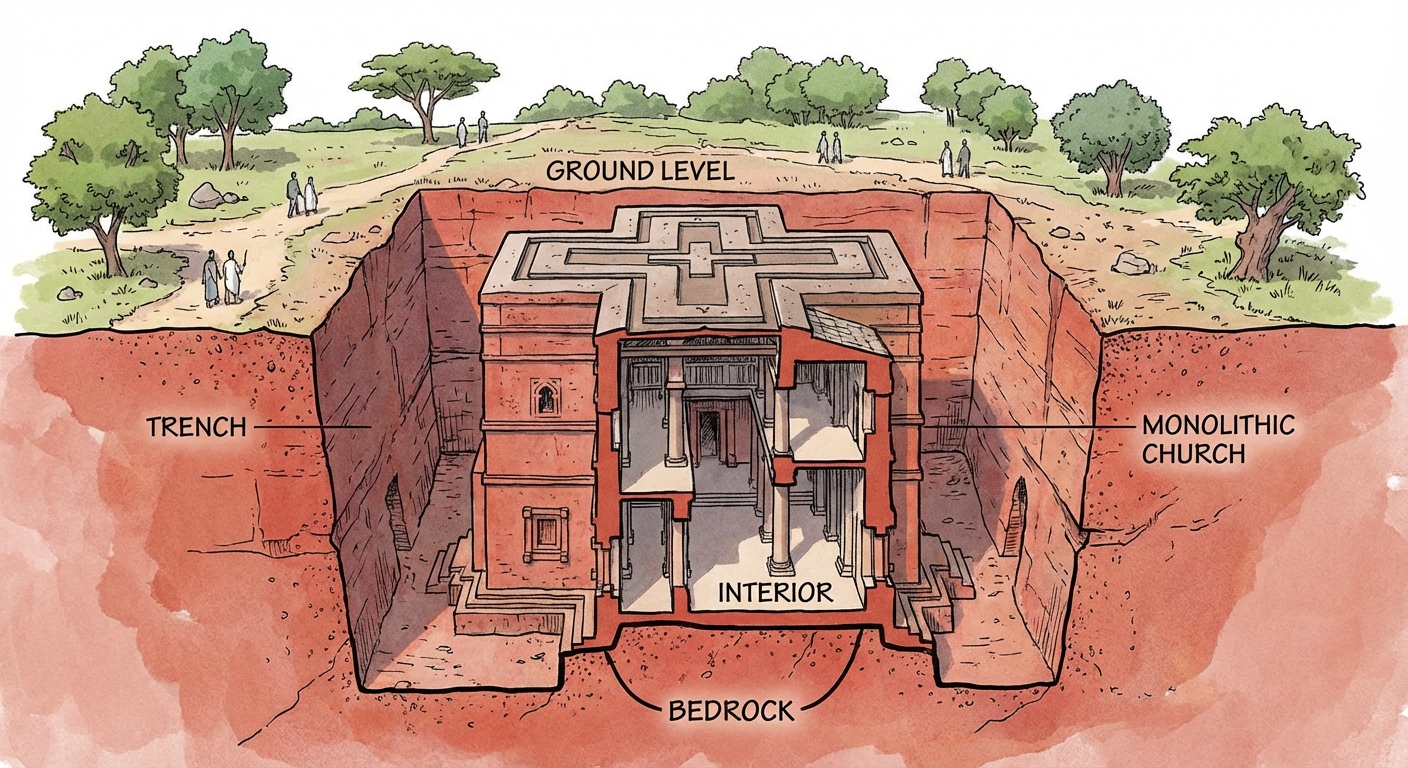
Unlike built architecture (additive), these churches are subtractive. They are monolithic, meaning they were carved out of a single continuous block of volcanic tuff rock.
- Bet Giyorgis (Church of St. George): The most famous of the 11 churches.
- Form: Carved in the shape of a Greek cross (equilateral arms). The roof includes carved continuous geometric patterns.
- Function: An active pilgrimage site and place of worship (still in use today).
- Context: The interior features frescoes and architectural details (columns, arches) that mimic built structures, even though they hold no structural weight in a carved rock monad.
Illuminated Manuscripts and Icons
Ethiopian art is characterized by a distinct "Second Style" or Solomonic style:
- Two-dimensionality: Figures are flat with heavy outlines.
- Frontality/Eyes: Emphasis on large, almond-shaped eyes (the window to the soul) and frontal poses.
- Geometric Abstraction: Use of bright, contrasting colors and chaotic, pattern-filled backgrounds.
African Textiles and Personal Arts in the East
While the AP curriculum highlights West African textiles (like Kente) and Central African personal objects (like Ndop figures), East African personal arts are defined by their cosmopolitan nature due to trade.
The Impact of the Indian Ocean Trade
East African art is not isolated; it is the result of confluence.
- Beadwork: Glass beads imported from India and Europe became integrated into Southeast African status items. In Great Zimbabwe, beads were not just jewelry but currency.
- Swahili Coast Architecture: Blend of Bantu indigenous African roots with Islamic influence (coral stone construction, niche designs), though this is more peripheral to the core AP 250 works.
Personal Religious Objects
In Ethiopia, Processional Crosses are vital personal and liturgical arts.
- Material: Usually silver, gold, or brass (lost-wax casting).
- Design: Intricate lattice patterns representing the order of the cosmos and the everlasting nature of God. They are carried in processions to bless the faithful.
Comparison Table: East African Sacred Spaces
| Feature | Great Zimbabwe (Shona) | Churches of Lalibela (Ethiopian) |
|---|---|---|
| Primary Material | Granite (Coursed blocks) | Volcanic Tuff (Red rock) |
| Construction | Additive (Dry masonry stacking) | Subtractive (Carving down into earth) |
| Religious Focus | Ancestral Spirits / Royal Authority | Coptic / Orthodox Christianity |
| Symbolism | Granary (Provision/Harvest) | New Jerusalem / The Cross |
| Key Term | Ashlar Masonry | Monolithic |
Common Mistakes and Pitfalls
Confusing Great Zimbabwe with Ancient Egypt:
- Mistake: Assuming the stone walls were built by Egyptians or Phoenicians (a colonialist myth).
- Correction: Great Zimbabwe is purely indigenous African architecture built by the ancestors of the Shona people.
Misunderstanding the "Conical Tower":
- Mistake: Thinking the tower is a watchtower or a fortification for archers.
- Correction: It is solid rock all the way through. It cannot be entered or climbed. It is a symbolic silo/granary, not military infrastructure.
Geographic Confusion:
- Mistake: Mixing up Zimbabwe (South-East) with Mali (West, Djenne).
- Correction: The Great Mosque of Djenne is adobe (mud brick) and requires annual replastering. Great Zimbabwe is stone and requires no mortar.
Date Attribution:
- Mistake: Dating Great Zimbabwe to the BC era.
- Correction: It flourished c. 1000–1400 CE, contemporary with the European Middle Ages.