CUM 301 Petroleum Cglkklhemistry - Notes Summary
Page 1
CUM 301 Petroleum Chemistry: Course overview by Dr. Ayur, Date: 13-
 FEB-24
Petroleum Composition:
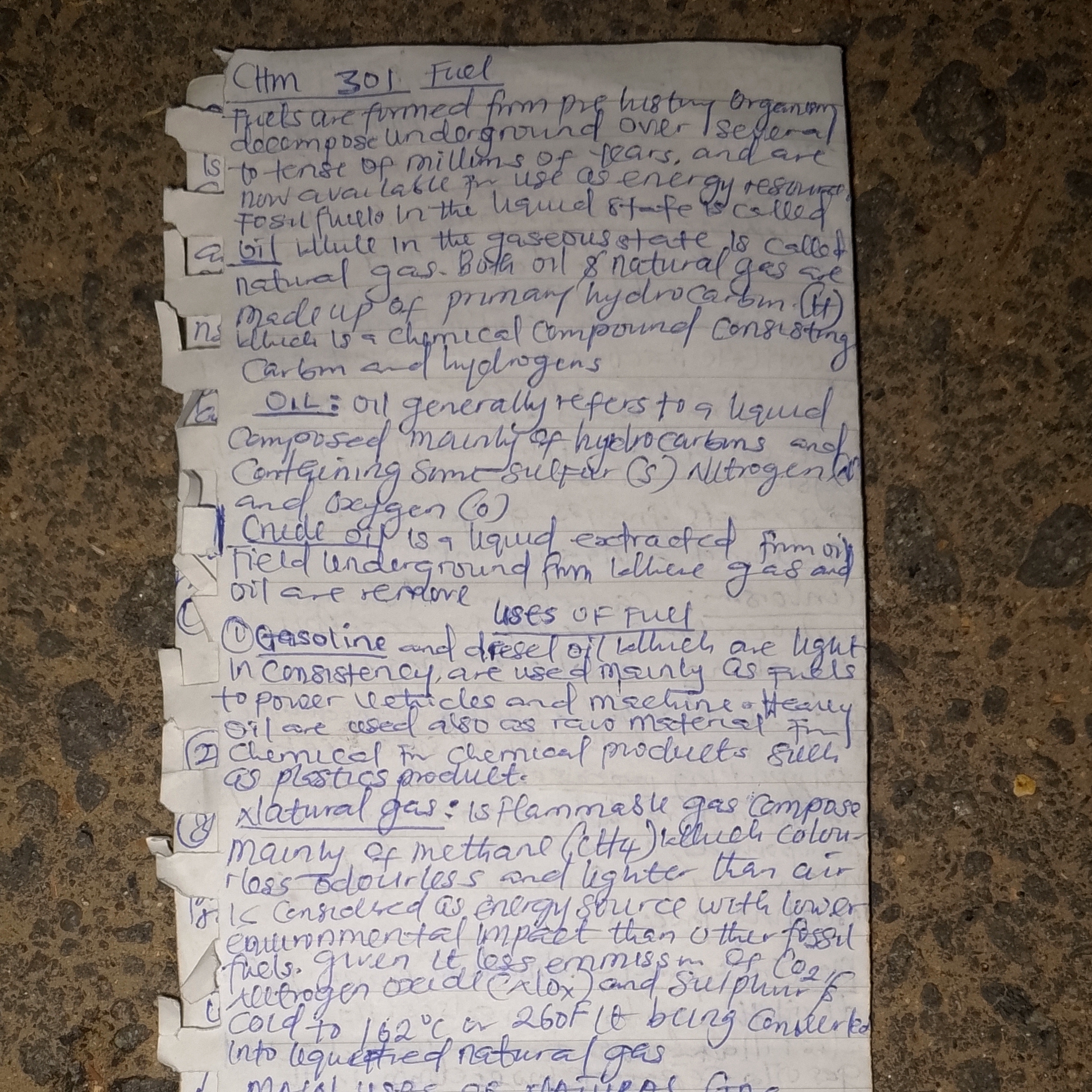
Fossil fuels formed from prehistoric organic matter, taking millions of years to decompose underground.
Classified as liquid (oil) or gaseous (natural gas).
Hydrocarbons (C and H) are key components.
Page 2
Uses of Oil:
Fuels: Gasoline (naphtha), diesel for vehicles; medium oil for larger machines.
Heavy oil as raw material for chemicals and plastics.
Natural Gas Composition:
Mainly methane (CH₄), colorless and odorless; has environmental advantages over other fuels.
Page 3
Distribution of Natural Gas:
Used in households as city gas; also in industries and power generation.
Origin of Oil & Natural Gas:
Formed over millions of years from organic materials.
Page 4
Formation Process:
Accumulation of dead organic matter.
Transformation into kerogen in source rocks over time.
Kerogen turns into oil/natural gas under heat and pressure.
Page 5
Petroleum Products Derived from Crude Oil:
Petrol: Largest product from crude oil.
Diesel: Mixture of hydrocarbons, boiling point 150-380 °C.
Jet Fuel: Accounts for about 10% of crude oil.
Kerosene: Common in aviation; clear liquid from hydrocarbons.
Page 6
Other Products:
Paraffin: A refined version of kerosene.
Heavy Fuel Oil (HFO): Residual product from refining processes.
Liquefied Petroleum Gas (LPG): Used for cooking and heating.
Page 7
Petrochemicals:
Derived from refining petroleum; main categories include:
Olefins (e.g., ethylene, propylene).
Aromatics (e.g., benzene, toluene).
Page 8
Sediments and Sedimentation:
Sediments are solid materials moved by erosion.
Settling results in sedimentary rock formation.
Page 9
Types of Sedimentation:
Discrete Settling: Sand and grit particles.
Flocculation: Particles clumping together.
Zone Sedimentation: Concentrated particle settling.
Page 10
Petroleum Refining Process:
Conversion of crude oil into valuable products.
Steps: Separation, Conversion, Treatment.
Page 11-12
Breakdown of Refinery Products:
Crude oil provides diverse products (e.g., gasoline, LPG).
Primary sources of energy: Petroleum (38.8%), Natural Gas (22.9%), Coal (26.6%).
Page 13-14
Refinery Process Overview:
Uses fractional distillation and chemical conversion.
Focus on producing fuels and necessary materials for combustion engines.
Page 15-17
Detailed Refinement Processes:
Distillation separates crude oil into fractions.
Conversion processes like cracking and reforming create lighter hydrocarbons.
Page 18
Final Products from Refining:
Liquefied Petroleum Gas (LPG): Domestic use.
Gasoline: Production from fractions.
Kerosene: Fuel for jets.
Heavy Oils: For lubrication and industrial use.
Residues: Useful for road making and other applications.