Crime Scene and Physical Evidence Collection
Forensic Science
Forensic is defined as a “matter of public debate.”
Forensic Science is better defined as “science applied to law.”
Not only to test but use that evidence in investigation to testify
There are strict legal rules which must be adhered to for physical evidence to be introduced into court and testified about.
Sound evidence= sound conviction
Mapp hearings = admissibility of evidence in court.
Ocassionally allow evidence collected in a crime scene to be test, if its useful for to sway the jury.
May apply to both criminal AND civil law cases.
Car crash due to faulty car part, stolen car to find finger prints
Forensic science is not a unique branch of science; it is the intersection of other major sciences:
Biology: human samples
Chemistry: toxins,posions
Physics: Fire arms
Forensic Scientists study a wide variety of specific disciplines:
DNA (Forensic Biology)
Fingermarks: How they were made and who are they from
Ballistics: Analyzing firearms, bullets, and shell casings to determine the weapon used and the trajectory of the shots. Play with guns
Anthropology: Bones
Forensic Medicine: Autopsy to see what cause the time of death
Criminalistics (Hair& Fiber, Glass Analysis, Microcrystal Tests, etc.)
Toxicology: DUI cases, posion, drugs,
Entomology: Study how insects can provide insights into time of death and other crucial details regarding the crime scene.
Roles of Crime Scene Technicians
Respond to Crime Scenes.
Crime scenes can be made from ANY crime (Civil case), not just murder or rape.
Observe the nature of the scene.
Observation is the most powerful tool in the CSI arsenal.
Is anything out of place, misaligned, or inconsistent with the expected layout of the environment? This can include misplaced objects, signs of struggle, or any anomalies that could suggest a scenario contrary to the initial report.
Technology, following step, testify are all secondary.
Document the scene and potential physical evidence.
Photograph & Sketch
Error with caution, anything can be evidence so it's crucial to meticulously note down all relevant details and ensure that no potential evidence is overlooked.
Collect potential physical evidence.
Properly package evidence to preserve it.
The ones who took the evidence(field tech) are not able to take that into a lab and test it themselves, as that can easily allow a defense attorney to state that they planted evidence to make them guilty.
So those who test the evidence (lab tech) don't know what they’re testing it for. This process helps maintain the integrity of the evidence and ensures that it can be used effectively in court during prosecution.
Submit evidence to the lab for analysis.
Establish a reliable reconstruction of the crime, working with other investigators.
Work with other investigators and show their ability to work their way through the scene.
Necessary Traits for Crime Scene Technicians
Be a strong observer!
Don't do an interview first with officers and victims, but rather last, as it leads to biased judgment/cognitive bias that can influence the collection and interpretation of evidence, leading to potential biases in investigation outcomes.
Be a strong observer, independent, and separate from personal feelings to ensure that evidence is collected objectively, without allowing preconceived notions to cloud one's judgment.
Have a strong stomach and a good sense of humor.
You will encounter scenarios that will disgust you. Mental health is important.
Stay focused on the task at hand; your primary objective should be to collect and preserve evidence without letting emotions cloud your judgment.
Be aware of what you DON’T know!!
Nobody can know every discipline of forensic science; it is better to know WHERE you can find information.
Don’t lean into assumptions; consult with someone rather than doing it on your own. Therefore, continuous training and collaboration with experts in different facets of forensics are essential for maintaining objectivity and precision in the collection and analysis of physical evidence.
Strong ethical commitment to the unbiased investigation.
Forensic Investigations are made by only physical evidence and how the pieces connect, not by personal belief or emotions.
Every crime scene is different no matter the similarities
Be able to plan out a course of processing a crime scene in an orderly manner.
Prioritize evidence that is easily destroyed or contaminated.
Be knowledgeable of the law and court proceedings.
Forensic evidence is a very different type of testimony.
Be articulate in how the scene was processed and why each piece of evidence was collected.
Mostly fact-based, the presentation of evidence should focus on the methods used to collect, preserve, and analyze each item, ensuring that all protocols were followed to maintain integrity and chain of custody. Additionally, it is crucial to document each step of the evidence collection process meticulously, including the time, date, and individuals involved, to provide a clear and reliable record that can withstand scrutiny in court.
Jury members give a great deal of credence to what the “CSI” says; they watch the same TV shows as we do!!!
They will believe you more than officers,witness etc.
Why did you not want what you did
Crime Scene Evidence
Types of evidence that can be discovered:
“Fleeting” or Perishable Evidence.
Easily damaged like rain, walking over
Obvious Physical Evidence.
puddle of blood, clothing, gun, gloves
Trace Evidence.
Clear stain, like dilute blood plasma, sperm, vaginal tissue, spit, saliva, hair, fibers, and soil.
If you're sending anything to the lab that you don’t know what it is, use an instrumental method through microscopy.
It helps us know what the identity is and what it is.
Pieces of evidence can tell us:
Timeline of events.
What happened when?
What happened to whom?
What happens first, all the way to last?
Forensic Science begins at the crime scene!!!
Importance of evidence:
Context of evidence.
The collection and preservation of physical evidence is crucial, as it helps to reconstruct the events that transpired, identify suspects, and exonerate the innocent.
Probative value of evidence.
How likely is it that the particular item we collect to one individualize the suspect?
i.e, high probative value is fingerprints, while cotton fibers have low probative value.
Evidence must be carefully analyzed to determine its relevance and reliability, ensuring that only the most significant information is utilized in the investigation. Additionally, understanding the context in which the evidence was obtained is essential for establishing its admissibility in court.
Reconstruction layers and contributors.
If I have good evidence in context with high probative value then then I can make a solid reconstruction.
Crime Scene Searches
The search of a crime scene will vary with the conditions in which the scene is found.
We wouldn’t search a national park in the same manner as a one-bedroom apartment
The search must be composed of a few simple elements:
SAFE!!!! (Is that gun loaded?)
Your safety and your team should always be the top priority, ensuring all potential hazards are assessed before beginning the search.
Logical
Methodical
Thorough
Search Patterns
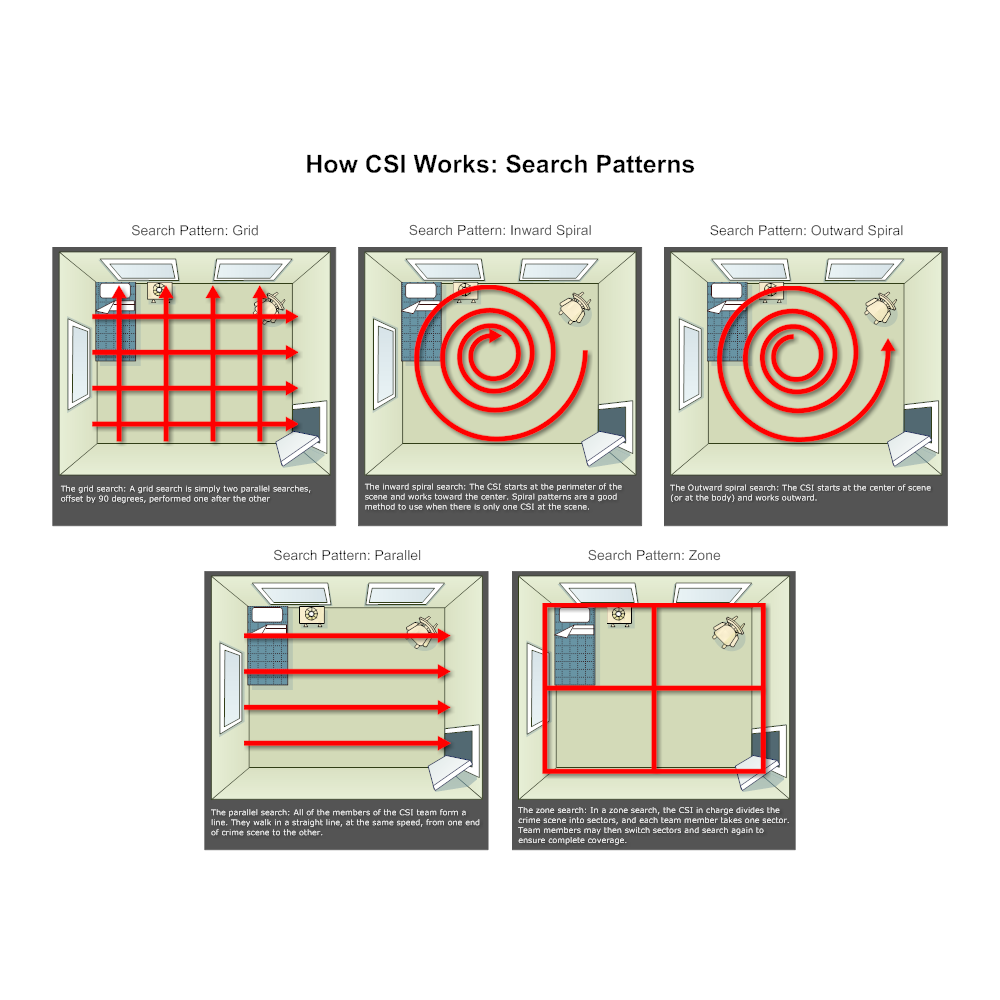
Spiral or Circular
Small room-sized area
You walk in a spiral shape, you walk in the outermost part of the room.
Then work from outward to inwards or inwards than outwards
If you do this, you have to be distraction-free, not lose focus on the collection process, and ensure that all evidence is meticulously documented and secured.
Grid Search
Meant for room-sized search
you snake through horizontally and then vertically, turn on the axis north and south, in the loops, so you're systematically covering every inch of the area to ensure no evidence is overlooked.
Better to have two than one person do this to cover more ground and make sure you don’t lose your place
Zone (Quadrant)
Excellent for very large spaces (parks/woodlands)
Easy to cover most accurately and efficiently, ensuring that all potential evidence is documented and preserved.
Line Search
Large Areas (roadways)
Everyone would March in a slow straight line, if someone find evidence than it would be flagged
You're able to cover a lot of ground simultaneously, and a strong ability to methodically move allows for thorough examination and documentation of the crime scene.
Without properly trained or disciplined searchers on the team, it can easily be thrown off and evidence lost. As everyone goes to look at the said evidence, when you go back, you might be lost.
Methodical Search
Layered Search
Crime scene searches must cover a full 540°.
Searches should be both linear and encompass height and width of the area.
Crime Scene Photography
One of the most important aspects of processing a crime scene.
Fairly and accurately records the nature and state of the crime scene upon the arrival of the CSI.
You haven’t move anything, touched anything, is it possible someone did it before you got there
Provides a vision of what happened for investigators (reconstruction).
Multiple layers through multiple parties
So photography helps with everyone being on the same page.
Demonstrates WHAT and WHERE all the evidence was found within the scene.
Photos will be used in conjunction with a sketch to paint a picture.
Some evidence may be destroyed when tested. Photos preserve their appearance.
Photography of the scene should first be taken of the whole scene at wide angles.
The scene overalls should tell a story and should be taken from the perimeter to help show the overall size of the scene.
Scene Overalls do NOT focus on evidence.
Give them an idea of the size,the scope, and some of the significant features present in the area, as these factors can aid in understanding the context of the incident.
Evidence should be photographed at a mid-range.
A couple of pieces of evidence at the same time.
Demonstrate where the particular piece of evidence is located compared to other pieces.
Evidence should be photographed at close range.
Close-range photos should be taken with and without a reference scale.
Scale will show the actual size of the evidence if a reconstruction (such as an enlarged photo at a trial) needs to be made.
Scale can provide context.
Crime Scene Photography is NOT Forensic Photography!!!
Forensic Photography (also called “Scientific Photography”) involves highly specified equipment and instruments to take photos in a lab setting.
Nearly impossible to achieve “Scientific” quality in a field investigation.
Sketch of Crime Scene
It can be thought of as a “map” of the crime scene.
Must have three parts (maybe four):
Label identifying the scene (date, crime, etc.)
Compass Points (specifically NORTH)
The words “NOT DRAWN TO SCALE”
A “Key” (may be on a separate sheet)
Simple Sketch = Rough Sketch
Neat Sketch = Finished Sketch
Sketch by permanent areas
Evidence Collection
Safety before all other protocols.
render it safe before collecting any physical evidence to ensure the protection of both investigators and the integrity of the scene. Such as sending it to a lab.
Wear appropriate P.P.E.
P.P.E. = Personal Protection Equipment
Identify what the item is before collection.
Is it safe to collect?
Has it been properly documented?
What will that item be tested for?
One collector should only collect ONE piece of evidence at a time.
Prevent Cross-Contamination
Cross Contamination = transfer of evidence from one item onto another.
Can be from evidence to evidence or outside source.
Change gloves after EACH item handled.
Only package one piece of evidence in a single container.
Do not mix evidence items.
Biological evidence in paper containers.