Gluconeogenesis

Gluconeogenesis refers to the synthesis of glucose, which takes place in the cytosol via a similar pathway to glycolysis. While at glance it may seem that the reactions are the same but reversed, there are 3 irreversible reactions in glycolysis that must be bypassed in gluconeogenisis.
These irreversible reactions are:
conversion of phosphophenolpyruvate to pyruvate using pyruvate kinase (step 10)
phosphorlyation of fructose-6-phosphate to fructose-1,6-bisphosphate by phosphofructokinase-1 (step 3)
conversion of glucose to glucose-6-phosphate by hexokinase (step 1)

To overcome the first challenge, two different enzymes are used together in gluconeogenesis
Pyruvate carboxylase converts pyruvate into oxaloacetate inside the mitochondria
activated by acetyl-CoA derived from B-oxidation of fatty acids
Oxaloacetate is reduced to malate to exit the mitochondria, but converts back to oxaloacetate once in the cytoplasm
Phosphoenolpyruvate carboxykinase (PEPCK) converts oxaloacetate into phosphoenolpyruvate
requires GTP as a phosphoryl donor, creating GDP

As the pathway moves forward, the second challenge arises with the irreversible reaction of the phosphorylation of fructose-6-phosphate. This is overcome by the use of fructose-1,6-bisphosphatase
Whereas enzymes ending in -kinase add phosphate groups, enzymes ending in -phosphatase remove phosphate groups
Fructose-1,6-bisphosphatese removes the 1’ phosphate group via hydrolysis
This is the rate-limiting step of gluconeogenesis
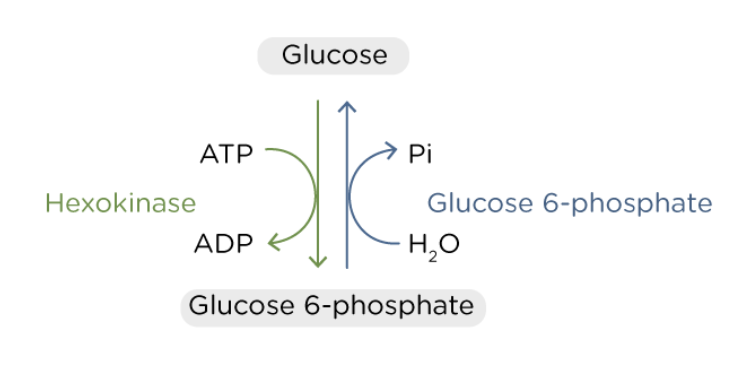
The final bypass involves the 1st step of glycolysis, which is the initial phosphorylation of glucose to glucose-6-phosphate. Gluconeogenesis utilizes a second phosphatase to overcome this step,
Glucose-6-phosphatase, which is located in the ER, removes the phosphate group on glucose-6-phosphate to convert it back to glucose
Glucose is then transported back into the cytoplasm, and enters circulation