Formation of the Solar System
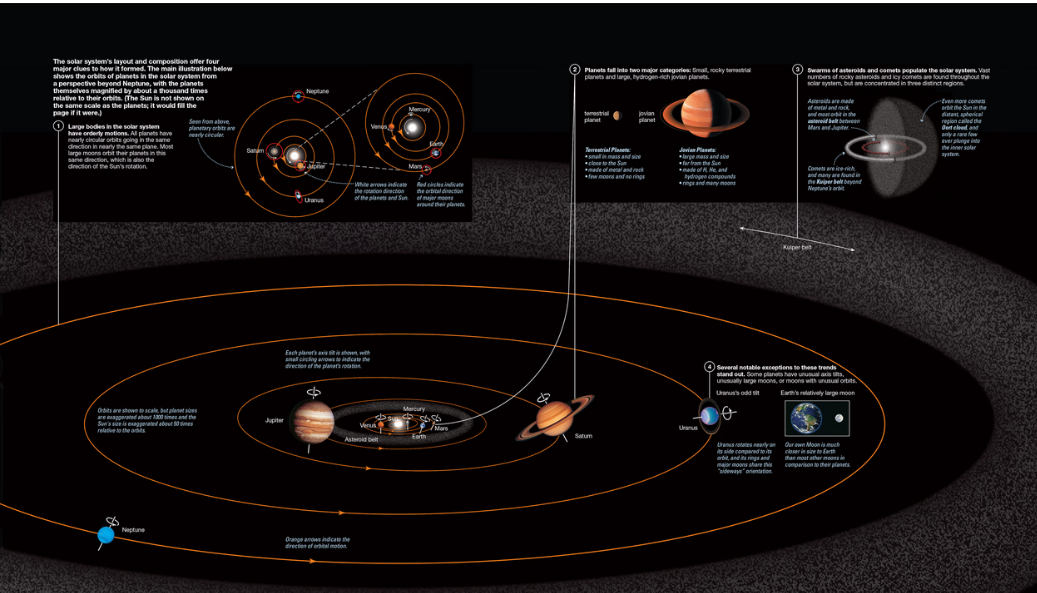
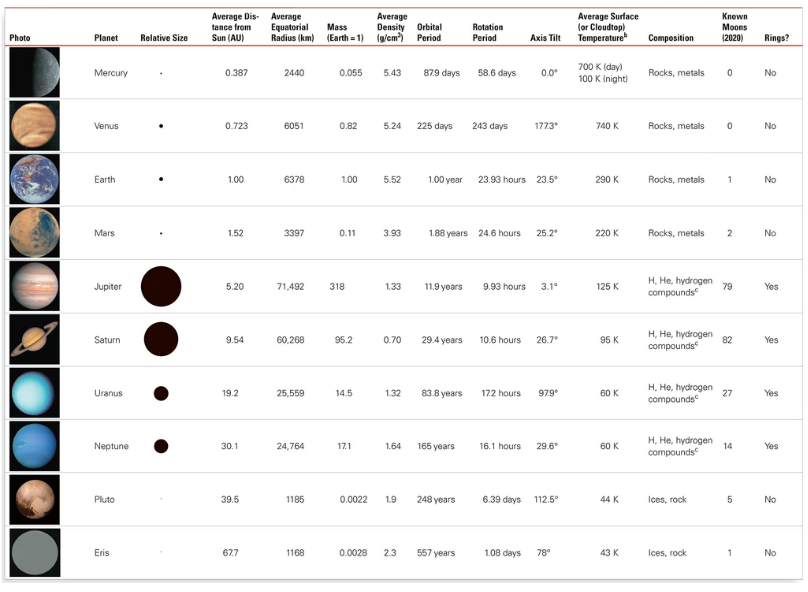
☾ Our solar system is not a random collection of worlds, but a system that exhibits many clear patterns of composition and motion
The Sun
Radius: 696,000 km= 109REarth
Mass: 333,000MEarth
Composition (by mass): 98% hydrogen and helium, 2% other elements
☾ The Sun is by far the largest and brightest object in our solar system.
☾ It contains more than 99.8% of the solar system’s total mass, making it nearly a thousand times as massive as everything else in the solar system combined.
☾ The Sun’s surface is a roiling sea of hot (about 5800 K, or 5500°C or 10,000°F) hydrogen and helium gas
☾ The surface is speckled with sunspots that appear dark in photographs only because they are slightly cooler than their surroundings.
☾ Solar storms sometimes send streamers of hot gas soaring far above the surface.
☾ The source of the Sun’s energy lies deep in its core, where the temperatures and pressures are so high that the Sun is a nuclear fusion power plant
☾ Each second, fusion transforms about 600 million tons (600 billion kg) of the Sun’s hydrogen into 596 million tons of helium.
The “missing” 4 million tons becomes energy in accord with Einstein’s famous formula, E=mc2
☾ The sun’s gravity governs the orbit of the planets
☾ The sun’s heat is the primary influence on planetary surface and atmosphere temperatures.
☾ It’s a source of virtually all light in our solar system— planets and shine as they reflect its rays, creating the vibrant visuals we observe from Earth. Moreover, this energy also drives atmospheric dynamics and weather patterns on the planets, playing a crucial role in shaping their climates.
☾ Charged particles flowing outward from the Sun make up the solar wind that interacts with planetary magnetic fields and influences planetary atmospheres.
Mercury
Average distance from the Sun: 0.39 AU
Radius: 2440 km = 0.38REarth
Mass: 0.055 MEarth
Average Density: 5.43 g/cm3
Composition: rocks, metals
Average surface temperature: 700 K (day), 100 K (night)
Moons: 0
☾ The innermost planet of our solar system, and the smallest of the eight planets.
☾ Desolate, cratered world with no active volcanoes, no wind, no rain, and no life.
Because there is virtually no air to scatter sunlight or color the sky, you could see stars even in the daytime if you stood on Mercury with your back toward the Sun.
☾ Posses both hot and cold extremes , with surface temperatures soaring to about 800°F (427°C) during the day and plummeting to -330°F (-201°C) at night.
☾ Tidal forces from the Sun have forced Mercury into an unusual rotation pattern: Its 58.6-day rotation period means it rotates exactly three times for every two of its 87.9-day orbits of the Sun.
This combination of rotation and orbit gives Mercury days and nights that last about 3 Earth months each.
☾Mercury’s high density (calculated from its mass and volume) indicates that it has a very large iron core,
Venus
Average distance from the Sun: 0.72 AU
Radius: 6051 km=0.95REarth
Mass: 0.82MEarth
Average density: 5.24 g/cm3
Composition: rocks, metals
Average surface temperature: 740 K
Moons: 0
☾Venus is the second planet from the Sun and is nearly the same size as Earth.
It has an unusual rotation:
Very slow rotation period
Retrograde rotation (spins opposite Earth)
As a result, the Sun rises in the west and sets in the east.
☾Venus is permanently covered by dense cloud layers, hiding its surface from view.
☾Before spacecraft exploration, very little was known about its geology.
☾Radar mapping by spacecraft revealed:
Mountains, valleys, and craters
Extensive evidence of past volcanic activity
☾Because of its Earth-like size, thick atmosphere, and proximity to the Sun, early science fiction often imagined Venus as a lush, tropical “sister planet” to Earth.
☾Venus experiences an extreme greenhouse effect, heating its surface to about 470°C (880°F).
☾The heat is constant: day and night are equally scorching because the atmosphere traps heat extremely efficiently.
☾Surface pressure is immense, comparable to being nearly 1 km (0.6 miles) underwater on Earth.
☾Instead of a lush “sister planet,” Venus is more like a classic depiction of hell—blistering, crushing, and hostile.
☾ Venus and Earth share similar size and composition, yet have drastically different surface conditions.
☾ This contrast suggests Venus can teach us important lessons about climate and atmospheric evolution.
☾Venus’s greenhouse effect is driven by carbon dioxide, the same gas driving global warming on Earth.
☾ Studying Venus may help us better understand and address climate challenges on our own planet.
Earth
Average distance from the Sun: 1.00 AU
Radius: 6378 km=1REarth
Mass: 1.00MEarth
Average density: 5.52 g/cm3
Composition: rocks, metals
Average surface temperature: 290 K
Moons: 1
☾The only known oasis of life in our solar system.
the only planet in our solar system with oxygen to breathe, ozone to shield the surface from deadly solar ultraviolet radiation, and abundant surface water.
☾ Temperatures are pleasant because Earth’s atmosphere contains just enough carbon dioxide and water vapor to maintain a moderate greenhouse effect.
☾ Earth is the first planet the line of planets with a moon
Mars
Average distance from the Sun: 1.52 AU
Radius: 3397 km=0.53REarth
Mass: 0.11MEarth
Average density: 3.93g/cm3
Composition: rocks, metals
Average surface temperature: 220 K
Moons: 2 (very small)
☾ The last of the four inner planets of our solar system
☾ Mars is larger than Mercury and the Moon but only about half Earth’s size in diameter; its mass is about 10% that of Earth.
☾ Two tiny moons, Phobos and Deimos, which may once have been asteroids that were captured into Martian orbit early in the solar system’s history.
☾Mars contains extraordinary geological features, including:
Volcanoes larger than any on Earth
A giant canyon stretching nearly one‑fifth around the planet
Polar caps made of frozen water and carbon dioxide (dry ice)
☾Although Mars is frozen today, its surface shows strong evidence of a warmer, wetter past:
Dried‑up riverbeds
Floodplains filled with rocks
Water‑formed minerals
☾Large‑scale liquid water likely disappeared over 3 billion years ago, but underground liquid water may still exist and occasionally reach the surface.
☾Mars looks somewhat Earth‑like, but is not habitable without protection:
Extremely low air pressure (far below Mount Everest levels)
Very cold temperatures
Almost no oxygen
No ozone layer, leaving the surface exposed to dangerous UV radiation
☾ More than a dozen spacecraft have already flown by, orbited, or landed on Mars.
☾ Future missions — possibly including human explorers — aim to study ancient riverbeds and polar ice to determine whether Mars ever supported life.
Jupiter
Average distance from the Sun: 5.20 AU
Radius: 71,492 km=11.2REarth
Mass: 318MEarth
Average density: 1.33g/cm3
Composition: mostly hydrogen and helium
Cloudtop temperature: 125 K
Moons: at least 79
Jupiter is vastly larger than the inner planets:
300+ times the mass of Earth
Over 1000 times Earth’s volume
Its most iconic feature, the Great Red Spot, is a massive, long‑lived storm large enough to fit 2–3 Earths.
Jupiter is composed mainly of hydrogen and helium, like the Sun, and has no solid surface.
Descending into Jupiter would mean encountering crushing gas pressures long before reaching any core.
Jupiter has dozens of moons and a thin, faint ring system.
Four large moons — Io, Europa, Ganymede, Callisto — are known as the Galilean moons and show remarkable diversity:
Io: most volcanically active world in the solar system
Europa: icy shell likely covering a subsurface ocean, making it a prime target in the search for life
Ganymede: largest moon in the solar system; may also have a subsurface ocean
Callisto: heavily cratered, with possible subsurface water and many unexplained surface features
Saturn
Average distance from the Sun: 9.54 AU
Radius: 60,268 km=9.4REarth
Mass: 95.2MEarth
Average density: 0.70g/cm3
Composition: mostly hydrogen and helium
Cloudtop temperature: 95 K
Moons: at least 82
The second-largest planet in our solar system
only slightly smaller than Jupiter in diameter, but its lower density makes it considerably less massive (about one-third of Jupiter’s mass).
Made mostly of hydrogen and helium and has no solid surface.
Famous for its spectacular rings
All four of the giant outer planets have rings, but only Saturn’s can be seen easily.
Although the rings look solid from a distance, they are made of countless small particles, each of which orbits Saturn like a tiny moon.
particles of ice and rock range in size from dust grains to city blocks.
Saturn has many moons, including at least two that are geologically active today.
Enceladus:
Features ice fountains erupting from its southern hemisphere.
Titan:
The only moon in the solar system with a thick atmosphere.
Extremely cold surface temperatures make liquid water impossible.
Data from the Cassini spacecraft and Huygens lander (2005) revealed:
A surface shaped by erosion, with riverbeds and lakes.
These features are carved not by water, but by liquid methane and ethane.
Uranus
Average distance from the Sun: 19.2 AU
Radius: 25,559 km=4.0REarth
Mass: 14.5MEarth
Average density: 1.32g/cm3
Composition: hydrogen, helium, hydrogen compounds
Cloudtop temperature: 60 K
Moons: at least 27
Made largely of hydrogen, helium, and hydrogen compounds such as water (H2O), ammonia (NH3), and methane (CH4)
Methane gas gives Uranus its pale blue-green colo
Lacks a solid surface
More than two dozen moons, along with a set of rings somewhat similar to those of Saturn but much darker and more difficult to see
The entire Uranus system — planet, rings, and moons — is tipped on its side relative to the other planets.
This extreme axial tilt was likely caused by a massive collision early in Uranus’s formation.
The tilt produces the most extreme seasons in the solar system.
Near Uranus’s north pole, a floating observer would experience:
42 years of continuous daylight
Followed by 42 years of continuous night
Only one spacecraft, Voyager 2, has ever visited Uranus.
Much of what we know about Uranus comes from that flyby, though modern telescopes continue to provide new insights.
Scientists hope to send a future mission to study Uranus, its rings, and its moons in far greater detail.
Neptune
Average distance from the Sun: 30.1 AU
Radius: 24,764 km=3.9REarth
Mass: 17.1MEarth
Average density: 1.64 g/cm3
Composition: hydrogen, helium, hydrogen compounds
Cloudtop temperature: 60 K
Moons: at least 14
has been visited only by the Voyager 2 spacecraft.
Neptune has rings and many moons.
Its largest moon, Triton, is bigger than Pluto and one of the most intriguing moons in the solar system.
Triton’s icy surface shows features resembling geysers, but they erupt nitrogen gas, not water.
Triton is the only large moon that orbits its planet in a retrograde (backward) direction, opposite Neptune’s rotation.
This backward orbit strongly suggests Triton was once an independent object orbiting the Sun before being captured by Neptune’s gravity.
Pluto
Pluto’s average distance from the Sun: 39.5 AU
Radius: 1185 km=0.19REarth
Mass: 0.0022MEarth
Average density: 1.9 g/cm3
Composition: ices, rock
Average surface temperature: 44 K
Moons: 5
Pluto and Eris are part of the Kuiper belt, a vast region of icy bodies beyond Neptune.
The Kuiper belt is similar to the asteroid belt, but:
It lies much farther from the Sun
Its objects are icy and comet‑like, not rocky
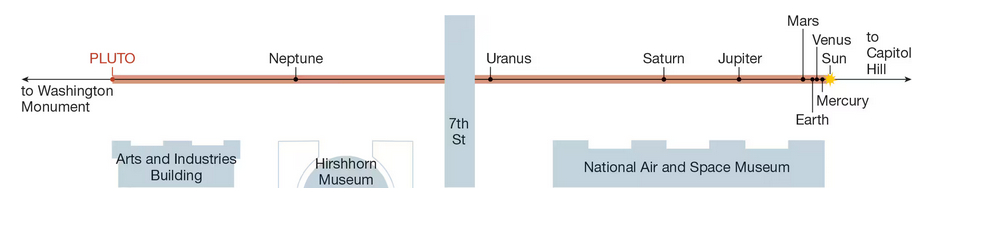
Pluto lies at an extreme distance from the Sun — as far beyond Neptune as Neptune is beyond Uranus.
Because of this distance, Pluto is extremely cold and receives very little sunlight; even daytime is dim.
From Pluto, the Sun appears only as a bright star‑like point in the sky.
Pluto’s largest moon, Charon, is in synchronous rotation with Pluto:
One side of Pluto always sees Charon dominating the sky
The opposite side never sees Charon
Studying Pluto and other dwarf planets is difficult due to their small size and great distance.
Two major spacecraft missions have expanded our knowledge:
New Horizons (flyby of Pluto in 2015)
Dawn (orbited and studied Ceres from 2015–2018)
The Nebular Theory of Solar System Formation
⓵ Patterns of motion among large bodies. The Sun, planets, and large moons generally orbit and rotate in a very organized way.
⓶ Two major types of planets. The eight planets* divide clearly into two groups: the small, rocky planets that are close together and close to the Sun, and the large, gas-rich planets that are farther apart and farther from the Sun.
⓷ Asteroids and comets. Between and beyond the planets, vast numbers of asteroids and comets orbit the Sun; some are large enough to qualify as dwarf planets. The locations, orbits, and compositions of these asteroids and comets follow distinct patterns.
⓸ Exceptions to the rules. The generally orderly solar system also has some notable exceptions. For example, among the inner planets only Earth has a large moon, and Uranus is tipped on its side. A successful theory must make allowances for exceptions even as it explains the general rule
Patterns of Motion Among Large Bodies — The Sun, planets, and large moons orbit and rotate in an organized way.
All planetary orbits are nearly circular and lie nearly in the same plane.
All planets orbit the Sun in the same direction: counterclockwise as viewed from high above Earth’s North Pole.
Most planets rotate in the same direction in which they orbit, with fairly small axis tilts. The Sun also rotates in this direction.
Most of the solar system’s large moons exhibit similar properties in their orbits around their planets, such as orbiting in their planet’s equatorial plane in the same direction that the planet rotates.
Two Major Types of Planets
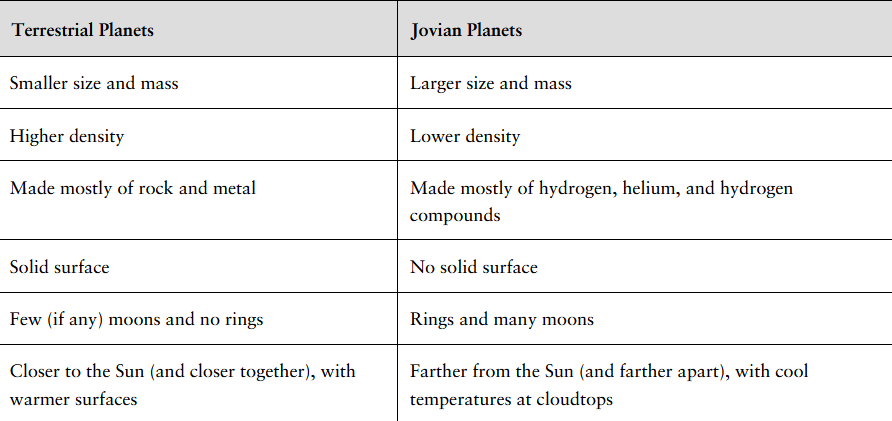
Terrestrial Planets → Rocky planets similar in overall composition to Earth.
⪧Mercury, Venus, Earth, and Mars.
relatively small and dense, with rocky surfaces and an abundance of metals in their cores.
few moons; no rings
Jovian Planets → Giant gaseous planets similar in overall composition to Jupiter.
⪧ Jupiter, Saturn, Uranus, and Neptune.
larger in size and lower in average density than the terrestrial planets,
many moons; rings
lack solid surfaces; made mostly of hydrogen, helium, and hydrogen compounds—compounds containing hydrogen, such as water, ammonia, and methane.
gas giants
Asteroids and Comets
Asteroids are rocky bodies that orbit the Sun much like planets, but they are much smaller
Most known asteroids are found within the asteroid belt between the orbits of Mars and Jupiter
Rocky asteroids and icy comets far outnumber the planets and their moons
Asteroids → A relatively small and rocky object that orbits a star; asteroids are officially considered part of a category known as “small solar system bodies.
Asteroid Belt → The region of our solar system between the orbits of Mars and Jupiter in which asteroids are heavily concentrated.
Comets are also small objects that orbit the Sun, but they are made largely of ices (such as water ice, ammonia ice, and methane ice) mixed with rock.
They orbit the Sun in one of the two distinct regions
The first is a donut-shaped region beyond the orbit of Neptune that we call the Kuiper belt (Kuiper rhymes with piper)
contains at least 100,000 icy objects that are more than 100 kilometers in diameter, of which Pluto and Eris are the largest known
The second cometary region, called the Oort cloud (Oort rhymes with court), is much farther from the Sun and may contain a trillion comets.
These comets have orbits randomly inclined to the ecliptic plane, giving the Oort cloud a roughly spherical shape.
Comets → A relatively small, icy object that orbits a star. Like asteroids, comets are officially considered part of a category known as “small solar system bodies.”
Kuiper Belt → The comet-rich region of our solar system that resides between about 30 and 100 AU from the Sun. Kuiper belt comets have orbits that lie fairly close to the plane of planetary orbits and travel around the Sun in the same direction as the planets.
Oort Cloud → A huge, spherical region centered on the Sun, extending perhaps halfway to the nearest stars, in which trillions of comets orbit the Sun with random inclinations, orbital directions, and eccentricities.
Exceptions to the Rules
Most planets rotate in the same direction as they orbit the Sun, but there are major exceptions:
Uranus rotates on its side.
Venus rotates backward (clockwise when viewed from above Earth’s North Pole).
Most large moons orbit in the same direction as their planet’s rotation, but many small moons have unusual or irregular orbits.
Earth’s Moon is a major exception among terrestrial planets:
Mercury and Venus have no moons.
Mars has tiny moons.
Earth, by contrast, has one of the largest moons in the entire solar system.
A successful theory of solar system formation must account for both the general patterns and these notable exceptions.
Nebula Theory
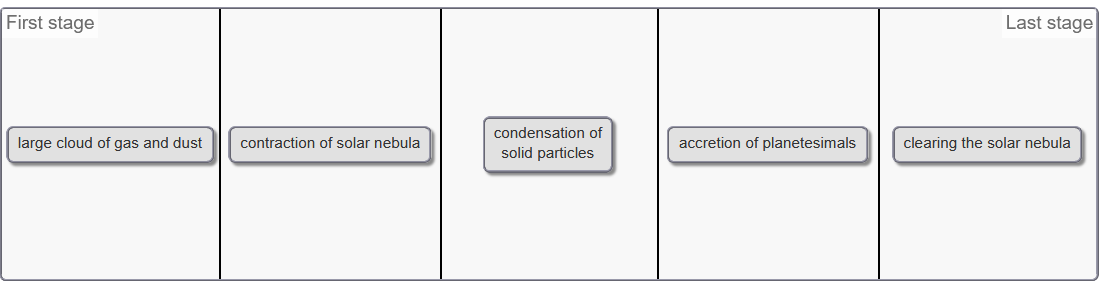
The nebular theory holds that our solar system formed from the gravitational collapse of a great cloud of gas.
The nebular theory says that stars form from collapsing clouds of gas and dust, and the leftover material naturally forms a rotating disk. Planets should form in these disks.
many stars should have planets orbiting around them, following similar processes to our own solar system's formation.
Nebula Theory → The scientific theory that describes how our solar system formed from a cloud of interstellar gas and dust. This process led to the formation of the Sun at the center, while the remaining material coalesced into the planets, moons, asteroids, and comets that we observe today.
⇒ the nebular theory clearly predicts that planets should be a common outgrowth of the star formation process, so the discovery of extrasolar planets represents a particularly strong validation of the theory.
Giant Impact Hypothesis → Our Moon formed when a Mars‑size object collided with the young Earth.
⇒ This collision caused material to be ejected into orbit around Earth, which eventually coalesced to form the Moon. The Giant Impact Hypothesis not only explains the origin off the Moon but also sheds light on the unique characteristics of the lunar surface, such as its lack of atmosphere and the presence of isotopic similarities with Earth.
Origin
The particular cloud of gas from which our solar system was born is usually called the solar nebula.
Solar Nebula → The piece of interstellar cloud from which our own solar system formed.
⇒ The solar nebula contained hydrogen and helium from the Big Bang and heavier elements produced by stars.
Condensation in the solar nebula depended entirely on temperature:
Inner solar system (hot):
Only rock and metal could solidify.
Hydrogen compounds (like water, methane, ammonia) stayed gaseous.
Hydrogen and helium never condensed anywhere.
Outer solar system (cold):
Hydrogen compounds could condense into ices.
Rock and metal also condensed, but they were a small fraction of the material.
Explaining the Major Features of the Solar System
⪧As the solar nebula collapsed under gravity, it didn’t automatically start as a disk. Instead:
Gas and dust clumps were moving in many random directions.
As they collided, their motions averaged out.
Random vertical motions were canceled by collisions.
Motion around the center of mass was preserved (angular momentum).
The result was a thin, rotating disk — the protoplanetary disk.
How a star-forming cloud collapses under gravity:
Heating
As the solar nebula collapsed, its temperature increased.
This rise in temperature reflects conservation of energy:
Gravitational potential energy → kinetic energy of infalling gas → thermal energy through particle collisions.
The center of the nebula became the hottest and densest, where the Sun ultimately formed.
Spinning
As the cloud shrank, it spun faster, just like an ice skater pulling in their arms.
This acceleration in rotation is due to conservation of angular momentum.
Even a cloud with barely noticeable rotation will spin rapidly once it contracts.
Faster rotation prevented all material from collapsing into the center, keeping the nebula spread out.
Flattening
Collisions between particles made their motions more orderly over time.
Randomly moving clumps merged, averaging out their velocities.
This process naturally transformed the nebula into a thin, rotating disk.
Collisions also reduced orbital eccentricities, making orbits more circular.
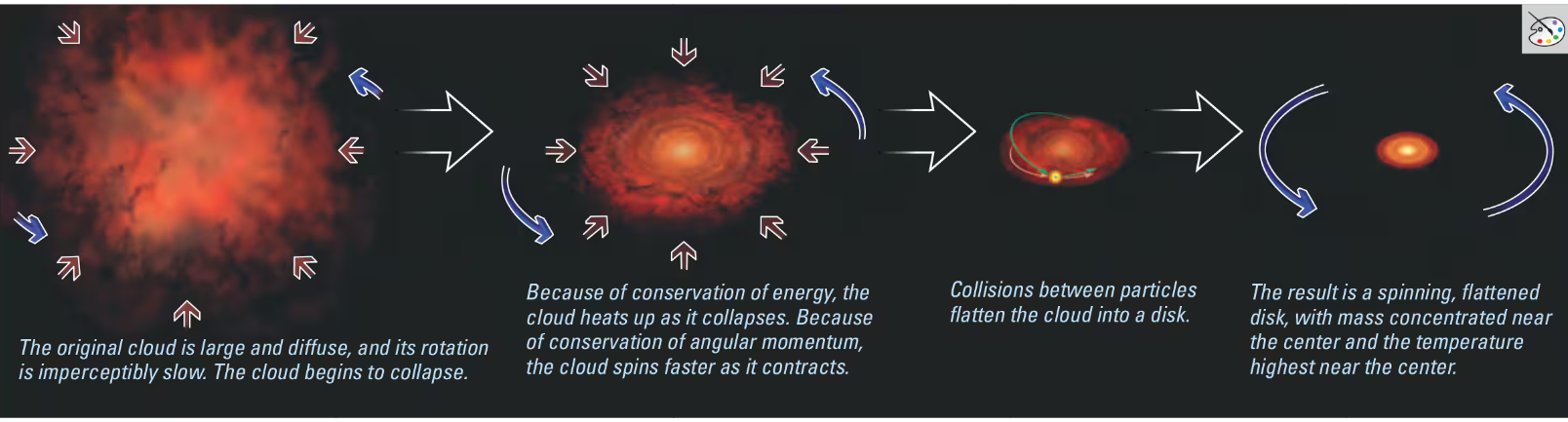
⪧ The orderly motions of our solar system are a direct result of its birth in a spinning, flattened cloud of gas.
⪧ Observations of spinning disks of gas around other stars support the idea that our solar system formed from a similar disk.
Why are there two major types of planets?
The planets began to form after the solar nebula had collapsed into a flattened disk of perhaps 200 AU in diameter (about twice the present-day diameter of Pluto’s orbit).
Planet formation began around tiny “seeds” of solid metal, rock, or ice:
At the center of the collapsing solar nebula, gravity gathered enough material to form the Sun.
In the surrounding disk, gas was too spread out for gravity alone to clump it into planets.
Planet formation required “seeds” — small solid particles that gravity could later build upon.
These seeds formed through condensation, similar to how snowflakes form in Earth’s clouds.
When temperatures dropped low enough, atoms and molecules bonded and solidified out of the gas.
Condensed particles began microscopic, but grew over time as more material stuck to them.
These growing solid particles became the building blocks from which planets eventually formed.
Different materials condense at different temperatures. The ingredients of the solar nebula fell into four major categories:
Hydrogen and helium gas (98% of the solar nebula). These gases never condense in interstellar space.
Hydrogen compounds (1.4% of the solar nebula). Materials such as water H2O, methane CH4, and ammonia NH3 can solidify into ices at low temperatures (below about 150 K under the low pressure of the solar nebula).
Rock (0.4% of the solar nebula). Rocky material is gaseous at high temperatures but condenses into solid form at temperatures below 500 K to 1300 K, depending on the type of rock.
Metals (0.2% of the solar nebula). Metals such as iron, nickel, and aluminum are also gaseous at high temperatures but condense into solid form at temperatures below 1000 K to 1600 K (depending on the metal)
⪧ Hydrogen and helium made up ~98% of the solar nebula and never condensed, remaining gaseous everywhere.
Other materials condensed only where temperatures were low enough, creating distinct zones in the disk:
Closest to the Sun:
Too hot for any material to condense.
Near Mercury’s orbit:
Cool enough for metals and some rock types to condense into tiny solid grains.
Other rocks and all hydrogen compounds stayed gaseous.
At distances of Venus, Earth, and Mars:
Temperatures allowed more rock types to condense.
Asteroid belt region:
Cool enough for carbon‑rich minerals and water‑bearing minerals to condense.
Beyond the frost line (between Mars and Jupiter):
Cold enough for hydrogen compounds (like water, methane, ammonia) to condense into ices.
These temperature‑dependent condensation patterns shaped the composition differences between inner rocky planets and outer icy/gas‑rich worlds.
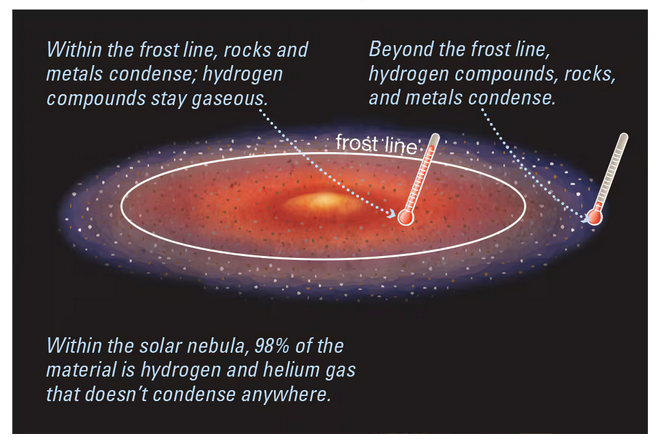
⪧ The solid seeds contained only metal and rock in the inner solar system, but also included ices in the outer solar system.
Building the Terrestrial Planets
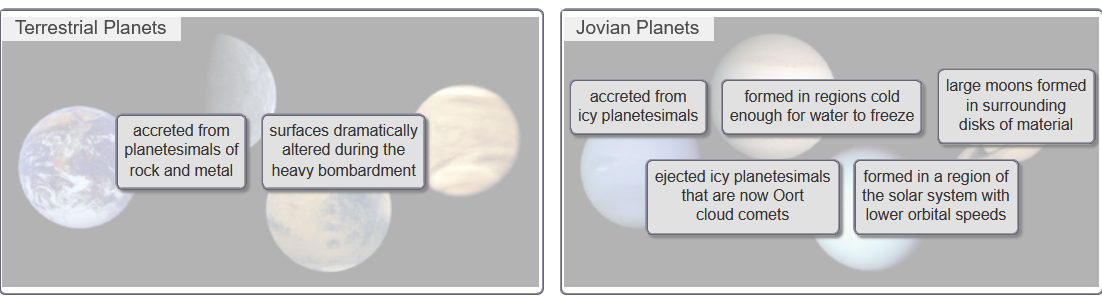
The solid seeds of metal and rock in the inner solar system ultimately grew into the terrestrial planets we see today, but these planets ended up relatively small in size because rock and metal made up such a small amount of the material in the solar nebula.
Accretion → The process by which small objects gather together to make larger objects.
Accretion began with the microscopic solid particles that condensed from the gas of the solar nebula.
These particles orbited the forming Sun with the same orderly, circular paths as the gas from which they condensed.
Small particles thereby began to combine into larger ones
As the particles grew in mass, they began to attract each other through gravity, accelerating their growth into boulders large enough to count as planetesimals
Planetesimals → The building blocks of planets, formed by accretion in the solar nebula.
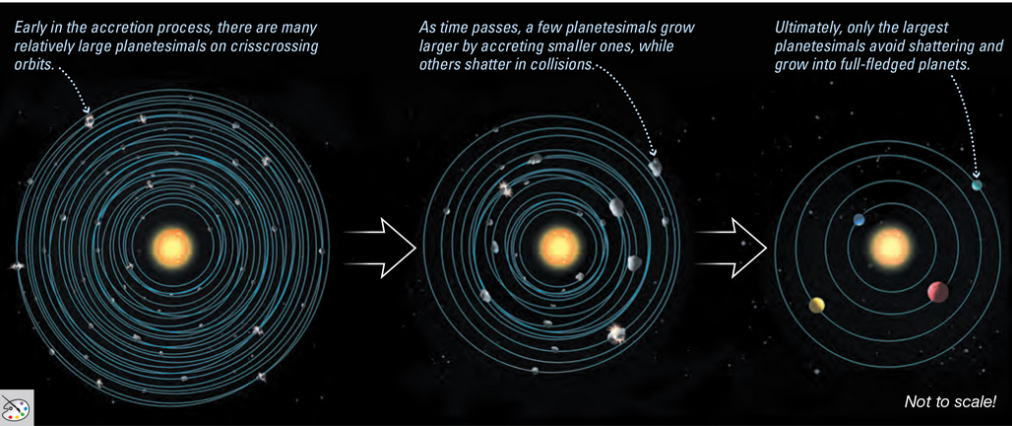
The planetesimals grew rapidly at first.
as they grew larger, they had both more surface area to make contact with other planetesimals and more gravity to attract them.
once the planetesimals reached these relatively large sizes, further growth became more difficult.
Gravitational encounters between planetesimals tended to alter their orbits, particularly those of the smaller ones.
With different orbits crossing each other, collisions between planetesimals tended to occur at higher speeds and hence became more destructive.
Such collisions tended to shatter planetesimals rather than help them grow. Only the largest planetesimals avoided being shattered and could grow into terrestrial planets.
■ Computer simulations support this model of the accretion process — observational evidence comes from meteorites, rocks that have fallen to Earth from space.
Making the Jovian Planets
Accretion in the outer solar system began similarly to the inner solar system, but with a key difference:
Ices could condense, adding to the available solid material.
Outer solar system solids included ice + rock + metal, making them more massive than inner rocky seeds.
Present‑day outer solar system bodies (comets, icy moons) still show this ice‑rich composition.
However, icy planetesimals alone cannot explain the huge amounts of hydrogen and helium in the jovian planets.
Leading model of jovian formation:
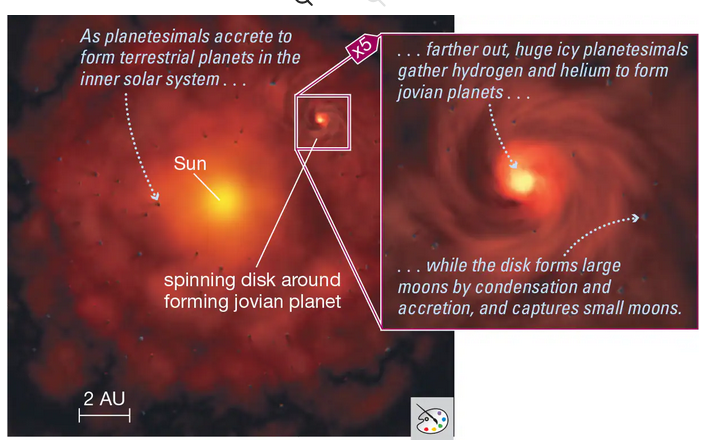
The largest icy planetesimals grew big enough for their gravity to capture hydrogen and helium gas from the surrounding nebula.
Captured gas increased their mass, which increased their gravity, allowing them to pull in even more gas.
This runaway process turned them into gas giants, very different from their icy beginnings.
Each forming jovian planet became surrounded by its own disk of gas, created by the same heating, spinning, and flattening processes that shaped the solar nebula.
Large moons of the jovian planets formed within these disks:
They accreted from ice‑rich planetesimals inside the mini‑disks.
As a result, they have nearly circular orbits,
Orbit in the same direction as their planet’s rotation,
And lie close to the planet’s equatorial plane.
Clearing the Nebula
Most of the hydrogen and helium gas in the solar nebula never became part of any planet.
This leftover gas was cleared by:
High‑energy radiation (UV and X‑rays) from the young Sun
The solar wind, a stream of charged particles blown outward in all directions
Young stars are known to have much stronger winds and radiation, so the early Sun likely had enough power to sweep away the remaining gas.
Clearing the gas locked in the final compositions of the planets.
If the gas had remained longer:
It might have cooled enough for hydrogen compounds to condense even in the inner solar system.
Terrestrial planets could have accreted ices, or even hydrogen and helium, becoming very different worlds.
If the gas had been cleared earlier:
The raw materials for planets might have been removed before planets fully formed.
These extreme scenarios did not occur in our solar system, but they may occur around other stars.
Planet formation can also be disrupted when radiation from nearby hot stars blows away material from a forming solar nebula.
Where did asteroids and comets come from?
Asteroids are the rocky leftover planetesimals of the inner solar system, while comets are the icy leftover planetesimals of the outer solar system.
The asteroids and comets that exist today probably represent only a small fraction of the leftover planetesimals that roamed the young solar system.
The rest are now gone. Some of these “lost” planetesimals may have been flung into deep space by gravitational encounters, but many others must have collided with the planets
Impact craters → A bowl-shaped depression left by the impact of an object that strikes a planetary surface (as opposed to burning up in the atmosphere).
Heavy Bombardment → The period in the first few hundred million years after the solar system formed during which the tail end of planetary accretion created most of the craters found on ancient planetary surfaces.
Comets are leftover ice-rich planetesimals —objects made mostly of frozen water, methane, ammonia, and other volatile compounds. They formed in the cold outer regions of the solar nebula and never grew large enough to become planets.
How do we explain the “exceptions to the rules”?
Captured Moons
Large jovian moons formed in disks of gas around their planets, giving them orderly, circular, equatorial, prograde orbits.
Some moons, however, have irregular orbits — retrograde motion or large inclinations — which cannot be explained by formation in a disk.
These irregular moons were likely leftover planetesimals that originally orbited the Sun, not the planet.
To become a moon, a passing object must switch from an unbound orbit to a bound orbit, which requires losing orbital energy.
For the jovian planets, this energy loss likely occurred through friction with the extended, dense gas envelopes surrounding them during formation.
This is similar to how low‑orbit satellites around Earth lose energy due to atmospheric drag.
If friction slowed a passing planetesimal enough, it could be captured into orbit as a moon.
Because the capture process is random, captured moons often:
Orbit backward (retrograde)
Have tilted or highly eccentric orbits
Most small moons of the jovian planets are thought to be captured objects.
Mars may have captured its two tiny moons, Phobos and Deimos, when it once had a more extended atmosphere capable of slowing them down.
Giant Impact
Capture cannot explain Earth’s Moon:
The Moon is far too large to have been captured by a planet as small as Earth.
Co‑formation cannot explain it either:
If Earth and the Moon formed together, they would have similar compositions.
Instead, the Moon has a much lower density, showing it lacks much of Earth’s metal‑rich interior material.
These facts require a different origin story.
Leading hypothesis: the giant impact model:
Early in solar system history, a Mars‑sized planetesimal struck the young Earth.
The impact blasted material from Earth’s outer layers into space.
This debris formed a ring around Earth.
Over time, the material in the ring accreted to become the Moon.
⪧ Our Moon is probably the result of a giant impact that blasted Earth’s outer layers into orbit, where the material accreted to form the Moon.
The Age of the Solar System
Dating Rocks
Radiometric Dating → The process of determining the age of a rock (i.e., the time since it solidified) by comparing the present amount of a radioactive substance to the amount of its decay product.
A radioactive isotope has a nucleus prone to spontaneous change, or decay, such as breaking apart or having one of its protons turn into a neutron
Decay rates are usually stated in terms of a half-life—the length of time it would take for half the nuclei in a collection to decay.
We can determine the age of a rock through careful analysis of the proportions of various atoms and isotopes within it.
Half-Life Formula:
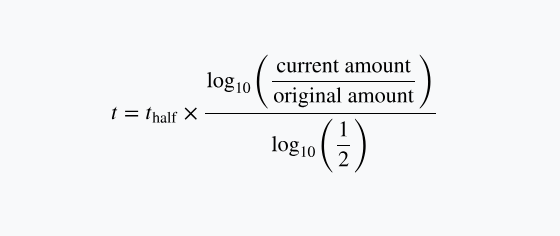
where t is the time since the rock formed
thalf is the half-life of the radioactive substance
“log10” is the base-10 logarithm
Earth Rocks, Moon Rocks, and Meteorites
Age dating of the oldest meteorites tells us that the solar system is about 4.5 billion years old.
Our solar system is old—born about 4½ billion years ago—but it is still only about one-third as old as our 14-billion-year-old universe.