L1 - Igneous Petrology
Specific Terminology and Concepts
Crystallization and Melt Composition
Understanding the relationship between crystallized minerals and melt composition over time based on specific mineral assemblages.
Phase diagrams to explain changes in composition due to crystallization.
Igneous Rock Features
Micrographs and Experimental Samples
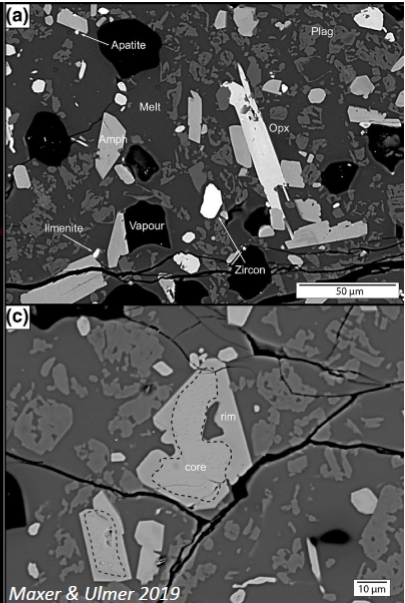
In analysis of backscatter electron microscopes, the brightness depends on the weights of the atoms within the crystals.
Rock Types and Melting Processes
Intrusive and extrusive rocks are texturally difference, with the intrusive rocks having a larger crystal size and potentially a more balanced
The textures of rocks can tell us much about how theywere formed, past intrusive and extrusive.
For example, the presence of minerals like amphiboles can tell us that magma is hydrated and of a certain depth in the mantle, or the progression of magma composition over time, as seen in zoning. They can also tell use the timing of crystal growth with relation to one another by the size of the crystals and how they interact with one another.
Tectonic Settings and Their Associations
Production Rates and Budgeting
Overview of annual magma production rates at different geological settings:
Ocean Ridge (Constructive Margins): Approximately 21 cubic kilometers annually.
Subduction Zones (Destructive Margins): Estimated at 8-9 cubic kilometers annually.
Intraplate Volcanoes: Account for ~4 cubic kilometers of annual magma production.
Isolated and unassociated with a plate boundary, producing exotic rock compositions and are important within the chemical budget of the Earth.
These numbers show that magmatism is mostly associated with plates, with most being underwater
Conceptualizing Magma Behavior
Melting and Crystallization Mechanisms
Importance of understanding melting processes and type of materials produced at different pressures and conditions.
Mechanisms affecting rock formation and differentiation over geological timescales, such as the interaction of volatiles like water and the oxidation state of magmas.
Magma Classification and Analysis
Distinction between descriptive versus normative classifications in igneous rock naming and identification.
Reference to the identified minerals in thin section observations to help in proper rock naming.
Composition and Naming of Igneous Rocks
Composition of rocks
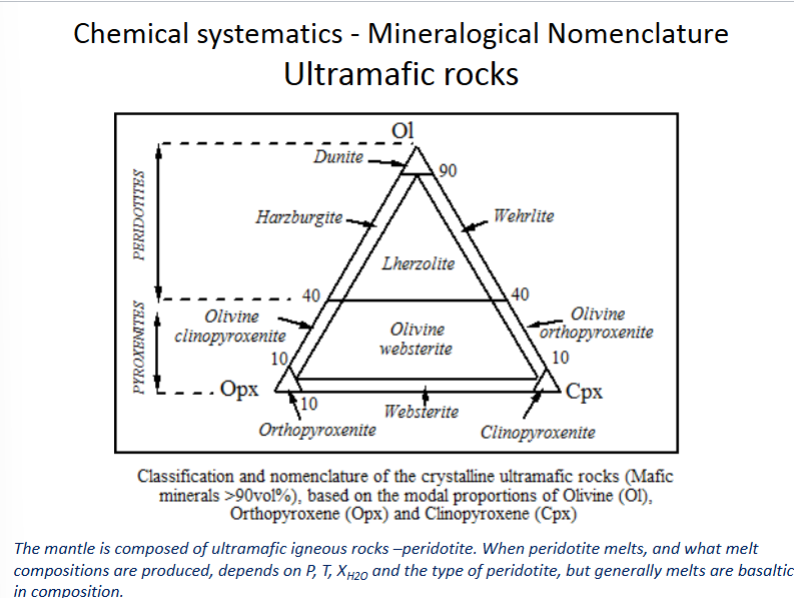
Ultramafic rocks are made up of >90% mafic minerals by volume (minerals rich in Mg and Fe).
They are classed by their proportions of olivine, opx and cpx
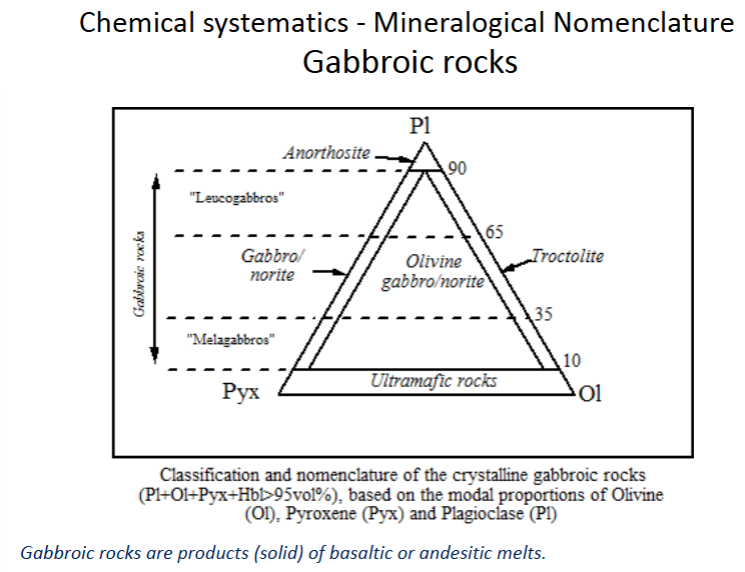
Gabbroic/mafic rocks are made up of pyroxenes, plagioclase and olivine.
Granitic/silicic rocks are made up of quartz, K-feldspars and plagioclase
Naming of rocks
Igneous rocks can vary widely in composition, leading to the establishment of various conventions for naming them. This classification is fundamentally artificial, as all boundaries delineated between rock types such as basalt andesite represent conventions rather than strict natural divides.
For completely crystalline rocks, naming these rocks becomes straightforward; the chemical constituents of the rocks are wholly contained within the minerals present, which are easily visible.
When rocks crystallize under equilibrium conditions, the minerals' positions and compositions maintain consistency throughout the rock. For example, in a crystalline rock, the mineral proportions can be quantitatively evaluated using digital imaging technology to assess thin sections of rocks.
Modal approach (the mode) - The dominant approach involves estimating the mineral proportions and using these to determine the rock's classification on diagrams such as the granite ternary diagram or the alternating composition diagram based on the minerals olivine, orthopyroxene, and clinopyroxene.
Volcanic Rock Characteristics
Unlike completely crystalline rocks, volcanic rocks can exhibit a glassy texture due to a high percentage of melt that is rapidly frozen. For instance, fine-grained volcanic rocks contain a significant glass matrix, complicating their composition analysis. This is especially apparent in silicic rocks with viscous magmas.
To classify these kinds of rock, we use chemical methods to try and derive the minerallogy that would make up the rock if left to cool under modelled conditions (1atm, anhydrous). This is called the CIPW Norm
Constituents of Igneous Rocks
Silica Content:
Silica (SiO₂) is typically the dominant constituent, with common concentrations exceeding 50%. This component plays a crucial role in determining the rock type and appears as the first major oxide listed in rock analyses.
Aluminum Oxide:
After silica, aluminum oxide (Al₂O₃) is usually the next most abundant component, followed by various other oxides such as calcium oxide (CaO).
Oxide Representation:
It’s common practice to express igneous rock compositions in terms of oxides for ease, despite the fact that silica might not always be in the SiO₂ molecular form, as it's often bound in minerals or polymerized structures. By measuring oxide content, we can have totals of oxides add to 100%.
Iron Content:
In chemical analyses, iron is frequently represented as total iron (Fe) because distinguishing between iron(II) and iron(III) conditions can be methodologically complex.
Often rocks contain minerals regarded as major as they take up more than 1% of the rock’s composition. These are common minerals found in rocks.
Quartz (SiO2)
Orthoclase (KAlSi3O8)
Plagioclase (NaAlSi3O8-CaAl2Si2O8 series)
Pyroxenes (such as diopside and enstatite)
Nepheline (Na3KAl4Si4O16)
Iron and titanium oxides such as ilmenite (FeTiO3) and magnetite (Fe3O4).
Techniques for Analyzing Rock Composition
Chemical analysis of igneous rocks often employs modern techniques such as x-ray fluorescence (XRF) spectrometry. In this process, samples are usually prepared as glass beads, from which their respective compositions can be quantified.
An example is three different basalt samples, analyzed for their chemical components, where variations in silica, titanium, and aluminum are noted with relevant concentrations. The classification and comparison of these basalt samples facilitate understanding the evolutionary processes in a volcanic context.
Basalt Tetrahedron
The Basalt Tetrahedron illustrates the coexistence of minerals such as olivine, orthopyroxene, and quartz, explaining why certain minerals do not coexist.
Olivine can’t coexist with quartz as they can form a more stable mineral phase in opx.
Quartz and nepheline cannot coexist as they form plagioclase for the same reason.
Only certain sequences in igneous differentiation lead to specific minerals coexisting while others will not due to intrinsic stability conditions.
Nepheline, olivine, clinopyroxene and plagioclase form alkali basalts. These are SiO2 undersaturated.
Olivine, plagioclase, orthopyroxene and clinopyroxene form olivine tholeiites. These are SiO2 saturated.
Opx, plag, cpx and qtz form quartz tholeiites. These are SiO2 oversaturated.
These minerals are all calculated to exist under ideal conditions, but for example there are rarely every qtz phenocrysts apparent in a basalt, even in a qtz tholeiite. This is because the SiO2 content is so low.
Chemical Evolution of Magmas
The classification of igneous rocks also involves tracking their evolutionary pathways (tracking individual oxides ratios) as magmas differentiate.
As a magma cools, the minerals crystallize in a specific order, which illustrates changes in the composition of the residual liquid as elements like iron, magnesium, potassium, and calcium behave predictably. This can be represented using variation diagrams that track silica content against other constituents. Silica is used as it is a common constituent of all igneous rocks, and also because silica content generally changes linearly.
Common Trends in Differentiation
As an example, plotting the iron content against silica typically shows a decrease in iron concentration as silica increases, while potassium often increases in these sequences.
Variations exist between different volcanic systems regarding their iron enrichment characteristics, leading to classifications of certain rocks into groups such as foidites or alkaline rocks.
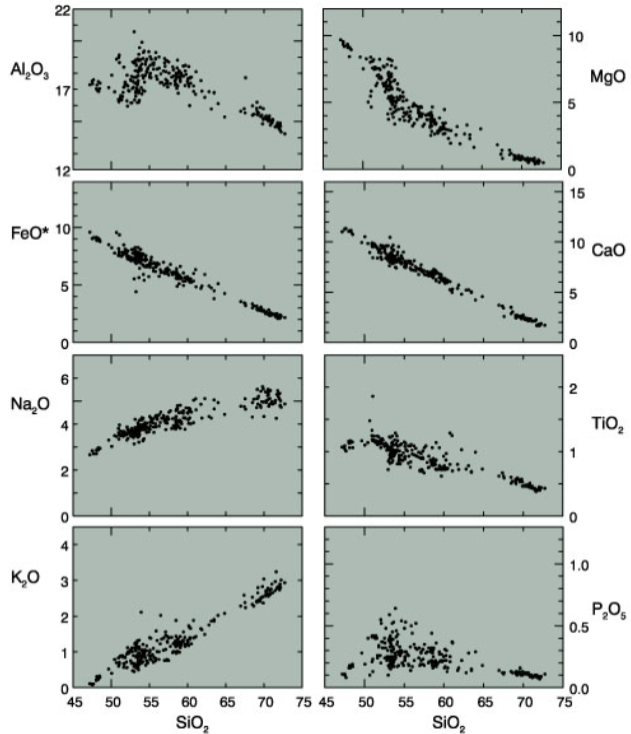
We can say that all of these trends are associated with minerals containing these elements crystallising alongisde each other. These also correlate with the crystallisation order of the crystals.
This evolution path is known as the liquid lines of descent.
This process is called chemical differentiation/evolution and depends on conditions like P, T, xH2O and redox conditions.
The evolutionary path of a melt can be inferred from the variations found within rock samples from either a single volcano or single eruptions at individual volcanoes,
For example:
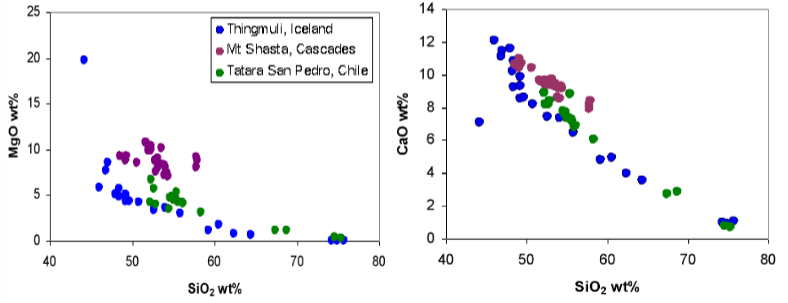
The trends for both MgO and CaO are rather the same for all of the samplings. We can look to another graph to solve this.
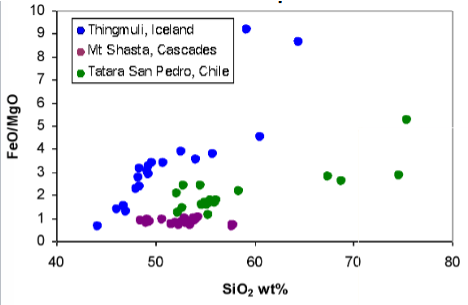
There is a much clearer separation here, where each sample set seems to be following their own trend. Some trends show enrichment in iron, known as tholeiitic trends, while the other stays constant, forming calc-alkaline trends
These can be plotted on an AFM diagram.
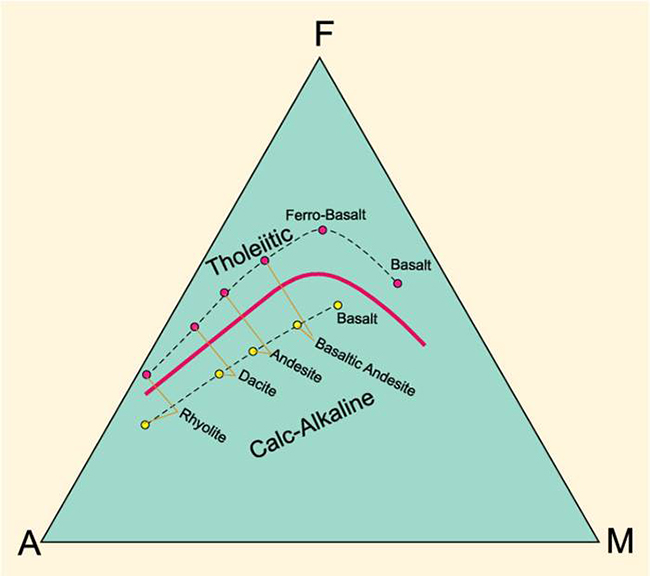
We can see that as the basalt evolves in the tholeiitic trend, it gets enriched in iron, while with the calc-alkaline trend, there is a fairly linear decrease.
When in dry conditions with relatively low pressures, iron enrichment occurs, causing a tholeiitic trend.
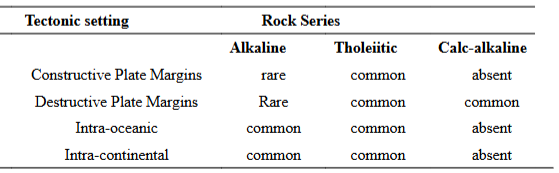
Calc-alkaline trends are found in subduction zone volcanics, but not always.
Phase Diagrams
Understanding Phase Changes
The examination of phase diagrams illustrates how various mineral phases behave under specific conditions of temperature and pressure. The Gibbs phase rule serves as a crucial guideline, defining the relationship between components, phases, and degrees of freedom in a system.
Stable phases change with varying conditions; for instance, the transition from solid to liquid in igneous rocks reflects changes in temperature and pressure that align with equilibrium thermodynamics principles.
Dihedral Angles and Crystallization
Dihedral angles illustrate the interactions between minerals and their melt during crystallization, which affects the viscosity and connectivity of the melt network within igneous rocks.
The significance of low dihedral angles contributes to the ease of melt extraction in geological settings, facilitating the identification of beneficial properties in the analysis of igneous rocks.
Conclusion: Implications for Petrology
The understanding of igneous rocks involves not only classification and analysis of their composition but also an intricate analysis of the processes of melting and crystallization governed by their thermal conditions. The implications of these findings extend into practical applications within field petrology, improving the classification and comprehension of igneous systems. As research evolves, the focus on computational methods and advanced analyses anticipates a deeper grasp of igneous differentiation and system evolution.