12: Behavioral Ecology
TopHat:
Which of the following is NOT a tactic that animals living in groups use to reduce the overall probability of predation?
avoidance of predation by scattering
Which describes a plant species with perfect flowers?
plant has both male and female parts
Migratory birds are likely responding to what environmental cue to initiate the behavior leading to migration from the northern breeding grounds to their more southern overwintering areas?
changes in day length
Behavioral Ecology
Behavioral ecology: The study of the evolutionary basis for animal behavior due to ecological pressures.
Organisms behavior are also important for fitness and subject of natural selection
Emerged from ethology
Four questions to address when studying animal behaviors:
What are the: 1- mechanistic causes 2- ontogeny / development 3- survival value / evolutionary history 4- phylogeny of a behavior?
Niko Tinbergen
Examples
Reproductive behavior
Flying behavior (v-formation)
Kleptothermy
Huddling, a form of thermoregulation
Evolutionarily stable strategy
Strategies that are subject to evolution, often are stable endpoints
Evolutionary game theory
Resource defense
Defending a territory vs. opportunistic mating
Territories provide:
Habitat for females to lay eggs
Valuable when space is limited and females are abundant
Males need to weigh the cost of defending a territory vs. probability to mate
Sexual selection
An example of behavioral ecology using damselflies
Polygamy is the dominant strategy in insects
Monandry, the reproductive strategy of females mating only once in their life, is very rare in insects.
1. Females might maximize their reproductive success by mating only once, particularly if mating costs are very high and males do not provide nutrients or other benefits.
2. If females are short-lived and the encounter rate between males and females is very low, females might benefit from monogamy due to time constraints.
3. Males usually benefit by inducing female monandry even if this is not the best option for their mates, creating intense sexual conflict over mating frequency.
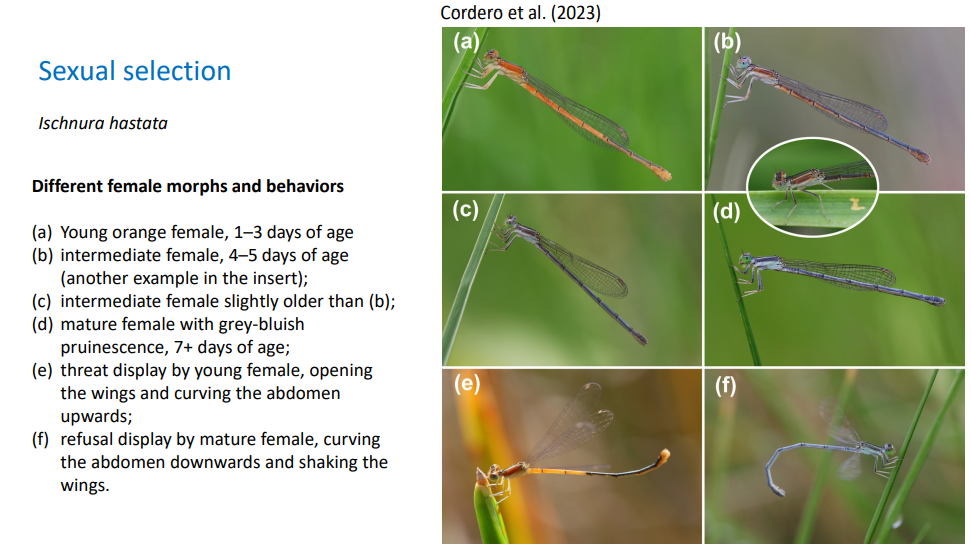
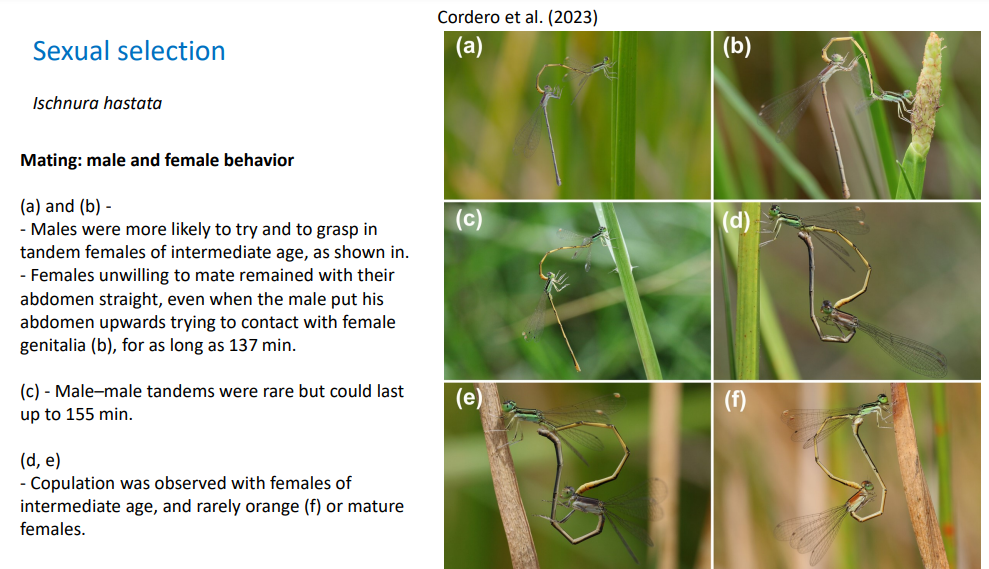
Sexual selection Conclusions
Conclusions
Short lifespan has been selected for female monandry, creating an intense sexual conflict for mating rate.
Females can resist male attempts to mate, therefore controlling the resolution of the conflict.
Whether occasional polyandry occurs in this species needs to be studied using molecular markers.
In general, male damselflies are able to remove sperm from the female genitalia. In this context, future studies aimed at testing if the ability of sperm removal is maintained in I. hastata males are of special interest.