12-04: Nucleic Acids
Nucleic Acids
- Nucleic acids: molecules that are polymers made of nucleotides
- When we link many nucleotides together, we get a nucleic acid
- They store hereditary information and can produce identical copies of themselves
- DNA, deoxyribonucleic acid: double stranded
- RNA, ribonucleic acid: single stranded
Nucleotides
- Nucleotides are made of 3 components (in a single nucleotide)
- Pentose
- 5 carbon sugar
- Either a ribose sugar in RNA or deoxyribose sugar in DNA
- Phosphate group
- Bonded to C5 with a phosphate ester linkage
- Nitrogenous base - 1 of 4:
1. Adenine (A) 2. Guanine (G) 3. Cytosine (C) 4. Thymine (T) in DNA, or Uracil (U) in RNA * a. b. and c. are possessed by both RNA and DNA
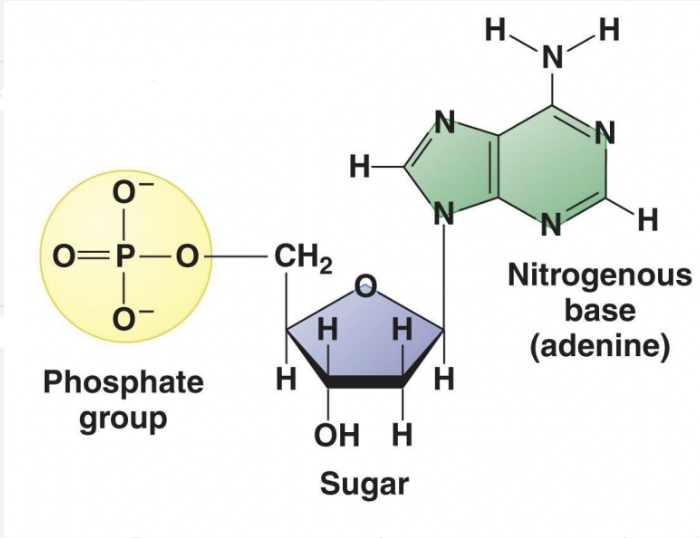
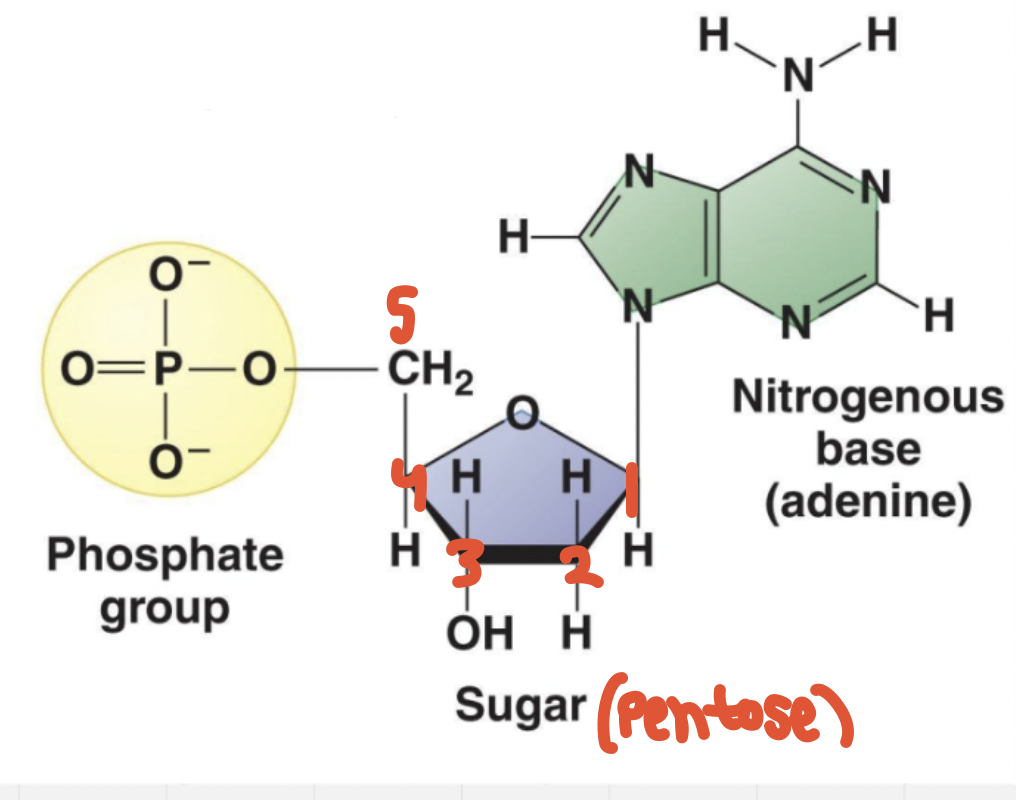
Phosphates can have OH’s, but in an aqueous environment, H and O ionize into H⁺ and O⁻ as H⁺ dissociates
Formation:
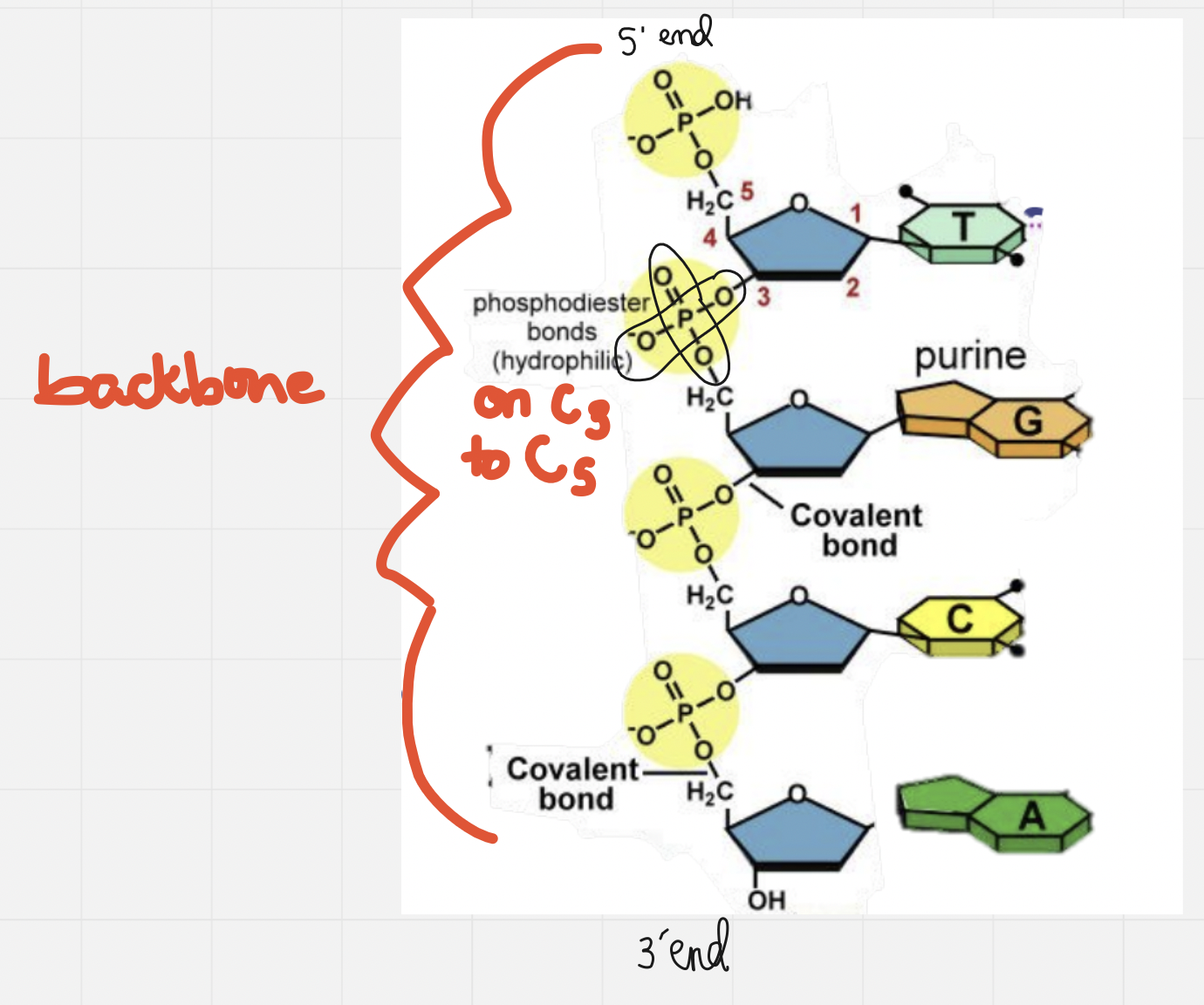
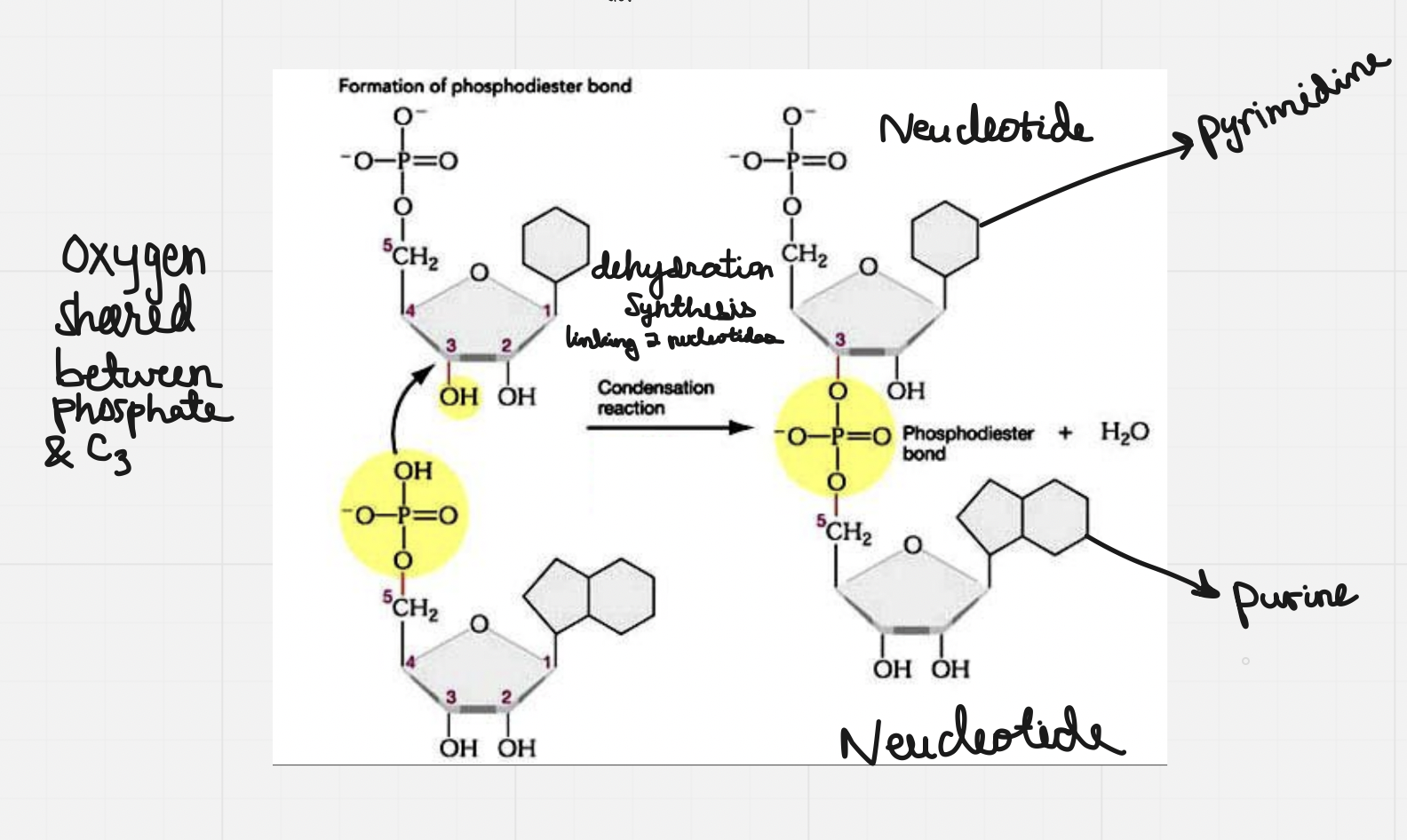
- The sugar from one carbon and the phosphate from another carbon form a phosphodiester bonds to make a long backbone
- The phosphate has 2 ester linkages to 2 different carbons: C5 on the original/first sugar to C3 on the new/second sugar
- Covalent bonds between the phosphate group on nucleotide on the hydroxyl of the C3 hydroxyl of a sugar on the nucleotide
Nitrogenous bases
- Nitrogenous bases point towards the inside of the polymer, away from the backbone
- Two types of nitrogenous bases
- Pyrimidines
- Single ringed
- Cytosine (C), Uracil (U), Thymine (T)
- CUT are the pyrimidines since they are a double ringed “CUT” in half!
- Purines
- Double ringed
- Adenine (A) and Guanine (G)
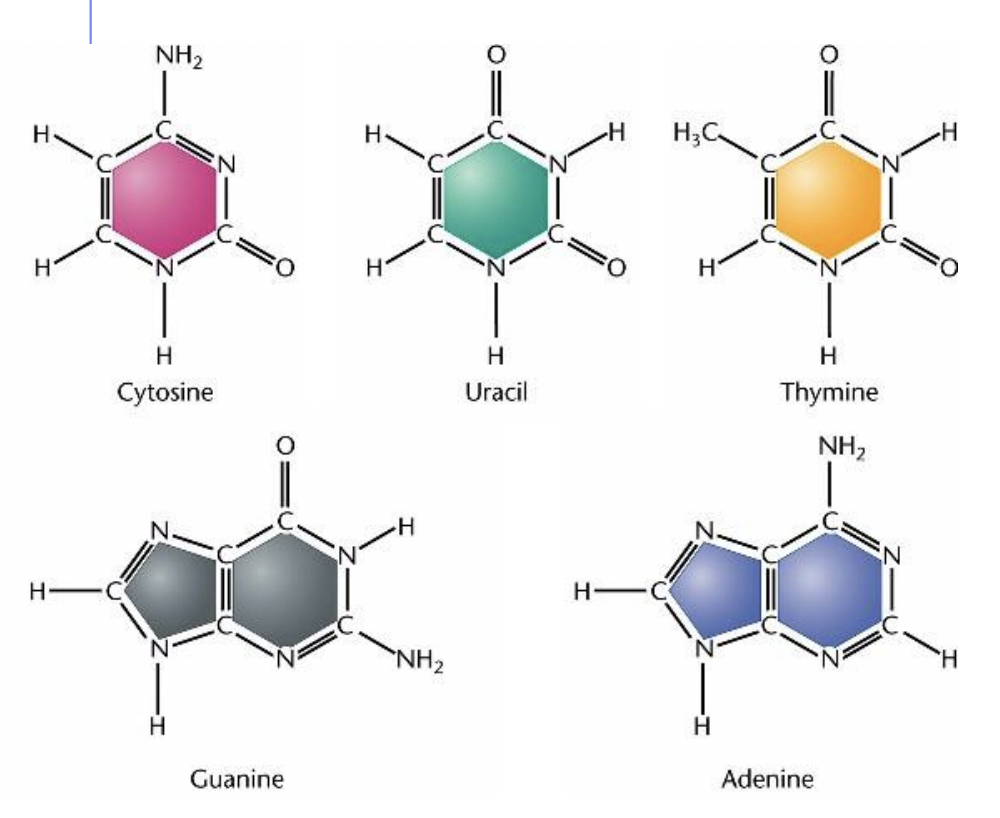
DNA
- 2 strands of nucleotides together – bigger structure, ladder that twists into a helix
- Double stranded
- Bases point towards each other
- Cytosine (C) and Guanine (G) are complementary base pairs and join together with 3 hydrogen bonds (bonded to the N)
- Adenine (A) and Thymine (T) are complementary base pairs and join together with 2 hydrogen bonds
- Each strand of DNA has a free phosphate at one end and a free sugar at the other – one strand runs backwards relative to the other strand
- They run “anti-parallel” (parallel but in opposite directions)
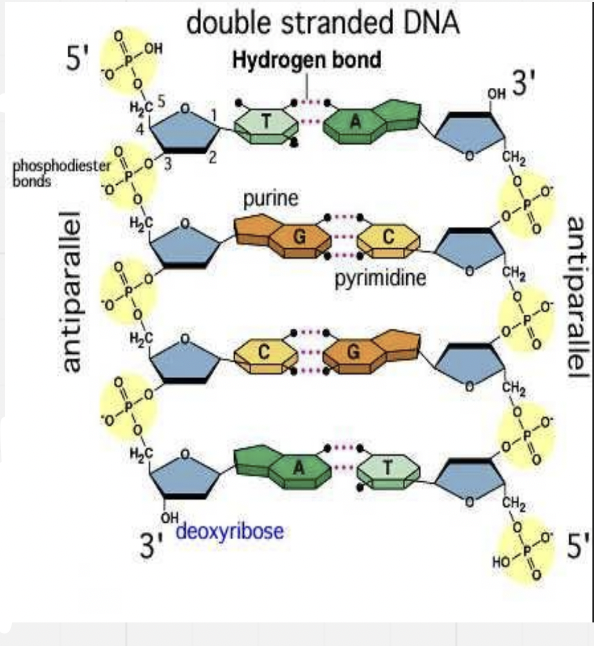 Must be antiparallel in order for the H bonds to occur
- Coils into a double helix
- Twisted ladder
- Phosphate sugar backbone around the outside and bases point towards the inside
RNA
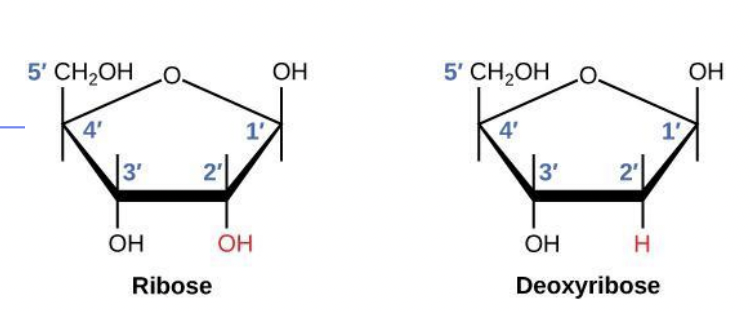 Difference is on C2
RNA has many different functions (e.g. mRNA (Messenger RNA), tRNA, rRNA)
Comparing DNA and RNA
| DNA | RNA | |
|---|---|---|
| Sugar | Deoxyribose | Ribose |
| Bases | A, G, T, and C | A, G, U, and C |
| Strands | Double stranded | Single stranded (but can be double stranded if needed) |
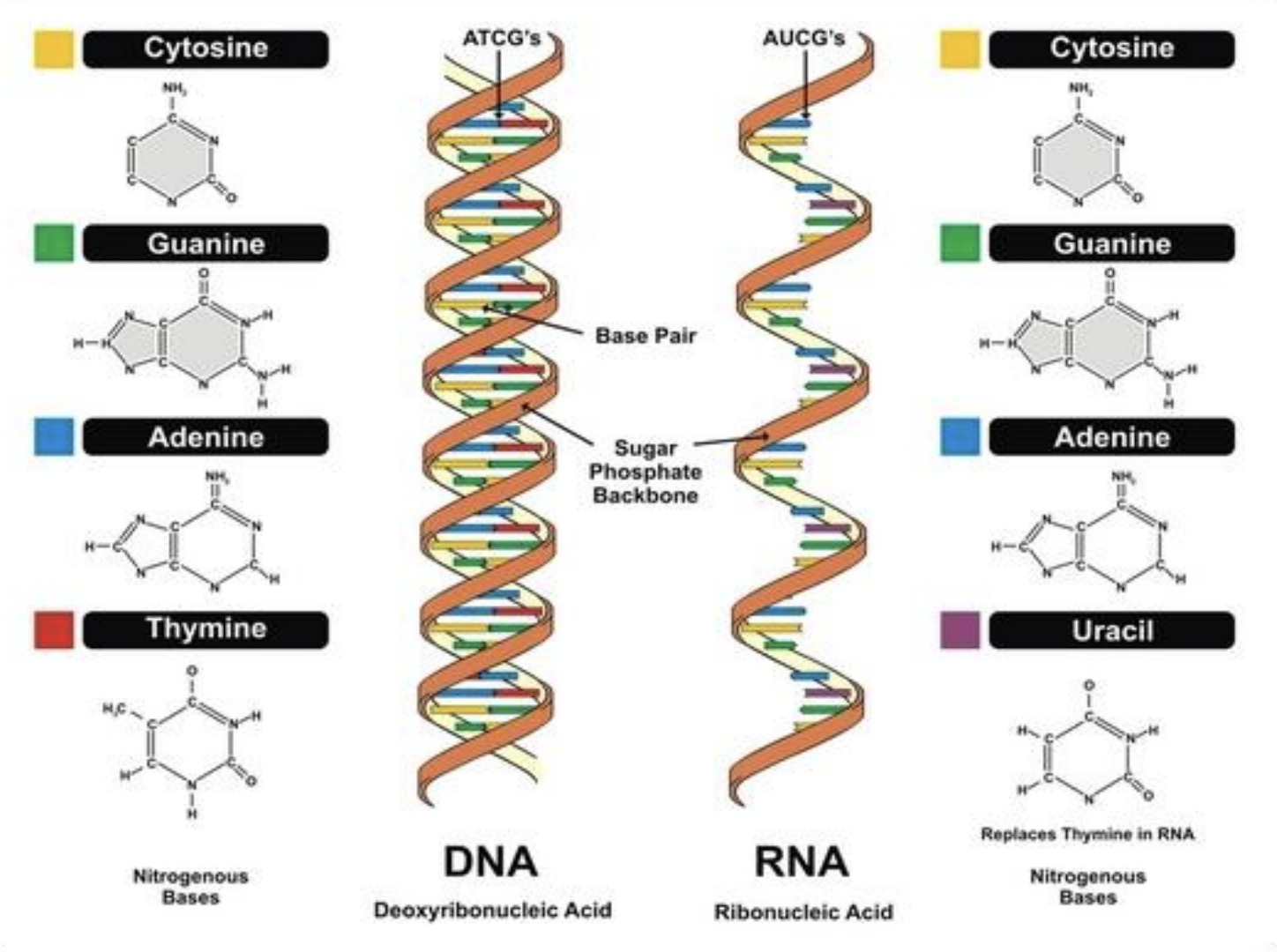
Other nucleotides
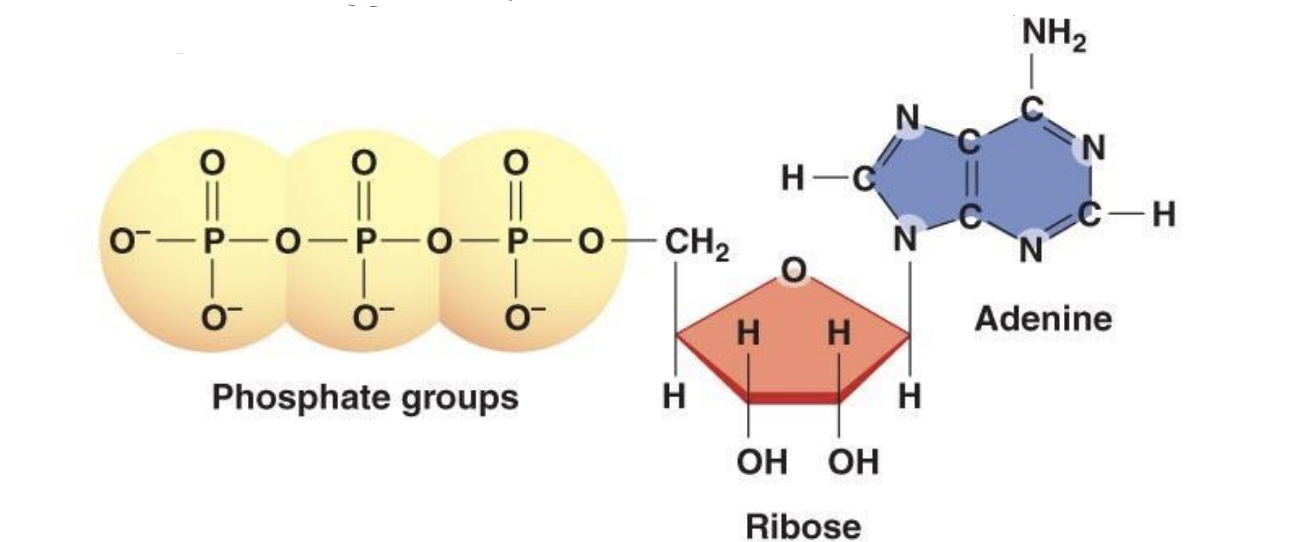
ATP
- ATP: adenosine triphosphate
- Has all of the features of a nucleotide but rather than 1 phosphate, it has a triphosphate (3)
- Adenine and ribose + 3 phosphates
- Cells use it as a source of energy – mitochondria synthesizes ATP which is useful for other cellular chemical processes
- Used for energy transport within the cell
- The only format of energy out cells can use (“currency”)
- The removal of 1 phosphate group releases energy to be used
Nucleotide Derivatives
- Derivatives of nucleotides are used in the production of ATP
- Used to transport H⁺ and electrons from one reaction site to another
e.g.
- nicotinamide adenine dinucleotide (NAD+)
- flavin adenine dinucleotide (FAD)
- cyclic adenosine monophosphate (cAMP)
Bottom line: not every nucleotide has to be in DNA & RNA