Unit 0 Scientific Practices
1.1 Interaction of Heredity and Environment
Nature vs Nurture
Nature = heredity/ genetics
Nurture = environmental factors
Interactionist perspective: Nature and Nurture
Main perspectives of Psychology
Biological
Emphasizes the role of genetics and physiology on behavior
Evolutionary
Emphasizes the role of natural selection on behavior
Used to justify eugenics
arranging reproduction to increase the occurance of desirable traits
Cognitive
Emphasizes the role of internal mental processes on behavior
Humainstic
Emphasizes a person’s inherent goodness and growth capacity on behavior
Behavioral
Emphasizes the role of learned/ observable behaviors on behavior
Sociocultural
Emphasizes the role of social and cultural context on behavior
Biopsychosocial
Emphasizes the role of biological, psychological and social factors on behavior
Epigentics
Emphasizes the role of environment and behavior on gene expression
Used in identical twin studies
Vocabulary
Psychology: the scientific study of behavior and mental processes
Scientific because of the use of empiricism and scientific method
Empiricism: the idea that scientific knowledge in developed through observation and experimentation
Behavior: any observable and measurable action taken by a person/animal
Menatal processes: internal subjective experiences inferred from behavior
Basic research: scientific inquiry that aims to increase psychology’s knowledge base
Pure science
Applied research: scientific inquiry that aims to use psychology to solve practical problems
Real world application of science
Hindsight bias: the tendency to believe that we could've forseen an event after it happened
Overconfidence: the tendency to believe that we know more than we do
Correlation ≠ causation: don’t percieve patterns in random events
1.2 Steps to conduct a valid research
Theory
an explanation based on observation/ prediction
Hypothesis
a testable prediciton
Null hypothesis
a statement of “no effect” or “no difference”
Operational definition
a specifically worded statement of exact procedures used in a study
used for replication
Research
has three types
Descriptive research: decribes
Case study: one or more person are studies in depth
Naturalistic observation: observing things in their natural habitat
Participant observation: when the researchers are immersed in the day to day lives of the participants
Surveys/ Interview: method of obtaining self-reports
Correlational research: variability
Correlation is always between 0 and 1
Graphed in a scatter plot
Experimental research: cause and effect
Independent variable: what’s being manipulated
Control group: non-manipulated group
Experimental group: manipulated group
Dependent variable: the outcome of manipulation
Confounding variable: a factor other than the independent variable that can influence the results
Statistics
meausured data that can be interpreted
two types
Descriptive statistics: numerical data used to describe characteristics
Central tendency: marks the center of a distribution
Mean: mathematical average
Positive skew: when the avg is high because of an outlier
mean is to the right of median
Negative skew: when the avg is low because of an outlier
mean is the the left of median
Median: middle number
Mode: most frequent number
Variability: how much the scores differ in a disribution
Variance: how much the scores vary from the mean
Range: the difference between the highest and lowest scores
Standard deviation: how much the scores deviate from the mean
Z is the unit of standard deviation
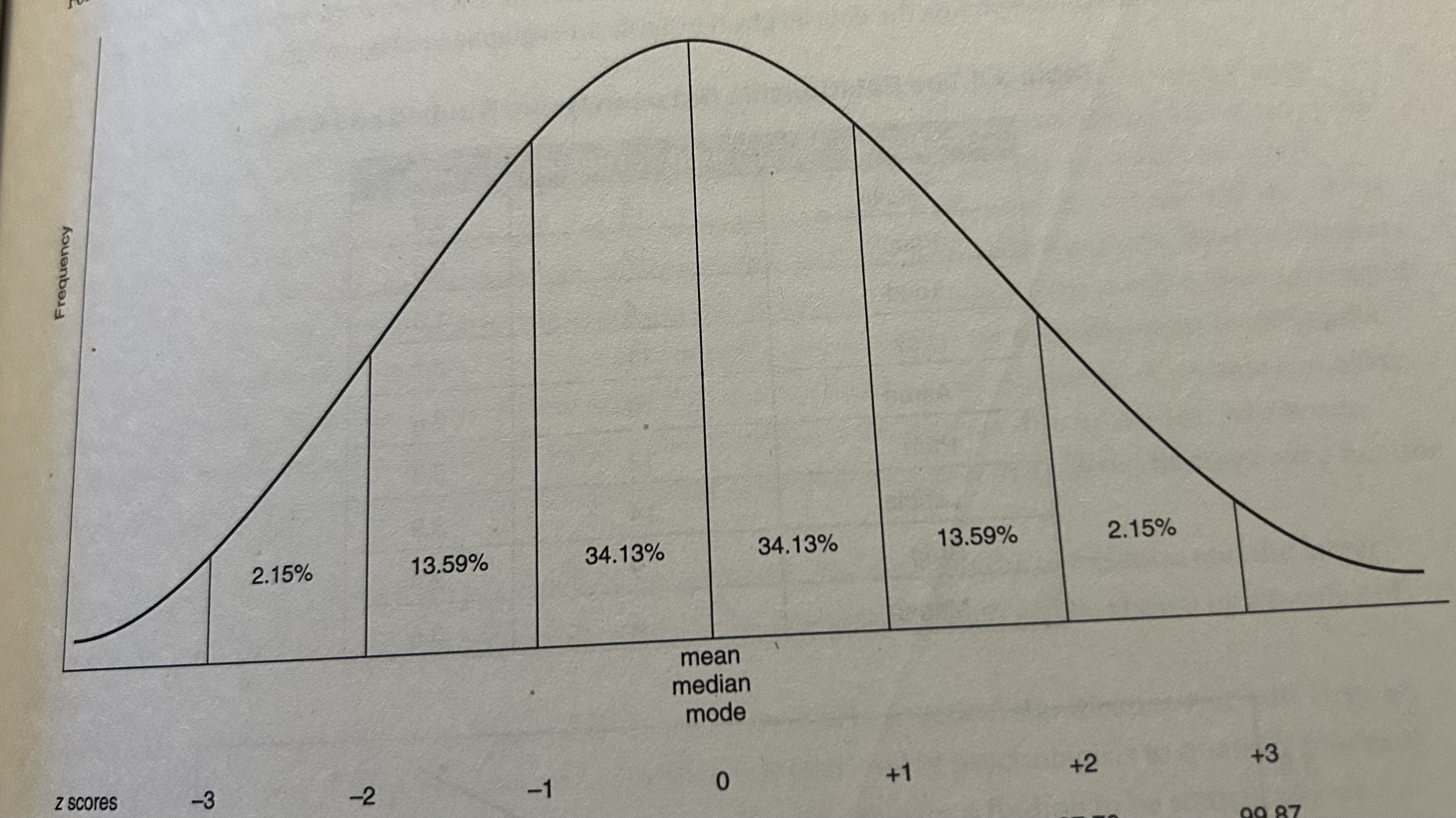
Infarrential statistics: allows for the generalization of the probability of something being true based of the sample data
Vocabulary
Population: all the people in a group being studied
Random sample: a sample that faily represents a population because each person has an equal chance of getting chosen
Representative sample: sample that has the same disribution of demographics as a population
Sampling bias: when a sample doesn’t accurately represent the broader population
Self desirablility bias: the tendency for people to answer surveys in a way that makes them favorable
Self reporting bias: the tendency for people to inaccurately report about themselves in surveys/ interviews
Regression to the mean: the tendency for exterme scores to fall back toward the average
Directionality problem: the difficulty in determining correlation and cause and effect
Third variable problem: a situation where a correlation might be affected by a third variable
Meta-analysis: when the researcher combine the results of multiple studies in the same topic to reach a conclusion
Leads to better generalizability
Subject response bias: when participants in an experiment act in a way that they thin the researchers want them to act
Experimenter bias: when the expectations of an experiment influence the result of the research
Blind procedure: method used to reduce bias by withdrawing information
Single-blind procedure: participants are uninformed about the treatment they’re receiving
Double-blind procedure: participants and researchers are uninformed about the treatment they’re giving/receiving
Placebo: an inert treatment without any medication inside
Placebo effect: the tendency for a participant’s well-being to improve after taking a placebo
Statistical significance: statement of how likely a result occured by chance
p is the value of statistical significance
p has to be less than 0.05 (5% change it occured by chance) for a study to be statistically significant
1.3 APA Ethical Guidelines
American psychological association’s ethical guidelines for human and animal research
Animal research
Humane care for the animals
Acquire animals legally
Minimized amount of pain
Reasonably natural living condition
Have research proposal approved by the animal ethics committee
Human research
No coercion
participation is voluntary
Informed consent
participants are given enough information to make a decision
Minimal deception
if the nature of the study requires deception it shouldn’t be so extreme
Right to withdrawal
participant has the right to leave at any moment in a study
Confidentiality
the participant’s privacy is protected and identies aren’t released
Protection from harm
participants can’t be placed at a significant mental/ physical distress
Debriefing
participants must be told the purpose of the study after the study and have the right to know the results