Art History Fall Quiz
Questions:
Which of the following best demonstrates the application of formal and contextual analysis, emphasizing the importance of close looking? Carefully observing the colors, shapes, and lines of a painting to analyze how its visual elements contribute to its meaning, while also considering its historical and cultural background
How does Meta Vaux Warrick Fuller’s Talking Skull reflect both personal and cultural themes? It explores universal human awareness of mortality and cultural longing for ancestral connection
What is one of the key messages conveyed in the Bangudae petroglyphs? The petroglyphs showcase human integrity and interaction with a diverse natural environment
What art-historical idea is highlighted by Anni Albers’s Pasture? The distinction between fine art and craft is unnecessary and often culturally biased
In ancient Mesopotamia, between 5000 and 2000 BCE, which major economic institutions were established that would bring about developments in the arts? The temple and palace
Between 5000 and 2000 BCE, substantial changes occurred in ancient Mesopotamia, including the development of belief systems in deities and local mythologies that led to which literary development? Narratives about Mesopotamian gods and goddesses
Which art form rapidly developed with the rise of agricultural communities in Mesopotamia between 6000 and 4000 BCE? pottery
Through the design of the White Temple at Uruk, which type of building was elevated to the realm of the gods? house
Before this technology was eventually abandoned, which construction technique was used to build the Limestone Temple in the Eanna complex? ashlar masonry
Which new design innovations were utilized to create a pictorial narrative on the Uruk Vase? The use of registers
Which invention served as a bureaucratic tool during the Uruk period? cylinder seals
During the Early Dynastic period in southern Mesopotamia, what discovery in urban graves shows the growing wealth of the urban elite class? Precious materials and prestige goods
What are the two distinct features carved into every votive figure found at the Temple of Abu in Eshnunna? Clasped hands and large inlaid eyes
The stele of Eannatum was one of the first public monuments to combine which two things? inscription and visual narrative
Toward the end of Akkadian rule, what became an economic institution that also featured a divine character? palaces
The head of an Akkadian ruler is an example of which new metallurgical art? lost-wax casting
The Disk of Enheduanna provides the earliest known example of what? a named author
Which feature of the statue of Gudea represents his religious dedication? The clean-shaven face and royal woolen cap with stylized curls
What was inscribed on each brick of the ziggurat at Ur when it was built, around 2100 BCE? The name of the ruler who built the ziggurat
During the Middle Bronze Age, how were the visual arts incorporated into everyday life? Mold-made terra-cotta plaques and figurines
The Law Stele of Hammurabi, inscribed with laws and topped with a sculptural representation of Hammurabi as the ruler and dispenser of justice. How is the idea of his authority achieved? Showing Hammurabi existing on the same plane as the divine Shamash
For what reason did the palace of Mari become famous across West Asia? It had 260 rooms and multiple courtyards
What feature of the fresco depicting the investiture of Zimri-Lim connects Mari with the Aegean? The use of iconography such as mythological creatures, including the sphinx
Which design features in Hattusha suggest a connection between the Hittites and the Mycenaeans? Cyclopean masonry combined with Monolithic figures
The Hittites believed that springs were sites of communication with ancestors and gods of the underworld. What was built in these areas to signify belief? Water monuments and complexes
What was included as part of the construction of the city of Karkamish? orthostat programs
Much of the Assyrians’ increasing wealth was used for imperial building projects. What did these projects include? Palaces, temples, and urban infrastructure
The throne room of Ashurnasirpal II was highly decorated with orthostats that were carved to commemorate the King. What symbol was behind the throne? An official emblem of the Assyrian state
What does the lion-hunt orthostat at Nineveh display? Representation of pain and suffering
The highly decorated ceremonial entrance to Babylon, the Ishtar Gate, featured glazed molded bricks that depicted what? mythological creatures
How does the Bisotun rock relief depict the importance of Darius I? The use of hierarchical scale
the hypostyle hall in the Apadana brought together _____? West and Central Asian styles, along with Egyptian and Greek styles
Which of the following best describes the significance of the Nile River to ancient Egyptian civilization? The Nile was central to Egyptian agricultural cycles, social order, and spiritual beliefs
How did the spiritual concept of ma’at relate to the role of Egyptian kings during the Old Kingdom? Ma’at symbolized earthly order and social cohesion, and Egyptian kings presented themselves as preservers of this order
Which of the following statements best describes the art and architecture of Hierakonpolis during the Predynastic period? Hierakonpolis contained elaborate burials with wall paintings that depicted various everyday human activities along the Nile River
What does the Narmer Palette found at Hierakonpolis signify about the political situation in Egypt around 3000 BCE? It symbolizes the unification of Upper and Lower Egypt under a single ruler, likely King Narmer
What cultural significance is attributed to the Narmer Palette? It demonstrates early representations of kingship and includes hieroglyphic writing
Which of the following best describes how funerary practices and architecture were represented in the Early Dynastic period in Abydos? Royal tombs featured single-chamber or multi-chamber structures lined with mudbricks, roofed with wood, and mounded with soil
Which of the following comparisons accurately reflects the differences between funerary architecture at Abydos and Saqqara during the Early Dynastic Period? Abydos used single- and multi-chamber tombs with mudbrick linings, while Saqqara featured mastaba tombs with several chambers and slanted walls
Which funerary practice in the Old Kingdom emphasized the belief in the divine role of the king as the preserver of ma’at? monumental-scale funerary complexes and the utilization of resources and labor for their construction
What was the purpose of the elaborate funerary complexes constructed during the Old Kingdom of Egypt, particularly in the Third and Fourth Dynasties? To aid rulers in their transformation and ensure the continuity of the cosmos
What was the significance of false doors in the funerary architecture of Old Kingdom Egypt? False doors symbolized the threshold between the living and the dead
Which of the following features characterizes the funerary complex of Djoser in the Old Kingdom? The use of complex subterranean structures and carved plant-like forms in stone
Which of the following best describes the function and style of the interior wall decorations found in the mastaba tomb og Ti from Old Kingdom Egypt? They were decorated with detailed scenes from Ti’s daily life and accomplishments to assist his ka
Based on the features of the statue of Menkaure and his queen, what can be inferred about the role of artistic representation in royal portraiture during the Old Kingdom? Artistic representation was used to idealize and standardize the depiction of royalty
What aspect of the mastaba tomb decoration is illustrated by the description of the northern wall of Ti’s chapel in his tomb at Saqqara? The representation of Ti in hierarchical scale to indicate his importance as a high-ranking official
What role did art play in trade and diplomacy during the Bronze Age? Art was used to foster political alliances and economic relations through actions such as gift-giving
What do Tutankhamun’s dagger and sheath illustrate about artistic styles during the Late Bronze Age? Their design integrates motifs from multiple Mediterranean cultures, reflecting an international artistic style
What major innovation in monumental architecture emerged during the reign of Nebhepetre Mentuhotep in the Middle Kingdom? The use of rock-cut structures
How are the features of statues from the Twelfth Dynasty, particularly those of Senusret III, different from those of the Old Kingdom? They depict kings with expressive, individualistic faces
How does the kneeling statue of Hatshepsut assert her royal authority? By portraying her wearing the trappings of a male king
What was a significant change Akhenaten introduced during his reign? he replaced the god Amun-Ra with Aten as the primary state deity
What was the Great Hypostyle Hall at Karnak meant to evoke? The sacred primordial marsh
What was the purpose of the early writing systems of the Mesopotamians, the Shang dynasty, and the Olmec/Maya cultures? Economy, recordkeeping, and identifying the ruling class
How did the Cycladic culture extend seafaring trade routes to provide resources throughout the region? islands
the early Cycladic cemeteries at Chalandriani are unique due to their ____? corbeled roof
What was the purpose of the frying pans discovered in Cycladic tombs? Its purpose is unknown
What were the Cycladic folded-arm figurines used for? Several purposes, including ritual use
the earliest figural depictions on Crete date to ___? 9000 BCE
During the early Middle Bronze Age, what was the function of the palaces? economic centers
Which design aspect of the snake-goddess figurines suggests trade with West Asia? Their flounced skirts
Akrotiri, a Bronze Age settlement on an island to the north of Crete, was influenced in what way by the Minoan culture of Crete? Through material culture
How does the fresco of three women found at House Xeste 3 in Akrotiri represent the stages in a rite of passage? By showing an adult woman, a young woman, and a pre-pubescent girl
What is thalassocracy, and what role did it play in Crete’s influence in the Cyclades? A supremacy based on maritime power. It controlled the region and spread cultural influences
Minoan-style frescoes depicting Minoan subjects such as those on Knossos have been discovered in Svaris, Egypt. What is one unique attribute that characterizes the Minoan style? The exclusion of green paint
What were the earliest large-scale relief sculptures on the Greek mainland? grave steles
What is an important feature of a tholos tomb? a dome
What is the period after the collapse of Mycenaean culture and the end of the Bronze Age known as? a dark age
What indicates that the grave in Lefkandi was a warrior’s tomb? The inclusion of iron weapons and horses in the grave
The Geometric period saw the creation and rise of the many cultural practices that ancient Greece is known for, including all of the following EXCEPT for what? naturalistic art
What indicates that the Geometric krater was a burial marker for a man? Kraters were used to mix wine with water at a symposium
What would have been characteristic of an early Greek temple during the Geometric period? a statue of the temple’s deity
The Protoarchaic period in Greece saw a rise in immigration from people escaping what? The Assyrian Empire
What sets the stone temple at Prinias in Crete apart from others of its kind? It was the first Greek temple decorated with sculpture
What characteristics of Corinthian black-figure pottery are derived from West Asian art? The types of animals depicted on the pottery
In which Greek colonies were some of the best-preserved Archaic temples built? Magna Graecia
What do some scholars suggest the division of the cella at the Temple of Hera I at Posedonia indicates? The worship of two deities
Scholars suggest that the Peplos Kore is an image of which deity? Artemis
Why is it important to analyze context when trying to date and understand the original function of a kore or kouros? Stylistic changes were not completely linear
Why does recent analysis suggest that the sculptures on the east and west pediments of the Temple of Aphaia were made in different styles? Artistically, one pediment looks forward, and the other looks back
Why have so few Classical Greek bronze works survived to the present? They were often melted down, and the bronze was reused
What is the earliest known state-sponsored sculptural group that commemorates a perceived attempt to protect Athenian democracy? The Tyrant Slayers
Which of the following impacted the production of art in Greece during the ‘Classical Period ‘? Humanism
The iconography of Pheidias’s statue of Athena and the metopes of the Parthenon share which of the following themes? the triumph of Greek civilization over barbarism
Which of the following structures was constructed in the second wave of building projects on the Athenian Acropolis after Pericles’ death? The Erechtheion
In attempting to create a work of ideal, harmonious proportions, the sculptor Polykleitos wanted to convey which of the following concepts? Arete
Marble copies of the Doryphoros (Spear Bearer) are thought to be based on which of the following? Polykleitos’s Kanon
Riace Warrior A, like the Doryphoros (Spear Bearer), uses which of the following to naturalistically depict the human body and create a sense of balance and harmony to the work as a whole? Contrapposto
where can most surviving Classical Greek sculptures of mortal women be found? Cemeteries
What types of scenes are frequently depicted on Lekythoi? Scenes related to funerary rituals
Which of the following characteristics may account for the rise in the popularity of Athenian red-figure pottery in the Classical Period? Techniques used to make red-figure pottery allowed for greater naturalism
How does the imagery on the Niobid krater differ from earlier imagery on Athenian red-figure pottery? The figures are places at different heights
Artwork:
Artwork 1: Uruk Vase (Warka Vase)

1. Culture
Sumerian (Ancient Near East, Uruk Period)
2. Materiality & Medium
Type of object: tall, carved, functional/ritualistic vessel (vase).
Materials and techniques: Sculpted out of alabaster using low-relief carving (bas-relief) techniques to create registers.
3. Visual Characteristics
The composition of the vase is strictly organized into three distinct horizontal bands or registers separated by blank groundlines, utilizing a clear hierarchical scale. At the base, bands of water and vegetation give way to animals and human figures depicted in a stylized, composite profile, culminating in a large narrative scene at the top register where the largest figures appear.
4. Iconography & Cultural Significance
The narrative depicts a religious offering procession honoring Inanna, the Sumerian goddess of fertility and war, who stands at the top gate accepting gifts of abundance from a naked priest class. This structured imagery serves as a political and religious statement of a well-ordered cosmos, reinforcing the ruler’s divine role in maintaining the agricultural bounty and spiritual harmony of the city-state.
Artwork 2: Votive Figures from the Temple of Abu

1. Culture
Sumerian (Ancient Near East, Early Dynastic Period)
2. Materiality & Medium
Type of object: Free-standing votive statues (sculpture in the round).
Materials and techniques: Carved from gypsum, limestone, and alabaster, with eyes intricately inlaid using shell, black limestone, and lapis lazuli.
3. Visual Characteristics
These free-standing figures exhibit highly stylized anatomy, featuring rigid, cylindrical bodies, stiff postures, and clasped hands holding tiny ritual cups. Their most prominent visual feature is their oversized, wide-open eyes inlaid with vibrant shell and lapis lazuli, which draw immediate attention against the pale limestone surface.
4. Iconography & Cultural Significance
These figures functioned as surrogate worshipers placed inside the temple to offer perpetual, non-stop prayer to the god Abu on behalf of elite elites. The massive, unblinking eyes symbolize eternal vigilance and rapt attention toward the divine, embodying the core Sumerian religious obligation of constant devotion.
Artwork 3: Royal Standard of Ur (Battle & Feast Sides)

1. Culture
Sumerian (Ancient Near East, Early Dynastic Period)
2. Materiality & Medium
Type of object: A portable wooden box or standard with sloping sides (precise original function unknown, possibly a soundbox).
Materials and techniques: Wood inlaid with shell, lapis lazuli, red limestone, and bitumenacting as an adhesive mosaic surface.
3. Visual Characteristics
Both faces are divided into three horizontal registers read from bottom to top, utilizing a distinct hierarchy of scale where the king's head physically breaks through the upper border frame. The "Battle Side" utilizes dynamic diagonals to show moving war chariots and bound prisoners, while the "Feast Side" relies on a more static, horizontal alignment of seated figures enjoying a banquet.
4. Iconography & Cultural Significance
The two opposing sides represent a dual narrative of Sumerian kingship, contrasting the ruler's role as a fierce military conqueror with his role as a peaceful, wealthy provider celebrating victory. Found within a lavish royal tomb context, this object serves as a powerful political monument demonstrating the state's organized military structure, social stratification, and the divine right of the ruler.
Artwork 4: Law Stele of Hammurabi

1. Culture
Babylonian (Ancient Near East)
2. Materiality & Medium
Type of object: A tall, public celebratory monument and legal marker known as a stele.
Materials and techniques: Carved from a single, massive piece of polished black basalt using low-relief carving at the top and incised cuneiform script text across the shaft.
3. Visual Characteristics
The monument stands as an imposing, rounded pillar with a relief sculpture at the top that depicts a formal interaction between a standing mortal and a seated deity. The figures are carved in profile with stiff, frontal torsos, utilizing a strict hierarchy of scale where the sun god Shamash would dwarf King Hammurabi if he were to stand up.
4. Iconography & Cultural Significance
The relief scene depicts King Hammurabi receiving the symbols of justice, the ring and staff, directly from Shamash, the god of justice and the sun, which visually validates the divine origin of the laws written below. Below this relief, the extensive cuneiform text outlines a harsh, reciprocal legal code ("an eye for an eye") designed to physically unify the Babylonian empire under a centralized, divine judicial authority.
Artwork 5: The Narmer Palette

1. Culture
Egyptian (Early Dynastic Period, Dynasty 0)
2. Materiality & Medium
Type of object: A ceremonial, double-sided cosmetic palette.
Materials and techniques: Meticulously carved from a flat slab of graywacke(siltstone) using crisp low-relief carvings arranged in horizontal registers.
3. Visual Characteristics
Both sides of the shield-shaped palette are organized into distinct horizontal registers featuring highly stylized human figures drawn in a rigid, composite perspective. The dominant visual element is the massive figure of King Narmer, whose physical size breaks the scale of the other figures as he dynamically strikes a kneeling enemy on the reverse side.
4. Iconography & Cultural Significance
The palette serves as a political monument celebrating the unification of Upper and Lower Egypt under King Narmer. This political triumph is communicated through symbolic imagery, including Narmer wearing the specific crowns of both regions, the smiting of foreign enemies, and intertwined beast necks that represent the forced harmony of a newly united country.
Artwork 6: Pyramids on the Giza Plateau
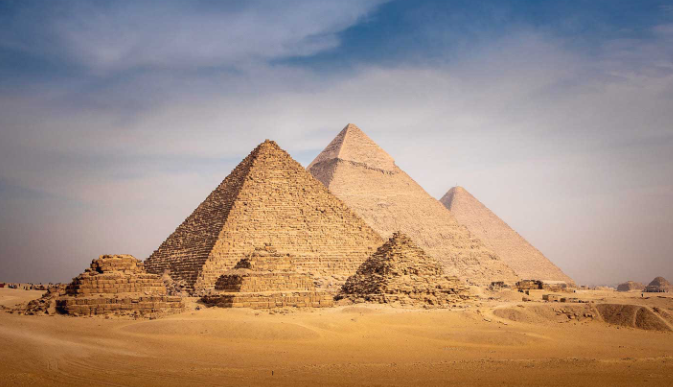
1. Culture
Egyptian (Old Kingdom, Fourth Dynasty)
2. Materiality & Medium
Type of object: A massive complex of royal monumental tombs (architecture).
Materials and techniques: Constructed using millions of massive, quarried limestone and granite blocks stacked in precise geometric layers.
3. Visual Characteristics
The complex is dominated by three colossal, perfectly geometric four-sided pyramids that rise sharply out of the flat desert plateau toward the sky. Their stark, unornamented surfaces were originally encased in smooth, polished white limestone that captured the bright desert sunlight to create a dazzling, reflective effect.
4. Iconography & Cultural Significance
These architectural marvels functioned as regeneration places for the deceased pharaohs(Khufu, Khafre, and Menkaure), ensuring their smooth transition into the afterlife as gods. The iconic pyramid shape directly mimics the slanting rays of the sun, serving as a symbolic stone ramp or ladder that allowed the king’s soul to ascend to join the sun god Re.
Artwork 7: King Menkaure and a Queen

1. Culture
Egyptian (Old Kingdom, Fourth Dynasty)
2. Materiality & Medium
Type of object: A high-relief ka statue (sculpture).
Materials and techniques: Carved out of an exceptionally durable block of graywacke, showing traces of red and black pigments.
3. Visual Characteristics
The two figures are carved almost completely in the round but remain physically attached to a thick stone back slab, presenting a completely frontal, symmetrical posture. They display idealized, unblemished bodies and rigid, unyielding expressions, with the king confidently stepping forward with his left leg while the queen gently wraps her arm around his waist.
4. Iconography & Cultural Significance
This sculpture functioned as a home for the Ka (the life force/spirit) of the deceased pharaoh in case his physical mummy was ever destroyed. The unyielding stiffness of the stone, the timeless lack of emotion, and the queen's supportive gesture all combine to project a powerful message of eternal authority, political stability, and divine marital unity.
Artwork 8: Funerary Complex & Kneeling Statue of Hatshepsut


1. Culture
Egyptian (New Kingdom, Eighteenth Dynasty)
2. Materiality & Medium
Type of object: A rock-cut mortuary temple complex housing freestanding ritual statues.
Materials and techniques: The temple is carved directly out of living sandstone cliffs, while the kneeling statues are sculpted from heavy granite blocks.
3. Visual Characteristics
The temple features a series of long, rhythmic colonnaded terraces connected by central ramps that echo the natural horizontal lines of the towering cliffs above. The accompanying granite statues depict Hatshepsut kneeling symmetrically on a flat base, maintaining a completely rigid posture while extending two globular offering jars forward.
4. Iconography & Cultural Significance
This complex was built to celebrate the legacy and divine right of Hatshepsut, Egypt's most prominent female pharaoh, providing a dedicated site for rituals honoring her spirit after death. To legitimize her rule in a male-dominated society, the statues purposely depict her wearing the traditional pharaonic regalia—including the royal kilt, headdress, and ceremonial false beard—showing her participating in a kneeling ritual reserved strictly for kings presenting offerings to the gods.
Artwork 9: Toreador Fresco (Bull-Leaping Fresco)

1. Culture
Minoan (Bronze Age Aegean, Crete)
2. Materiality & Medium
Type of object: A decorative architectural wall painting (fresco).
Materials and techniques: Created using the buon fresco (true fresco) technique, where pigments are applied directly onto wet lime plaster, chemically bonding the image to the wall.
3. Visual Characteristics
The painting features dynamic, curving lines that capture the powerful, elastic motion of a charging bull surrounded by three slender, stylized human figures. It utilizes a highly stylized Minoan color convention where the active bull-leaper over the center of the beast is painted with darker skin, while the two flanking figures are rendered with pale white skin.
4. Iconography & Cultural Significance
The scene illustrates the prominent Minoan ritual or sport of bull-leaping, which likely served as a critical rite of passage or religious ceremony within the Palace at Knossos. The bull itself was a central symbol of divine power and fertility in Minoan culture, and the athletic interaction emphasizes human harmony and agility in the face of raw natural forces rather than violent conquest.
Artwork 10: Fresco from House Xeste 3 (Women Gathering Saffron)
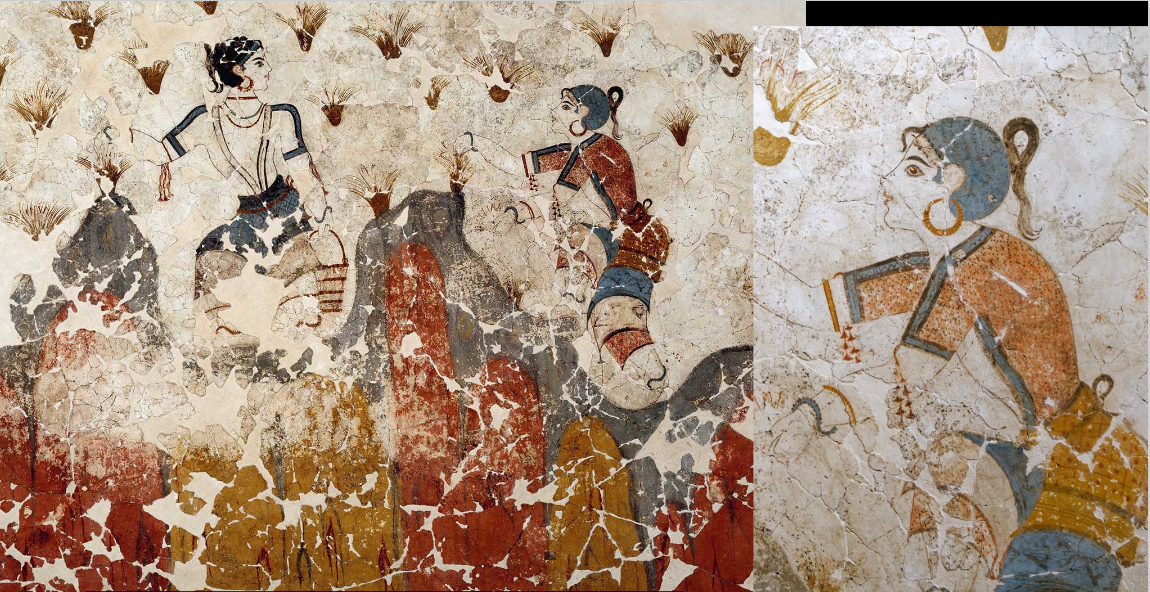
1. Culture
Minoan / Cycladic (Bronze Age Aegean, Akrotiri on Thera)
2. Materiality & Medium
Type of object: A narrative architectural wall painting (fresco).
Materials and techniques: Painted onto interior domestic walls using pigment on wet lime plaster (true fresco), beautifully preserved by volcanic ash layers.
3. Visual Characteristics
The fresco presents highly stylized female figures with shaved heads, blue ritual locks, and elaborate striped garments interacting within a natural landscape. The lines are loose, fluid, and decorative, emphasizing the organic shapes of the rocky terrain and the delicate crocuses the women are harvesting.
4. Iconography & Cultural Significance
The imagery represents a female coming-of-age ritual, where young girls gather saffron crocuses to present to an enthroned goddess. In this society, saffron held massive economic value and medicinal importance, particularly for easing menstrual cramps, making this narrative a symbolic celebration of puberty, fertility, and gender-specific societal roles.
Artwork 11: Treasury of Atreus
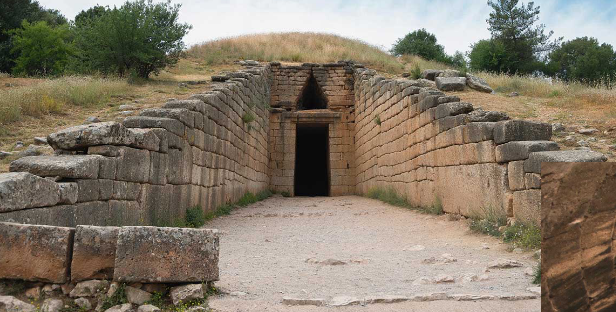
1. Culture
Mycenaean (Late Bronze Age Greece)
2. Materiality & Medium
Type of object: A monumental royal tholos tomb (architecture).
Materials and techniques: Constructed using corbeled masonry, where layers of finely cut stone blocks are stacked and shifted slightly inward until they meet at a single capstone at the top.
3. Visual Characteristics
The structure is approached by a long, uncovered stone pathway (dromos) that leads to an imposing post-and-lintel doorway topped by a triangular relieving space. Inside, the chamber opens into a vast, unornamented beehive-shaped dome that relies entirely on the precise weight distribution of its stones to stay standing without interior pillars.
4. Iconography & Cultural Significance
This elite tomb functioned as a monumental burial place for Mycenaean rulers, designed to loudly project the immense wealth and engineering capability of the citadel. The earthen mound piled over the exterior combined with the dramatic, dark interior space reflects an architectural focus on the afterlife, ancestor veneration, and the preservation of dynastic power.
Artwork 12: Temple of Hera I (Paestum)

1. Culture
Archaic Greek (located in Paestum, Italy)
2. Materiality & Medium
Type of object: A monumental peripteral religious temple (architecture).
Materials and techniques: Constructed primarily out of local limestone, which was originally finished with a smooth layer of protective white plaster.
3. Visual Characteristics
The temple is low and heavy, characterized by thick, closely spaced Doric columns that feature a severe swelling in the middle of the shafts known as entasis. The design includes an unusual odd number of nine columns across the front facade, creating a central column row down the interior cellar that physically bisects the sacred interior space.
4. Iconography & Cultural Significance
Dedicated to Hera, the queen of the Olympian gods, this temple served as an earthly home for the deity's cult statue and a public showcase of civic pride. The massive, compressed appearance of the columns reflects the early Archaic struggle to master monumental stone engineering, emphasizing structural stability and safety over delicate mathematical proportions.
Artwork 13: Kouros from Anavysos (Kroisos Kouros)

1. Culture
Archaic Greek
2. Materiality & Medium
Type of object: A free-standing grave marker statue (sculpture in the round).
Materials and techniques: Masterfully carved from a single block of marble and finished with encaustic paint details.
3. Visual Characteristics
The statue depicts a completely nude young male standing in a rigid, frontal posture with his hands clenched at his sides and his left foot stepped forward. While it retains the blocky symmetry and stiff hair of earlier Greek art, it features more rounded, naturalistic muscle definition and the characteristic, blank Archaic smile.
4. Iconography & Cultural Significance
This figure functioned as a funerary monument for Kroisos, a young warrior who died heroically in battle. Rather than serving as an exact portrait, the statue presents an idealized, timeless embodiment of youth and physical perfection, honoring the youth's aristocratic status and his sacrifice for the state.
Artwork 14: Amphora with Ajax and Achilles Playing a Board Game

1. Culture
Archaic Greek (signed by the artist Exekias)
2. Materiality & Medium
Type of object: A large, two-handled ceramic storage vessel known as an amphora.
Materials and techniques: Formed on a potter's wheel and decorated using the black-figure pottery technique, utilizing a fine clay slip for silhouettes and a sharp stylus to incise microscopic details.
3. Visual Characteristics
The vessel boasts a rich, black glazed body that frames a single, central narrative panel displaying two armored figures leaning over a small table block. The composition is masterfully balanced, with the dramatic forward lean of the heroes' bodies and the orientation of their spears perfectly echoing the natural, swelling curves of the vase handles.
4. Iconography & Cultural Significance
The scene depicts the Trojan War heroes Achilles and Ajax taking a tense break from combat to play a game of dice, unaware of the tragic fates awaiting them both. This innovative image captures a psychological "calm before the storm," reflecting the Archaic Greek cultural fascination with human destiny, camaraderie, and the tragic burdens of heroism described in Homeric epic poetry.