Reflex Arc
Reflexes
Rapid, automatic responses to a change in external/internal environment
Protects the body from injury
Properties
Stimulus -> Required to trigger a reflex (Not spontaneous)
Involuntary -> occurs without any conscious thought
Rapid -> only a small number of neurons are involved
Stereotyped -> occurs in the same way each time it happens
Most reflexes are coordinate by the spinal cord -> Spinal Reflex
The message is not carried to the brain, however, it can be made aware after the response has been carried out
Some reflexes involve the unconscious parts of the brain -> reflex
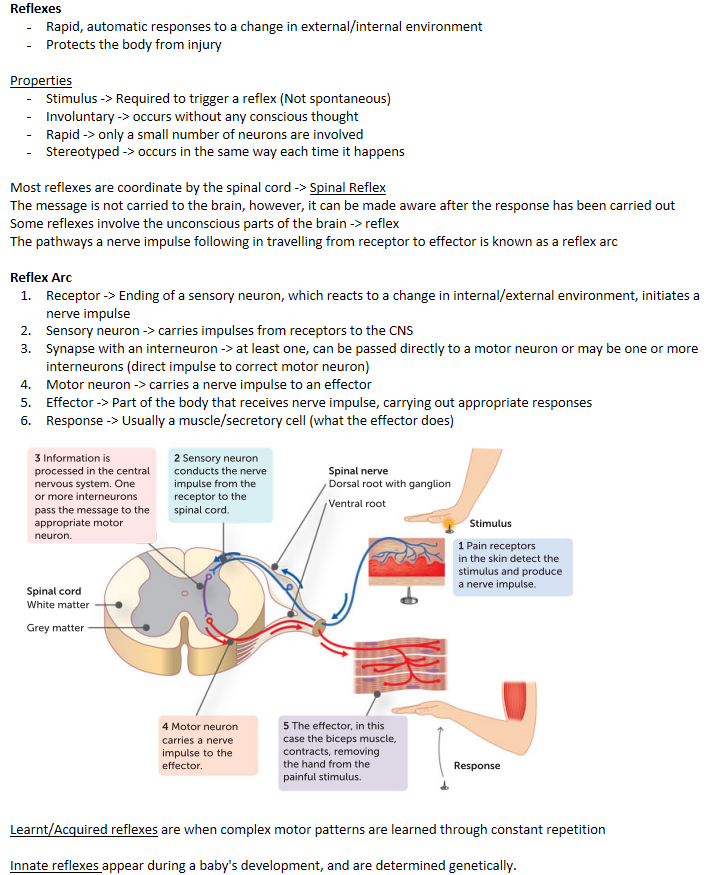
The pathways a nerve impulse following in travelling from receptor to effector is known as a reflex arc
Reflex Arc
Receptor -> Ending of a sensory neuron, which reacts to a change in internal/external environment, initiates a nerve impulse
Sensory neuron -> carries impulses from receptors to the CNS
Synapse with an interneuron -> at least one, can be passed directly to a motor neuron or may be one or more interneurons (direct impulse to correct motor neuron)
Motor neuron -> carries a nerve impulse to an effector
Effector -> Part of the body that receives nerve impulse, carrying out appropriate responses
Response -> Usually a muscle/secretory cell (what the effector does)
Learnt/Acquired reflexes are when complex motor patterns are learned through constant repetition
Innate reflexes appear during a baby's development, and are determined genetically.