transpiration
The main force which draws water from the soil through the plant is a process called transportation. Stomata must be open during daylight hours when the plant is photosynthesising in order for gas exchange to occur in the leaf. Water evaporates out of the cells in the leaf and diffuses through the open stomata and causes a kind of suction which pulls water up the stem. The water travels up the xylem as a continuous column and this flow of water is called the transpiration stream.
Water enters the plant from the soil, via osmosis, through the root hair cells.
Factors affecting transpiration
Because transpiration is the evaporation of water from the leaf and diffusion of water through the stomata, any changes which increase the rate of these processes will gave the same effect on transpiration, there are four main factors affecting transpiration:
LIGHT INTENSITY
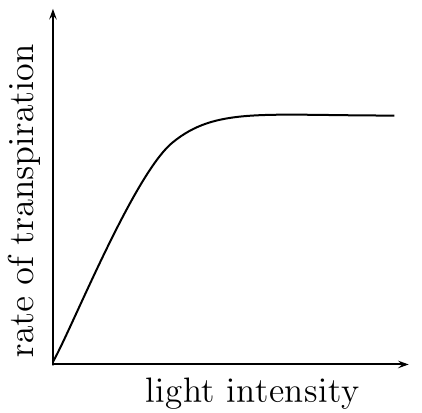
The increase is due to the stomata opening which will allow more water to evaporate, the plateau is because all the stomata are open and it cannot increase further.
TEMPERATURE
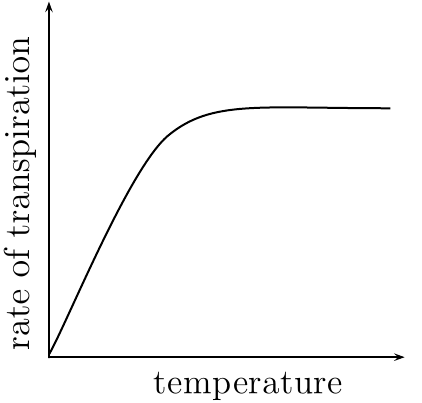
The increase is due to more evaporation of water and more kinetic energy meaning faster diffusion, the plateau is because at too high a temp too much water is lost so stomata closes.
AIR MOVEMENT
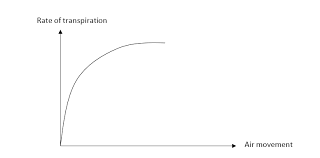
Wind pushes away water vapour from near leaf which causes a steeper concentration gradient.
HUMIDITY
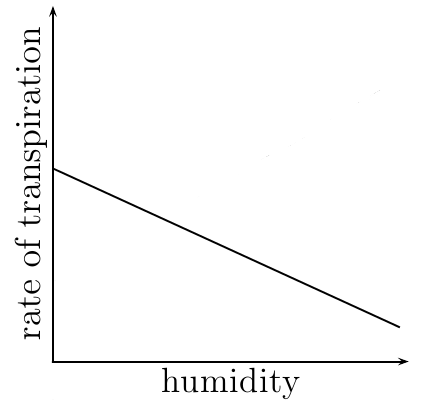
More humid the more water outside of leaf which makes the water potential gradient less steep so less water evaporates