Types of Rocks
Unstable hills are a natural disaster waiting to happen. Earthquake geologists investigate the likelihood of hills collapsing from earthquakes. The first step involves identifying the types of rock present. Some rocks are strong and can withstand earthquakes. Others are not so lucky.
Types of rock
Geologists examine features of rocks in order to classify them. These features include the rock's hardness, texture and grain size, and the types of minerals it contains. Together, they tell the story of how the rock formed and how strong the rock is.
Watch the following video to learn more about the different types of rock. You don't need to remember all of the information presented in this video. Instead, just focus on the three main types of rock and how they are distinguished from each other.
Igneous rocks
Deep below the Earth's surface, temperatures are high enough for rock to melt. While it is below the surface, molten rock is called magma. When magma rises to the surface in a volcanic eruption, it is called lava.
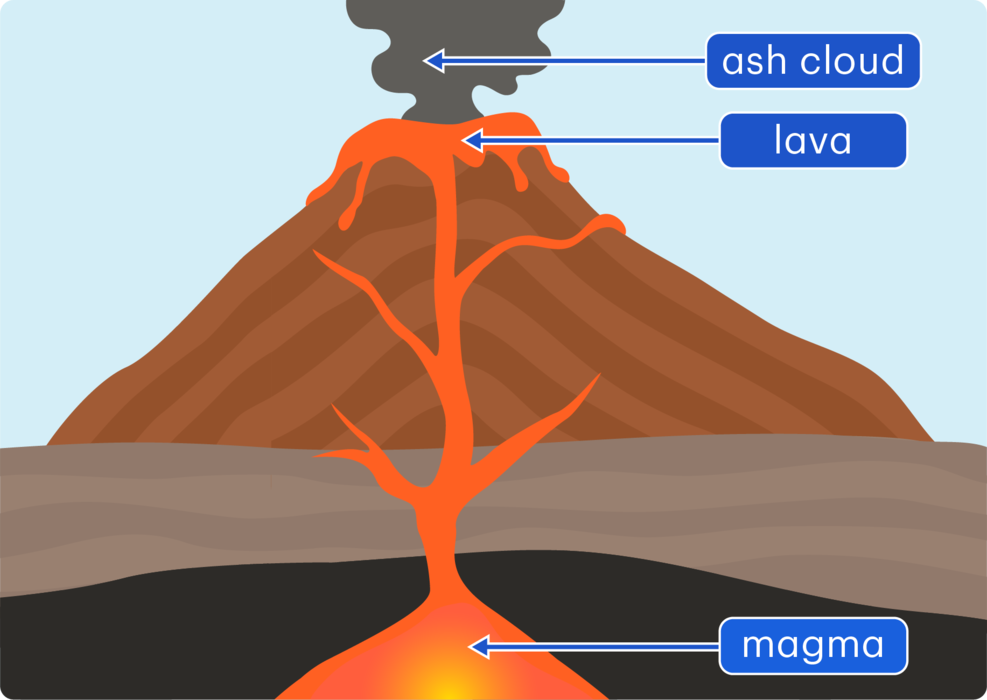
When molten rock cools and solidifies, it forms igneous rock. The size of the crystals in an igneous rock indicates how quickly it cooled.
- Magma that cools slowly underground produces an igneous rock with large crystals.
- Lava that cools quickly on the surface produces an igneous rock with small crystals, or no crystals at all!
Sedimentary rocks
Rocks at the surface are exposed to heating, cooling, wind, rain, flowing water, chemical attack, plants and animals. These influences slowly break down the rock in two ways:
- weathering is the breakdown of rock while it remains in the same place
- erosion is the wearing away and removal of rock
Together, weathering and erosion break rocks down into small pieces or particles, known as sediments. The particles range in size from mud and sand to pebbles and boulders. Weathering and erosion usually occur gradually, but they can happen quickly with the help of natural hazards. The 2015 Nepal earthquake caused the quick erosion of rocks by triggering landslides.
Sediments can be transported large distances by wind, rivers and ocean currents. They are eventually deposited in layers on the bottom of rivers, lakes and seas. Over thousands or millions of years, thick sequences of sediment form.
The lowest layers are:
- compacted by the weight of overlying material
- cemented together by new minerals growing in the spaces between grains of sediment
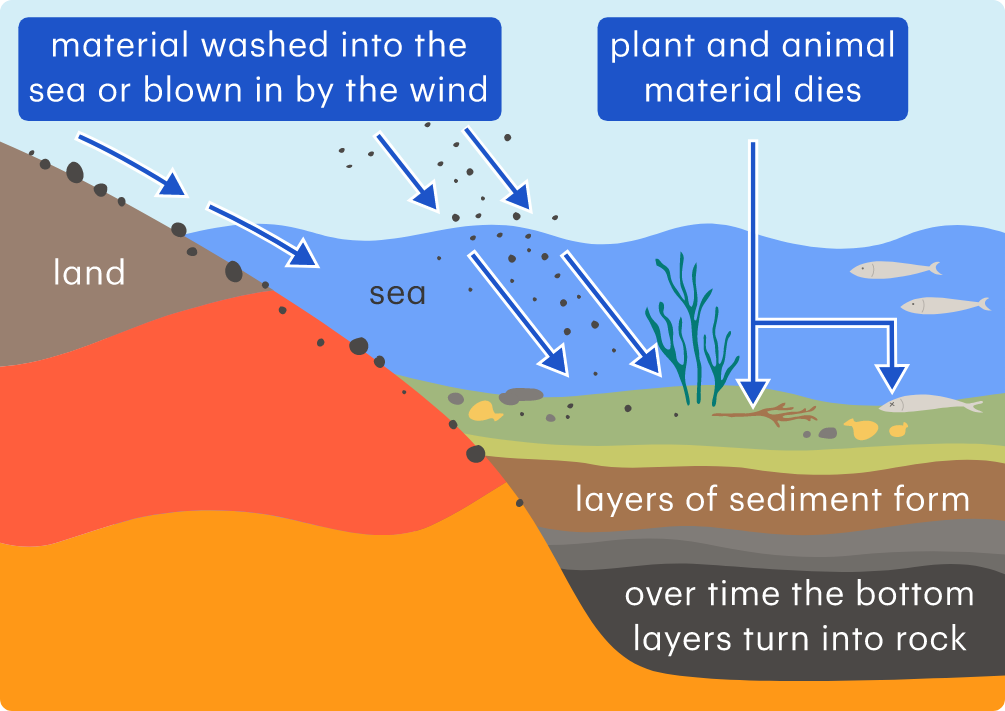
These two processes – compaction and cementation – turn the loose sediment into a single solid mass, forming sedimentary rock.
Sedimentary rocks can also form from the remains of living things. For example, limestone forms from shells and corals that collect on the ocean floor and are buried by sediments. Coal is a type of rock that forms in a similar way from the remains of dead plants.
Metamorphic rocks
High temperatures and pressures deep beneath the surface cause metamorphic rocks to form.
When a rock is put under these extreme conditions, the types of minerals that make up the rock change so a new rock has formed. The shapes and sizes of the crystals also change. As a result, metamorphic rocks are usually stronger than their original "parent" rocks.
The parent rocks of metamorphic rocks can be sedimentary, igneous or other metamorphic rocks. A few examples of metamorphic rocks being formed are shown in the diagram below. Gneiss (pronounced like "nice") can form from different parent rocks when they are subjected to very intense heat and pressure.