ELECTRON CONFIGURATION
Modern Electron Theory
Describes electrons using quantum mechanics; electrons occupy energy levels and orbitals, not fixed paths.
Atomic Spectroscopy
Energy absorption excites electrons to higher levels, releasing light of specific colors upon return.
Each element has a unique line spectrum; practical applications include fireworks and astronomy.
Bohr Model
Proposed by Niels Bohr (1913); electrons in specific orbits at certain distances from the nucleus.
Electron Cloud
Are space in which electrons are likely to be found.
Location of electrons depends upon how much energy the electron has.
Electron with the lowest energy are found in the energy level closest to the nucleus.
Electrons with the highest energy are found in the outermost energy levels, farther from the nucleus.
Wave Model
Based on wave mechanics; electrons do not follow definite paths.
Electron cloud indicates probable locations rather than precise paths.
Louis de Broglie (1924) suggested that not only light but also
matter (like electrons) behaves as a wave.
Electron microscopes
Can see objects much smaller than light microscopes because electrons have tiny wavelengths.
Heisenberg Uncertainty Principle
States that both position and momentum of an electron cannot be precisely determined simultaneously.
Describes electron locations as probability clouds.
Instead of sharp orbits, we talk about probability clouds—places where an electron is most likely to be.
Quantum Mechanics
The Schrödinger Model
• Erwin Schrödinger developed equations to describe electrons as
waves in 3D space.
These areas of high probability are called orbitals.
• Types of orbitals:
• s: spherical
• p: dumbbell-shaped
• d and f: more complex
• Each electron is described by four quantum numbers:
• Principal number (n) – the energy level or shell (1, 2, 3…).
• Angular number (l) – shape of the orbital (s, p, d, f).
• Magnetic number (mₛ) – orientation of the orbital in space.
• Spin number (mₛ) – spin direction (+½ or –½).
Quantum Numbers
Four quantum numbers describe electrons:
Principal (n): energy level
Angular (l): shape of orbital
Magnetic (m): orientation of orbital
Spin (s): direction of electron spin.
Pauli’s Exclusion Principle
No two electrons can have the same four quantum numbers; each orbital holds 2 electrons with opposite spins.
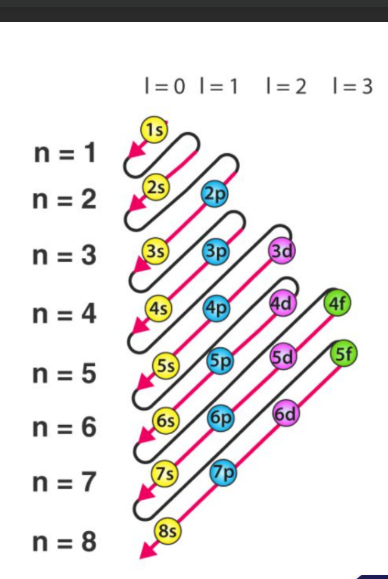
Aufbau’s Principle
Electrons fill lower-energy orbitals first; order of filling: 1s → 2s → 2p → 3s → 3p → 4s → 3d → 4p…
Hund’s Rule
Electrons fill orbitals of the same energy singly before pairing to reduce repulsion; stability increases.
Electronic Configuration
Represents the arrangement of electrons in an atom.
Notation rules follow Pauli's, Aufbau's, and Hund's principles.
Examples include:
Hydrogen (Z=1): 1s¹
Oxygen (Z=8): 1s² 2s² 2p⁴.
Summary
Atomic spectroscopy reveals unique electron movements and spectra.
Wave-particle duality described by De Broglie; uncertainty in electron location affirmed by Heisenberg.
Quantum mechanics defines electron behavior; theoretical principles guide orbital filling.
Electronic configuration aids in predicting chemical behavior based on arrangement.