Language Development - Chapter 7 p.244-254
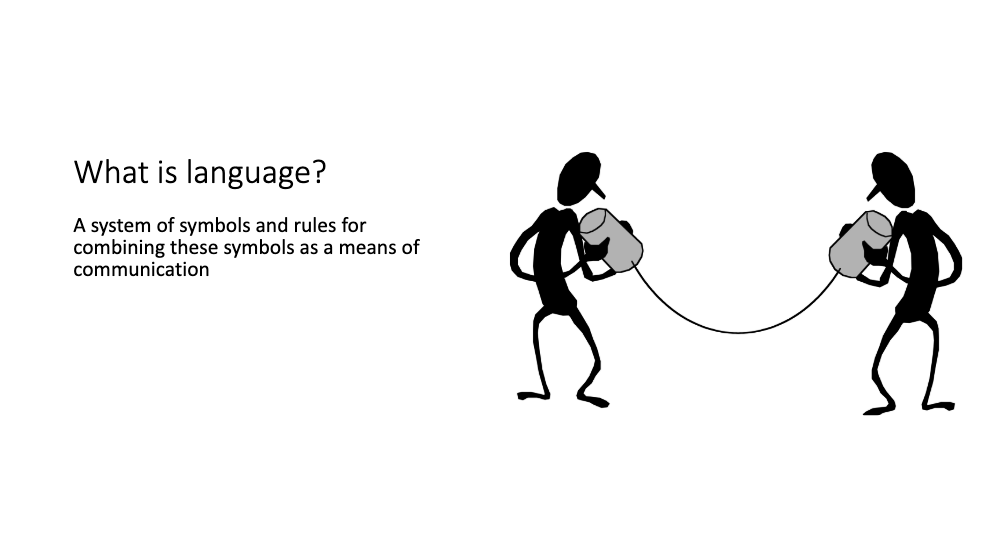
What is Language?
Four Important Properties of language:
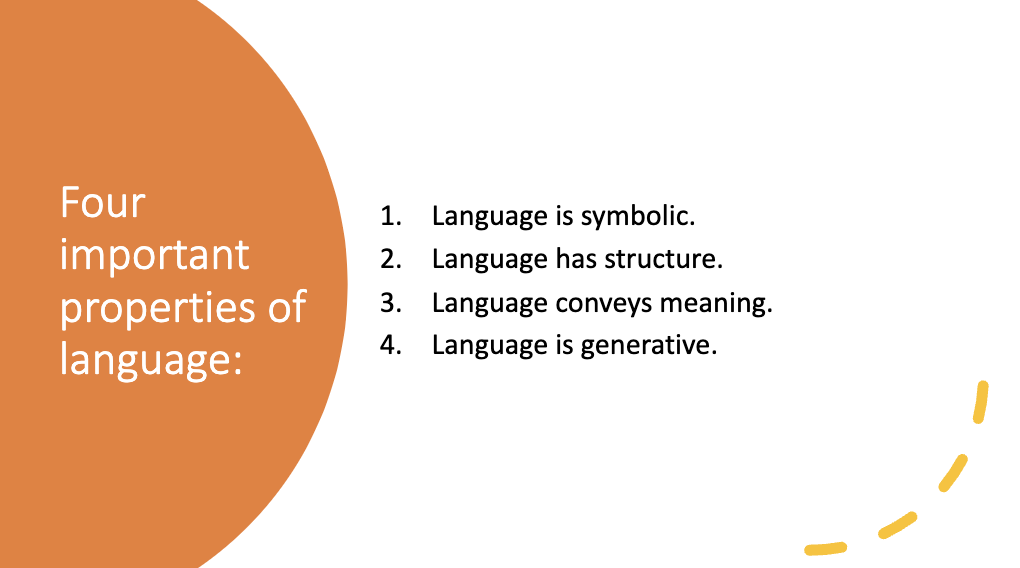
Language is symbolic
Language has structure
Follows a set of rules
The users of that language understand that set of rules
We understand things are more common then others
Language is generative
Language can be combined in new and novel ways to convey new or same ideas
Example: Our exams are not identical with each other, trying to convey the same set of ideas using different words and structures illustrates the flexibility of language
Language convey’s meaning
Theories of Language Development
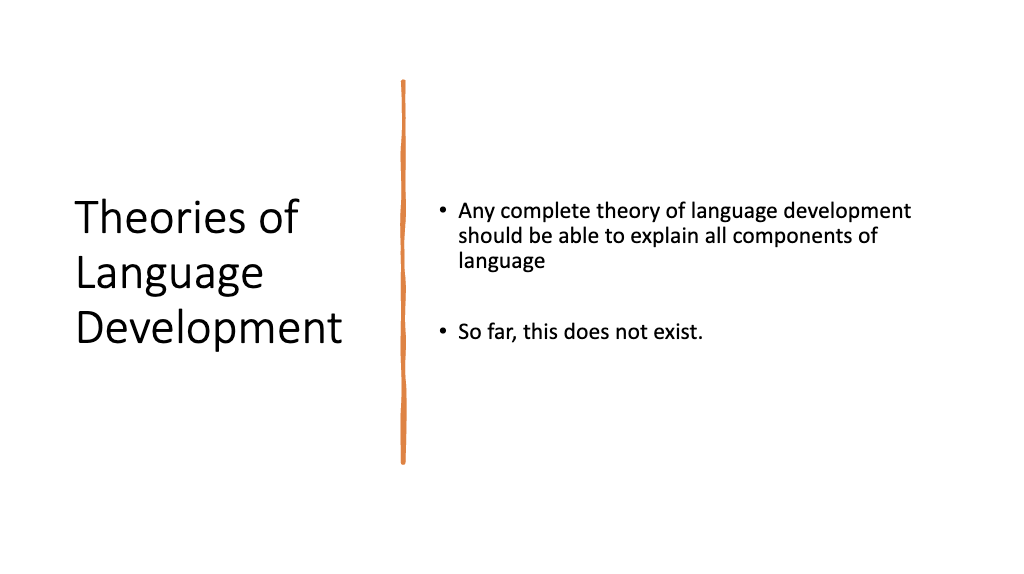
Complete theories should be able to explain all the components of language, but none of them really do
We are still trying to discover a theory of language linguistics
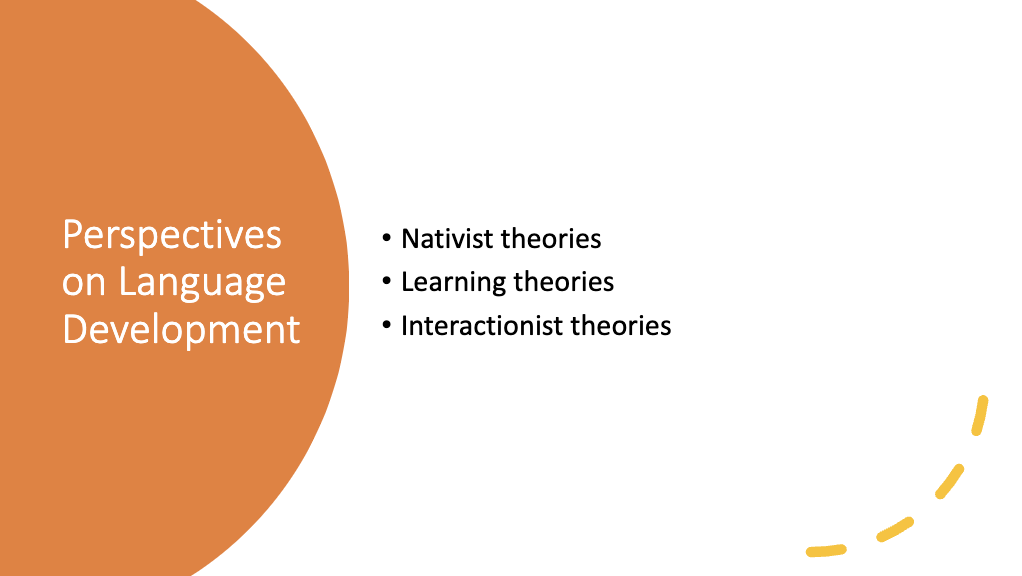
Perspectives on Language Development
The Child’s Task
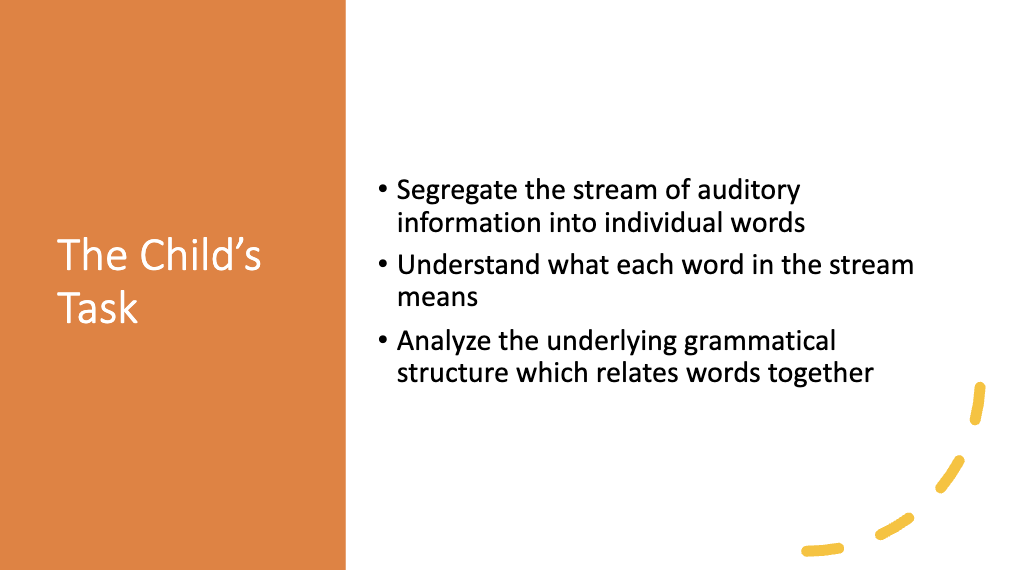
What is the language task in development?
Babies figure out segregating by the time they are 4-5 months
“Whata ya doing”
Babies have the problem of segregating sounds
Babies pull apart speech signals then convey meaning
The Structure of Language
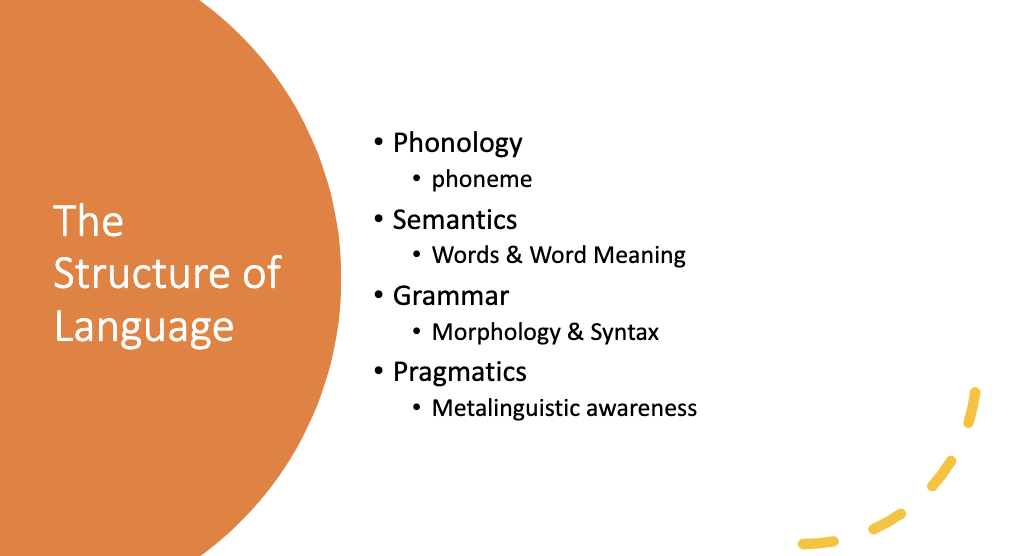
Phonology
Sounds of the language
Semantics
Meaning
Grammer
Rules
Pragmatics
The way in which language is used
Tendencies of the speaker
Inflections
Phonological Development
Systematic age related changes in the ability to perceive and produce the basic sounds of language
Language use basic sounds, it depends on the language
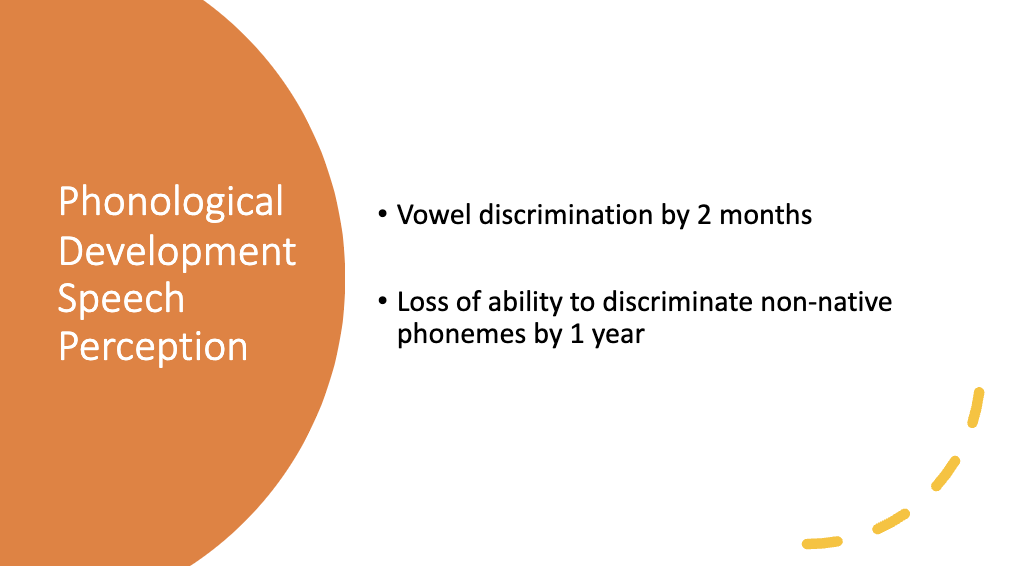
Phonological Development Speech Perception
Babies are able to discriminate the different vowel sounds by 2 months
Loss of ability to discriminate non native phonemes by 1 year
We tune into native language sounds and tune out languages we aren’t familiar with
Easier to be learn languages at a younger age
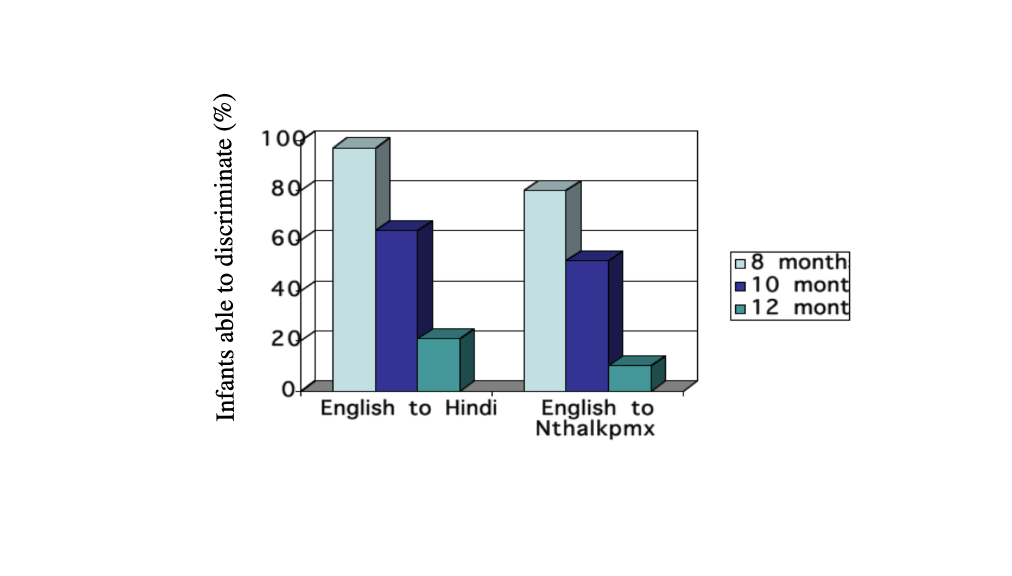
Chart
Discriminate between different vowel sounds
Babies growing up in english speaking homes, invite babies to come in to distinguish English vs. a different language
The number of invites to discriminate is high at 8 months and gets lower
8 month babies can distinguish all phonemes
By 12 months babies cannot distinguish there different phonemes
Younger infants 6 months are capable are hearing all the different phonemes but then over time they narrow down to their native phonemes
Phonological Development Speech Production
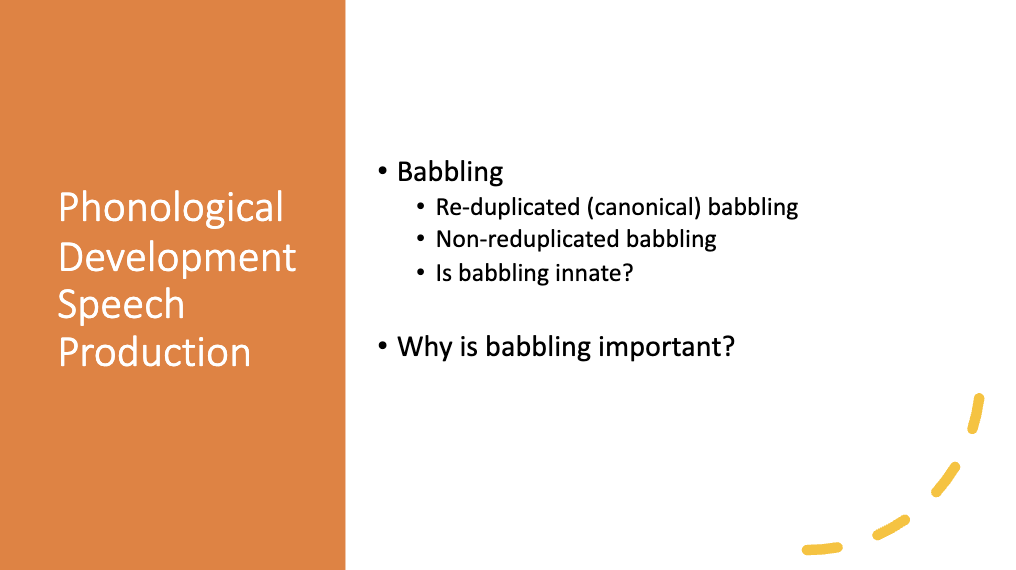
Babbling begins around 4-5 months
Canonical - repeated babbling starts first
Non reduplicated babbling
Start making vowel sounds
Cooing
Is babbling innate?
It is innate that has a universal timeline
Regardless of culture
Even with babies who are deaf also babble roughly around the same time points
Deaf infants have sign language as babbling as well
Being able to hear yourself hear these sounds helps
maintain babbling behaviour - this is reinforcing behaviour
Why is babbling important?
Babbling might help figure out the segmentation
Infants babble become more and more tune that are apart of their native language an decline phonemes that aren’t apart of their native language
Babbling becomes shaped by the people around them , reinforcing certain set of sounds
Nativist Theory & Phonology
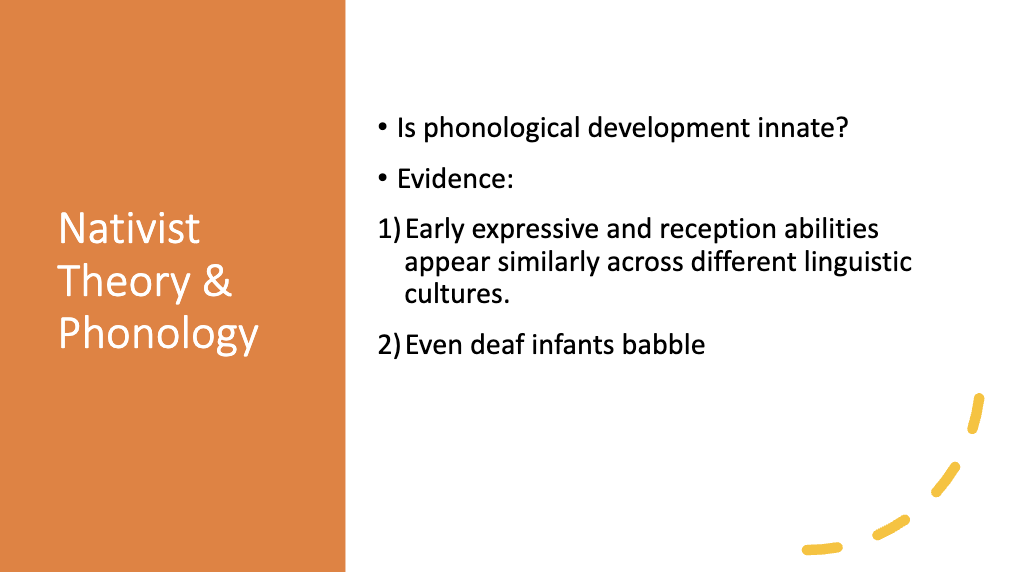
Innate piece around this development
Interactionist Theory and Phonology
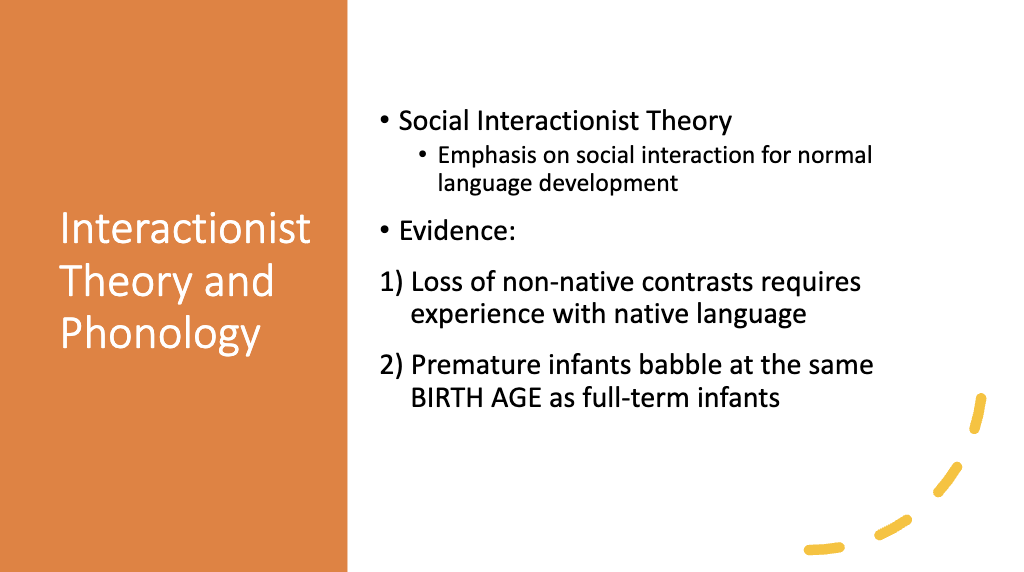
Innate components and experimental prices that shape development
Babies growing up in english households are set with english phonemes
The social interactions with their caregivers
Premature babies are born earlier and are similar to their gestational age
premature babies babble and have the same amount of experience compared to full term babies
They start babbling at the same time: about experience rather than time
Its about the auditory and experiences with people that hone this development
Semantic Development Learning Words
The learning of meaning
Comprehension of bunch of sentences
But it starts with comprehension of sub components of words
As early as 6 months
Jusczyk, 1999
Two screens one with a picture of mom and dad
In between the screens is a speaker, the baby might hear “mommy”
When the babies hears “mommy” they direct their heads to the picture of mom
Babies know the meaning of “mommy”
By 24-30 words they know the meaning to
Word learning happens in mother infant interactions
Mom is primarily at home with the baby
Mom and baby engage interactions: highlighting things in the environment
Drive infants attention to objects and word association to that object
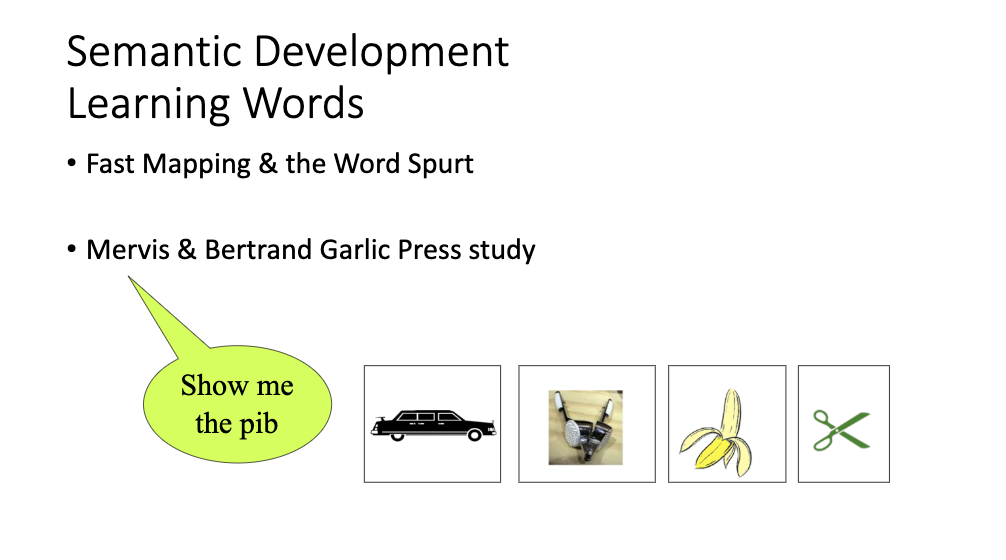
Fast mapping and the word spurt
The process of fast mapping allows infants to quickly learn and associate new words with their meanings, leading to a significant increase in vocabulary known as the word spurt
18-24 months
Mervis & Bertrand Garlic Press study
Process of exclusion/elimination to figure out word meaning
Babies are encountering objects they don’t know the name and meaning to but some objects they do
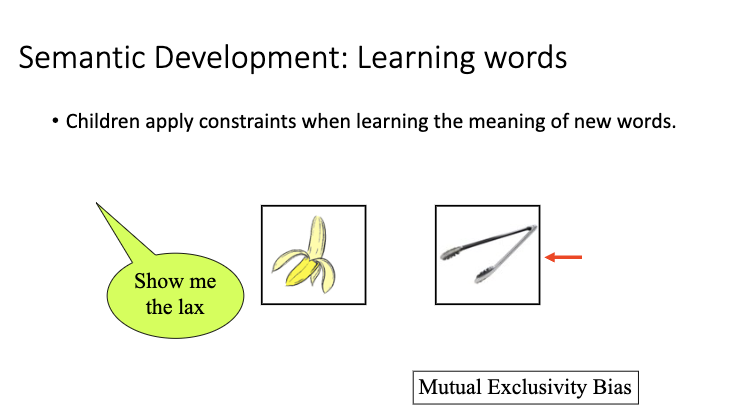
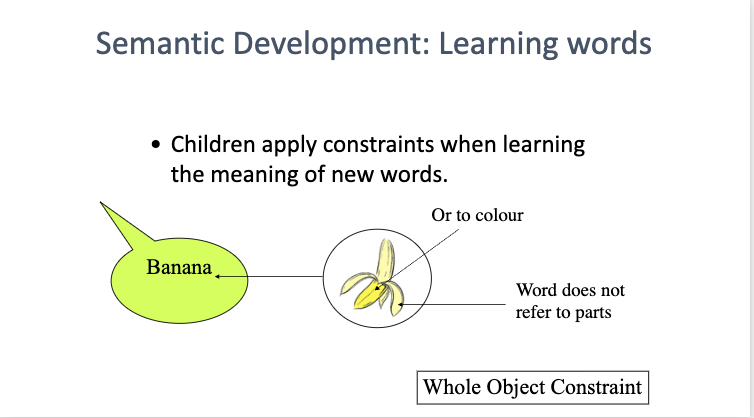
What are the constraints children are using?
Mutual Exclusivity
The assumption that each object has a unique name, leading children to infer that a new label must refer to an unfamiliar object.
Take the things you don’t know and link them together: One object has one label
Show me the lax
Example: If a know this is banana then this can’t be banana
Whole object constraint
the assumption that a word refers to the whole object rather than its parts or properties, which helps children limit their interpretations as they learn new vocabulary
This principle allows children to focus on understanding the entire object first, preventing confusion over individual attributes or subsets
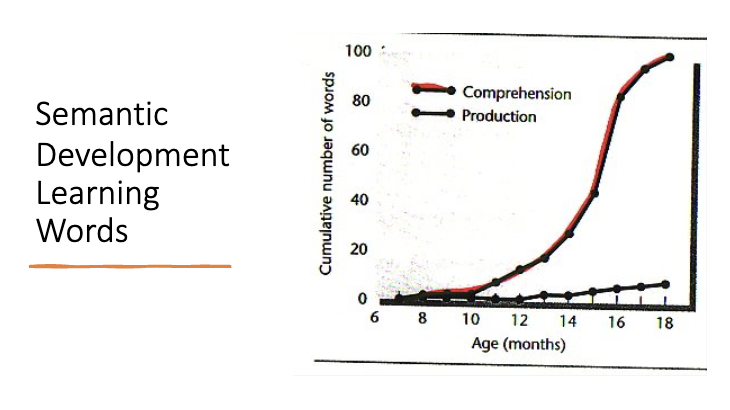
How do access what sin the mind when children are incapable of producing the production part
Redline refers to children’s comprehension of words: what they are understanding
The bottom flat line refers to production: what they are saying at loud
Example: People who understand a second language but are unable to speak the language
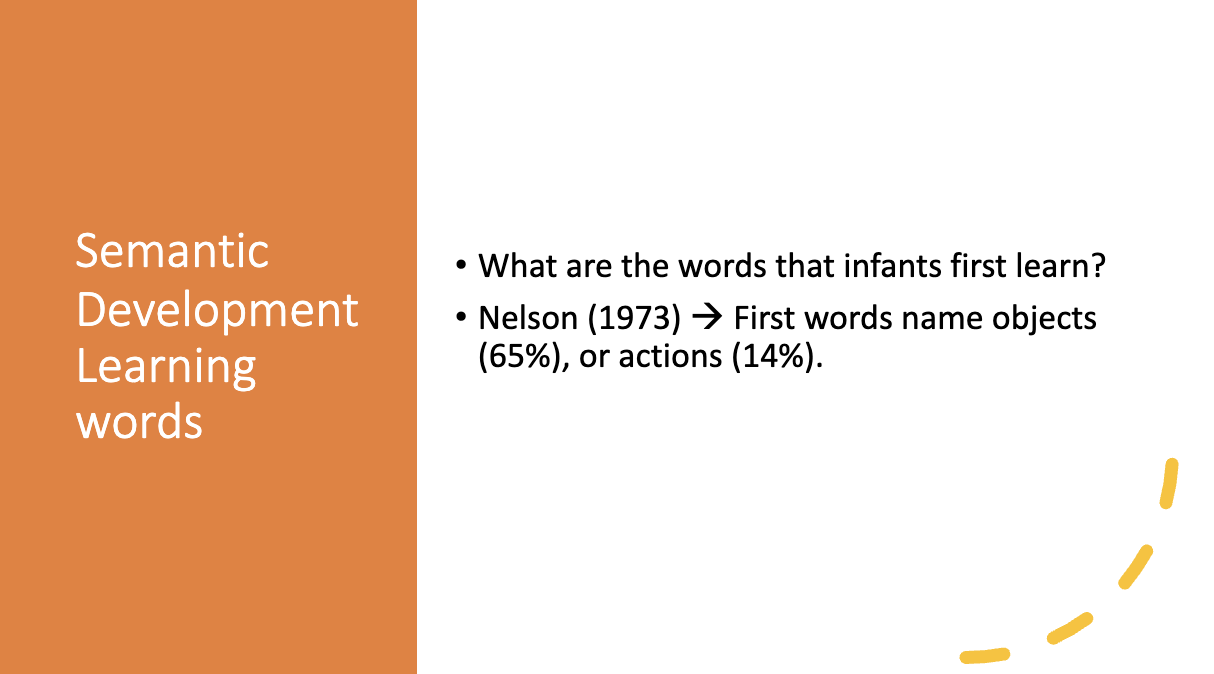
What are the words that infants first learn?
Nelson, 1973
preschoolers, wrote down things they were saying
He found that most first words in early development were nouns: names of objects and then verbs: action words
What does that tell us?
Kids can point out different objects
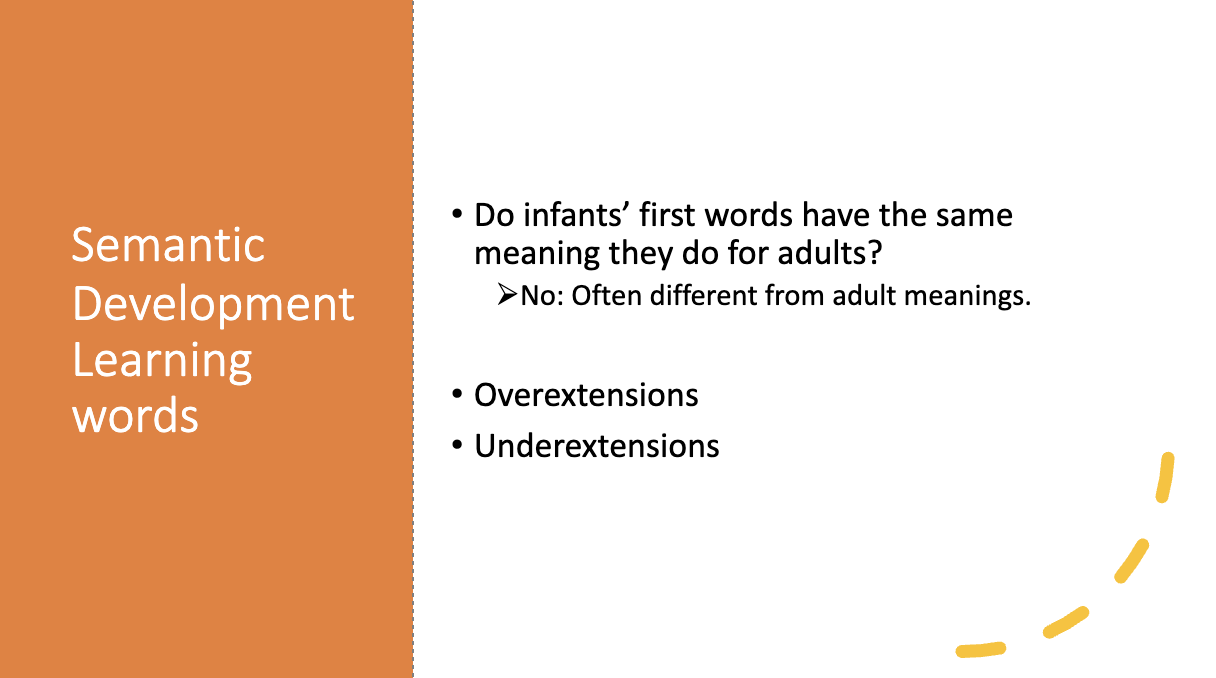
Do children have the same understanding of the meaning of words compared to adults?
No they do not
Overextensions
children often apply a word too broadly, using it to label objects that may not fit the adult definition, which indicates their developing understanding of language
Anything that is four legged and furry is a dog
Example: Over using the word dog
Under extensions
Children may fail to use a word for a broader category, applying it too narrowly to specific instances, which shows their ongoing process of learning and refining their vocabulary. Example: Referring to only their own pet as a "dog" and not recognizing other dogs as part of that category
Example: A child may understand they have a dog at home but it’s limited to that
Children are trying to figure out trying to figure out the word, compare to adults who understand categories of objects and things
Nativist Theory & Semantics
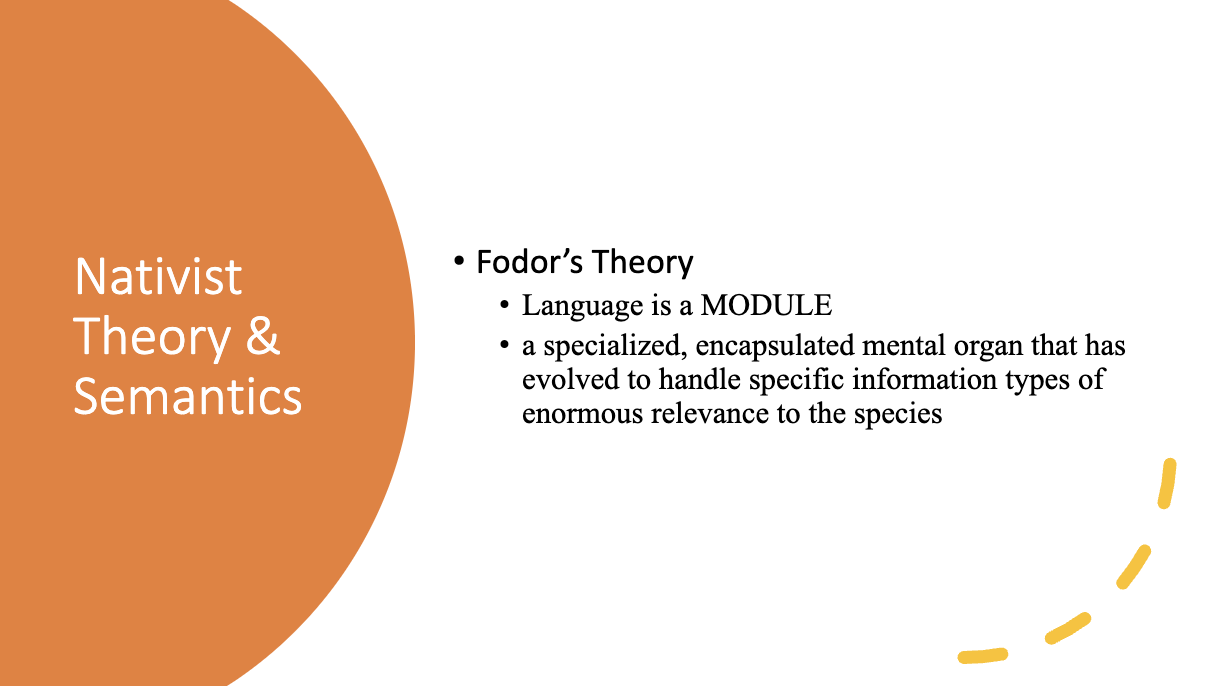
Fodor’s Theory:
Fodor's Theory posits that humans have an innate capacity for language, suggesting that our understanding of semantics is deeply rooted in the cognitive structures that allow us to categorize and interpret the world around us
Language is larger part of cognition
There are different module sets and they come from our genetics
Language is an important piece of human species
Learning Theory & Word Learning
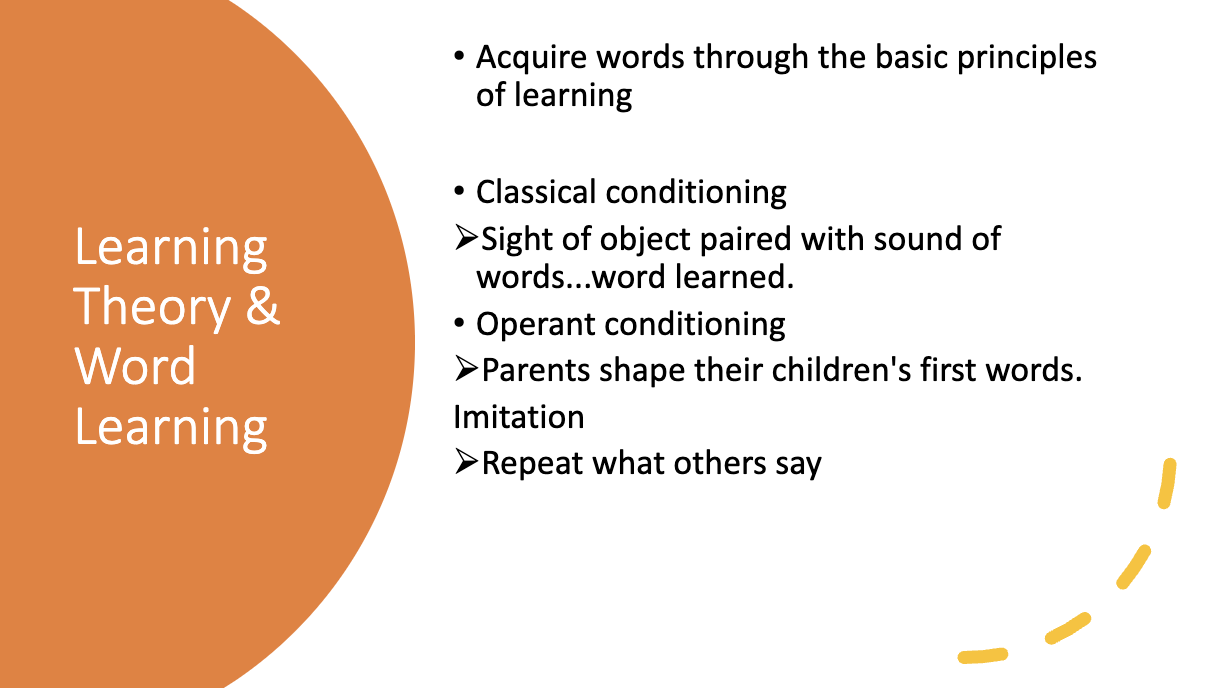
Classical Conditioning
Example: Seeing a banana and the sound “banana” creates a connection in association to each other
Imitation
Hearing language around them
Nativist and Nurturing learning
Neither are happening and both are happening at the same time
Grammatical Development Two Word Utterances
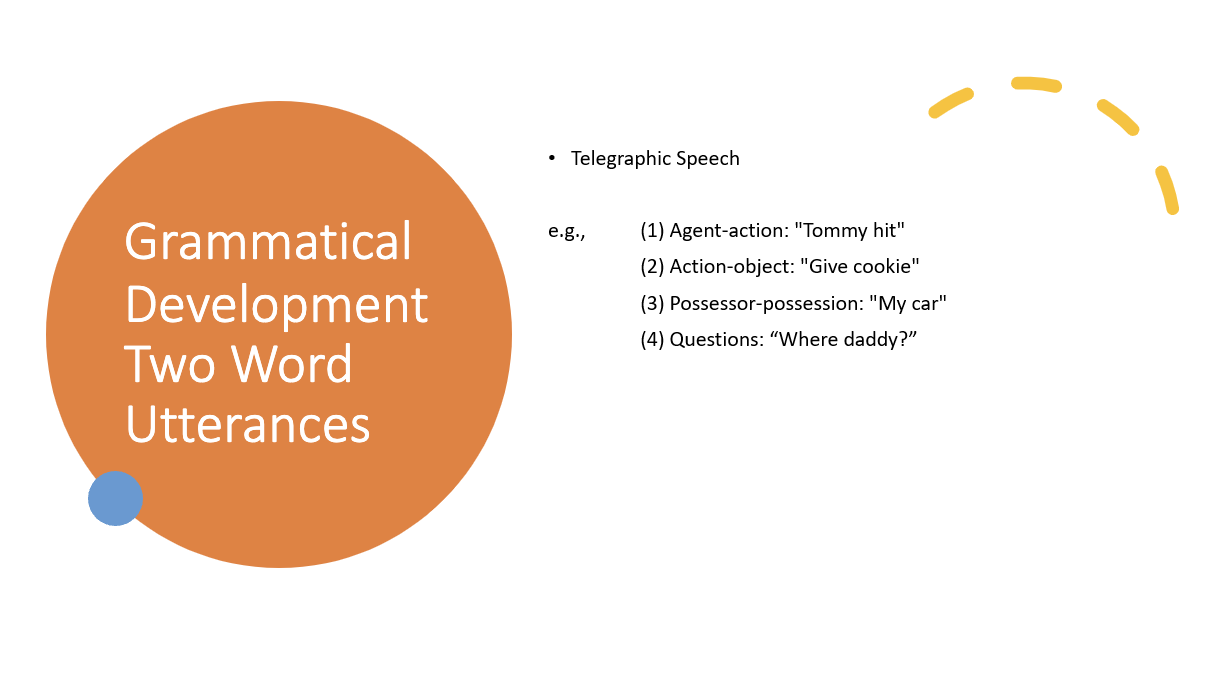
Telegraphic Speech
This stage of language development typically occurs around the age of two, where children begin to combine words into short, simple sentences that convey essential meanings, often omitting less critical words
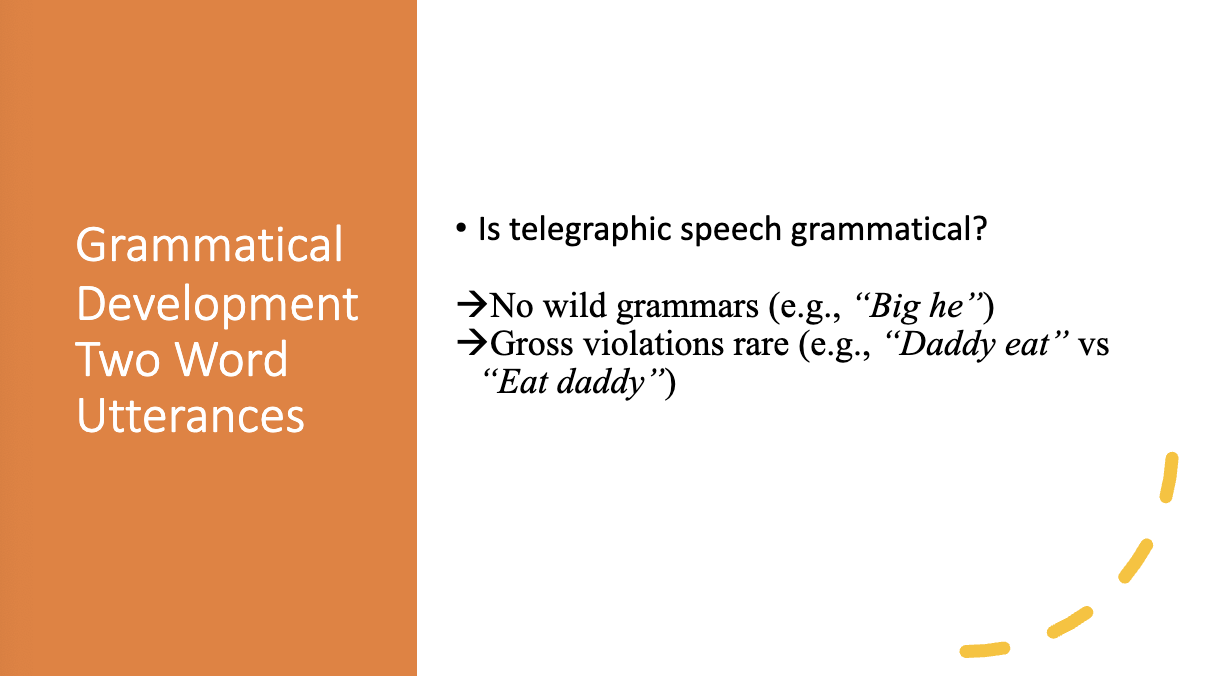
Telegraphic speech is grammar
Grammatical Development Morpheme Acquisition
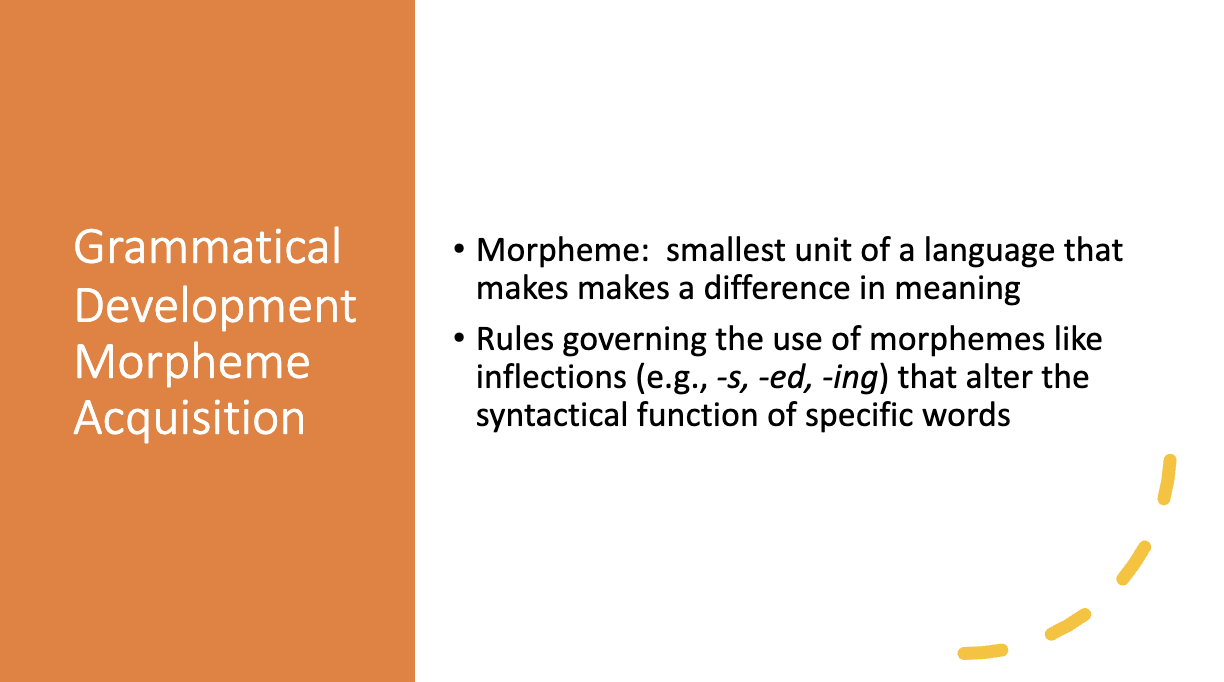
Morpheme
Sets of phonemes
Example: Like the letter “S” is a sound and is used to add plural meaning
Constraints to how we use morphemes
Constraints to the Development of Grammar
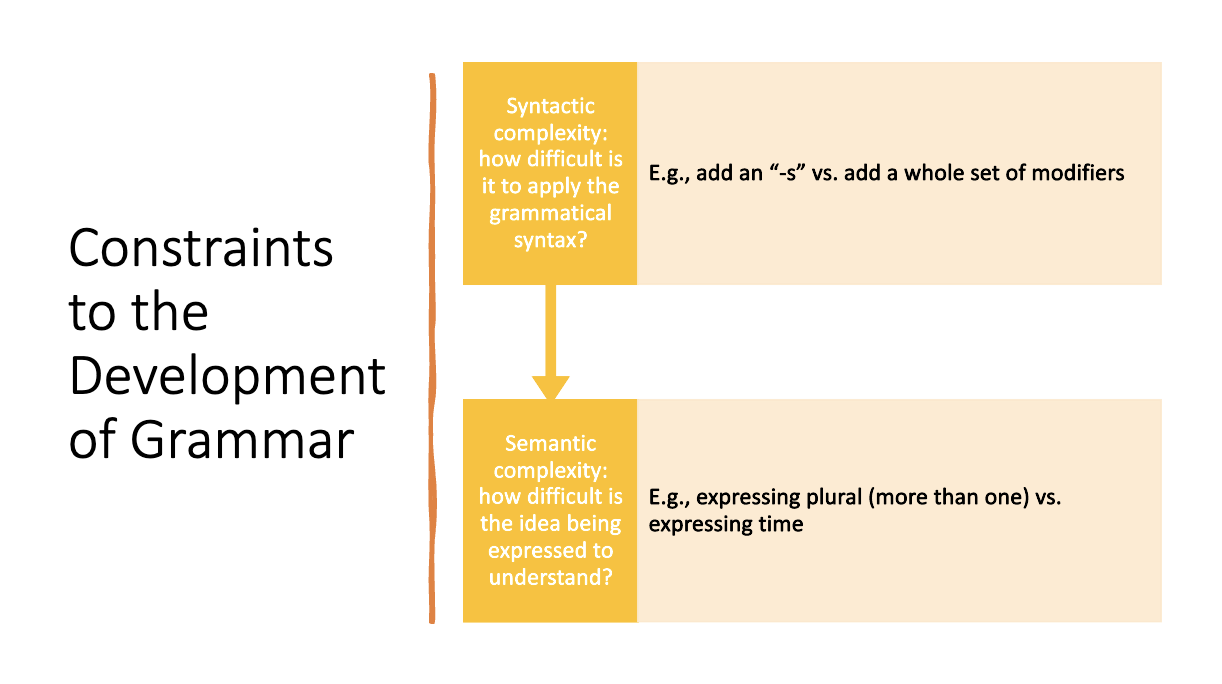
Syntactic Complexity
How hard is it to do and apply the grammatical piece
Example: Adding an “S” to make something plural in English or in Cantonese you must add a word to indicate plurality
Semantic Complexity
This refers to the difficulty in understanding and using words that have multiple meanings or require nuanced interpretations, which can hinder a child's ability to grasp more advanced grammatical structures
For instance, the word "bat" can refer to a flying mammal or a piece of sports equipment, and understanding the context is crucial for children to use such words correctly in sentences
Past tense: When children learn to use past tense forms of verbs, they must navigate the semantic complexity of irregular verbs, which do not follow standard conjugation rules, such as 'go' becoming 'went' instead of 'goed'
Our understanding of the world comes through language
Grammatical Development Exceptions to the Rule
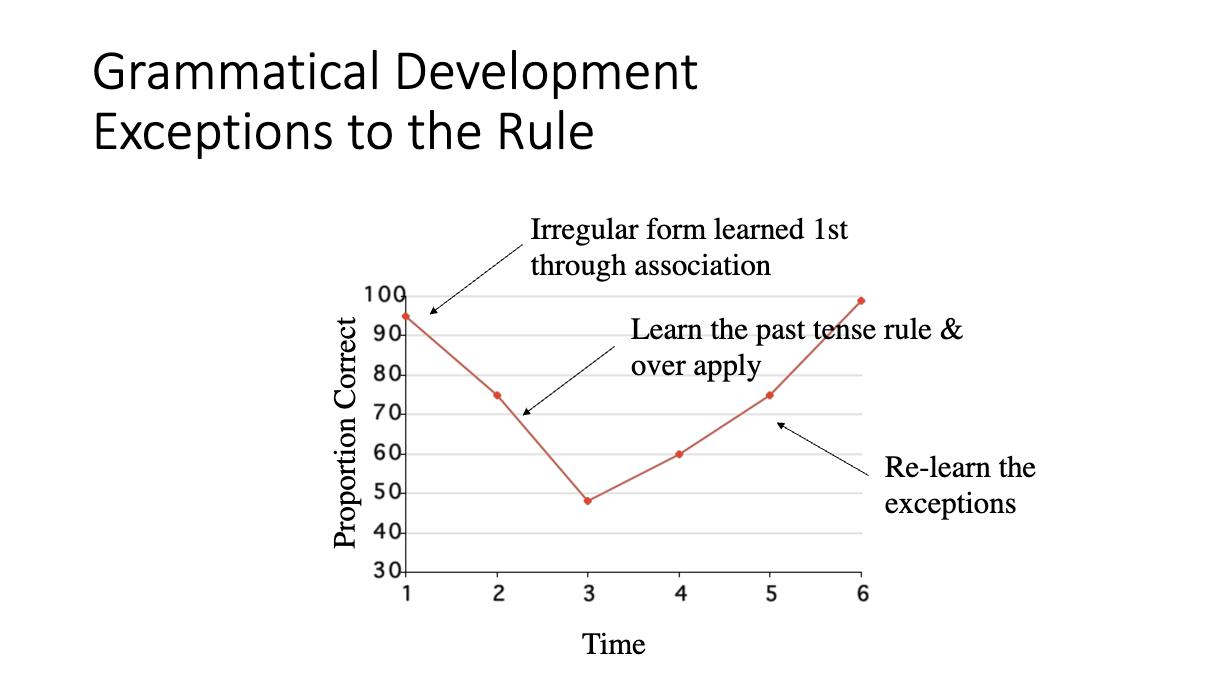
Challenges to which the children acquire morphemically changes
How do children have an understanding to irregular usage of the language?
Imitation
Nativist Theory & Grammar
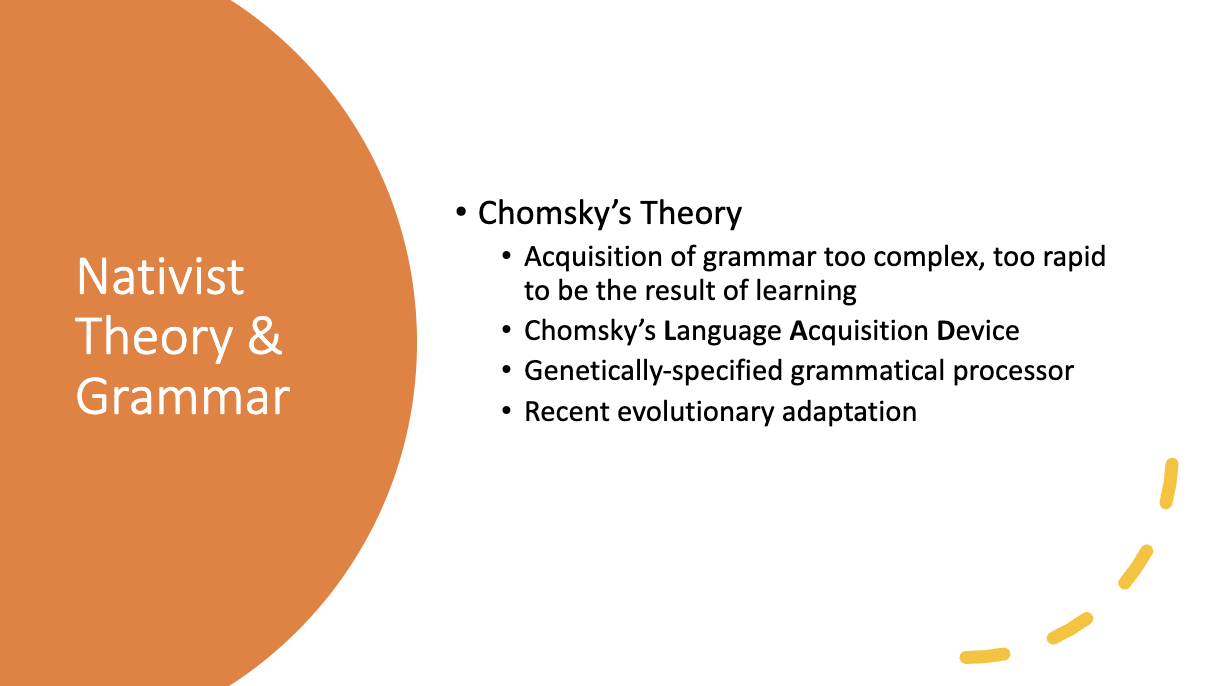
Chomsky’s Theory
Genes play a crucial role in language acquisition, suggesting that humans are biologically predisposed to develop language skills (as children don’t have time to learn language through experiences)
Evolutionary adaption
Evidence for Innate Origins of Language (Chomsky’s Theory)
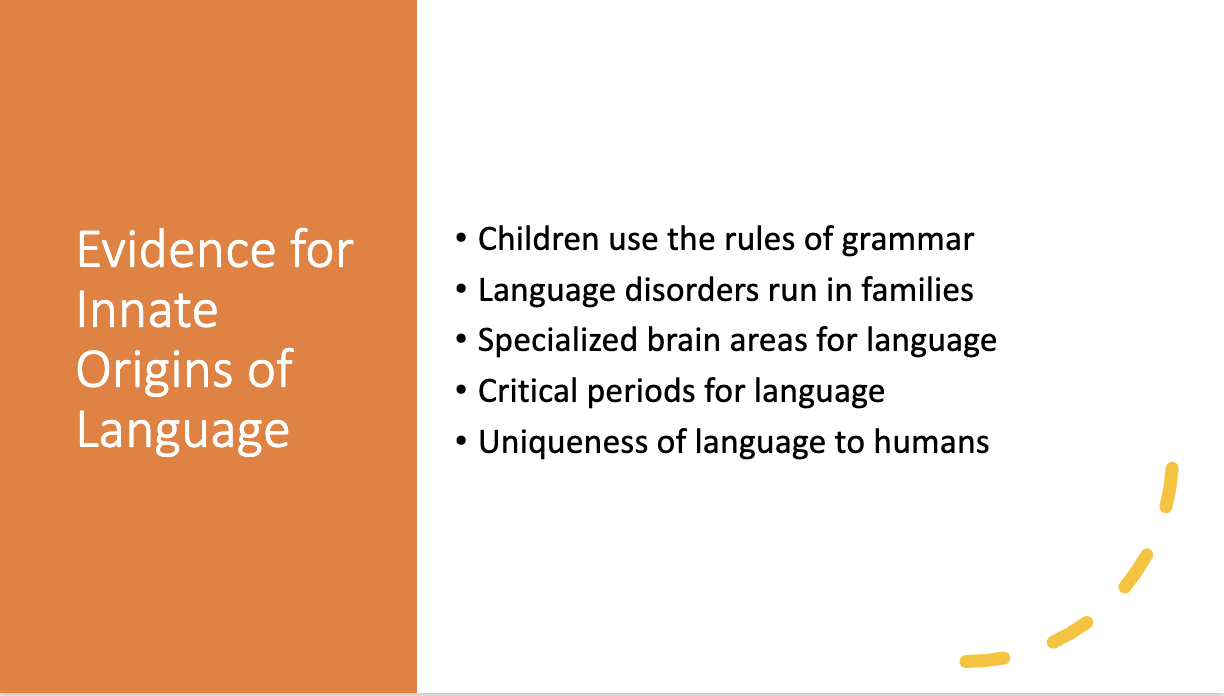
Children use grammar, children have the grammar already
Language disorders run in families
Specialized anatomy in our brain to process language
Critical period for language
The critical period for language acquisition is a time frame during which children are particularly receptive to learning language, typically occurring from birth until around age seven
Genie case: a well-known example of a child who missed this critical period due to severe isolation, highlighting the challenges faced in language development when exposure is delayed
Uniqueness of language to humans
Unlike other forms of communication found in the animal kingdom, human language is characterized by its complexity, use of syntax, and ability to convey abstract concepts.
A set of families related to each other in the Ozark
Isolated from people
language disorder in grammatical morphemes
We can pass down a language disorder (supports Chomsky’s theory)
Challenges to Nativist Theory - Chomsky’s Theory

Children use rules of grammar - How do we know children understand grammar?
Pinker
Set of studies
Presented nonsense scenarios and put them in contexts where children had to apply grammatical rules, demonstrating their innate understanding of sentence structure4
Testing them in the plurality of the scenarios revealed that even when faced with unfamiliar words, children were able to correctly apply rules of pluralization, indicating a deep-seated grammatical competence
Senatatic boot strapping: this theory suggests that children use their innate grammatical knowledge to make inferences about the meanings of new words based on their syntactic roles in sentences
Example: “Riked” not a real word but children understanding how to use the word
Learning Theory and Grammar
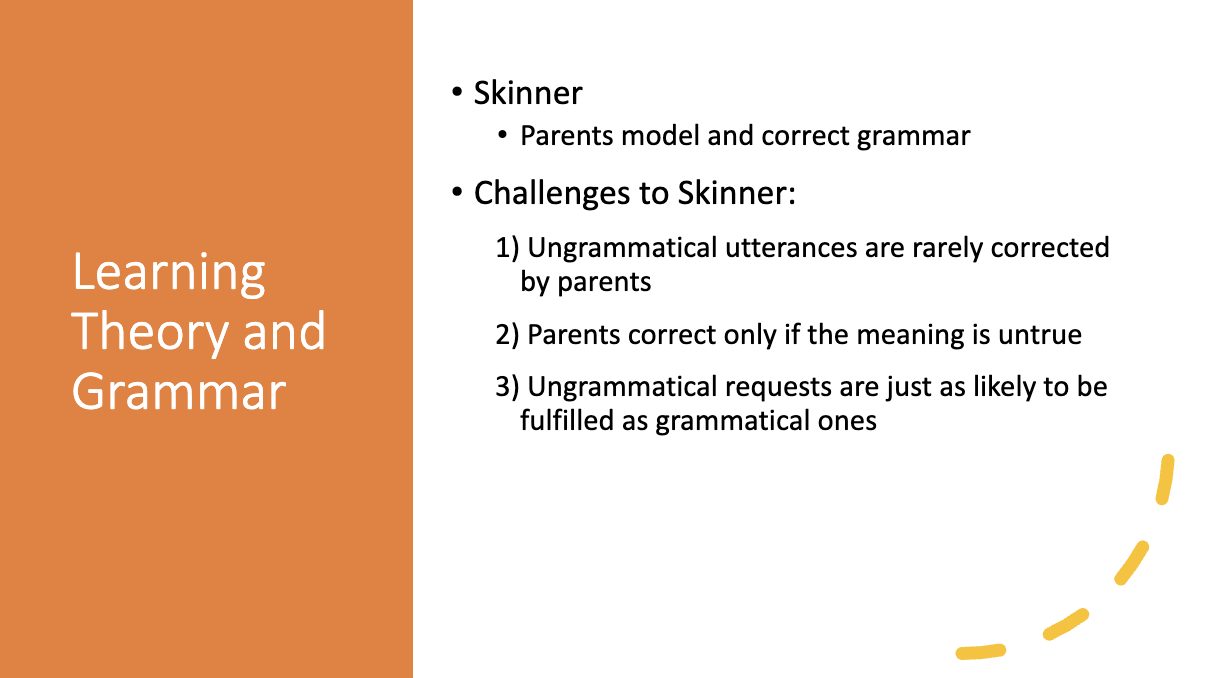
Skinner
Own theory of language
Proposed that language acquisition occurs through operant conditioning, where reinforcement and imitation play crucial roles in the development of speech
Too reliant on caregivers
Parents rarely correct grammar
Parents care more about meaning
Theory is too focused on too reliant on caregivers
Example: Parents don’t deny a child a cookie if they misuse grammar
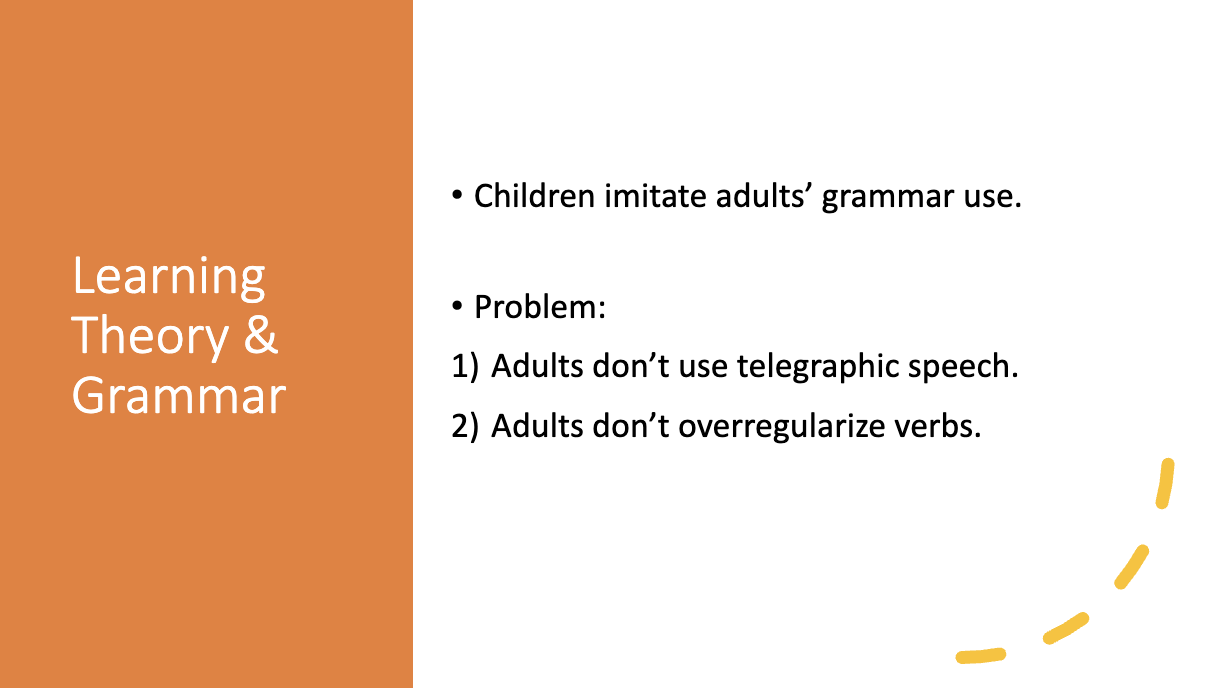
Challenges to Skinner’s Theory
Chomsky is dominant in the language field
There are Specialized brain regions for language
Broca’s area
Crucial for speech production and language processing, enabling individuals to form grammatically correct sentences.
Lesions: people have the ability to understand whats happening but don’t have the language capacity to produce
Wernickes’s area
Responsible for language comprehension, allowing individuals to understand spoken and written language, but damage to this area can result in fluent but nonsensical speech
Primary auditory
This area processes auditory information, playing a crucial role in the perception of sounds and the ability to differentiate between various phonetic elements essential for language acquisition
Word salad
A term used to describe a condition where speech is grammatically correct but lacks meaningful content, often resulting from damage to specific areas of the brain involved in language processing
Development of Function
Formal questions asked
What is the purpose of language in communications?
Pragmatics
Pragmatics refers to the context-dependent aspects of language use, including how meaning is constructed in social interactions and the influence of cultural norms on communication
Development of Function Pragmatics
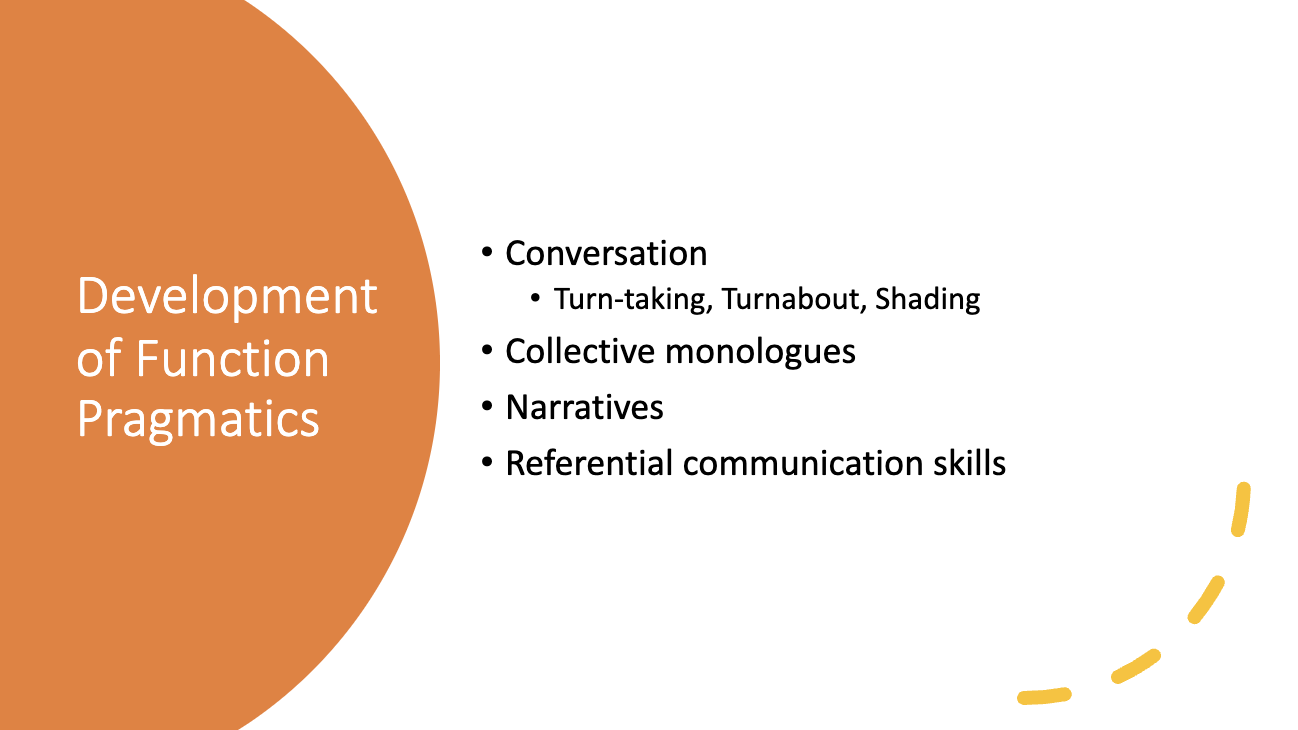
Conversations are social interactions
Turn-taking (you say something the other person says something)
Turnabout: a strategy used in conversations where one speaker acknowledges or builds upon what the previous speaker said, promoting deeper dialogue and understanding
Shading: a technique where speakers subtly adjust their tone, volume, or speed to convey emotions or emphasize points, which can enhance the effectiveness of communication, thats of deflecting attention away from oneself while still engaging in the conversation
Collective Monologue: a situation where participants in a conversation speak at the same time without truly engaging with one another, often resulting in parallel discussions that lack meaningful interaction
Narratives: a storytelling technique that allows individuals to share personal experiences or imaginative tales, fostering connection and empathy among listeners while facilitating language growth
Referential communication skills: The ability to indirectly convey information
Infants need to learn about the social dynamics on how we talk to each other
Mom and baby spend a lot of time together, building a non verbal connection: The baby quickly learns that when they admit coos and babbling they enter a type of conversation typically with their Mom
Mom’s who talk a lot to their babies increase babies vocabulary before they enter school
Turn-taking: Mom starts pointing at objects and labelling them
Development of Function Modulating Other’s Behaviour
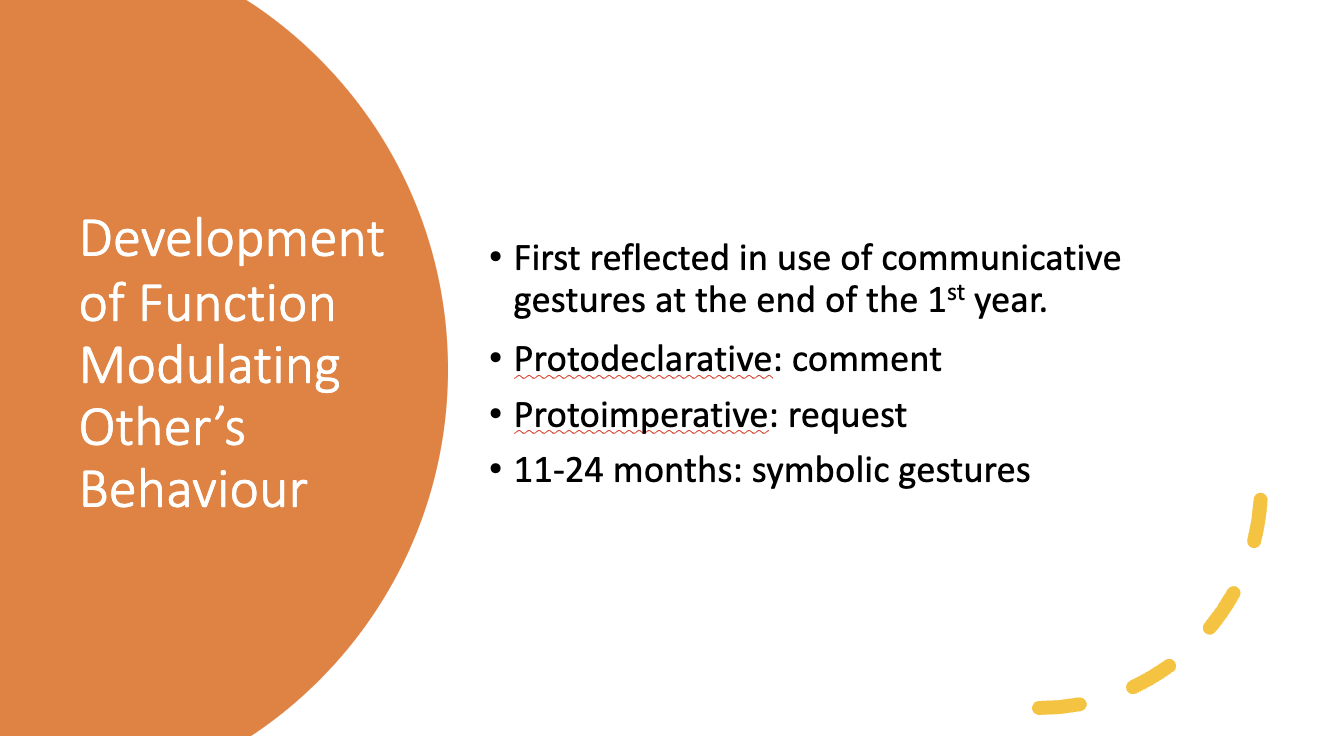
Infants use gestures to communicate
Protodeclarative: Comment
Pointing at things
“Interesting things I want you to attend to this thing that I’m alos attending to”
Protoimperative: Request
Requesting someone to give them the object or to help them achieve a goal, such as "Get that!" or "Help me!"
“Pointing at a cookie jar, I want a cookie”
Gesturing to be picked up
11-24 months: Symbols gestures
Universal gestures: pointing, gesturing to be picked up
Development of Function Modulating Others’ Thoughts
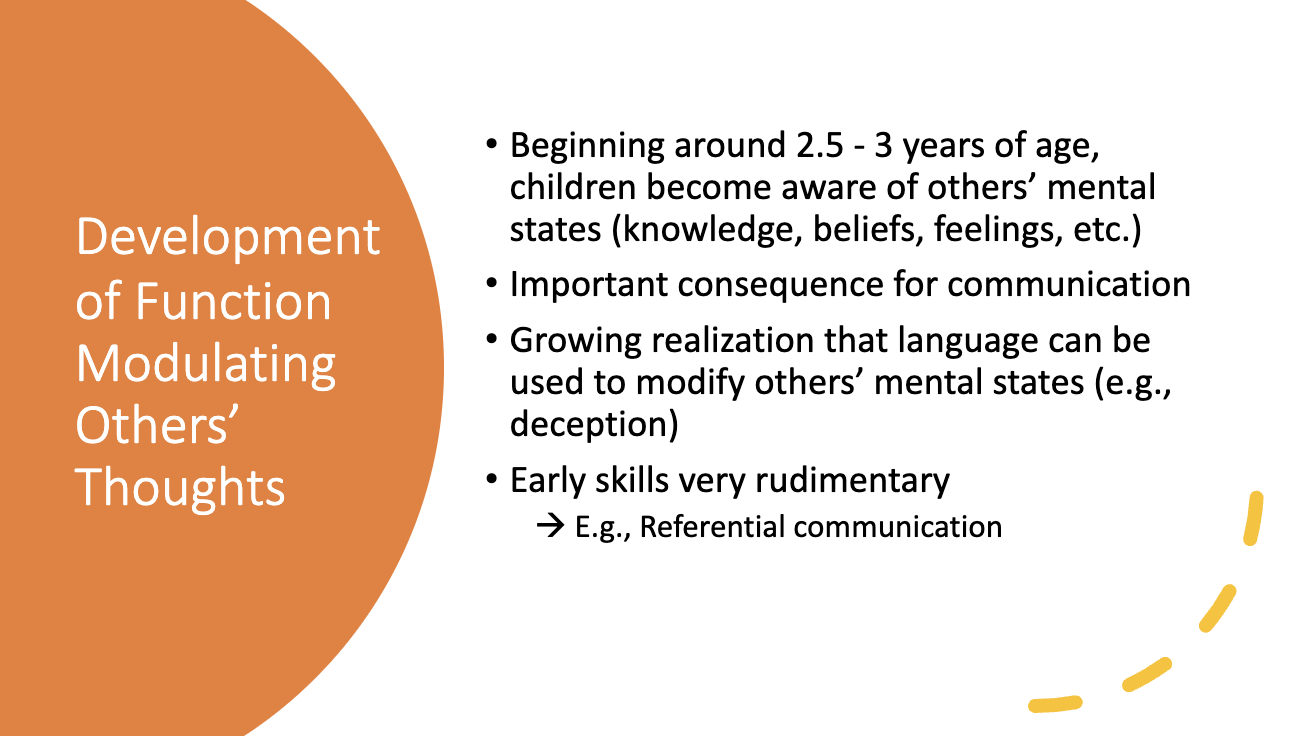
Piaget (sensorimotor/pre-operational): Egocentric
Textbook
The Origins of Language Development
Language Acquisition
Identify the major perspectives on language acquisition and summarize the strengths and weaknesses of each
Three major approaches have guided thinking on language acquisition:
One is based on learning theory
The second centers on innate and genetically determined capabilities
Third represents a combination of the first two approaches
Learning Theory Approach (Language as a learned skill)
The theory that language acquisition follows the basic laws of reinforcement and conditioning
Example: A child who articulates the word “da” may be hugged and praised by their father, who jumps to the conclusion that they are referring to him, this reaction reinforces the child, who is more likely to repeat the word
Children learn to speak by being rewarded for making sounds that approximate speech
Through the process if shaping, language becomes more and more similar to adult speech
Cons:
With the learning approach, it doesn’t seem to adequately explain how children acquire the rules of language as readily as they do
Example: Young children are reinforced when they make errors
Parents are apt to be just as respon- sive if their child says, Why the dog won’t eat? as they are if the child phrases the question more conventionally (Why won’t the dog eat?). Both forms of the question are understood correctly, and both elicit the same response; reinforcement is provided for both correct and incorrect language usage
Children can apply linguistic rules to nonsense words
In one study, 4 year old children heard the nonsense verb “to pilk” in the sentence “the bear is pilking the horse”
Later, when asked what was happening to the horse, they responded by placing the nonsense verb in the correct tense and voice”He’s getting pilked by the bear”
Nativist Approaches: Language as an Innate Skill
Nativist Approach
The theory that a genetically determined, innate mechanism directs the development of language
According to Chomsky, people are born with an innate capacity to use language, which emerges, more or less automatically, through maturation
Universal grammar: A similar underlying structure shared by all the world’s languages, according to linguist Chomsky
In this view, the human brain is wired with a neural system called language acquisition device (LAD)
A neural system of the brain hypothesized to permit understanding of language structure and provide strategies for learning the particular characteristics of a language
Language is uniquely human, made by a genetic predisposition to both comprehend and produce words and sentences
Cons
Some researchers argue that certain primates are able to learn at least the basics of language, an ability that calls into question the uniqueness of the human linguistic capacity
Some critics believe that infants use of general cognitive abilities underlies their language learning
The Interactionist Perspective on Language Development
Neither the learning theory nor the nativist perspective fully explains language acquisition
Some theorists have turned to a theory that combines both schools of thought
The interactionist approach to language development suggests that language development is produced through a combination of genetically determined predisposition and environmental circumstances that help teach language
The interactionists perspective accepts that innate factors shape the broad outlines of language development
However interactionists also argue that the specific course of language development is determined by the language to which children are exposed and the reinforcement they receive for using language in particular ways
Social factors are considered to be a key to development because motivation provided by ones membership in society and culture and one’s interactions with others lead to the use of language skills
How are Language and Thought Related?
Compare and contrast the different theories about the relationship between language and thought
Linguistic relativity hypothesis
The theory that language shapes and may determine the way people of a given culture perceive and understand the world
The hypothesis suggest that language provides categories that help children construct their perceptions of people and events in their surroundings, in short the notion is that language shapes and produces thinking
The view that language shapes and produces thought is not the only plausible sequence however
Consider an alternative: that inside of language being the cause of thought, the relationship works in the opposite direction, with language being the result of thinking about the world in particular ways and undergoing certain experiences, in this view thought produces language
The view that thinking shapes language is consistent with Piaget’s views of the development of language
Piaget argued that the emergence of symbolic function (the ability to use mental symbols, words, and objects to represent something that is not physically present) during the pre-operational period is a key aspect of development of language skill
Some developmentalists reject both the view that language shapes thought and the view that thought shapes language
Instead they support an intermediate position; that language and thought are intertwined and influence one another
Example: Vygotsky argues that although in the early stages of life, language and thinking develop independently
By age two they become interdependent
More precise thought leads to better language
As children develop more advanced cognitive abilities (such as categorization, problem-solving, and memory), they can express themselves more clearly and accurately.
For example, a toddler who initially calls all four-legged animals "dog" will, with cognitive growth, learn to distinguish between "dog," "cat," and "horse" as separate categories, refining their language
More advanced language enables deeper thought
As children learn more words and grammatical structures, they can think in more complex ways.
For example, learning words like "before," "after," or "because" helps children understand and articulate relationships between events, improving their logical reasoning.
Mastery of abstract words (e.g., "justice" or "freedom") allows for more complex, conceptual thinking that would be difficult without language
Example: Imagine a child learning about numbers. At first, they might just recognize "one," "two," and "three." But as their cognitive skills develop, they begin understanding patterns and relationships like addition and subtraction. This, in turn, allows them to use more complex language—moving from "I have more" to "I have two more than you."
Connection to Theories
Vygotsky’s sociocultural theory strongly supports this idea, arguing that language is not just a tool for communication but also shapes thought itself
Piaget viewed language as a reflection of cognitive development but believed thought develops independently before language plays a major role
The Inuit language (which includes several distinct dialects) has no more words for “snow” than does the english language
Language Shapes Thought (Linguistic Relativity Hypothesis)
This view, associated with Sapir-Whorf Hypothesis, suggests that the language we speak influences how we think and perceive the world.
Evidence supporting this idea:
Language influences how we store and retrieve information in memory.
The words we have available (linguistic categories) affect how we evaluate and categorize people (Gleitman & Papafragou, 2005; Casasanto, 2008).
Example: Some languages have multiple words for colours (e.g., Russian has separate words for light and dark blue), and speakers of those languages may perceive colour distinctions more clearly than speakers of languages with fewer colour terms
Thought Shapes Language
This perspective argues that cognitive development drives language acquisition rather than the other way around.
Supporting evidence:
Children’s first words are shaped by their experiences, regardless of the language they speak (e.g., most babies first learn words for “mom,” “dad,” food, and animals).
People can perceive differences in color even if their language lacks specific words for them (Rosch, 1974; Zhang et al., 2007).
Example: Even if a language doesn’t have a distinct word for “turquoise,” speakers can still recognize and differentiate it from blue or green
Thought and Language Influence Each Other (Reciprocal Relationship)
This perspective, often associated with Vygotsky, suggests that thought and language initially develop separately but later become intertwined—mutually shaping and reinforcing each other.
Experimental evidence supports this idea (Riley, 2008), and most developmentalists consider this the most accurate explanation.
By the time children reach age 2, their cognitive development and language skills work together, supporting more advanced thinking and communication.
Example: A child’s growing cognitive skills help them express more complex ideas (e.g., shifting from “want toy” to “I want the red car”).
At the same time, exposure to more complex language (from parents, teachers, or books) helps expand their ability to think in new ways
Children’s Conversations: Speaking to and with Children
The Language of Infant-Directed Speech
Describe how infant directed speech affects children’s language development
Infant directed speech
A type of speech directed toward infants that is characterized by short, simple sentences
Characteristics of Infant-Directed Speech (IDS)
Simplified Language – Short, simple sentences to make communication easier.
Higher Pitch & Exaggerated Intonation – Helps grab the infant’s attention.
Increased Frequency Range – More variation in tone makes speech more engaging.
Repetition of Words – Reinforces learning and helps infants recognize patterns.
Concrete, Familiar Topics – Focuses on objects and actions the baby can understand (e.g., “Look at the ball!”)
Why is IDS Important?
Research suggests infant-directed speech supports language learning by making words more recognizable and keeping babies engaged.
It also helps with social bonding, as babies respond positively to the exaggerated intonation and emotional tone
Comparison to Other Speech Adjustments
Just as we modify speech for infants, we also adjust how we talk to non-native speakers (sometimes called foreigner-directed speech).
Similar to IDS, this includes simplified vocabulary, slower speech, and exaggerated pronunciation to enhance understanding
How IDS Changes Over Time
Early on, IDS may include non-word sounds (e.g., cooing, babbling) that mimic infants' prelinguistic vocalizations.
As infants grow, IDS becomes more structured, resembling telegraphic speech (short, simple sentences without unnecessary words).
By one year, IDS begins to shift toward a more adult-like style:
Sentences become longer and more complex.
Parents slow down and emphasize key words using pitch.
Language becomes more precise, adjusting to the child's vocabulary level
The Importance of IDS in Language Acquisition
IDS helps infants learn language faster by making speech more engaging and easier to process.
Studies show that babies exposed to more IDS tend to develop vocabulary earlier (Bergelson & Swingley, 2012; Eaves et al., 2016).
Infants are naturally drawn to IDS, preferring it over regular adult speech, which suggests it plays an innate role in language learning.
Cultural and Social Variations in IDS
IDS exists across cultures, but there are variations in how it is used (some languages may exaggerate pitch more, while others focus on repetition).
Parents adjust IDS based on the child’s sex:
Girls tend to hear more diminutives (e.g., "kitty" instead of "cat," "dolly" instead of "doll").
This suggests early socialization patterns in language use
Key Takeaways on Gender Differences in Infant-Directed Speech and Its Possible Impact
Differences in How Parents Speak to Boys vs. Girls
Mothers tend to use firmer, more direct language with boys (e.g., “No.”).
Girls receive softer, more indirect responses, often involving distraction or emotional phrasing (e.g., “Why don’t you do this instead?”).
As a result, boys may grow up hearing more assertive and clear-cut language, while girls are exposed to more emotionally expressive and indirect speech (Perlmann & Gleason, 1990).
Do These Early Language Differences Influence Adult Behavior?
No direct evidence confirms a causal link between childhood linguistic experiences and adult communication styles.
However, studies suggest that as adults:
Men tend to use more assertive, confident language (e.g., “Let’s do this.”).
Women are more likely to use tentative or hedging phrases (e.g., “Maybe we should try this.”).
These findings are correlational, meaning early linguistic exposure could play a role, but other factors (e.g., socialization, cultural norms) also contribute (Hartshorne & Ullman, 2006; Plante et al., 2006)
Other Influences on Language Development
Gender is not the only factor shaping a child's language.
The quantity of speech in the household also plays a major role—children in more verbally rich environments develop stronger language skills earlier.
Socioeconomic factors impact language exposure, as children from wealthier families often hear more words daily than those from lower-income backgrounds
The Links Between Language Development and Poverty
Explain how socioeconomic status influences language development in children
Key Insights on Language Exposure and Socioeconomic Status
Early Research: Socioeconomic Status and Language Exposure
The influential Hart & Risley (1995) study found that children from low-income families hear 30 million fewer words than those from wealthier families by age 3.
This research suggested that more affluent parents talk to their children more often, providing them with richer language exposure, which could influence cognitive and academic development
More Recent Findings Challenge the “30 Million Word Gap”
Sperry et al. (2019) expanded the definition of language exposure to include all caregivers and the child’s broader environment (not just primary caregivers).
Their results did not find a consistent link between socioeconomic status and the number of words preschoolers hear.
This suggests that even children from lower-income families may receive just as much linguistic input as those from wealthier households when all sources are considered.
The Real Impact of Poverty on Cognitive Development
Even though language exposure alone may not differ drastically across income levels, poverty still negatively affects children’s cognitive development in other ways.
By age 5, children raised in poverty tend to score lower on IQ tests and other cognitive measures.
Poverty reduces access to educational resources (e.g., books, quality preschool programs).
Financial stress can also affect caregivers' mental health, limiting the psychological and emotional support they provide to their children
English Language Learners: Bilingual Education vs. Immersion
Compare bilingual education to the immersion approach, and identify the cognitive benefits of being bilingual
Bilingual Education
One approach to educating students whose first language is not english is bilingual education, in which students are initially taught in their native language, while at the same time learning english
With bilingual instruction, students are able to develop s strong foundation in basic subject areas using their native language
The goal of most bilingual education programs is to gradually shift instruction to english
An alternative approach is to immerse students in English
Teaching solely in that language
Initially teaching students in a language other than english hinders their efforts to learn english and slows their integration into society